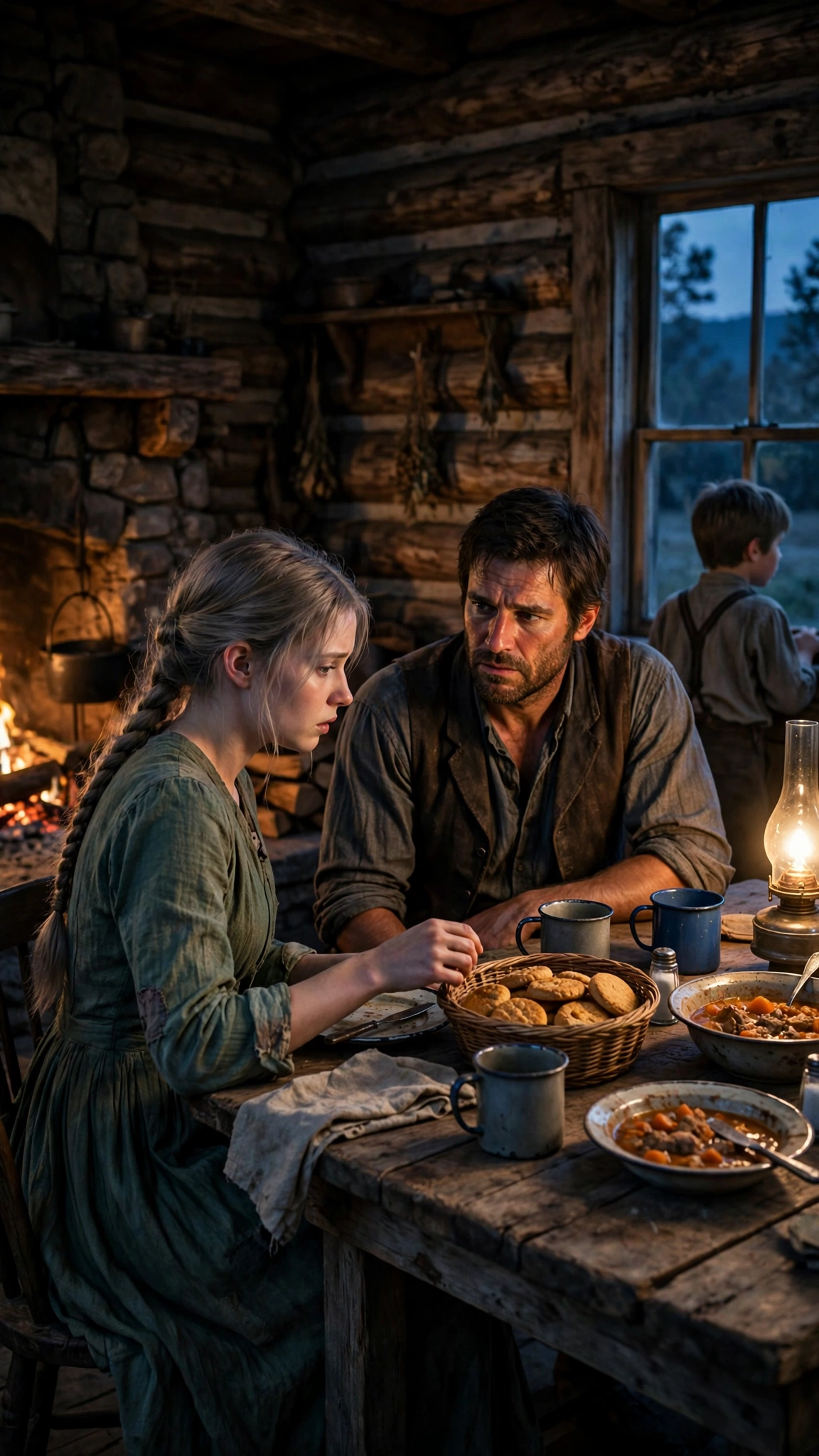
The oil lamp burned low over the supper table, and outside the log walls of the farmhouse the blue evening was coming down over Red Creek like water rising. The stew was still steaming in the iron pot. There were potatoes, and carrots, and greens, and a wicker basket of golden biscuits in the middle of the table, and Hannah Brooks sat before a full plate and did not touch any of it.
Her hand had reached for a biscuit once. It had stopped in the air, inches above the basket, and it had come back to her lap, where her fingers were now tightening against the faded green cloth of her dress, beneath the table where no one could see them. She watched Noah eat. The boy was nine, all elbows and suspenders, and he ate the way boys eat, without thinking about it, a spoonful of stew and then a bite of biscuit, and she watched him the way a person watches a door that might open or might not.
Across the table, Cole Turner watched her.
He was thirty-eight, and the ranch had weathered him the way wind weathers a fence post, dark brown hair going a little gray at the temples, a short beard, his shirtsleeves rolled to the elbow, a worn dark vest over his shirt. He had been a widower for three years. He had buried his first wife in the spring, under the cottonwoods, and he had lived alone with his nephew ever since, and he knew the look of a person who was hungry. He had seen it in cattle in a hard winter. He had never seen it in a woman sitting at his own table, in his own house, with food enough for three.
"Aren't you hungry?" he asked.
It was quiet. That was the first thing. Not the words. The quiet underneath them. The fire crackled in the hearth, and a spoon settled against a plate somewhere, and outside, the evening insects had started up in the grass.
"Yes," Hannah said.
Her voice was small, and it was steady, and it did not sound like the voice of a woman who had just said yes to food. It sounded like the voice of a woman answering a question in a courtroom.
Cole slid the basket toward her. It scraped softly across the wooden table. The biscuits were golden on top, still warm, and the smell of them rose up into the lamplight, and Hannah pulled her hand back from the basket as if the basket had moved on its own, as if it had lunged at her.
"Then eat."
She looked down at the basket as though taking something from it could bring punishment.
Noah had stopped chewing. He was watching her now, his spoon halfway to his mouth, and there was something in his face that had not been there a moment before — not fear, exactly, but the beginning of understanding that something in this room was wrong in a way he did not have a name for.
Hannah looked at Noah. She looked at Cole. She looked at the basket. And then, very softly, as if the words themselves might be punished for being spoken, she said, "May I have the pieces nobody wants?"
The farmhouse went quiet in a way that had nothing to do with the fire or the insects or the evening. The fire went on crackling. The spoon in Noah's hand did not move. Cole did not move. The lamp flame bent a little in a draft, and the shadows on the log walls leaned, and Hannah sat with her hands in her lap and waited, the way she had waited all her life, for someone to decide whether she was allowed to eat.
Cole looked at her untouched plate. He looked at her frightened face. And something shifted behind his eyes — not anger, not yet, but the slow, dawning realization of a man who has just understood that the thing in front of him is not what he thought it was. He did not raise his voice. He did not move suddenly. He put his hand on the basket and pushed the whole of it closer to her, until it stood between them like an offering and an accusation at once.
"You can have whatever you want."
Hannah looked more frightened, not less. Her eyes went to the basket, and to his face, and back to the basket, and her breathing changed, quick and shallow, the way a small animal breathes when it is cornered and deciding whether to run.
Slowly, so slowly that Cole could see the trembling in her fingers from across the table, she reached for a whole biscuit. Her fingers almost touched it. They stopped. She glanced at Cole. He gave one small nod, the smallest nod a man can give, and she lifted the biscuit from the basket with both hands, as if it were something breakable, as if it were something alive.
She held it with both hands. She broke it in half.
And then, instead of eating either piece, she slipped one half beneath the edge of a folded cloth beside her plate, tucking it away, hiding it, saving it for later, for a time when there might be no food at all.
Cole saw her do it. His eyes narrowed — not with anger, but with alarm, the alarm of a man watching someone drown in shallow water.
"Hannah…" he said.
She froze. Her hand came away from the hidden bread as if she had been caught doing something forbidden, as if the cloth had burned her. Her eyes rose toward Cole, frightened and apologetic, and her face had gone the color of the dusk outside the window.
"I'm sorry."
Cole stared at her. And in that moment he understood, finally and completely, that this fear had not begun at his table. Whatever had taught Hannah Brooks to be afraid of food, to ask permission for the broken pieces, to hide half a biscuit under a cloth as if the world might take it from her — whatever that was, it had begun long before she ever came to Red Creek, and it was still with her, sitting at his table, wearing her face.
He opened his mouth to ask her. He never got the question out.
Because outside the farmhouse, faint at first and then closer, came the sound of a horse approaching through the blue evening.
Noah turned toward the window. Cole looked toward the sound. And Hannah's face, which had already lost its color, lost the rest of it, until she was white as the folded cloth beside her plate.
—
Three days earlier, the train had come into Red Creek at noon, and Hannah Brooks had stepped down onto the platform with one carpetbag and a letter folded into her coat pocket, and she had looked at the town the way a person looks at a place they have already decided will not keep them.
The letter was from a rancher named Cole Turner. It had come to her father's house six weeks before, in an envelope with a Montana postmark, and it had asked, in plain, careful handwriting, whether the young woman described in the matrimonial advertisement would consider a marriage of convenience on a cattle ranch at Red Creek, where there was a house, and work, and a boy of nine who needed a woman's care, and a man who needed a wife. It had promised respect, and a home, and no demands beyond what she was willing to give. It had been signed, simply, Cole Turner.
Her father had read it twice, and then he had read it a third time, and then he had done something she had never seen him do: he had smiled. Not a kind smile. The smile of a man who has just found a door he did not know was there.
"A husband," he had said. "A ranch in Montana. A man who will take you off my hands and pay the train fare besides. You will write back and accept, Hannah. You will accept today, before he changes his mind."
She had accepted. She had written the letter in her own hand, because her father had stood over her while she wrote it, and he had told her what to say, and she had said it. She had not told Cole Turner that her father had kept her mother's money. She had not told him that she had not eaten a full meal in her own house since she was sixteen. She had not told him anything at all, because there was no language for what her father had done to her that a stranger would believe, and because she had learned, long ago, that telling made everything worse.
The train had carried her west for four days. She had eaten the food she had packed in a cloth — dry bread, a little cheese, an apple — and she had eaten it in small pieces, a little at a time, because that was how she had always eaten, because her father had taught her that a woman who eats too much is a woman who steals. At every station she had hidden what was left, wrapping it in the cloth and tucking it into her bag, because she had learned that food left in the open is food that disappears.
When the train stopped at Red Creek, she stood on the platform and looked at the mountains, and at the dust, and at the long road that ran out of town toward the ranches, and she felt the old fear settle into her stomach like a stone. This was the place. This was the man. There was no going back. The train fare had been paid. The letter had been answered. Her father had already spent the money Cole had sent for her ticket — she knew that, because she had seen the bottle on the table the night the money arrived.
A man was waiting on the platform. He was tall, and broad through the shoulders, and his dark brown hair was going gray at the temples, and he had a short beard and rolled shirtsleeves and a worn dark vest, and he was holding his hat in his hands the way a man holds his hat when he is nervous. A boy stood beside him, nine years old, in a shirt and suspenders, his hair combed flat with water, staring at her with open curiosity.
"Mrs. Brooks?" the man said. And then he corrected himself. "Miss Brooks. I'm Cole Turner. This is my nephew, Noah."
She had nodded. She had not known what to say. She had rehearsed words on the train — thank you, and it is good to meet you, and the journey was fine — but all of them had dried up in her mouth, because the man in front of her was looking at her the way no one had ever looked at her: not as a burden, not as a thief, not as a mouth to feed, but as a person he had been waiting for.
They had ridden out to the ranch in a wagon, the boy sitting up front beside Cole, Hannah sitting in the back with her carpetbag, and the road had run through grassland and then through cottonwoods, and then the log farmhouse had come into view, solid and low against the mountains, with a barn behind it and a corral and smoke coming from the chimney. It was a good house. It was a better house than any house she had ever lived in. And that frightened her more than anything, because good things in her life had always been taken away, and she did not know how to hold one without waiting for it to be snatched back.
Cole had shown her the house. He had shown her the kitchen, and the pantry — a real pantry, with shelves, and flour, and beans, and dried apples, and a tin of coffee — and he had shown her the room that would be hers, with a bed, and a washstand, and a window that looked out over the creek. He had told her, plainly, that the marriage would be what she wanted it to be. That there was no hurry. That she was free to eat when she was hungry, and sleep when she was tired, and that no one in his house would ever raise a hand to her.
She had listened, and she had nodded, and she had not believed a word of it. Not because he was lying. Because she had never lived in a house where words like that were true, and she did not know how to believe them yet.
That first night, she had sat at the supper table with Cole and Noah, and the table had been full — stew, and potatoes, and biscuits — and she had eaten three spoonfuls of stew and one small piece of biscuit, and she had waited for someone to tell her to stop, and no one had. She had gone to her room and lain awake, listening to the house settle, listening to the wind in the cottonwoods, and she had taken the half biscuit she had hidden in her sleeve and eaten it in the dark, in small bites, because that was how she had always eaten, and because the dark was the only place she had ever felt safe enough to be hungry.
The second night had been the same. The third night was the night at the supper table, the night of the basket, and the folded cloth, and the words she had not meant to say out loud — "May I have the pieces nobody wants?" — and the look on Cole Turner's face when he understood, at last, that the woman he had married was afraid of his table.
And now the horse was coming through the blue evening, and Noah had turned toward the window, and Cole was looking toward the sound, and Hannah sat with her hands in her lap, white as the folded cloth, and she knew, with a certainty that went down to her bones, that the horse was not coming for Cole.
It was coming for her.