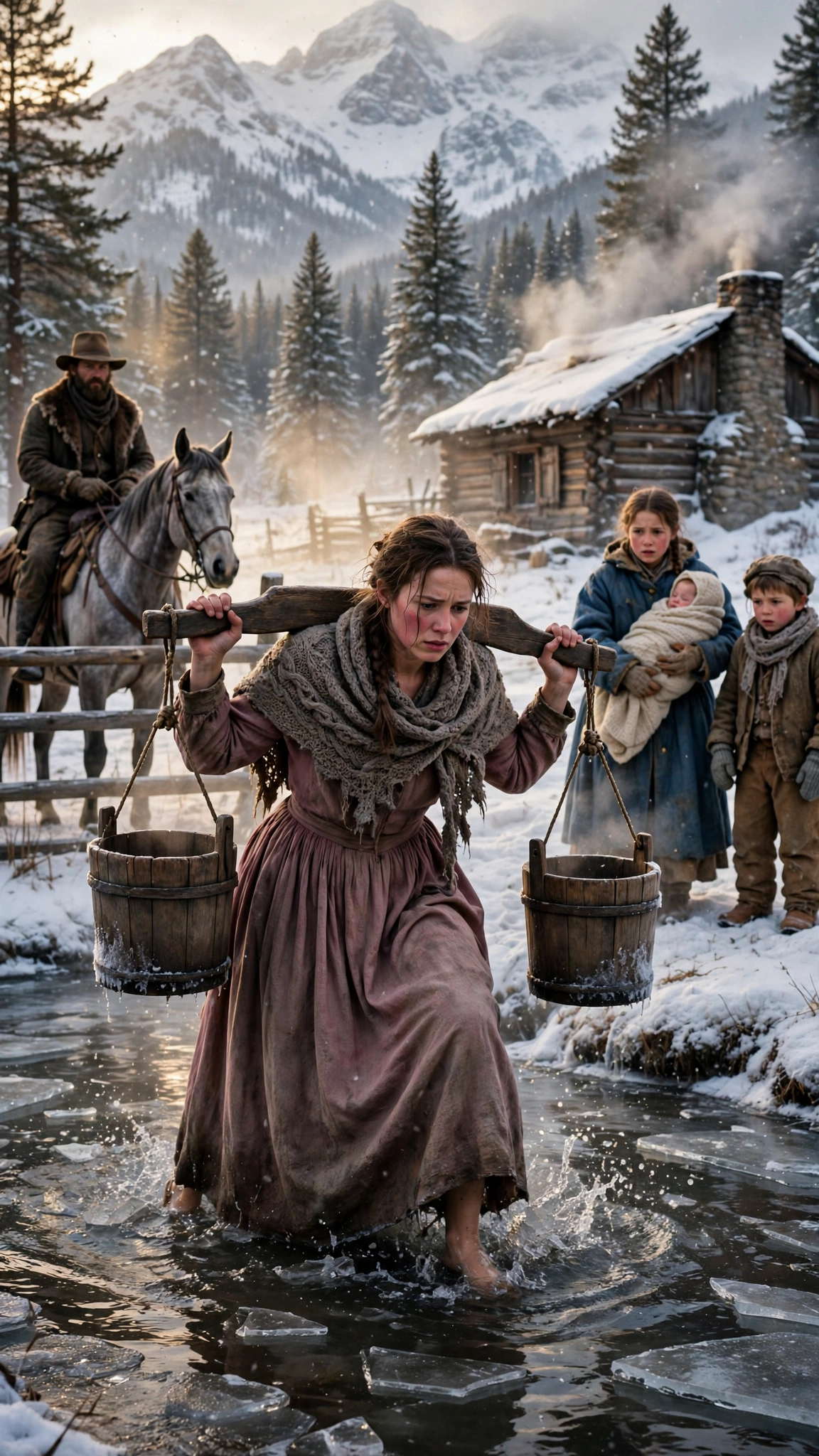
Bane did not come back to the cabin. But his threat rode the valley like a cold wind all through the rest of the winter, and Addie heard it in every piece of news that came up the road.
He had gone to the county board, they said, and demanded that Pritchard the clerk be dismissed for certifying papers against him. He had gone to the mercantile and told his customers that Jonas Reed was a meddler and a thief who had stolen a widow's debt for his own purposes. He had told anyone who would listen that the Marsh children were still in danger, and that the county would rue the day it let a barefoot widow keep three children she could not feed.
None of it worked. Pritchard kept his office, because the board — shamed by Hale's report of the false figures — voted to keep him, and to open an inquiry into Bane's own accounts. The mercantile's customers kept coming, because Bane was the only store in Helena, but they came with their eyes open now, and they counted their change twice. And the valley — the ranchers and the farmers and the women who had watched Addie bury her husband with her own hands — closed ranks around her the way a valley does when it has decided where the right of a thing lies.
Mrs. O'Rourke brought a ham. The Whitfields brought a sack of flour. Old Mr. Abernathy, who had not left his farm in three years, rode over in the snow to tell Addie that Henry had been a good man and that she was doing him proud. And Jonas Reed came every other day, riding Smoke through the snow, bringing firewood and coffee and news, and sitting by the fire while Clara read to Anna from the Bible, and Peter showed him the wooden horse Henry had carved, and Addie mended his shirts because his own mending was, he admitted with a sheepish grin, a disgrace to the territory.
The debt was paid, but the loan was not. Jonas had been clear about that: the money was a loan, and Addie would pay it back by working at his ranch when the spring came. And when the spring came — late, as springs do in Montana, with the snow lingering in the hollows into April and the creek running high and cold with meltwater — Addie kept her word.
She left Clara in charge of the cabin three days a week, the way Henry had once left her in charge, and she walked the twelve miles to Cottonwood Creek with Peter riding on Smoke's saddle in front of Jonas, and she cooked for Jonas's hands — twelve hungry men, who ate like wolves and praised her cooking like it was a kind of miracle — and she mended shirts and darned socks and put the ranch house in order for the first time in seven years.
The ranch house was a good house, solid and warm, with wide windows and a stone fireplace and a kitchen big enough to feed an army. But it had the air of a place where no woman had lived for a long time. The curtains were gone. The pantry was a chaos of tins and sacks. There were no flowers on the table, no quilt on the spare bed, no small signs of a life lived in company. Addie saw it, and she did not comment on it, because it was not her house and not her business. But she put the pantry in order, because a pantry in order was a thing she could do, and she hung clean curtains she sewed herself from muslin Jonas bought in Helena, because a kitchen without curtains was a thing that offended her, and she did not think about why it offended her, or what it meant that she cared.
Jonas noticed. He noticed everything she did, the way a man notices the return of something he thought he had lost. He came home from the range in the evenings and found his house smelling of bread and stew, and his shirts mended, and his table set, and his hands fed, and for the first time in seven years, he did not eat alone.
Anna recovered fully in the spring. The fever left her the way winter leaves the valley — slowly, and then all at once — and by May she was crawling after Peter across the cabin floor, and pulling herself up on the furniture, and laughing the loud, fearless laugh of a baby who has forgotten she was ever ill. Dr. Hollis came out in April and listened to her chest and pronounced her sound, and he looked at Addie, and at the cabin, and at the children, and he said, "You did well, Mrs. Marsh. Better than most would have. Your husband would be proud."
Addie thought about that, long after he rode away. Your husband would be proud. She had not thought about Henry in weeks — not really thought about him, not the way she had in November and December, when every corner of the cabin held his absence. The grief was still there, a quiet ache under her ribs, but it had changed. It was no longer a wound. It was a scar. And a scar, she was learning, was a thing you could live with.
She thought about Henry on the rise behind the cabin, under the pine cross, and she went up there one evening in May, with wildflowers in her hand — the first of the season, small and white and stubborn — and she laid them on the grave, and she talked to him, the way she used to talk to him when he was alive and working in the yard below.
"I kept them, Henry," she said. "I kept the children. I kept the cabin. I paid the debt. I did it, Henry. I did it barefoot, and I did it afraid, and I did it anyway."
The wind moved through the pines. The creek ran below, loud with meltwater. And Addie stood on the rise with the wildflowers in her hand, and she felt, for the first time since November, something like peace.
—
Jonas did not propose in the spring. He was not a man who rushed, and he had learned, in seven years of living alone, that the things worth having were worth waiting for. He watched Addie work in his kitchen. He watched her with the children. He watched the way Clara had begun to laugh again, and the way Peter followed him around the ranch asking questions about cattle and horses and the world, and the way Anna had learned to say his name — "Jonas," clear as a bell, the first word she had spoken since the fever, which made him have to turn away and pretend to check the fence for a moment.
He watched, and he waited, and he thought about Sarah, and about the house that had been empty for seven years, and about the woman who had put curtains in his kitchen and order in his pantry, and he thought about what it would mean to ask her, and what it would mean if she said no, and what it would mean if she said yes.
He thought about it all through the spring, and into the summer, and he did not say a word. He was a patient man. He had waited seven years. He could wait a little longer.
On the long summer evenings, when the work was done and the hands had gone to the bunkhouse, Jonas would take Peter out to the corral and show him how to curry a horse, slow and patient, and Peter would ask a question with every stroke, and Jonas would answer every one, as if a boy's questions were the most important work of the day. Clara sat on the porch with Anna and read aloud from the Bible, her voice steady in the twilight, and Addie listened from the kitchen window and thought about how strange it was that a house she had never lived in could begin to feel like a place she belonged. The ranch had been empty for seven years, and now it rang with children's voices, and Jonas walked through it in the evenings with his shoulders a little lower and his step a little slower, the way a man walks when he is no longer carrying something alone.
One evening in July, after the hands had eaten and gone to the bunkhouse, Jonas took Peter out to the corral to teach him to ride. Peter was six, and small for his age, and the pony Jonas had chosen for him — a gentle sorrel mare named Daisy, who had carried three of the hands' children before him — stood patient as a stone while Jonas lifted the boy into the saddle and showed him how to hold the reins, and how to sit, and how to ask the horse to walk on.
Addie watched from the kitchen window, with her hands in the dishwater, and she saw Peter's face — lit up like a lantern, all fear gone, all pride — and she saw Jonas walking beside the pony with one hand on Peter's leg, steadying him, talking to him in a low voice, and she felt something turn over in her chest, slow and deep, like a stone rolling in a creek bed.
"He is good with him," Clara said, coming to stand beside her at the window. She had been watching too.
"Yes," Addie said. "He is."
"Momma," Clara said, after a moment, "do you remember when Papa taught me to ride?"
Addie remembered. Henry had taught Clara on the same kind of gentle pony, in the same kind of patient way, on a summer evening much like this one, and Clara had laughed the same laugh Peter was laughing now.
"I remember," Addie said.
"Mr. Reed is not Papa," Clara said, carefully, the way she said everything careful now. "But he is kind the way Papa was kind. And I think Papa would like him. I think Papa would want us to be happy, even though he is gone."
Addie looked at her daughter — ten years old, and wiser than any ten-year-old should have to be — and she put her arm around her, and they stood together at the window, watching Peter ride around the corral in the golden evening light, with Jonas walking beside him, and Addie thought about Henry, and about the pine cross on the rise, and about the seven years Jonas had spent alone, and about the curtains in his kitchen, and she thought: perhaps a heart does not have room for only one person. Perhaps it grows. Perhaps that is what it is for.
But the valley noticed, the way valleys do. Mrs. O'Rourke noticed, and told her husband, who told the hands, who told each other, and by June the whole of Cottonwood Creek knew that Jonas Reed was courting the widow Marsh, even if Jonas Reed himself had not yet said so out loud.
Addie noticed, too. She noticed the way Jonas looked at her across the table. She noticed the way he found reasons to ride to her cabin on days when there was no reason. She noticed the way he had begun to ask her opinion — about the cattle, about the hands, about the price of hay — as if her opinion mattered, as if she were not a widow he had rescued but a partner whose judgment he trusted.
And she noticed something else, which frightened her more than Bane ever had: she was glad to see him. Every time. She looked forward to the sound of Smoke's hooves on the road. She saved the best piece of pie for his plate. She found herself thinking, while she mended his shirts, about the way his hands looked when he held a cup of coffee, and the way his voice went low and careful when he talked to Anna, and the way he had knelt in the snow beside her footprint, all those months ago, and touched the fever drops to her baby's lips as if the baby were made of glass.
She did not know what to do with these thoughts. She had been Henry's wife, and Henry was dead, and she had three children and a cabin and a debt that was paid but a loan that was not, and she had built a life out of bare feet and cold water and stubbornness, and she did not know how to build a life out of anything else.
So she waited, too. She waited for the summer to end, and for the harvest to come in, and for the first frost, and for Jonas Reed to find the words, or not find them, and she told herself that whatever happened, she would be all right, because she had walked barefoot through a frozen creek and kept her children, and a woman who could do that could do anything.