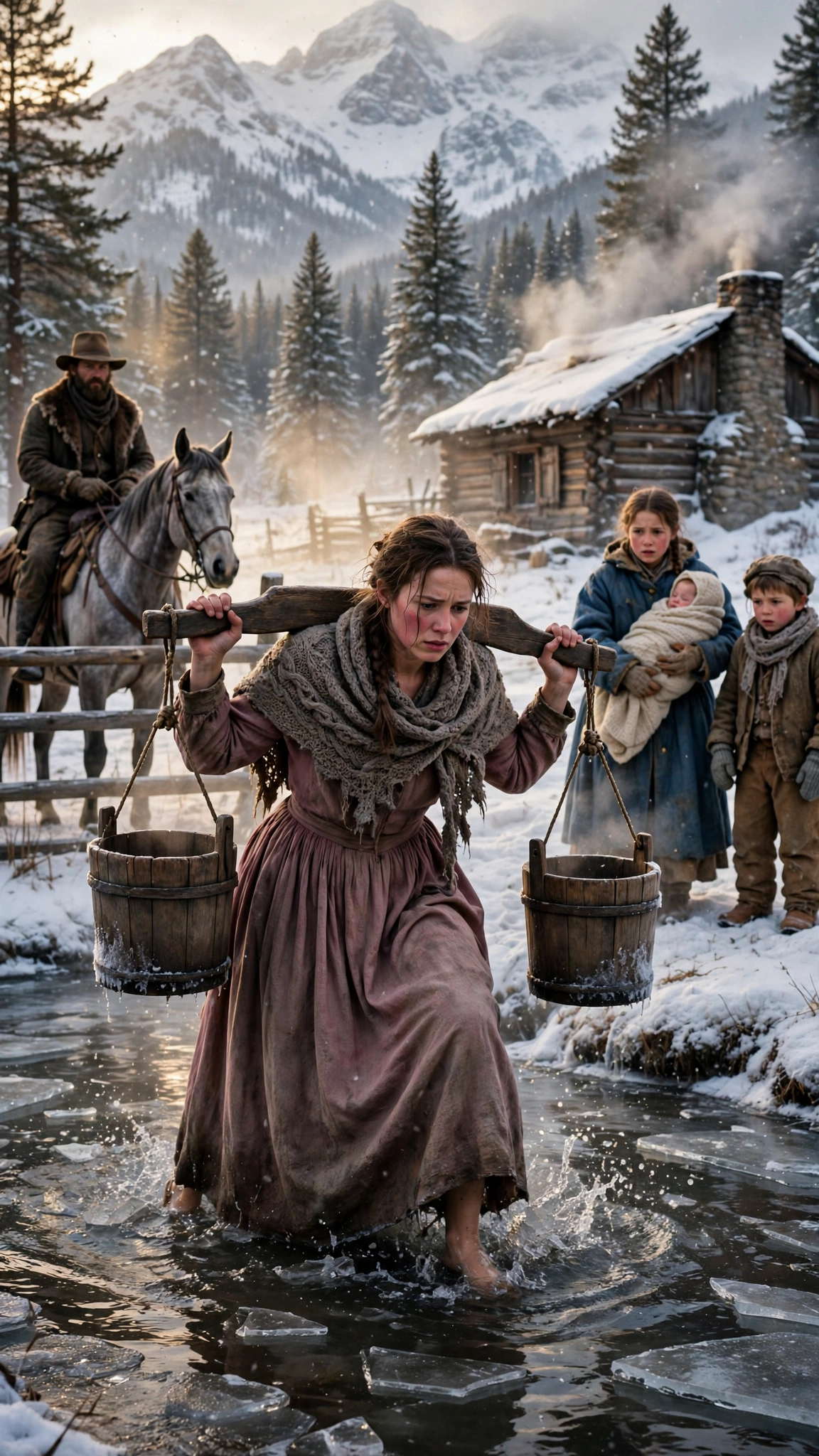
He asked her in September, on the bank of Stillwater Creek, in the place where it had all begun.
The harvest was in — a good harvest, the best in three years, with the wheat standing tall and the corn thick on the stalk — and the air had the first edge of autumn in it, and the cottonwoods along the creek had turned gold. Jonas had ridden over in the morning, the way he did most mornings now, and he had helped Addie carry the water, and he had mended the fence where the winter had pulled it down, and he had sat on the cabin steps with Peter, whittling a whistle out of a willow branch, while Clara read to Anna in the doorway.
In the late afternoon, when the light went gold across the water, he asked Addie to walk with him to the creek, and she went, because she had learned to go where he asked, and they stood on the bank together, looking at the water running clear and cold over the stones, and Jonas took off his hat, and held it in his hands, and looked at the creek, and then at her, and then at the creek again, the way a man looks at a thing he is gathering the courage to say.
"Mrs. Marsh," he said, and then he stopped, and shook his head, and started again. "Addie. I have been trying to find the right words for this since June, and I have not found them, and I do not think I am going to find them, so I am going to say it plain."
He took a breath. "I am not asking you to marry me because I saved you, or because you owe me anything. You do not owe me anything. The loan is paid — you worked it off by August, every cent, and I have the figures to prove it. I am not asking you because you need a husband. You have proved, to me and to this whole valley, that you do not need anyone. You walked barefoot through a frozen creek and kept your children, and no woman who can do that needs a man to save her."
He paused, and looked at her, and his eyes were steady.
"I am asking you because my house has been empty for seven years, and you put curtains in my kitchen, and my hands have eaten at a table you set, and my horse knows the road to your cabin better than he knows the road home, and my life is better with you in it. I am asking you because Clara reads to Anna in my doorway, and Peter asks me questions about cattle, and Anna says my name, and I have not been alone since the day I knelt in the snow beside your footprint. I am asking you because I love you, Addie Marsh, and I want to spend the rest of my life standing beside you — not in front of you, and not behind you, but beside you, the way I stood beside you on Friday, when Bane came with his wagon."
Addie stood very still. The creek ran below them, loud and clear, and the cottonwoods moved in the wind, and the sun was going down behind the mountains, and she thought about Henry, and the pine cross on the rise, and the boots she had sold, and the paper nailed to her door, and the morning she had stood barefoot in this same creek with a yoke across her shoulders and a baby burning with fever in her daughter's arms.
She thought about all of it, and then she thought about Jonas Reed, standing in front of her with his hat in his hands, asking her to stand beside him, and she thought about what Henry would have said, if Henry had been standing there.
Henry would have said: say yes.
"I have conditions," she said, and her voice was steady, and her chin was up, and she was not the barefoot woman in the creek anymore, or not only her. She was a woman who had kept her children and paid her debts and put curtains in a man's kitchen, and she knew her own worth.
"Name them," Jonas said.
"The cabin stays mine," she said. "It is Henry's cabin, and the children's home, and I will not give it up. We will live there, or we will live at your ranch, or we will live in both places, but the cabin is ours, and no man will ever take it from us again."
"It stays yours," Jonas said.
"The children come first," she said. "Always. In everything. If there is ever a choice between them and anything else, I choose them."
"So do I," Jonas said.
"And I will not be a wife who sits in a house and waits," she said. "I will work. I will cook and mend and keep the books, and I will have my own money, and I will buy my own boots, with my own wages, and no man will ever again be able to say that I owe him my life."
Jonas smiled then — a real smile, wide and unguarded, the first she had ever seen on his face.
"Addie Marsh," he said, "I would not want you any other way."
She said yes. She said it standing on the bank of Stillwater Creek, with the water running clear below them and the cottonwoods gold above them and the sun going down behind the mountains, and Jonas put his hat back on, and he took her hand, and they walked back to the cabin together, and Clara saw them coming, and Clara knew, before they said a word, because Clara was ten years old and had learned to read her mother's face the way other children read books.
They were married in October, in the little church in Helena, with the whole valley in attendance — Mrs. O'Rourke and the Whitfields and old Mr. Abernathy and Deputy Hale and Pritchard the clerk, who had written the papers that saved them, and Dr. Hollis, who had given Anna the drops. Clara stood beside her mother in a new blue dress, holding Anna, who wore a cream blanket for the occasion, and Peter stood beside Jonas, solemn as a judge, holding the ring on a cushion he had made himself from a piece of velvet.
Bane did not come. Bane had left the county in August, after the board's inquiry found that he had falsified figures on three other mortgages besides the Marshes', and the mercantile had a new owner — a young man from St. Louis with honest eyes and fair prices — and no one in the valley missed Luther Bane, or spoke of him, except to say that good riddance was the only fitting epitaph for a man who tried to take children from their mother over twenty-five dollars and ninety-two cents of imaginary money.
The wedding was a small affair, and a joyful one, and when it was over, they rode home to the cabin on Stillwater Creek — all five of them, with Anna asleep in Addie's arms and Peter riding in front of Jonas on Smoke — and they found the cabin warm and the fire lit, because Clara had asked Mrs. O'Rourke to come ahead and light it, and there were wildflowers on the table, and a loaf of bread in the oven, and a new pair of boots waiting by the door.
The boots were Addie's. She had bought them herself, the week before, with her own wages from the summer's work at the ranch — good boots, sturdy leather, lined with wool, the kind of boots that would carry a woman through a Montana winter without fail. She had walked to Helena to buy them, the same road she had walked in her stockings to sell the old ones, and she had tried them on in the cobbler's shop, and she had paid for them with money she had earned with her own hands, and she had walked home in them, feeling the leather firm around her feet, and thinking about the morning she had stood barefoot in the creek, and how far she had come since then.
She put the boots on the morning after the wedding, and she walked down to the creek, and she stood on the bank, and she looked at the water running clear and cold over the stones, and she thought about the woman she had been — barefoot, afraid, carrying forty pounds of water on her shoulders because there was no one else to carry it — and she thought about the woman she was now — a wife, a mother, a woman with boots of her own and a cabin of her own and a family that was hers, whole and safe — and she smiled.
And then, because the water was needed, and because some things do not change, she picked up the yoke and the buckets, and she walked down into the creek, and she filled them, and she carried them home — not because she had to, not because there was no one else, but because she chose to, because the water was hers to carry, and the home was hers to keep, and the life was hers to live.
Behind her, on the bank, Clara stood with Anna in her arms, and Peter stood beside his sister, and Jonas stood at the fence with Smoke, watching her, and the Rockies stood white against the sky, and the smoke rose straight from the chimney, and the creek ran clear and cold and beautiful in the morning light.
Addie Marsh — who had been barefoot in Stillwater Creek, and who had sold her boots for medicine, and who had kept her children against a Friday that would have taken them — walked out of the water in boots she had bought with her own wages, carrying water she had chosen to carry, toward a home that was hers, and a family that was hers, and a future that was hers.
And the creek, which had once tried to freeze her feet, ran on beneath her, harmless and bright, as if it had never meant her any harm at all.
—
A year later, in the spring of eighteen eighty-four, a traveler passing through the valley on the road to Helena would have seen a cabin on Stillwater Creek with a new roof and a mended fence, and a garden already green behind it, and a woodpile stacked high and neat against the wall, and smoke rising straight from the stone chimney. He would have seen a woman in a dusty-rose dress — mended now, and clean — carrying water from the creek in boots of good leather, with a little girl in a cream blanket on her hip and a boy of seven running ahead of her with a fishing pole over his shoulder. He would have seen a girl of eleven in a blue coat, reading a book on the cabin steps, and a big man in a brown hat, mending harness by the barn, with a gray horse grazing nearby.
He would not have known, from looking, what that cabin had cost, or what it had survived. He would not have known about the barefoot morning in January, or the paper nailed to the door, or the Friday that had almost taken three children away. He would have seen only a family, living its life, in a place that was theirs.
And if he had stopped, and asked the woman at the creek how she had come to be there, she would have smiled, and told him the truth — that she had walked barefoot through a frozen creek, and sold her boots for medicine, and stood her ground against a man who tried to take everything from her — and that she had done it all, not because she was strong, but because she had three children who needed her, and a husband buried on the rise who had taught her that a family is worth any price, and a second husband who had taught her that a heart can hold more than one love, and still have room to grow.
She would have told him that the creek was cold, and the winter was hard, and the debt was real, and that none of it had been able to take what was hers. And then she would have picked up her buckets, and carried them home, and the traveler would have ridden on, thinking about the woman in the creek, and about the strength it takes to stand barefoot in freezing water and refuse to give up, and about how the smallest act of courage — a mother, carrying water for her children — can be the beginning of everything.