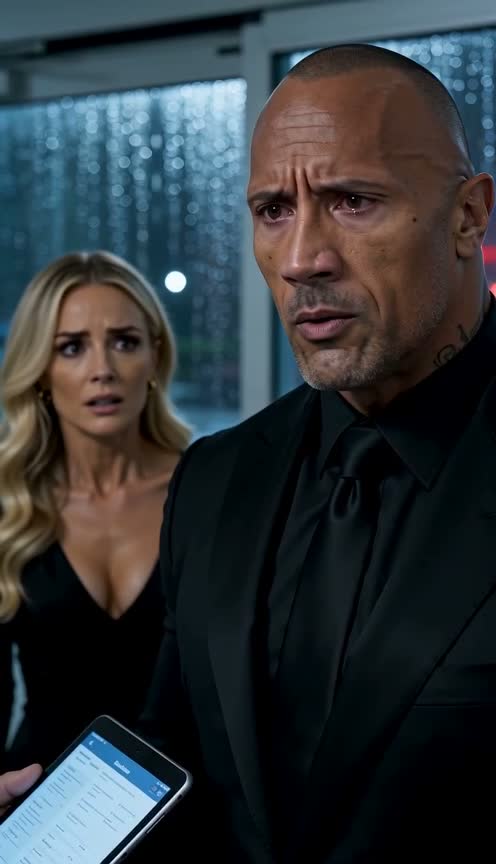
"Where are my children?"
The question hung in the fluorescent corridor. A nurse slowed mid-stride. Somewhere a monitor beeped its small indifferent song. Dr. Walsh looked from Adrian's face to Vanessa's — and the doctor, who had spent thirty years reading the weather of families in crisis, finally understood what room he was actually standing in.
"I — " He clutched the tablet. "Mr. Moretti, I may have made an error in — "
"No." Adrian's voice was quiet and absolute. "You read a chart. Read it to me now. All of it."
"Those records are your wife's confidential — "
"They are my children's records." Adrian took one step closer, and it was not a threatening step, which somehow made it worse. His eyes were wet and utterly steady. "Doctor. I have just learned that I have a son and a daughter. I have learned it standing next to the woman who hid them from me. I am asking you — as the only honest man in this building — not to become the third person to lie to me about my own blood."
Ethan Walsh had delivered the Moretti twins on a gray March dawn. He had watched their mother refuse, with a broken calm he still thought about at night, to name a father. He had filed the charts. He had wondered, at every checkup since, what kind of man leaves a woman like that alone with two babies — and the man's face had never once worn this expression. This was not the face of a man who had walked away. This was the face of a man who had been robbed and was only now hearing the sound of the alarm.
"Come with me," the doctor said quietly. "Not the chart. I'm not permitted the chart. But I will tell you what any father has a right to be told by the man who delivered his children."
What he told him, in a small consultation room that smelled of antiseptic and coffee, took four minutes and rearranged Adrian Moretti's entire past.
Twins. Born March 12th, six weeks early, strong lungs, no complications beyond the ordinary terror of prematurity. Sophie, five pounds one ounce. Noah, four pounds eleven, the blue eyes open from the first minute, looking at the world like he owned it. Mother refused all contact attempts — "Doctor," Adrian said hoarsely, "what contact attempts?" — and Walsh frowned: the hospital's standard follow-ups, the father's-information requests, all declined by the mother, who had said, and the doctor remembered it word for word because it had troubled him: "There is no father. Not anymore."
Adrian sat with that sentence the way a man sits with a bullet — perfectly still, mapping the damage.
"She believed I knew," he said at last. "She believed I knew and didn't come. My God. She sat in that room alone believing I had looked at my own children and turned away."
"Mr. Moretti — " Walsh hesitated. "There's one more thing. In December, your wife mailed a registered letter to your house. She mentioned it at a prenatal visit, afterward. She said she'd written to tell you everything, and that your silence was her answer. She stopped — " the doctor's voice gentled, "— she stopped hoping, after that letter went unanswered."
December. The letter.
Adrian was already standing. He knew — with the total, icy clarity that had built his empire — exactly whose hands that letter had passed through on its way to the drawer of his study desk. He could see the whole architecture now, the way you see a whole building in the instant it catches fire: the stolen envelope, the burned photograph, the phone call deleted in the night, the story about a lover two floors up. Every brick. Every brick had her fingerprints on it, and under every brick, his own gullibility, laid like mortar by his own hands.
He walked back out into the corridor.
Vanessa was waiting where he'd left her, and to do her a justice she never did herself, she did not run. She stood with her bandaged wrist held against her stomach like a shield and watched him come toward her with the face she had been dreaming about — in the bad dreams, the ones she woke from at 4 a.m. — for two years.
"Since December," Adrian said. He stopped an arm's length away. His voice never rose. "The letter she sent in December. The call in January. My son's eyes, Vanessa. Did you think you could bury my children forever? Did you think they'd stay eight months old and silent? Children grow. Secrets grow teeth."
"Adrian — " Her voice cracked open. "Adrian, listen to me. She left you. She was leaving before I ever — yes, I hid it, yes, God forgive me, I hid it, but do you understand what she was? She was a wife who couldn't give you — and I could, I can, I would have given you everything, I just needed time, if you'd just — "
"You gave me nothing." The words fell like stones into still water. "You took. That is the only verb of your life. You took her letter, you took my children's first year, you took — " For the first time his voice broke, and he mastered it with visible effort, the way a man holds a door against a flood. "You took the night my daughter was born, and you spent it in my bed wearing my shirt, and you let me believe — "
He stopped. He looked at her for a long moment, and what she saw in his face was worse than rage. Rage would have meant she still mattered enough to burn. What she saw was the exact expression he wore for strangers. For the dead.
"My men will take you home," he said. "Pack what you brought into my house. Not what I gave you — what you brought. You have until morning. If you are in this city after Sunday, it will not be as my guest."
"Adrian." She was crying now, the real kind, the kind she'd never permitted herself on camera. "Where are you going?"
He was already walking — toward the glass doors, toward the rain, toward the other side of eight stolen months. He did not turn around.
"To meet my children."
His driver had the address before Adrian reached the car — his people had always been able to find anyone in Chicago inside the hour, and it shamed him to the bone that it had taken him eight months to ask them to find the only people who mattered. A warm-lit apartment above the river. Claire's apartment. He sat in the back seat with his hands open on his knees like a man carrying something fragile and invisible, watching the wet city streak past, rehearsing nothing, because for once in his life Adrian Moretti had no strategy at all. He had a heartbeat like a hammer and a terror he had never felt facing any gun: that she would look at him the way she had looked at the empty chair beside her hospital bed. That his son would hide his face. That his daughter's first word to him would not be a word at all, but a stranger's wariness.
His lieutenant Marco was waiting at the hospital doors — Marco, who had served Adrian for fourteen years and feared him appropriately and loved him a little despite it. He took in his boss's face in one glance and did not ask a single question, which is the highest form of loyalty in that world.
"The address is confirmed, boss. River North, high floor. She's — " Marco hesitated, and something in the hesitation told Adrian that the report had a weight to it. "Boss, the doorman knows the family. Mrs. Moretti and the babies. Twins. He said the lady's — he said she's good people. Quiet. Does it all herself mostly." A pause. "He asked if you were the husband. I said I couldn't say. He said — " Marco, a man who had delivered some of the worst news in Chicago over the years, delivered this last piece gently, like an egg. "He said, 'Tell him the boy has his eyes. Everybody says so.'"
Adrian stood in the rain with the hospital doors sighing open and closed behind him, and he put one hand flat against the wet wall of the building, because the ground had moved.
"He said that."
"Yes, boss."
"Marco." Adrian's voice was barely a voice at all. "You've known me fourteen years. You've seen me in rooms where men didn't walk out. I am going to tell you something no living person has heard me say." He looked at his lieutenant, and Marco would remember that look for the rest of his life — he would describe it, years afterward, as the night the boss became a person. "I am frightened. I don't know what to say to her. I have a speech for every room on earth except that one."
Marco considered this with the gravity it deserved.
"Boss," he said at last, "my Rosa, when I messed up — and I mean messed up, the real kind — I went with flowers the first time. She threw them out the window. Second time I went with an excuse. She threw that out too, and it was verbal, so picture it. Third time I went with nothing and I just said the true thing, standing on the step, and she let me in to say the rest of it." He shrugged, embarrassed at his own wisdom. "Go with nothing, boss. Say the true thing on the step."
Adrian looked at his empty hands.
"The true thing," he said.
It was on his lips the whole way across the city, being practiced and discarded and practiced again — I didn't know, I didn't know, I swear on my father's grave I didn't know — until he understood, somewhere on the rain-slick bridge over the river, that the sentence wasn't the point. The point was to be standing on the step when he said it. To have come himself. At last. In person. In the rain.
Across the city, in the warm-lit apartment, Claire Moretti zipped the last of the suitcases.
Boston. A gallery directorship, offered in September, refused in September, and then — this week, in a moment of 2 a.m. honesty — accepted. One year. A fresh city where no restaurant maître d' would ever say "Mr. Moretti's table," where her children would not grow up eight miles from a father who had, as far as she knew, chosen to un-know them. The flight was at dawn. Mrs. Okafor had cried and then packed the twins' things with cathedral efficiency. The rings were still in their dish by the window; Claire picked them up, held them a moment — two small gold circles, lighter than memory, heavier than luggage — and put them in her coat pocket. Not to wear. Just — not to leave behind. Even now. Even after everything. She hated that about herself a little, and she packed it too.
The twins were asleep in their cots, Sophie on her back with both fists up like a tiny boxer, Noah on his side, one hand open. Claire stood looking at them with her coat on, and she was reaching down to smooth Noah's blanket when the doorbell rang.
It was past eleven. No one came at eleven. Her sister had a key. Mrs. Okafor had gone home.
Claire went to the door with her heart rising into her throat, and she looked through the viewer — and the world tilted.
On the other side of the door, soaked from the forty steps between the car and the building, stood her husband. Not the ice king of the empire. Not the man of the photograph. A man with rain in his hair and an expression she had never seen on him in five years of marriage — naked, unguarded, terrified hope — holding, of all things, nothing. No flowers. No performance. Just himself, with his empty hands raised slightly, palms open, in the universal gesture of a man who comes in peace or in surrender.
His voice came through the door, muffled and unmistakable.
"Claire. I didn't know. Whatever you believe — God and this whole city as my witness — I didn't know. Open the door and I'll prove it. Or don't open it, and I'll say it through the wood until you believe me. I have all night. I have — " his voice fractured, just slightly, on the last word "— I've already lost eight months. I am not losing one more hour."