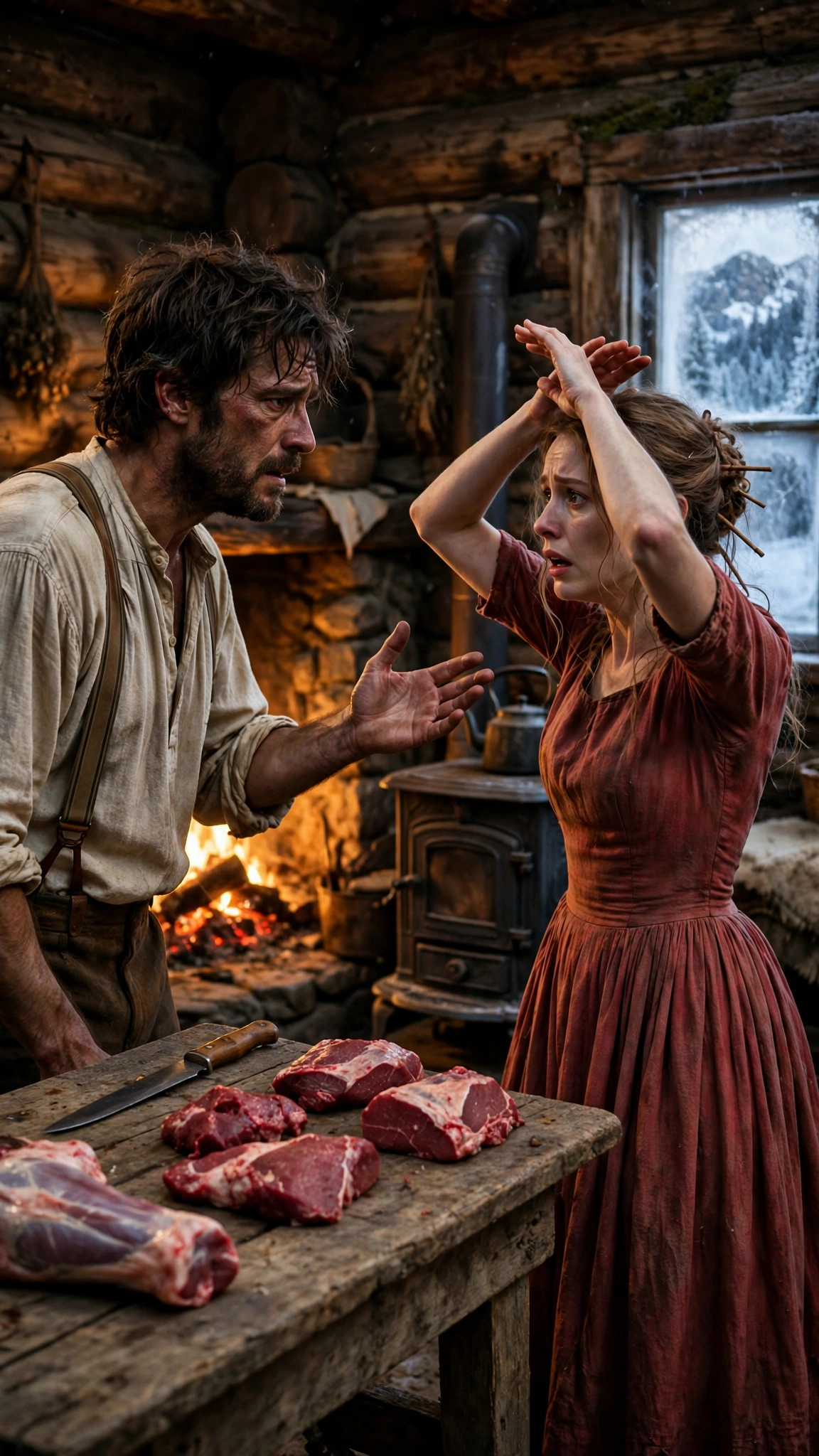
The winter Mave turned thirty, the snow came early to Bitterroot, and with it came a cold that settled into the bones of the trading post and would not leave.
Mave had been at Voss & Co. for nearly five years by then. Five years of cooking and scrubbing and mending, five years of the ledger that never shrank, five years of Merritt Voss's hand on her shoulder in the evenings, and his voice in her ear, low and reasonable, telling her what she was and what she owed.
She had stopped counting the bruises. There was no point in counting them. They came and went like the weather — dark purple along her ribs, yellow at the edges as they faded, new ones blooming before the old ones had healed. She hid them under her dress and said nothing, because there was no one to say anything to. Mrs. Pruitt had stopped trying to help her after the second winter, when Mave had shaken her head and turned away in the churchyard one time too many, and Reverend Bell, for all his kindness, was a man who believed the best of people, and Mave could not bring herself to tell him what happened in the back room of the trading post after dark.
She had learned Voss's moods the way a sailor learns the sky. There were days when he was almost kind — when he brought her an extra piece of bread at supper, or told her she had done a good job with the mending, or let her sit by the fire for an hour in the evening with her mother's Bible in her lap. And there were days when the smallest thing set him off — a door closed too loudly, a cup set down too hard, a look he did not like — and then his hand would close on her side, his fingers digging into her ribs, and he would hold her there and shout at her until her ears rang, and afterward he would smooth his coat and go back to his ledger as if nothing had happened.
It was on one of the kind days, in the autumn before her thirtieth birthday, that he told her the whole of it for the first time, sitting across from her at the kitchen table with a cup of coffee in his hand, speaking in the tone of a man discussing the weather.
"You know, Mave," he said, "you ought to be grateful to me. If it weren't for me, you'd have starved in the street after Jonah died. A widow with no money and no family — what would have become of you? I took you in. I fed you. I gave you work. And all I asked in return was obedience."
Mave kept her eyes on her hands, folded in her lap. She had learned not to answer when he talked like this. Answering only made it worse.
"Jonah understood," Voss went on. "He knew what he was doing. The night before he left on that last run, he came to me here, in this very room, and he signed the paper. He said, 'Merritt, if anything happens to me on the river, you take care of Mave. She's yours to look after.' And I said I would. And I have. I've looked after you, Mave. I've kept my word. The question is whether you'll keep yours."
He set the coffee cup down and leaned forward, and his eyes, pale as river water in winter, fixed on her face.
"He told me," Mave whispered, before she could stop herself, "he told me you were his friend."
Voss smiled then, a thin, cold smile that did not reach his eyes.
"And so I am," he said. "The best friend you have in this world. Remember that."
That night, lying on her narrow bed in the dark, Mave thought about Jonah for the first time in months — really thought about him, not as the laughing man with the red beard who had swept her off her feet in the yard, but as the man he had been in the last year of his life, tired and worried, coming home from the freight road with his shoulders bowed and his pockets empty.
She remembered the arguments. She remembered Jonah coming home late, smelling of whiskey, and sitting at the table with his head in his hands, saying the freight rates had fallen again, and Voss had raised the prices at the post again, and a man could not make a living hauling for Voss & Co. anymore, not the way things were going. She remembered him saying, one night, that he was going to quit Voss and haul for himself, and that Voss had laughed at him and said no teamster in the valley hauled for himself, not while Voss owned the road and the warehouse and the scales.
And she remembered, with a sudden cold clarity, the night before Jonah left on his last run. He had come home late, and he had been quiet, and he had sat on the edge of the bed and looked at her for a long time, and he had said, "Mave, if anything happens to me, you go to the reverend. You hear me? You go to Reverend Bell, and you tell him everything. Don't go to Voss. Don't trust Voss."
She had asked him what he meant, and he had shaken his head and kissed her forehead and said, "Just remember. The reverend. Not Voss."
At the time, she had thought he was only tired, only worried about the river ice. Now, lying in the dark in the back room of the trading post, she understood. Jonah had known. Jonah had known what Voss was, and he had warned her, and she had not listened, because she had been too afraid and too tired and too alone to understand what he was telling her.
Jonah had never sold her. She knew it now, in her bones, the way she knew her own name. Jonah had loved her, and he had warned her, and Voss had lied — he had lied about the paper, and he had lied about the debt, and he had lied about everything, and she had believed him because she had been too broken to question him.
The knowing did not free her. It only made the cage clearer. She still had no money. She still had nowhere to go. She still had the debt in Voss's ledger, and the paper with the signature she could not read, and the fear that if she ran, Voss would come after her with the law, and the law would believe him, because he was a respectable businessman and she was only a widow with bruises she could not explain.
But the knowing was a seed, and the seed began to grow.
It grew through the autumn, as the days shortened and the cold deepened. It grew when Voss struck her for a loaf burned black in the oven, and she lay on her bed that night and pressed her hand over the bruises on her ribs and thought, Jonah never sold me. It grew when Mrs. Pruitt, seeing her in the churchyard one Sunday with her shawl pulled tight and her eyes on the ground, pressed a small parcel of dried apples into her hands and whispered, "You don't have to stay, child. There's always a way out. You just have to be ready when it comes."
And then, in the first week of November, the notice went up on the church board, and Reverend Bell read it to her, and the seed broke open.
A mountain man sought a wife. A cabin high in the Rockies. A home, food, and safety. Inquiries through the Reverend Amos Bell.
Mave went to the reverend that same afternoon, after the service, when the church was empty and the light was failing through the high windows, and she told him — not everything, not yet, but enough. She told him about the debt, and the ledger, and the bruises, and the paper she could not read. She told him about Jonah's warning, and about the night before he died, and about the way Voss looked at her, and the way his hand closed on her side.
Reverend Bell listened without interrupting, his hands folded on his Bible, his face growing graver with every word. When she finished, he was silent for a long time. Then he stood up, and he went to the shelf behind the pulpit, and he took down the church ledger, and he turned the pages until he found what he was looking for.
"Mave," he said, and his voice was very quiet, "Jonah Hale came to me the week before he died. He asked me to keep a record. He said Voss had been pressing him for money he did not owe, and that he feared what Voss might do if anything happened to him. He asked me to write down that he owed Voss nothing — that the last freight run had paid his account in full. I wrote it down, child. It's here, in the church book, in Jonah's own hand, with his mark beside it. Voss has no claim on you. He never did."
Mave stared at him. The words did not make sense at first. They were too big, too impossible, like a door opening in a wall she had believed was solid stone.
"But the paper," she whispered. "He showed me a paper. With Jonah's name on it."
"A forgery," the reverend said, and there was iron in his voice now, the iron Mave had never heard there before. "Or a paper signed for something else entirely, and twisted to his purpose. Jonah could barely write his name, Mave — you know that. And a man does not sell his wife. Not Jonah. Not any man God would call a husband."
He closed the ledger and set his hand on it, and he looked at her with eyes full of sorrow and anger both.
"I should have seen it sooner," he said. "I should have come to you. Forgive me, child. But it's not too late. Gideon Marsh is a good man — I've known his family since I was a boy. He'll keep you safe. And Voss will not follow you up that mountain in winter. He won't dare. The pass closes in a fortnight, and once it does, you're beyond his reach until spring."
Mave wept then, for the first time since Jonah died — great, silent tears that ran down her face and dripped onto her folded hands, tears for Jonah, and for the years she had lost, and for the lie she had lived inside, and for the door that had opened at last.
The reverend wrote the letter to Gideon that same evening, and sent it up the mountain with a trapper, and ten days later Gideon's reply came back, and Mave packed her small bundle — two dresses, her mother's Bible, a comb, and a shawl — and on a cold morning in late November, with the snow beginning to fall, she left Bitterroot forever.
Voss was at the trading post when she went to fetch her bundle from the back room. He stood in the doorway and watched her, his arms crossed, his face unreadable.
"Going somewhere, Mrs. Hale?" he asked.
"I'm going to be married," she said, and her voice shook, but she said it, she said it out loud, and that was a kind of victory.
Voss was silent for a moment. Then he smiled, the thin, cold smile she knew so well.
"You'll be back," he said. "They always come back. And when you do, the debt will still be here. And so will I."
Mave did not answer him. She picked up her bundle and walked past him, out the door and into the snow, where Elias Crowe was waiting with the mule, and Reverend Bell was waiting with a blessing, and the mountain was waiting, white and silent, at the end of the road.
She did not look back. She was afraid that if she looked back, she would see him standing in the doorway, and she would lose her courage. So she kept her eyes on the trail ahead, and on the mule's ears, and on the snow falling soft and steady out of the grey sky, and she thought about the words Jonah had said to her on the night before he died.
You go to the reverend. Don't trust Voss.
She had gone to the reverend. And the reverend had sent her up the mountain. And now, for the first time in five years, Mave Calloway was free — or as free as a woman with bruises on her ribs and a lie still living in her heart could be.