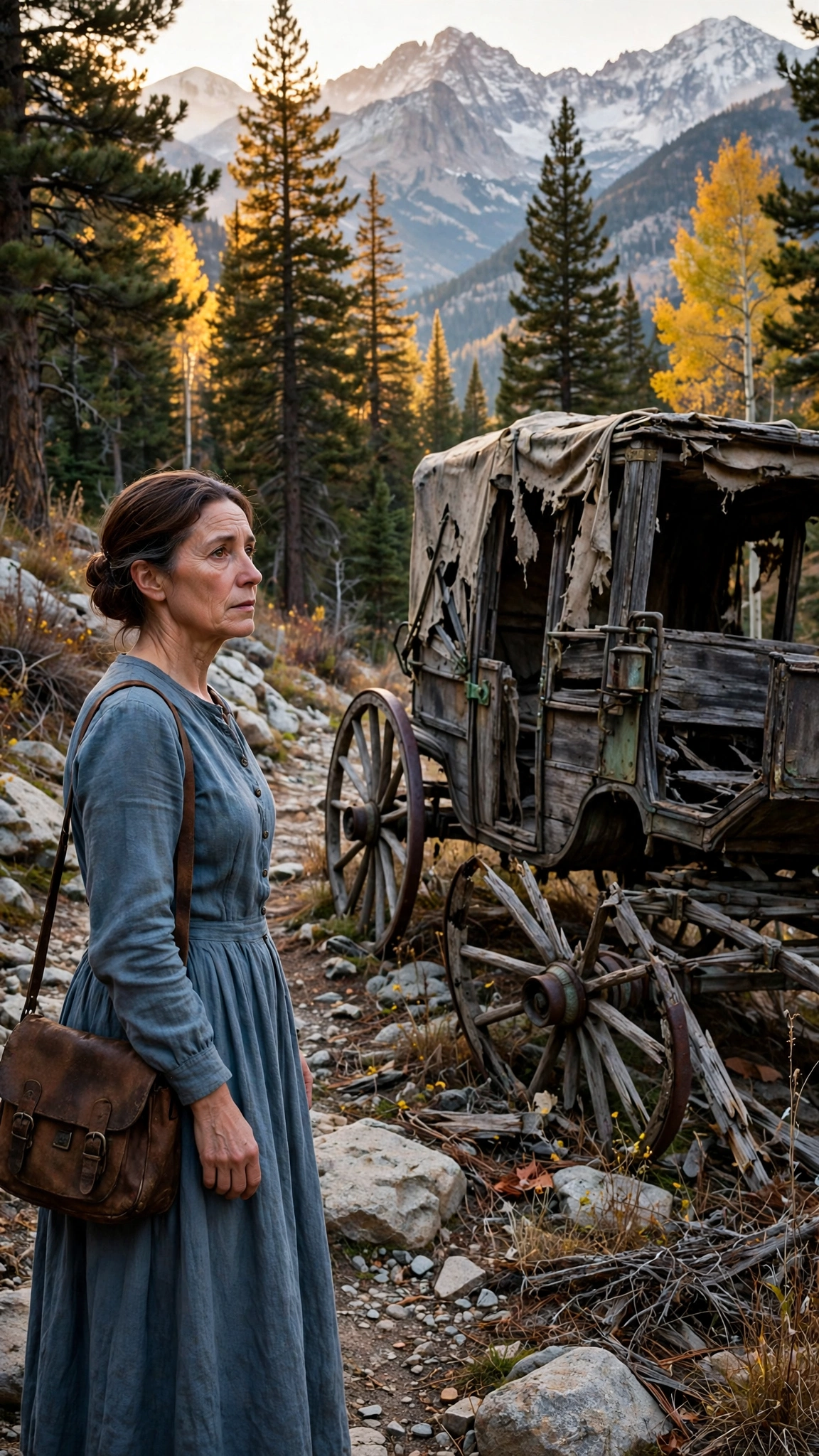
Claire reached Silverton just after one in the morning, walking down the middle of the empty main street with her dress torn and her left arm held tight against her body, and the first person she saw was a deputy sheriff named Tomás Herrera, locking the door of the small county office.
He took one look at her and stopped being a man locking a door. He was a deputy again, and then he was a first responder, and he had her sitting on the office steps with a blanket around her shoulders and a radio in his hand before she could finish her first sentence.
"Ma'am, are you hurt? Can you tell me your name?"
"Claire Bennett Mason," she said, and her voice sounded strange to her, hoarse and far away. "My husband pushed me off a mountain. I need to speak to the sheriff."
Deputy Herrera did not argue, and he did not doubt her, and later Claire would remember that as the first kindness of the night. He called the sheriff at home, and he called the clinic, and he stayed with her on the steps while the town slept around them, asking her careful questions in a calm voice: where, when, how far had she fallen, could she move her arm, was anyone else with her husband.
"A woman," Claire said. "I never saw her. I heard her voice. She said, 'Looks convincing.'"
The sheriff of San Juan County was a man named Roy Begay, sixty years old, a former Marine, with the patient face of a man who had spent forty years listening to people lie to him and learning to tell the difference. He arrived in twenty minutes, and he listened to Claire's whole story without interrupting once, and then he asked her to show him what was in her satchel.
She laid the bundle on his desk, in the little county office with the fluorescent lights buzzing overhead, and unfolded the oilcloth, and watched his face as he read Warren Mason's letter.
"Twenty-seven years," Sheriff Begay said quietly. "I've lived here my whole life, and I remember when Warren Mason died. Heart attack at the wheel, they said. Car went off the road near the old carriage trail." He looked up at her. "You're telling me his son pushed you off a mountain to keep this buried."
"I'm telling you what happened to me," Claire said. "The letter is what it is. The certificate is what it is."
The sheriff nodded, slowly. "Your husband came in here six hours ago, Mrs. Mason. He reported you missing. He said you slipped on a ledge while you were hiking, that he went for help, that he couldn't find you when he came back. He was very upset. He had a woman with him — his sister, Meredith Mason. She said she was waiting at the trailhead and heard you fall."
Meredith Mason. Daniel's younger sister, forty-four, a real estate broker in Denver, the woman whose voice Claire had heard from the ledge. It fit. It fit the way the last piece of a case fits, and Claire felt a cold, clean anger settle in her chest, the kind of anger that did not shake or shout but simply made her very, very clear.
"She was on the ledge with him," Claire said. "She said, 'Looks convincing.' She was not waiting at the trailhead."
Sheriff Begay wrote it down. "Tell me about the woman's voice," he said. "Anything you remember. Young or old? Accent?"
"Younger than Daniel," Claire said, thinking hard. "Impatient. Like she wanted it over with. She said, 'Looks convincing,' the way you'd say it about a photograph, or a piece of furniture. Like she was judging a performance."
The sheriff nodded, and he wrote that down too, and he did not say anything, but Claire saw the way his eyes flicked to the name on his notepad — Meredith Mason, forty-four, real estate broker, Denver — and she understood that he had already been thinking the same thing.
"I'll need to take a formal statement. And I need to get that shoulder looked at. The clinic in Silverton can stabilize it, but you'll need to go to Durango for the real work. Do you have someone you want me to call?"
Claire thought for a moment, and then she said the name of the one person she trusted completely: "Maggie O'Connell. She's my law partner in Denver. Her number is in my phone, and my phone is in my husband's car."
The deputy found Maggie's number through the clinic's directory, and Maggie answered on the second ring, and when Claire heard her friend's voice, the whole night came down on her at once — the fall, the ravine, the carriage, the letter — and she cried for the first time, quietly, sitting on the steps of the sheriff's office with a blanket around her shoulders, while Maggie said, "I'm coming. I'm getting in the car right now. Don't talk to anyone else until I get there. Don't sign anything."
The clinic doctor, a tired young woman named Dr. Patel, examined Claire's shoulder and told her what she already knew: the joint was dislocated, the ligaments were torn, and she would need surgery in Durango. "You're lucky," Dr. Patel said, taping the shoulder into a sling. "A fall like that — you should be dead. You should be at the bottom of that ravine."
"I know," Claire said. "I was supposed to be."
By dawn, the story had begun to move the way stories move in small mountain towns: fast, and in every direction at once. Daniel and Meredith Mason were brought to the sheriff's office separately, and they told their story separately, and their stories matched each other almost too well. She had slipped, he had gone for help, she had waited at the trailhead, they had both been frantic. The sheriff listened, and he wrote it down, and he asked Daniel about the carriage, and about his father's letter, and about a mining claim from 1898, and Daniel's face — calm, reasonable, grieving — did not change at all.
"I don't know what you're talking about," Daniel said. "My father died twenty-seven years ago. My wife fell on a hike. I don't know anything about a carriage."
Sheriff Begay let him go. He had to. There was no body, no witness, and a husband's word against a wife's word, and a letter that proved a crime committed in 1899 by a man long dead. But he kept the bundle, sealed in an evidence bag, and he kept Claire's statement, and he called the county attorney in Durango before the sun was fully up.
Maggie arrived at noon, driving straight from Denver, and she walked into the clinic with her coat still on and her briefcase in her hand, and she hugged Claire so carefully that she did not touch the sling.
"Tell me everything," Maggie said. "From the beginning. Every word."
Claire told her. The ledge, the fall, the woman's voice, the car door, the wheel ruts, the horseshoe, the carriage, the box, the letter. Maggie listened the way she had listened through twenty years of cases, and then she said, "We're going to Durango. You're going to have that shoulder fixed. And then we're going to file a land claim for Ruth Ann Crowe, and a criminal complaint against your husband, and we're going to do it in that order, because the land claim is the one he can't talk his way out of."
The night at the clinic was long. Dr. Patel took X-rays, and the X-rays showed what Claire already knew: the shoulder was dislocated, the ligaments torn, the joint swollen and angry. The doctor offered her strong painkillers, and Claire refused them, because she needed her head clear, because there were statements to give and decisions to make, and because she had spent the whole night being clear-headed, and she was not going to stop now. She took ibuprofen instead, and an ice pack, and she sat in a plastic chair in the little clinic with a blanket around her shoulders, and she told Deputy Herrera everything, slowly, while he wrote it down in a notebook in careful block letters.
The deputy told her, in return, what Daniel had done that evening. He had come into the sheriff's office at seven o'clock, with Meredith beside him, and he had reported his wife missing. He had been calm, and reasonable, and very upset in a controlled way, and he had said she slipped on a ledge, and that he had gone for help, and that he could not find her when he came back. Sheriff Begay had asked to see his boots, and Daniel's boots were clean. That was the detail the deputy remembered most. A man who had spent the afternoon searching a mountainside for his wife would have dirty boots. Daniel's boots were clean.
Maggie called twice on the drive down from Denver. The first time, she was on the highway south of Colorado Springs, and she said, "I'm coming, I'm driving as fast as I legally can, don't talk to anyone else." The second time, she was an hour out, and she said, "I've called the clinic in Durango. They'll take you first thing in the morning. I've called the county attorney's office and left a message. And Claire — I love you. You're going to be all right."
Claire slept for two hours in the clinic, in a narrow bed with a thin blanket, and she dreamed of the ledge, and of the gravel sliding, and of the flashlight sweeping over the carriage, and she woke up with her heart hammering, and the night nurse — a woman named Grace, with gray hair and a soft voice — sat with her until she fell asleep again.
Grace brought her warm milk in a chipped mug, and sat in the chair beside the bed, and told her about her own daughter, who had once fallen from a horse and broken her collarbone and been terrified of horses for a year afterward, until one morning she had simply gotten back on. "The body remembers the fall," Grace said, "but it also remembers getting up again. You have to give it a chance to remember the second part." Claire held the mug in her good hand and listened to the rain on the clinic roof, and thought about the walk out of the ravine, one careful hold at a time, and about how getting up again was the only part that mattered.
Maggie drove, and Claire dozed in the passenger seat, waking every so often to the sound of the tires and the sight of the mountains sliding past the window. Once, she woke to find Maggie's hand resting lightly on her good shoulder, and she did not move, because the weight of it was the first safe thing she had felt in days. Once, she woke and asked, in a voice thick with sleep and painkillers, whether anyone had filed Mrs. Alvarez's response.
"I filed it," Maggie said. "Yesterday. Before I left. The hearing is Monday, and we're ready, and Mrs. Alvarez knows you're all right — I told her you were in an accident, and that you'd be back next week."
Claire closed her eyes again, and she thought about Mrs. Alvarez's apartment, and the landlord who wanted her out, and the small, ordinary injustices that the clinic existed to fight, and she understood, suddenly and clearly, that her life was not over. It was waiting for her, in Denver, with its files and its hearings and its people who needed her, and all she had to do was get back to it.
Claire looked down at her hands, resting in her lap. There was dirt under her nails from the ravine, and a red mark across her palm where the satchel strap had cut in during the fall, and a thin scratch along her wrist from a pine branch. She thought about the hands that had held hers on the ledge, and then let go, and she flexed her fingers, slowly, one at a time, the way Ana would later teach her to do in physical therapy — a small, deliberate act of reclaiming something that was hers.
On the drive to Durango, with the mountains falling away behind them, Claire looked out the window at the San Juans and thought about the carriage, still standing in its hollow in the ravine, and about Warren Mason, who had tried to do the right thing twenty-seven years ago and died for it, and about Daniel, who had spent his whole adult life protecting a fortune that was never his. She thought about all of it, and she felt, underneath the pain in her shoulder and the exhaustion, something she had not felt in years: certain. She knew what had happened. She knew what she had to do. And she was going to do it.