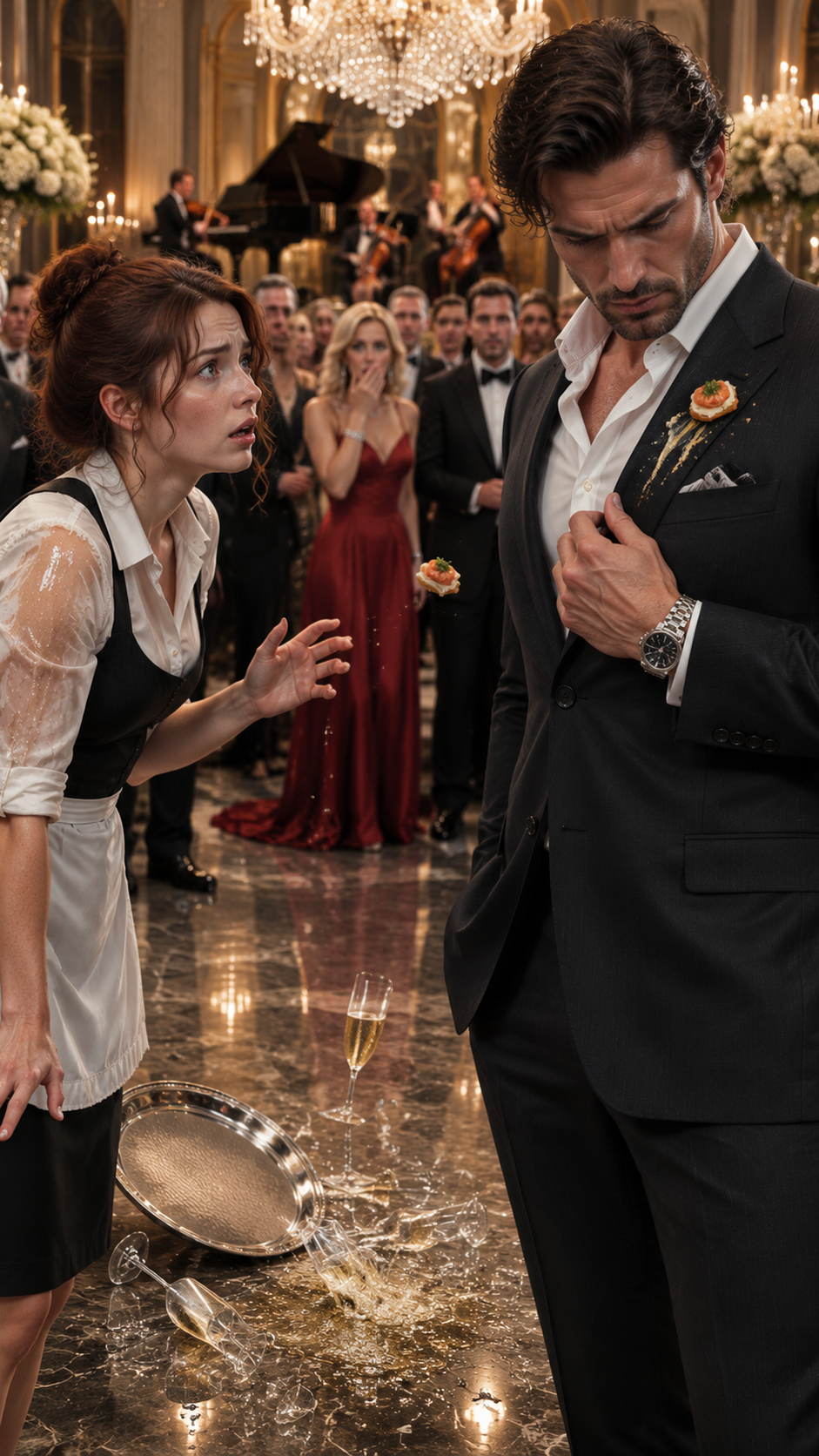
The message arrived before Evelyn had finished her coffee.
Her phone vibrated beside the folder of fundraiser schedules. She glanced down, expecting a reminder from Margaret about the afternoon rehearsal.
Instead, an unfamiliar number filled the screen.
*You don't belong in his world.*
Evelyn read it twice.
The words were brief, almost ordinary. That made them worse. Whoever had sent them knew enough about her to make the warning feel personal.
She set the phone facedown.
A second vibration followed.
*Stay away from Flynn Ashcroft, or everyone will know what you really are.*
For a moment, the studio seemed to lose its sound. The piano in the next room, the distant voices in the corridor, the traffic beyond the windows—all of it receded behind the hard beat of her pulse.
She took a screenshot, then forwarded both messages to Flynn.
His reply came less than a minute later.
*Where are you?*
*At the foundation studio.*
*Stay there. I'm coming.*
Evelyn frowned at the screen.
*I don't need rescuing.*
His answer appeared immediately.
*I know. I need to understand what is happening.*
She stared at the message. It was a better answer than she had expected, and that unsettled her almost as much as the threats.
When Flynn arrived twenty minutes later, he was wearing the charcoal suit he had worn to a morning meeting, the jacket open over a crisp white shirt. His dark hair was slightly disordered, as if he had run a hand through it several times on the drive over.
Daniel Reeves followed him into the studio carrying a slim laptop case.
Flynn went straight to Evelyn.
"Show me."
She handed him the phone.
He read the messages without changing expression. Only the tightening of his jaw betrayed his anger.
"Did either number contact you before?"
"No. Both are new."
"Have you received anything at home?"
"Nothing. Not that I know of."
Flynn looked at Daniel.
"Save the screenshots. Preserve the numbers and the message details. Don't reply."
Daniel nodded and took out his laptop.
Evelyn folded her arms.
"I can manage an unpleasant text message."
"I know you can."
"Then don't turn this into a security operation around me."
Flynn lowered his voice.
"Someone is threatening you because of your association with me. Pretending it is harmless won't make it harmless."
"And treating me like a problem to be managed won't make me feel safer."
He held her gaze.
For a moment, she expected him to argue. Instead, he nodded once.
"Then tell me what would help."
The question took some of the heat out of her anger.
"I want to know who is doing it," she said. "And I want to keep working. I won't have my name quietly removed from this program because somebody thinks I should disappear."
"You have my word."
"I want more than your word, Flynn. I want the truth, even if it makes your life inconvenient."
He looked down at the messages again.
"So do I."
***
The first sign that the threats were not isolated came that afternoon.
Evelyn arrived at the youth arts studio on Queen Street carrying a box of donated dance shoes. The program had been running in a modest converted warehouse for nearly three years, offering free classes in dance, music, and stagecraft to teenagers whose families could not afford private instruction.
The room was usually noisy by four o'clock. Students practiced steps near the mirrors, a volunteer piano teacher worked through scales with two girls, and someone was always laughing in the hallway.
That day, the studio was silent.
A notice had been taped to the front door.
Evelyn set down the box and read it.
The landlord had issued a new rental agreement. The monthly rent was to increase by one hundred percent, effective the following month. If the program could not meet the new amount, the organization would have to vacate the premises.
She read the figure again.
It was not a modest increase. It was a demand that would consume the program's entire operating reserve.
Margaret Ellis came out of the office, her face drawn.
"You saw it."
Evelyn looked at her.
"When did this arrive?"
"This morning. The property manager says the building has been reassessed and the increase is justified by market rates."
"They can't expect us to pay this with thirty days' notice."
"They can ask. Whether the notice is enforceable is another question. Our lawyer is checking."
Evelyn glanced through the glass panel. The dance floor was empty except for a stack of chairs.
"Where are the students?"
"I sent everyone home. We can't run classes until we know whether we have a room next month."
"What about the teachers?"
Margaret hesitated.
"That's the other thing."
She opened the office door and handed Evelyn a sheet of paper. Three volunteer instructors had withdrawn from the program. One cited a sudden change in work commitments. Another said she had been advised that the foundation was reviewing the program's leadership. The third had sent a short message saying she did not want to be involved in a project surrounded by controversy.
Evelyn read the names.
"They didn't even speak to me."
"I called them. They wouldn't discuss it."
"What controversy?"
Margaret's expression tightened.
"I don't know. But someone has been asking questions about you."
Evelyn looked at the empty studio again.
The anonymous messages had promised that everyone would know what she really was. Now the program she had worked to protect was being squeezed from several directions at once.
"This isn't a coincidence," she said.
"I don't think so either."
Evelyn put the paper down.
"We'll call the teachers again. I'll speak to the landlord. And we are not cancelling the students' classes permanently."
Margaret touched her arm.
"Evelyn, you can't carry all of this alone."
"I'm not planning to."
But as she looked at the empty floor, she wondered how many people would remain beside her once the pressure increased.
***
The newspaper item appeared the next morning.
It was tucked into the local arts section beneath a headline about a downtown gallery opening. The column was short, unsigned, and carefully phrased to sound like a concerned community report.
It described the youth arts program as a project whose leadership had become "unexpectedly entangled with the social life of a wealthy benefactor." It referred to Evelyn as a former catering worker who had attracted attention after a public dance with Flynn Ashcroft. It suggested that the program's charitable purpose might have become secondary to her sudden access to influential donors.
No allegation was stated directly.
The insinuation did all the work.
Evelyn read the item at the kitchen table of her small apartment. Her dark auburn hair was still in a loose, untidy bun, and she wore a plain sweater over her work clothes. A rent reminder lay beside the newspaper.
Her phone rang.
Sophie.
"Have you seen it?" Sophie asked.
"I'm looking at it now."
"It's disgusting. They make it sound as if you planned the whole thing."
Evelyn folded the paper.
"That's what they want people to think."
"Do you know who's behind it?"
"Not yet."
"Are you going to let Flynn handle it?"
Evelyn looked at the rent reminder.
"Flynn can investigate the source. He can't answer for me."
"You shouldn't have to defend yourself."
"No. But the students shouldn't lose their classes because someone printed a nasty paragraph, either."
After the call, Evelyn read the article again. It did not mention her years of training, the volunteer hours, or the children who had learned to stand in front of an audience without apologizing for taking up space.
It reduced her to a waitress who had danced with a rich man.
She put the paper in her bag. If someone wanted her to feel ashamed of where she had started, they had chosen the wrong person.
***
Flynn read the article in his office shortly after nine.
Daniel stood across from his desk, waiting.
"The paper says the reporter received an anonymous tip," Daniel said. "They won't identify the source."
Flynn put the page down.
"Who paid for the placement?"
"It wasn't a paid advertisement. The editor says it was submitted as a community-interest item."
"And the landlord?"
"The property company is registered through a holding group. We are tracing the ownership, but the increase was authorized by the building manager."
Flynn's expression hardened.
"The teachers?"
"Two received calls from someone claiming the program was under investigation. The third was sent a copy of the newspaper item before she resigned."
"Who made the calls?"
"Unknown numbers. One appears to have used a masked internet service."
Flynn stood and walked to the window.
He had spent years dealing with hostile competitors, aggressive negotiations, and people who believed money gave them the right to bend rules. He knew how to respond when an opponent made a direct move.
This was different. The attacks were designed to look unrelated, each one small enough to dismiss, together capable of destroying Evelyn's work and reputation.
"I want a private investigator," he said.
Daniel nodded.
"I have someone in mind. Noah Pike. Former financial-crimes investigator. He now handles corporate due diligence and discreet inquiries."
"Bring him in."
"I'll arrange it."
Flynn turned from the window.
"And Daniel?"
"Yes?"
"No one contacts Evelyn's landlord, teachers, or employer in my name without her knowledge. We investigate. We don't intimidate people."
Daniel gave a small nod.
"Understood."
***
Noah Pike arrived that afternoon.
He was in his early forties, lean, clean-shaven, and dressed in a navy suit that looked chosen for comfort rather than display. He carried a leather notebook and asked more questions than he answered.
Flynn introduced the situation without embellishment. He showed Noah the anonymous messages, the newspaper item, the rent notice, and the list of instructors who had withdrawn.
Noah studied each item.
"You believe these are connected?"
"I do."
"And you believe the person responsible is connected to you?"
Flynn paused.
"I believe the person wants Evelyn to think she is unsafe near me. That may be the same thing."
Noah looked up.
"Who would benefit from separating you?"
Flynn did not answer immediately.
Victoria Hale's name came to mind. Their relationship had been visible in Toronto's charity circles for nearly two years. They had attended dinners and public events together. People had assumed an engagement was inevitable, although Flynn had never made that promise.
But suspicion was not evidence.
"There are people who dislike the attention Evelyn has received," he said carefully. "I won't give you a list of enemies and ask you to confirm my assumptions. Follow the evidence."
Noah closed the notebook.
"Good. Then I need access to the foundation's communications records, the sponsor presentation history, and the original files sent to the printers."
Flynn frowned.
"Why the sponsor presentation?"
"Because you said the program's name disappeared from a draft?"
"I haven't said that."
Noah glanced at Daniel.
Daniel opened his laptop.
"There was a sponsor deck circulated yesterday. It listed the gala's beneficiary programs. Evelyn's youth arts initiative was absent. The communications team said it was a formatting error."
Flynn's eyes narrowed.
"Who approved it?"
"The final approval field is blank," Daniel said. "The file was uploaded through the events office account."
Noah made a note.
"Then I want the file history. Not a PDF. The editable original, including comments and revision metadata."
Flynn nodded.
"You'll have it."
***
The photographs arrived before Noah's first report.
He asked Flynn to meet him in a small conference room at the foundation. Evelyn was already there when Flynn entered. She sat at the end of the table with her hands folded around a paper cup of tea.
"I asked her to join us," Flynn said. "She deserves to see what we're looking at."
Noah placed a tablet on the table.
"These were sent to an anonymous account that contacted two local media outlets. The outlets haven't published them. One of their editors forwarded the submission to us after Daniel made an inquiry."
He opened the first image.
It showed Evelyn leaving the foundation building. The photograph had been taken from across the street, with the studio windows reflected in the glass behind her.
The second showed Flynn and Evelyn talking beside his car.
The third showed them inside the studio after a rehearsal. The image had been taken through a narrow gap in the blinds.
Evelyn leaned closer.
"That was the evening I stayed late to finish the students' schedule."
Flynn studied the image.
"I remember."
"You were there for less than fifteen minutes."
"Apparently someone thought it was worth photographing."
Noah opened a fourth image. It showed the two of them walking along the foundation corridor, Flynn carrying a stack of folders while Evelyn spoke to him.
The angle made the ordinary conversation look intimate.
Evelyn sat back.
"Someone has been following us."
"Yes," Noah said. "At least on three separate dates. We are checking nearby security footage to identify the photographer."
Flynn's hand tightened against the table.
"Can you trace the submission account?"
"Not directly yet. But the files contain metadata that may help establish when and where they were taken."
Evelyn looked at the photographs again.
"They want people to believe I'm using him."
Flynn turned toward her.
"You don't have to defend your relationship with me to strangers."
"There is no relationship to defend if we haven't even decided what this is."
The words landed more sharply than she intended.
Flynn did not look away.
"Then we should be honest about that, too."
Noah quietly closed the tablet.
"I'll leave you both to talk."
He gathered his notebook and stepped outside, leaving the door open behind him.
Evelyn looked at Flynn.
"I don't want to become a story people tell about your money."
"You aren't."
"You can't promise what everyone else will say."
"No. But I can promise not to let them decide what you are."
She looked down at her tea.
"I need this program to survive. The students need it. That's what matters right now."
Flynn nodded.
"Then that's what we'll protect."
***
The altered sponsor presentation was discovered the following morning.
Daniel sent Evelyn a message asking her to come to the foundation office. When she arrived, he was waiting with Noah and a large monitor displaying two versions of the fundraiser deck.
The first was the presentation Evelyn had helped prepare. It included the youth arts program, a schedule of student performances, a description of the free classes, and a budget showing exactly how donations would support instruction and studio access.
The second version had been circulated to the lead sponsors.
The program had been removed.
Evelyn's name was gone from the project leadership page. The student performance section had been replaced with a general statement about community outreach. The donation allocation table had been changed so that the youth arts program received no direct funding.
She stared at the screen.
"Who made this version?"
Noah enlarged the document properties.
"The file was created from the original presentation three days ago. The user account is listed as Events Administration, but that account is shared by several people."
"Who uploaded it?" Evelyn asked.
"The upload came from a terminal assigned to the executive event suite. We are requesting the access logs."
Flynn stood near the window, his expression cold.
"Why would someone alter the sponsor deck and leave the program out?"
Evelyn pointed to the revised allocation table.
"Because if the sponsors approve this version, the money won't reach the students. They'll be told the program wasn't part of the agreed fundraiser."
Daniel nodded.
"The revised deck also changes the order of the sponsors. One of the major matching donors is listed under a different category. It could affect the amount released after the event."
Noah opened the revision history.
"There are comments that were removed from the final copy. I recovered some of them from the document cache."
He displayed a short list. Most were routine notes about formatting. One comment had been attached to the page where Evelyn's name originally appeared.
*Remove the program lead. The announcement should focus on the foundation, not the waitress.*
Evelyn's face went still.
Flynn stepped closer.
"Who wrote that?"
"The comment author field has been cleared," Noah said. "But the revision was saved under a user profile connected to the events office. I need the access records to identify the person at the keyboard."
Evelyn looked from the comment to the altered allocation table.
"This wasn't a mistake."
"No," Flynn said. "It wasn't."
She pulled a chair toward the table and began comparing the two presentations line by line. Her expression changed as she found each alteration: the removed program name, the missing student performance, the reduced budget, and the new sponsor language.
She stopped at the final approval page.
The original presentation had two approval fields: one for the foundation's finance director and one for the event sponsor committee. Both had been completed.
The altered version contained a third field, added after the original file was copied. It was labeled *Executive Authorization*.
The name beneath it had been obscured by a white rectangle.
Evelyn leaned closer.
"Can you recover that?"
Noah examined the file.
"Possibly. The rectangle may be a separate object rather than a permanent deletion."
He opened the source file and selected the approval page. A few keystrokes later, the white block shifted.
Beneath it was a partial digital signature and a timestamp.
Flynn came around the table.
"Can you read the name?"
Noah enlarged the screen.
The first letter was visible. Then the second. The rest remained covered by a flattened image layer.
"I can recover the underlying file from the server backup," Noah said. "But I don't want to alter this copy. It is evidence."
Evelyn kept her eyes on the screen.
"Whoever did this knew the approval process. They knew which donors to remove and how to make the changes look administrative."
Flynn's voice was quiet.
"And they knew the program mattered to you."
She turned toward him.
"They weren't only trying to embarrass me. They were trying to erase the work."
Noah closed the presentation without saving any changes.
"I'll preserve both versions and obtain the server logs. We should also keep the original sponsor emails. If the altered deck was sent externally, the recipients need to be notified that it is not authoritative."
Flynn nodded.
"Daniel, contact the board chair and legal counsel. No sponsor receives another version until the records are verified."
Daniel left to make the calls.
Evelyn remained seated, staring at the frozen approval page.
Flynn pulled out the chair beside her.
"You all right?"
"I'm angry."
"You have every right to be."
"I want to know whether this was done by someone inside the foundation or someone who had access through the event company."
"Noah will find out."
"And I want to know why."
Flynn looked at the hidden signature.
"So do I."
Evelyn touched the edge of the paper printout Noah had left on the table.
"I want to see who approved it."
***
By late afternoon, the studio was nearly empty.
The students had been told that classes would resume the next day, although Evelyn had not yet solved the rent problem. Margaret had arranged for two instructors to return temporarily, and one former volunteer had offered to teach a weekend workshop without pay.
It was not enough to make the future secure.
But it was enough to keep the doors open for another day.
Evelyn stood alone near the mirrored wall, reviewing the revised schedule. Her phone lay beside her notebook. The two threatening messages remained saved in a separate folder, along with the newspaper item and the photographs Noah had shown them.
Flynn had offered to drive her home.
She had told him she wanted to finish the schedule first.
He had accepted, though not without asking her to call when she left.
A faint sound came from the corridor.
Evelyn looked up.
The studio door was closed. The lights in the hallway had been dimmed, and she could see no one through the narrow glass panel.
She checked the time.
A little after seven.
"Margaret?" she called.
No answer.
She walked toward the door, then stopped when she heard a soft metallic click.
Someone was outside.
Evelyn looked at her phone. Flynn's name was at the top of her recent calls. She reached for it, but before she could touch the screen, the handle moved.
Slowly.
The studio door handle began to turn.