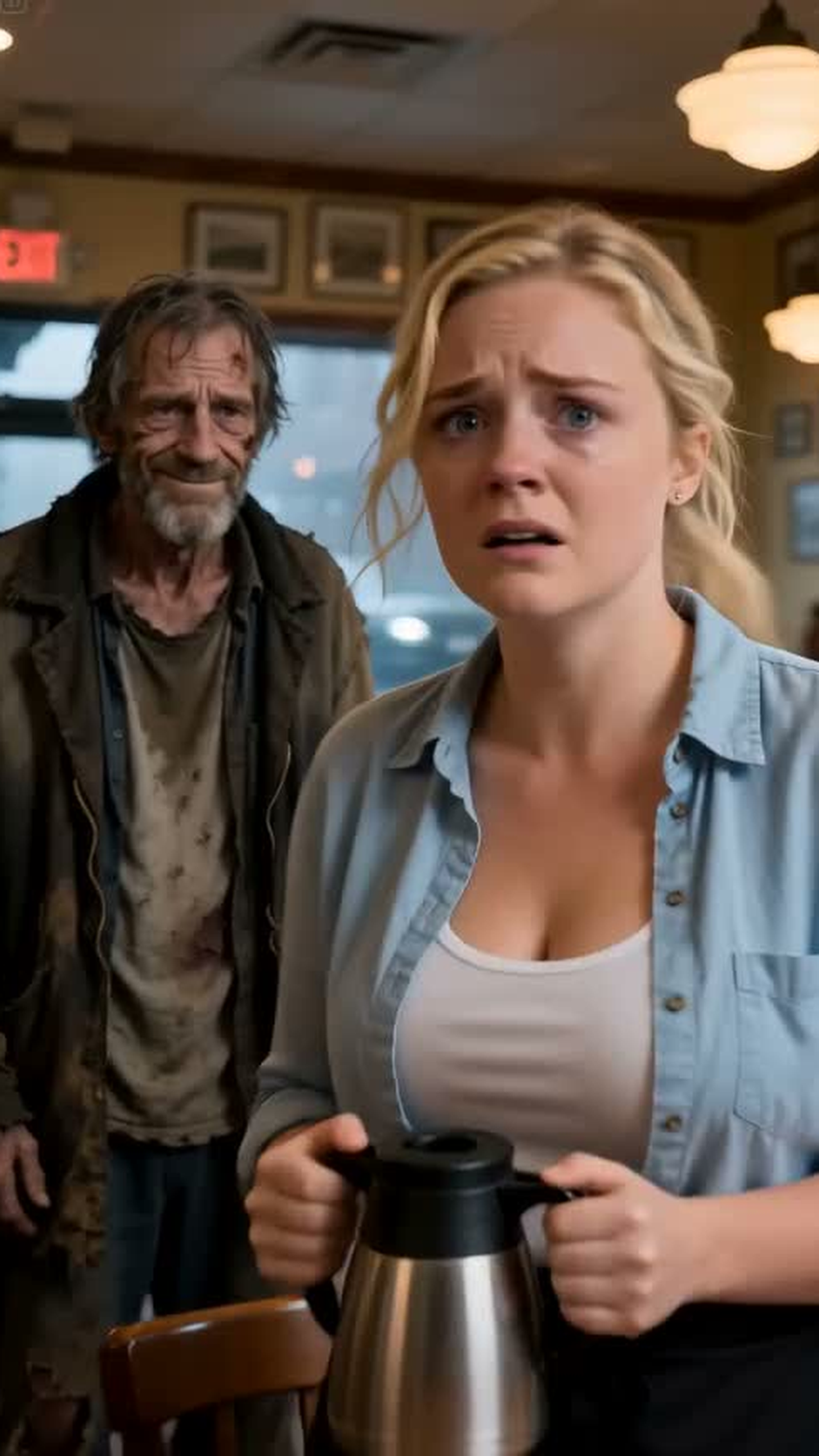
The rain came down the front windows of the Copper Kettle in long, crooked lines, and through it, the old man was watching her again.
He sat where he always sat now — under the narrow overhang by the entrance, where the awning kept the worst of the weather off and nothing else did. His coat was the color of wet earth, torn at one shoulder, buttoned wrong. His shoes were soaked through. Around his knees, his hands were locked together so tightly that Emma Lawson could see them shaking from twenty feet away, through glass, through rain.
People walked past him the way water walks past a stone. A woman with a stroller angled wide. Two men in work boots split around him without breaking their conversation. A teenager looked straight at him, through him, and kept scrolling.
The old man's eyes — pale, sharp, impossibly clear for a face that weathered — did not move from Emma.
"Let's see who still cares," he murmured, to no one, to the rain.
At the pass, Dana set a plate down in front of Emma with the particular clang of a woman who has been on her feet since five in the morning. Roast chicken. Mashed potatoes with the skin still in them, the way Emma liked. Green beans, a roll going golden at the edges. Steam rose off it in the cool air of the diner and fogged the edge of Emma's glasses where they hung from her apron string.
"Eat," Dana said. "You look like a ghost with a ponytail."
"I will. In a minute."
"You said that yesterday. Yesterday your minute had a table of six and a birthday in it."
Emma smiled because Dana was right and because smiling was cheaper than arguing. The plate was her staff meal — one a day, eaten standing up in the back if she was lucky, eaten cold if she wasn't. Her stomach made a small, honest sound. Through the window, beyond the counter and the booths and the framed photographs of the neighborhood as it had been forty years ago, the old man folded his shaking hands once more, tighter, and went on watching her.
She picked up the plate.
Dana caught her wrist — gently, the way you catch someone who is about to step off a curb. "Emma. That's your lunch."
"I know."
"You skipped breakfast. You told me you skipped breakfast because the milk had gone over and you weren't going to spend four dollars—"
"He needs it more."
Dana looked out the window. Dana looked at the plate. Dana, who had two kids and a husband on disability and understood down to the penny what a free meal was worth, let go of Emma's wrist and said nothing at all, which was the loudest thing she could have said.
The bell over the door rang. The rain came in with Emma and then the door sighed shut behind her and it was only the two of them under the awning, in the gray hush, with the traffic hissing past on the wet avenue.
He looked up. Close, he was older than he'd seemed through the glass and somehow less old — his eyes did the work of a younger man's eyes, measuring, unsurprised by everything except, apparently, this. He looked at the plate. He looked at her face. Something in his expression gave way, like a lock turning in a door nobody had opened in years.
She crouched so they were level, rain spotting her shoulders through the gap where the awning ended, and held the plate out with both hands.
"Why would you help me?" he asked. His voice was low and rough, but there was an odd care to the words, as if he had been saving the question.
Emma shrugged, embarrassed by how simple the answer was. "Because you're hungry."
He took the plate. His hands were still shaking, and hers were steady, and for one second both of them were holding on. Then she stood, wiped the rain off her forearms with the side of her apron, and went back inside to a dining room that had already forgotten either of them existed.
She never saw him eat.
What she never saw — what no one saw — was the napkin.
He ate slowly, like a man at a table in a house he owned. When the plate was done, he set the plastic fork down parallel to the rim, exact as a place setting. Then he took the white paper napkin, folded it once with his weathered hands, and drew from an inside pocket of the ruined coat a small pen — good brass, the kind of pen that does not belong to a man who sleeps rough — and wrote, in a hand like copperplate, four words.
She is the one.
He folded the napkin once more and put it in his breast pocket, over his heart, and sat back to wait for the part of the day he had come for.
It arrived twenty minutes later, out of the rain, in absolute silence.
Emma heard it before she understood it — not an engine sound exactly, but a change in the room. The rattle of the windows. Every head turning the way sunflowers turn. She was mid-pour at table nine, the black coffee pot raised, when Marla at the register said, in the voice of a woman announcing weather from another planet:
"Oh, my Lord. Who are those people?"
Three black sedans had come to rest along the curb outside, one behind the other, precise as a held breath. Their headlights burned through the rain and doubled themselves on the wet pavement. Nobody in the Copper Kettle moved. The cook's spatula stopped halfway to the grill. Somewhere a phone was already up, filming.
The door opened and the room went silent the way a church goes silent.
He was tall — that was the first thing. Navy three-piece suit cut so well it made every other man in the room look like a rough draft. Dark hair, trimmed beard, a watch that caught the pendant lights. Two men came in behind him in black suits, took the walls without being told, and became furniture with eyes. Emma would remember later that she had been afraid, but the truth was simpler: she had been riveted. He had the kind of face that made a room behave.
His gaze crossed the dining room once — booths, counter, pass — and stopped on her.
"Where is the waitress who fed him?"
The coffee pot weighed suddenly like an anchor. Table nine's refill dripped onto the saucer, unnoticed. Dana, beside the pie case, had gone the color of the pie case.
Emma's mouth opened. Nothing came out of it that she could account for afterward.
He crossed the room — not fast, not slow, the stride of a man who has never once had to hurry — and stopped a respectful distance from her, and she saw, up close, that his eyes were wet. That undid her more than the suit, the cars, any of it. Men like that were not supposed to have wet eyes.
"You fed my father," he said quietly, "when everyone else looked away."
Behind him, in the open doorway, framed by the rain and the black shine of the cars, the old man in the torn brown coat was standing — upright, composed, shoulders back, no trace of the shiver left in him — looking at her over his son's shoulder with a small, knowing smile.
Emma turned sharply toward him. Her heart was going like a trapped bird.
"Your — what?"
* * *
Three weeks earlier, Emma Lawson had been nobody at all, and glad of the arrangement.
She lived with her mother in a second-floor walk-up on Candler Street, four blocks and one unreliable bus from the Copper Kettle, in an apartment with a radiator that sang and a kitchen window that had not fully closed since the winter of the big freeze. Every morning began the same way, in the dark, with the pill organizer.
June Lawson's heart medication came in four colors and had to be taken in an order June pretended not to know and Emma pretended not to enforce. "You're not my mother," June would say, dry as toast, one slipper on, one slipper off.
"No," Emma would agree, setting out the water. "I'm worse. I'm your daughter. I keep lists."
The lists ruled the apartment. There was the list on the refrigerator (milk, beans, the cheap coffee that was also, defiantly, the good coffee). There was the list in Emma's apron pocket (ask Gus about Saturday hours, Mrs. Abernathy's decaf, table four's chair wobbles). And there was the list that lived in the back of her head and woke her up some nights at three: rent $1,150, due the first; pharmacy $86; the gas bill; the balance on the credit card that had carried her father's last winter in the hospital, three years gone and still charging her for it, month by month, like a subscription to grief.
She was twenty-seven. She worked doubles four days a week and singles the other three at a neighborhood restaurant where she had started at nineteen, bussing, and where her grandmother had worked before her — Rose Lawson, who had tied on an apron at the Copper Kettle in 1983 and taken it off, mostly, in 2009, and who had taught Emma the two laws of the trade.
One: everybody is carrying something heavier than their plate.
Two: feed people first. Ask later. Later takes care of itself.
The Copper Kettle had been feeding the neighborhood since 1962 — polished wood tables worn pale in the middle, a counter with eleven stools, pendant lights the color of late afternoon, and walls of framed photographs: the avenue before the chain stores, the flood, the championship parade, Gus's father in front of the grill in an apron that said KISS THE COOK in letters time had faded to a suggestion. Gus Papadopoulos himself was sixty-four, built like a fireplug, and spoke fluent grievance. His current grievance was the landlord, who had let it be known — through the coward's telephone of a property manager — that the building was being "evaluated for its market potential," a phrase Gus repeated the way other men repeated obscenities.
"Market potential," he would say, sliding a ticket onto the rail. "Sixty years I feed this street, and I am market potential. Table six wants the check, sweetheart. And the gentleman at the window booth says his eggs are philosophical. I don't know what that means and neither does he."
It was, Emma thought often and never once resented, a good life badly paid. She knew the regulars' orders, their divorces, their medications, which ones tipped in cash because "the card people take a cut, Emma," which ones were lying about being fine. She was plus-size and plain-spoken and tired in a way that sat behind her blue eyes like weather, and the diner loved her the way a house loves its load-bearing walls — without ever once saying so out loud.
The old man appeared on a Tuesday, in the last week of September, between one breath of the day and the next.
She noticed him because of the stillness. The sidewalk outside the Kettle was a river — school kids, dog walkers, the avenue's whole hurrying population — and he was the rock in it: seated on the low ledge beneath the entrance overhang, a torn brown coat around him like a tent, his hands folded, his head up. Not begging. No cup, no sign, no cardboard sermon. Just sitting, in the exact spot where everyone entering or leaving would have to decide, consciously, not to see him.
"New fixture," Dana said, following her eyes, and refilled the sugar pourers with the efficiency of a woman defusing something. "Give it a week. City moves them along, mostly."
"He's not asking for anything."
"That'll be what makes everybody nervous."
By closing, Emma had filled his water glass twice — set it on the ledge without ceremony, the way you'd set a thing on your own porch, and gotten, the second time, a single grave nod. She had learned nothing about him except that his shoes were falling apart and that his eyes, when they lifted, were clear as spring water and twice as cold, and that he watched the diner the way a man watches a house he used to live in.
That night, counting her tips at the kitchen table while her mother slept, Emma got to forty-one dollars and change and stopped, because the envelope in the drawer marked RENT in her own firm hand was two hundred and sixty dollars light and the first of the month was nine days away, and because through the not-quite-closed kitchen window she could hear the rain beginning — the front that the radio had been promising all week, come to sit on the city for three days.
She reheated tomorrow's staff plate in the oven to take the chill off the kitchen — roast chicken, mashed potatoes, green beans, a roll. Hers. Earned. The one hot meal of the day that asked nothing of her.
Nine days, she thought, looking at the envelope. Nine days, and something has to give.
Across town, in a house with a gate and a gravel drive and forty years of other people's fear folded into its foundations, a man in a navy suit stood in his father's empty bedroom doorway at midnight, phone in hand, listening to a detective tell him there was still no sign — no hospital, no morgue, no camera — of Salvatore Moretti.
"Sir," the detective said carefully, "men like your father don't just vanish. Somebody has him. Or—"
Adrian Moretti looked at the bed, made with hospital corners by a housekeeper who kept making it out of loyalty. "Find him," he said, "before whoever has him decides what he's worth."
He did not know — neither of them knew — that Salvatore Moretti was at that moment sitting dry and wakeful under the awning of a diner across the city, rain on the pavement in front of him like scattered coins, writing in a small leather notebook by the light of the streetlamp.
Day one, the old man wrote. The Copper Kettle. They walked past me like weather.
Then, after a moment, in the same copperplate hand:
The waitress brought water. She has Rose's eyes.