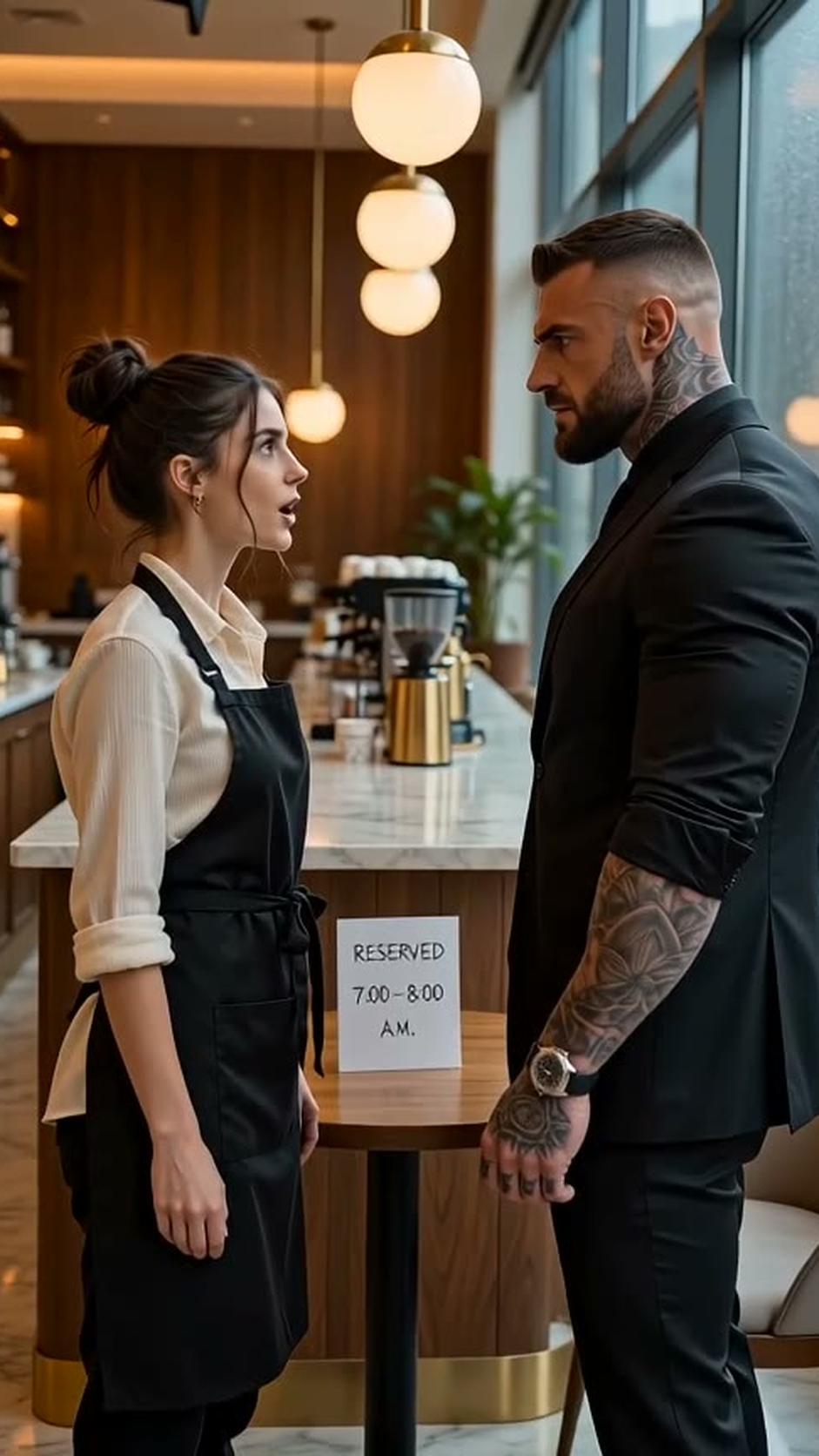
Matteo did not sit at the table. Elena understood later that this was the first thing — the thing Carlo would remember, telling it months afterward in the drivers' canteen with the air of a man describing weather he'd personally witnessed change. The boss had walked into his own café, in his own tower, and been refused his own table by a café worker standing in flour dust, and instead of ending her, he had done the arithmetic of the room: an old man, a map, a boy with a pen, two cold coffees. Work. Real work, the kind his grandfather had built the name on, happening at 7:06 in the morning in a building full of people who billed by the hour and produced by the quarter.
He took his coffee standing at the counter, where he could see the window, and he watched, and the café breathed again in careful sips around him.
Carlo, who missed nothing, watched Elena instead — the steadiness of her hands now that the crisis was past, the way she refilled the old men's cups without being asked, the way she answered the boy Danny's whispered question with two words and a nod toward the map. He also watched the clock, because Carlo watched clocks the way other men watched doors.
At 7:41 Walter Grady folded the map along its old creases, aligned it with the plastic sleeve by touch, and turned in his chair — turned all the way around, deliberately, like a man rotating a gun turret — and looked at Matteo Bellini for the first time.
"You Antonio's boy," Walter said. Not a question.
"I am."
"Your grandfather loaded trucks with my father. Your father knew every route in this city by its first name." The old man's eyes were pale and absolutely unafraid; men who have already lost everything they were ever going to lose acquire a quality that no bodyguard can rent. "He used to sit where you're standing, son. Four in the morning, before the routes went out, with the drivers. Coffee out of a pot you could tar a roof with. He said a route you won't drink coffee over, you don't understand yet."
Something moved through Matteo's face — not softness; Elena would have sworn it was closer to grief, arriving three years late and from a direction he hadn't guarded.
"He died before he could teach me the routes," Matteo said.
"He died before the company let him," Walter said, and turned back to his map, and that was all, and the hour resumed — but it was a different hour now, and everyone in the café knew it, the way everyone in a church knows when the sermon turns.
Carlo came back to the counter at 7:52 with two coffees and the particular expression of a man who has been reading a file that reads back.
"Brooks," he said, low, for his boss's ear only. "Elena Brooks. Twenty-eight. Café staff three years, one written warning — the table. No debts, no record, no affiliations. Lives with her mother in Pilsen. Mother's a widow." He set the coffee down. "Husband was Frank Brooks. Foreman, west warehouse, thirty-one years. Died on shift three winters back — heart attack, moving a trailer at one-forty in the morning in an ice storm, rerouting a convoy by hand so it wouldn't take the lake bridge." A pause the length of a held door. "Company ruled it off the clock, boss. Natural causes, outside assigned duties. No award, no newsletter, no pension adjustment. The determination was signed by a junior operations supervisor named Vance."
The rain made its gray music on the window. Matteo looked at the woman behind the counter, flour on her apron, pouring coffee for old men with the concentration of a person defusing something — looked at her the way he had looked at the map: like a document he had been meant to read years ago, in a building full of people paid to keep him from reading it.
"She's been writing that card," he said, "for the daughter's share of three years. In the lobby of the company that rounded her father down to the hour."
"Yes, boss."
"And this morning she stood between me and that table."
"Yes, boss."
Matteo turned his coffee once on the counter, precisely, the way other men crack their knuckles. "Carlo. Everything Gregory Vance has signed in five years. Everything he's buried, everyone he's separated, every memo that ever went into that office and didn't come out. By tonight."
"Already started," Carlo said, "at seven twenty."
At 8:00 exactly, the doors opened on Gregory Vance, arriving for his own appointment with two consultants, a tablet, and a smile laminated for the occasion.
He saw the table first. He saw Walter, and Hank, and Sal, and Joe, and the card still standing — and Elena saw the smile take the hit and hold, the way a windshield takes a stone: a small white star of damage, professionally ignored.
"Mr. Bellini," Vance said. "You're early. Wonderful — you've seen the floor, then. You've seen—" his eyes went to the window "—line fourteen, as it happens. The unauthorized reservation. I was going to walk you through the figures, but the situation rather presents itself. Premium window seating, occupied daily, unvetted retirees handling live routing documents — Legal has flagged the liability twice. The employee responsible has already been separated, as of yesterday, for exactly this pattern. I took the liberty—"
"Separated," Matteo repeated.
"Terminated. For cause. Miss—" Vance glanced at Elena for the first time, and the glance slid off her like water off glass. "—the young lady was informed Monday. Which makes her presence this morning a security matter, actually. Carlo, perhaps—"
"She's here because I haven't told her to leave," Matteo said, in a voice so quiet that the consultants took an involuntary step back toward the espresso machine. "Sit down, Gregory."
There was no chair. Vance stood, holding the tablet, while the café held its breath, and Elena understood that Paula had been wrong: nobody needed to save her. She had spent three years building the only weapon that could kill Gregory Vance — a room full of truth, in the open, in front of the one man he could not manage — and she had simply had to live long enough to be standing in it.
"Elena," Matteo said. He knew her name. Carlo, of course. Carlo would have known her name, her file, and her blood type by 7:20. "He says there's a liability at that table. Live routing documents. Tell me what the liability is."
So she told him.
She told him about the Cermak underpass — eleven feet posted, ten-eight in fact, floods from the bottom. She told him about forty-one loaded trailers at five o'clock tomorrow morning, and the storm the size of Ohio, and the memo Danny Reyes had submitted through proper channels two weeks ago, and the handwritten appendix Walter Grady had added, and the way both had gone into the office upstairs and never come out. She took the folded safety-line ticket stub from her apron pocket and laid it on the counter. She did not raise her voice once. Three years of pouring coffee in a room where powerful men talked had taught her exactly how much volume truth needs, which is none.
Matteo listened the way he did everything: completely, without moving. When she finished, he looked at Carlo.
"The memo," he said.
Carlo was already on his phone — not calling, reading; Carlo had a quality of attention that made other people's systems confess. "Submission record exists," he said. "Reyes, D. Routing safety memorandum, with attachment, received by the planning office fourteen days ago. Forwarded same day to the Office of the Vice President of Operations." His eyes came up. "Receipt logged. No action recorded. No response recorded. The physical appendix—" he looked at Vance "—would be in that office. Or that drawer."
"Gregory," Matteo said, "is there a safety memorandum in your drawer?"
For the first time in five years of floor walks and quarterly reviews, Gregory Vance's smile ran out of cells to fill. What replaced it was worse — calculation, visible, at speed. "There are hundreds of documents in my office, Mr. Bellini. Staff submit all manner of— if the young man's memo failed to meet the escalation criteria, that's a process question, not— the optimization plan was modeled, it was reviewed, the board—"
"The board," Matteo said, "will be fascinated by the escalation criteria for a drowning."
He turned back to Elena, and his voice changed — not softer, exactly; a man like Matteo did not do softer in public — but lower, and stripped of audience.
"You were terminated yesterday. You came in at six-forty-five this morning anyway. You wrote the card. You protected them in front of me knowing it cost you the last thing it could cost you." It was not quite a question. It was a man checking a sum he had already done and did not believe.
"I protected the hour," Elena said. "The hour is where they keep the company. You asked me this morning how long. I told you the truth."
"Longer than anyone noticed," Matteo said.
"Yes."
He held her gaze a moment longer than a boss holds an employee's, and something in the room's arithmetic changed again — Carlo felt it and filed it, the way he filed everything, for a future he was already quietly revising.
"Mr. Grady." Matteo had turned, with the deliberateness of a man addressing the only other authority in the room. "The plan. If it launches tomorrow as written — tell me what happens. Not the property. The men."
Walter took off his glasses. He had clearly been waiting all morning — all year — for someone with the power to act to ask the question in that order. "First trucks in the water by five-fifteen, son. A loaded trailer in a flooding dip doesn't float and it doesn't stop; it becomes a dam with a man in it. We'd lose drivers in the first hour — how many depends on how many scout cars the software bothered to send, which is none, because the software doesn't know there's anything to scout. After that it's not a logistics event, it's a rescue event, and then it's a funeral event, and then it's lawyers in this café drinking your coffee and explaining to widows what the word optimization means." He put his glasses back on. "Or. You let the people who know the water draw the roads tonight, and tomorrow it's a weather story on page six and nobody dies of a spreadsheet. Those are the doors, Mr. Bellini. Pick one with your eyes open."
Matteo looked at the map for a long moment, at the red X drawn by a younger Walter in a drier century. "Tonight," he said. "Here. Your table, your rules, your map. Carlo will bring you every driver, dispatcher and phone line in this company. What do you need from me?"
Walter considered him with the air of a man appraising a bridge. "Coffee that isn't from a machine a consultant picked. A red pencil that works. And nobody — nobody — gets told to leave my table before the work's done. Including you."
"Agreed," said the owner of Bellini Logistics, and Carlo wrote it down like a treaty.
Then Matteo's phone lit in Carlo's hand — Carlo carried his own and his boss's both — and the weather service banner slid across the screen, and the morning changed a third time.
Carlo read it twice. "Storm's been upgraded," he said. "Landfall off the lake, two a.m. Flood warning now includes the Cermak corridor specifically. They're projecting standing water in the underpass by four-thirty." He looked up. "Trucks roll at five."
"Nobody," Matteo said, "moves a truck tomorrow. Not one. Cancel the launch. Tonight, in person, in the dispatch office — Gregory, give Carlo the authorization codes."
And Gregory Vance, standing in the wreck of his own presentation, with his tablet against his chest like a shield, did the thing Elena would remember when she remembered that good men and bad men are mostly separated by what they do in the ten seconds after they've lost: he reached for the last piece of paper he had.
"The plan was board-approved, Mr. Bellini," he said, with enormous, ruinous calm. "The dispatch automation locked at noon today — it's a sealed launch protocol, designed by your own board precisely so that no single voice can override it in the field. There's no cancellation code in my office, or yours. The system opens for amendment at the Thursday review." His eyes moved, once, involuntarily, to the window table. "The only people alive who ever ran this company's routes around a sealed system did it by hand. On paper. With pencils."
Every head in the café turned, slowly, toward the small wooden table by the window, where four old men sat with their cold coffee and their forty-year-old map, listening to the future arrive in the shape of an apology it hadn't made yet.
Walter Grady took off his glasses and cleaned them, unhurried, with the corner of his handkerchief.
"Well," he said. "Son, you'd better pour us some fresh coffee. We've got a night's work, and the young lady's going to need her job back — because nobody routes this city by hand without the person who keeps the list."