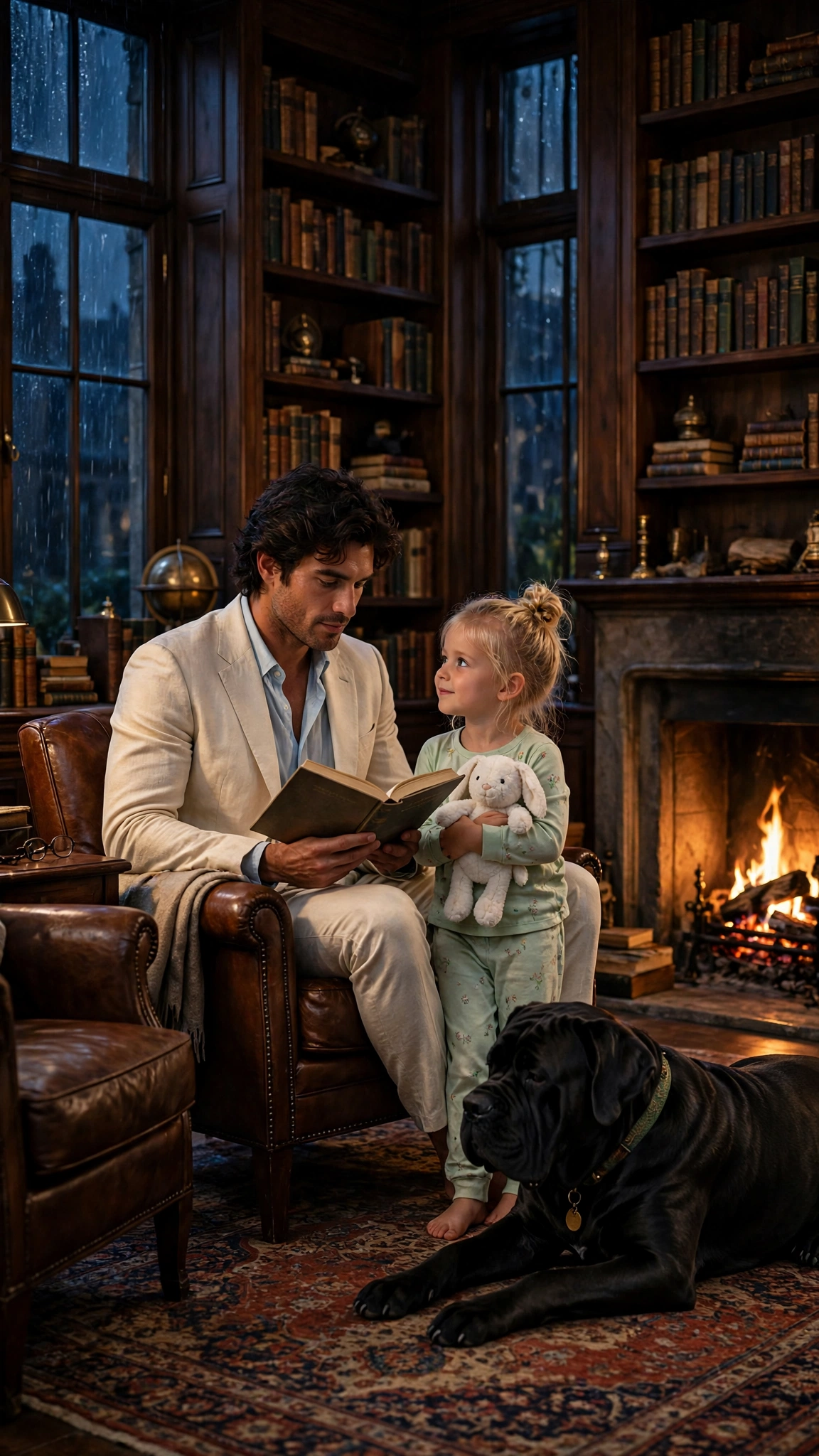
The rain had been falling on the Moretti house since nightfall, and it showed no sign of stopping.
It drummed softly against the tall windows of the library, ran in thin silver lines down the glass, and made the whole dark room feel smaller and warmer by contrast — a pocket of firelight in a cold, wet world. The fire burned low in the marble fireplace. The tall bookshelves stood in shadow, row upon row of old leather spines. The Persian rug glowed deep red under the lamplight. And in the middle of it all, in his leather armchair, Lorenzo Moretti sat reading, the way he did every night, because the library was the only room in the house where no one ever asked him for anything.
He was thirty-six years old, and he was the most feared man in the city, and at eleven o'clock at night he was a man alone with a book, in a cream suit with a light-blue open shirt, his dark wavy hair falling over his forehead, his silver watch catching the firelight every time he turned a page. The tattoos at the edge of his throat showed above his collar. His jaw was hard. His gray-brown eyes were fixed on the page. He had not looked up in an hour.
At his feet, on the rug, lay King.
King was a huge black dog — a Cane Corso, broad as a small bear, with a great square head and intelligent dark eyes and a green leather collar with a small gold tag that caught the firelight when he moved. He had been Lorenzo's dog for four years. He had guarded the gates, and the garden, and the house, and he had never once failed at it. He lay now with his chin on his paws, half asleep, the way he always did in the library at night, because the library was the only room in the house where his master ever truly rested.
The clock on the mantelpiece said eleven. The rain drummed on the windows. The fire popped softly. And then, very quietly, the library door opened.
Lorenzo did not look up. "Rosa," he said, without turning a page. "It is late. Whatever it is, it can wait until morning."
No one answered.
Lorenzo looked up.
In the doorway stood his five-year-old daughter.
Millie Moretti was small for her age, and at eleven o'clock at night she looked smaller still. Her blonde hair was tied up in a little top bun that had come half undone. She was barefoot, her small feet pale against the dark wood of the floor, and she wore her light green pyjamas — the ones with the tiny pattern on them, the ones Rosa had bought her in the spring — and she was hugging something white to her chest with both arms.
It was her bunny. A white stuffed bunny rabbit, soft and old, with one ear that flopped a little lower than the other. Her mother had given it to her. It was the only thing Millie owned that had belonged to her mother first, and she never slept without it, and she never, ever carried it downstairs in the middle of the night unless something was very wrong.
King lifted his great head. His ears rose. He looked at the little girl, and then at his master, and then back at the little girl, and his tail moved once, slowly, against the rug.
Millie took one step into the library. Then another. Her bare feet made no sound on the Persian rug. She stopped a few feet from her father's chair, and she looked at him, and Lorenzo saw that her eyes were wide, and that she was trying very hard not to cry.
"Millie," he said, and he closed his book. "What is it, tesoro? Did you have a bad dream?"
Millie shook her head. She hugged the bunny tighter.
"No, Papa," she said. "Not a dream."
Lorenzo set the book down on the arm of his chair. He leaned forward, his elbows on his knees, and he looked at his daughter the way he looked at problems — carefully, and without blinking.
"Then what?" he asked. "Tell me."
Millie looked down at the rug. She looked at King. She looked at the fire. And then she looked back at her father, and she asked the question she had come all the way downstairs in the dark to ask.
"Papa," she said, soft and earnest. "Can I borrow your dog tonight?"
Lorenzo stared at her.
Of all the things his daughter could have asked him — for a glass of water, for a story, for her mother, for the moon — she had asked him for his dog. His dog, who was lying right there at his feet, who had never once in four years slept anywhere except by his master's side.
"Millie," he said slowly. "King is right here. You can see him any time you like. Why do you need to borrow him tonight?"
Millie's small hands tightened around the bunny. Her voice, when it came, was very small.
"Because I'm afraid, Papa."
Lorenzo felt something cold move in his chest. He had heard his daughter say many things in five years. He had never once heard her say she was afraid — not of the dark, not of thunder, not of the men with guns at the gates, not of anything. Millie Moretti was the bravest person he knew.
"Why are you afraid?" he asked, and his voice was very quiet now. "What are you afraid of, tesoro?"
Millie looked at the tall windows, where the rain ran down the glass in silver lines, and then she looked back at her father, and she said it in a whisper, as if she were afraid the house itself might hear her.
"Someone knocks three times every night."
The fire popped. The rain drummed on the windows. King's ears rose higher.
Lorenzo did not move. "Knocks?" he said. "Knocks where?"
"On my door, Papa," Millie said. "Three times. Knock, knock, knock. Every night. I hear it, and I wait, and nobody comes in, and then it stops, and then I can't sleep, because I keep waiting for it to come again."
Lorenzo looked at his daughter for a long moment. And then he looked at King, who had risen to his feet now, silently, and was standing beside the little girl with his great head level with her shoulder, the way a soldier stands beside the person he has sworn to protect.
"Take him," Lorenzo said.
Millie blinked. "What?"
"Take him." Lorenzo stood up, and he walked over to the great black dog, and he laid his hand on King's broad head. "Take King tonight. He will sleep in your room. He will sleep by your door. And if anyone knocks — anyone at all — he will hear it before you do, and he will not let them in. Do you understand?"
Millie nodded, slowly. She looked at King, who looked back at her with his intelligent dark eyes, and then she looked at her father, and something in her small face changed — not quite a smile, but the beginning of one, the way the sky changes before the sun comes up.
"He looks lonely too," she said softly, looking at the great black dog standing alone by the fire. "That's why I want him, Papa. Not just to protect me. Because he looks lonely too."
Lorenzo looked at his dog. He looked at his daughter. And for the first time in a long while, Lorenzo Moretti understood something about his own house — something he had been too busy, and too proud, and too afraid to see.
They were all lonely. The girl, and the dog, and the man in the chair. They had been lonely together, in the same house, for three years, and none of them had known how to say it.
"Go on, then," he said, and his voice was rough. "Take him to bed, tesoro. And Millie — if you hear the knocking again, you tell King. And in the morning, you tell me. Do you promise?"
"I promise, Papa," Millie said.
She turned, and King turned with her, the great black dog moving silently across the Persian rug, and together — the small barefoot girl in her green pyjamas with her white bunny, and the huge black dog with the green collar — they walked out of the library and up the stairs, and Lorenzo stood alone in the firelight, listening to their footsteps fade, and to the rain on the windows, and to the silence of his house.
Someone knocks three times every night.
He had not known. His daughter had been afraid for weeks, maybe longer, and he had not known. He had been sitting in this room every night, reading his book, while three floors above him, a five-year-old girl lay awake in the dark, listening for a sound that should not have existed, holding a stuffed rabbit that had belonged to her dead mother, too frightened to sleep and too brave to cry.
Lorenzo Moretti, who had faced down killers and judges and rivals without ever once flinching, stood in his library in the middle of the night and felt, for the first time in years, afraid.
And then, slowly, he walked to the tall windows and looked out at the rain, and at the dark garden below, and at the gates, and he thought about the three years since Renata had died, and about the house he had built to keep his family safe, and about the walls he had raised so high that he could no longer see over them.
Somewhere in the dark, beyond the gates, someone was watching his house. Someone had been watching it for weeks. And tonight, for the first time, his daughter had told him the truth about it — not because he had asked, but because she had walked downstairs in her pyjamas, in the middle of the night, and asked him for his dog.
He would find out who was knocking. He would find out tonight. But first, he had to understand how it had started — and for that, he had to go back to the beginning.
It had started, like most things in the Moretti house, with a death, and a silence, and a little girl who learned too young how to be brave alone.
—
Three years earlier, on a rainy night in November, Renata Costa Moretti had gone out to fetch medicine for her two-year-old daughter, who was burning with fever, and a truck had run a red light on the wet road near the harbor, and she had never come home.
Lorenzo had been in his study when the telephone rang. He remembered the sound of it — a small, ordinary sound, the kind of sound that had no business changing a man's life. He remembered the policeman's voice. He remembered the rain on the windows. He remembered walking upstairs to his daughter's room and standing in the doorway, looking at the small sleeping child with the fever-flushed cheeks, and understanding, with a terrible clarity, that he was now the only person in the world standing between her and everything that could hurt her.
He had not cried. Not then. He had gone downstairs, and he had poured himself a drink he did not touch, and he had sat in the library until morning, staring at the fire, and he had made himself a promise: no one would ever hurt his daughter. No one would ever take her from him. He would build a wall around her so high and so strong that nothing — not rivals, not strangers, not the world itself — could ever reach her again.
He had kept that promise. He had doubled the men at the gates. He had put cameras on every wall. He had taught his guards to check every visitor, every delivery, every shadow. He had turned his house into a fortress, and his daughter into a secret kept inside it, and he had told himself that safety was the same thing as love.
It was Rosa who knew better.
Rosa was the housekeeper — a warm, dignified woman in her late forties, with dark hair tied in a neat bun, who had worked in the Moretti house for twenty years and had known Renata since they were girls together in the old neighborhood. Rosa had held Millie's hand through her first fever. Rosa had taught her to tie her shoes. Rosa had sat with her on the nights when she cried for a mother she could barely remember. Rosa did not need thanks. Rosa needed only to be allowed to stay.
She had never once asked Lorenzo for anything. She had simply stayed, and cooked, and cleaned, and brushed Millie's hair, and been there — the way some people are there, quietly, for years, without ever making a fuss about it.
It was Rosa who had given Millie the bunny, on the first anniversary of Renata's death. She had found it in a drawer, wrapped in tissue paper, with a small card in Renata's handwriting: "For my little bird, when she is old enough." Renata had bought it before Millie was born, for a baby she had not yet met, and Rosa had kept it for three years, waiting for the right day. And on that day, she had laid it in Millie's small hands, and Millie had held it to her chest, and she had not let go of it since.
"Your mama picked this out for you," Rosa had said, very gently. "Before you were born. She wanted you to have something soft to hold, for the nights when she could not be there to hold you herself."
Millie had not cried. She had simply nodded, and hugged the bunny, and whispered, "Thank you, Mama," to the empty room, and gone to sleep with it under her chin.
From that night on, the bunny went everywhere Millie went. It sat beside her at breakfast. It rode in the car. It watched from the pillow while she did her lessons. And at night, when the house went dark and the rain came down on the windows, Millie held it tight, and it was the closest thing in the world to her mother's arms.
Lorenzo did not know about the bunny's story. He had never asked where it came from. He had seen it a hundred times and thought nothing of it — a toy, like any other toy. He had not known that his dead wife had chosen it, or that Rosa had kept it for three years, or that it was the one thing in the house his daughter trusted completely.
He did not know many things about his own house. That was the problem. Lorenzo Moretti knew everything about his enemies — their names, their territories, their weaknesses, their debts — and almost nothing about the small, quiet life going on upstairs in his own home.
He did not know, for example, that Millie had stopped sleeping through the night.
It had started about a month ago, in the middle of October, when the nights grew longer and the rain came more often. At first, it was nothing — a sound, half heard, on the edge of sleep. A tap against glass. A knock against wood. Millie would wake, and listen, and hear nothing, and tell herself it was the rain, or the wind, or the old house settling in the cold. She would hold her bunny tighter, and close her eyes, and go back to sleep.
But the sound came again. And again. And each time, it was the same: three knocks, slow and deliberate, like someone knocking on a door and waiting for an answer. Knock. Knock. Knock. And then silence.
Millie began to dread the dark. She began to lie awake, staring at the ceiling, counting the minutes, waiting for the sound. She stopped eating her breakfast properly. She stopped playing in the garden. Rosa noticed — Rosa noticed everything about Millie — and she asked her, gently, what was wrong, and Millie, who had been raised to be brave and to never make a fuss, said, "Nothing, Rosa. I'm fine."
She was not fine. She was five years old, and she was afraid every night, and she did not know how to tell anyone, because the adults in her life were busy, and because the thing she was afraid of sounded impossible when she said it out loud.
Someone knocks three times every night.
It sounded like a story. It sounded like something a child would make up. Millie knew that. So she kept it to herself, and she held her bunny, and she waited, night after night, for the knocking to come, and for the knocking to stop, and for the morning to come and make it all seem like a dream.
Until tonight. Tonight, she had finally done the bravest thing she had ever done: she had gotten out of bed, in her pyjamas, in the dark, and walked downstairs to the library, to ask her father for his dog.
Because King was the only one in the house who was bigger than the fear.
That was how it started. A little girl, a stuffed bunny, a black dog, and three knocks in the dark. And a father who had spent three years building walls, and who was about to learn that the walls had never been the problem — and that the answer had been lying at his feet all along, with his chin on his paws, waiting to be asked.