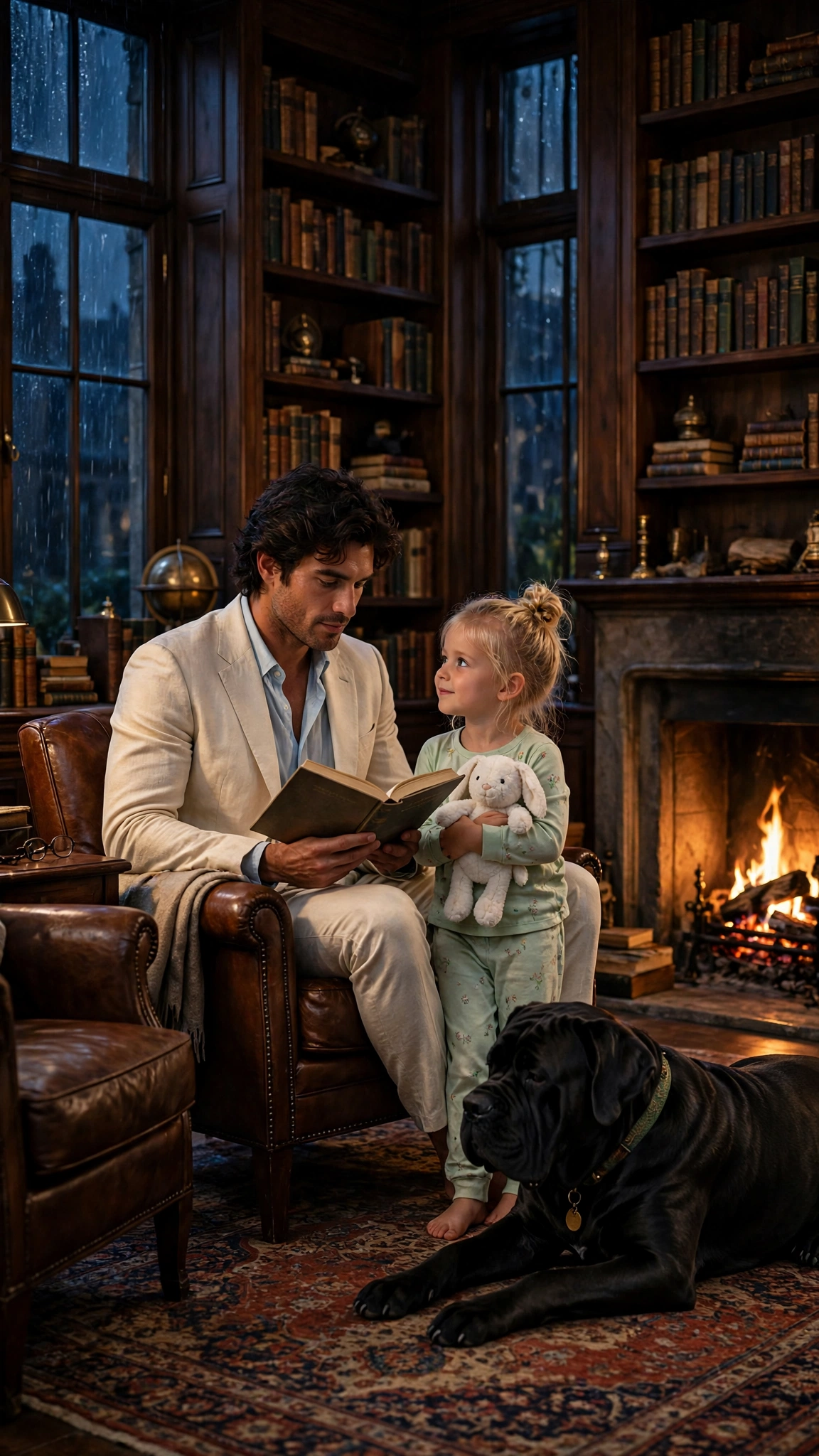
The Moretti house sat on a hill above the city like a ship above the sea, and from its terrace you could see everything Lorenzo Moretti owned: the gardens, the gates, the long drive lined with cypress trees, and beyond that, the rooftops of the town, and beyond that, the harbor, gray-blue in the morning light.
Lorenzo had bought the house when Millie was born, because Renata had wanted a garden, and a room with windows on three sides for the baby, and a library with a fireplace where they could read together on winter nights. He had filled it with everything money could buy — marble floors, tall windows, a dining room that could seat thirty people — and yet, in the three years since Renata's death, the house had felt less like a home and more like a headquarters. Men came and went at all hours. Telephones rang in the night. Guards stood at the gates in all weather. And Lorenzo, who had once been a young man who laughed easily, had become a man who checked the locks twice and trusted almost no one.
He did not like that about himself. He simply did not know how to be any other way.
On the morning after the night in the library — the night Millie had come downstairs in her green pyjamas and asked him for his dog — Lorenzo stood at his study window with a cup of black coffee and watched the rain wash the garden. King was not at his feet. King was upstairs, in Millie's room, lying across the threshold of her door like a wall made of muscle and fur, exactly where Lorenzo had told him to lie. Lorenzo had gone up himself, after Millie had fallen asleep, and looked in on them: his daughter curled on her side with the white bunny under her chin, and the great black dog stretched across the doorway, his eyes open, watching the dark corridor. Lorenzo had stood there for a long time, and he had thought about how strange it was that a dog understood his daughter better than he did.
King had come to the house four years ago, when Millie was one year old and Renata was still alive. Lorenzo had brought him home himself — a tiny black puppy, no bigger than a shoe, with oversized paws and a green collar that was far too big for him. He had bought him from a breeder in the hills, a man who raised Cane Corsos for guard work, and he had chosen the biggest pup in the litter, the one with the broadest head and the calmest eyes.
"For protection," Lorenzo had told Renata, when she laughed at him for bringing home a puppy the size of a loaf of bread and calling it a guard dog. "When I am not here, someone has to watch over you."
Renata had picked the puppy up and held him against her cheek, and the puppy had licked her chin, and she had said, "He is going to be enormous, Lorenzo. He is going to be the biggest dog in the whole city, and Millie is going to ride him like a horse."
She had been right about the enormous part. King had grown into a dog so large that visitors stepped back when he rose to his feet. His head came up to Millie's waist. His shoulders were as broad as a man's. But he had never once frightened Millie. From the time she could walk, King had followed her everywhere — to the garden, to the kitchen, to the library — moving silently on his great paws, lying down whenever she stopped, watching her with those intelligent dark eyes, as if he had been given a single job in the world and had decided to do it perfectly.
Lorenzo had not trained him to do that. No one had. King had simply decided, the way some dogs decide things, that the little girl was his.
It was Rosa who had first noticed it. Rosa was the housekeeper, a warm, dignified woman in her late forties, with dark hair tied in a neat bun and a simple dark uniform with a white apron, who had worked in the Moretti house for twenty years. She had known Renata since they were girls together in the old neighborhood, two friends with dark hair and quick laughs, sharing a bedroom and a bicycle and every secret. When Renata married Lorenzo, Rosa had come to work in the big house because her friend had asked her to, and when Renata died, Rosa had stayed — not because Lorenzo had asked her to, and not because of the wages, which she could have earned anywhere — but because someone had to raise Millie, and there was no one else in the world Rosa trusted to do it.
She had never told Lorenzo any of this. She had never asked for thanks. She had simply stayed, and cooked, and cleaned, and brushed Millie's hair, and sat with her on the nights when she cried for a mother she could barely remember. Rosa did not need thanks. Rosa needed only to be allowed to stay.
That morning, while Lorenzo stood at his study window, Rosa was in the kitchen, kneading bread dough with strong, practiced hands, and thinking about the little girl upstairs, and about the dog lying across her doorway, and about the question she had been carrying for a month and had not yet dared to ask.
She had noticed the change in Millie first. It had started small — the child eating less at breakfast, pushing her food around her plate, her eyes heavy in the morning, as if she had not slept. Then Rosa had noticed the dark circles under Millie's eyes, and the way she flinched at sudden sounds, and the way she had stopped going into the garden alone. A child who had once run everywhere now walked close to the walls, and stayed near the house, and looked over her shoulder at the gates.
Rosa had asked her, gently, what was wrong. And Millie, who had been raised to be brave and to never make a fuss, had said, "Nothing, Rosa. I'm fine."
Rosa had not believed her. Rosa had raised a child of her own, years ago, in another life, before she came to this house — a boy who had died young, of a fever, in a winter that Rosa never spoke about — and she knew the look of a frightened child the way other people knew the look of rain coming. She had watched Millie for a month, and she had waited for the child to tell her the truth, and last night, at last, Millie had told the truth to someone. Not to Rosa. To her father. And to a dog.
Rosa wiped her hands on her apron and went to the foot of the stairs. She could hear nothing from above — no crying, no footsteps, only the soft patter of rain on the roof. She stood there for a moment, listening, and then she went back to the kitchen, because there was bread to bake and a house to run, and because the men in this house did not like questions from the staff, even when the questions were the right ones.
Upstairs, in her room, Millie was awake.
She had woken early, as she always did now, because she had learned not to sleep deeply. She lay in her bed with the bunny under her chin, listening to the rain, and to the soft breathing of the great black dog across her doorway, and she felt, for the first time in a month, something she had almost forgotten how to feel.
Safe.
It was a strange word. She had not thought about it before. She had always been safe — Papa's house was the safest place in the world, everyone said so, with its walls and its gates and its guards — but safety, she was beginning to understand, was not the same as feeling safe. Safety was a wall. Feeling safe was a dog lying across your door, and a father who had listened, and a bunny that had belonged to your mother.
She looked at King, lying in the doorway with his great head on his paws, his green collar catching the pale morning light, and she thought about what she had said to her father last night: "He looks lonely too."
She had not planned to say it. It had simply come out, the way true things sometimes do, without asking permission. And it was true. King was lonely. She had seen it for a long time — the way he lay alone in the library every night while Papa read his book, the way he watched the door, the way he followed her everywhere during the day as if she were the only person in the house who ever really looked at him. King was a guard dog, and guard dogs were supposed to be alone, but Millie knew better. King was not lonely because he was a guard dog. He was lonely because, like her, he spent his nights waiting for someone to need him.
She slipped out of bed, very quietly, so as not to wake him, and she padded across the room on her bare feet, and she knelt down beside the great black dog, and she put her small hand on his broad head. King opened one eye, and looked at her, and his tail moved once, slowly, against the floor.
"Good morning, King," Millie whispered. "Did you hear it last night? The knocking?"
King's ears rose. He looked at the door, and then back at her, and Millie understood, in the wordless way children sometimes understand animals, that he had heard it. He had heard it every night, the way she had. And he had done nothing about it, because no one had told him to. Because no one had ever asked him to guard her door.
"Thank you," Millie whispered, and she pressed her cheek against his great head, and King sighed, a deep, contented sigh, and closed his eyes again.
Downstairs, Lorenzo finished his coffee and went to find Enzo.
Enzo Bianchi had been Lorenzo's right hand for fifteen years. He was a big, quiet man in his fifties, with gray in his hair and a scar through one eyebrow, and he was the only man alive whom Lorenzo trusted completely. When Lorenzo gave an order, Enzo carried it out without questions, and that was exactly why, on that morning, Lorenzo did something he had never done before: he asked Enzo what he thought.
"Enzo," Lorenzo said, "my daughter tells me someone knocks three times on her door every night. What do you think?"
Enzo was silent for a moment. He looked at his boss, and he looked out the window at the rain, and he thought about the house he had guarded for fifteen years, and about the things he had seen, and the things he had not seen, and he chose his words carefully.
"I think," Enzo said slowly, "that a five-year-old child does not invent a sound like that. And I think that if a dog growls at a door every night, there is something on the other side of it."
Lorenzo nodded. "Then find out what it is. Quietly. I don't want men stomping through the house and frightening her more. Check the doors. Check the windows. Check the garden door at the back — the old one, by the terrace. I want to know if anything has been moved, or left behind, or opened."
"Understood," Enzo said.
"And Enzo," Lorenzo said, "one more thing. From tonight, King sleeps in Millie's room. That is an order. If anyone asks, the dog is on duty."
Enzo's eyebrows rose, just slightly. In fifteen years, Lorenzo Moretti had never once given an order about a dog. "Understood, sir," he said, and he went to carry it out.
That day passed slowly, the way rainy days do in a big house. Millie did her lessons at the kitchen table with Rosa, practicing her letters in a workbook, the bunny sitting on the chair beside her like a small, silent classmate. King lay at her feet, his great head on the tiles, his eyes half closed, and every so often he would lift his head and look at the door, and his ears would rise, and then he would settle again.
In the afternoon, the rain stopped, and the sun came out for an hour, pale and watery, and Rosa let Millie go into the garden, with King beside her, to look at the roses. Millie walked the paths slowly, holding the bunny in one arm and King's collar in the other hand, and she thought about the night before, and about her father's face when she had told him the truth, and about the way he had said, "Take him," without hesitating, without asking her to explain, without telling her she was imagining things.
Papa had believed her. That was the thing. Papa had believed her, and he had given her his dog, and that was the first time in a month that Millie had felt like the world made sense.
She did not know, as she walked in the garden with her dog and her bunny, that below her window, in the library, the tall glass terrace doors stood open a crack, the way they always did, because the latch had been loose for years and no one had ever thought to fix it. She did not know that Enzo's men were already walking the grounds, looking for footprints in the wet earth. She did not know that her father was sitting in his study, staring at a photograph of her mother, and thinking about the night Renata had died, and about the three years he had spent building walls, and about the fact that the walls had never once kept his daughter from being afraid.
She knew only that tonight, when the dark came, King would be lying across her doorway, and that was enough.
That evening, after supper, Lorenzo did something he had not done in three years: he went to the library early, and he did not bring a book. He sat in his leather armchair, in his cream suit, and he waited. King came with him, and lay down by the fireplace, and Lorenzo watched the fire burn, and listened to the rain begin again on the windows, and thought about his daughter upstairs, and about the knocking, and about the man he had been for three years — a man who checked locks, and gave orders, and trusted no one, and called that love.
At ten o'clock, Rosa came to the library door with a cup of tea. She set it down on the small table beside Lorenzo's chair, and she stood there for a moment, and Lorenzo, who had never once asked Rosa for her opinion about anything, looked up at her and said, "Rosa. Do you think she is really hearing something?"
Rosa looked at him for a long moment. She had known this man for twenty years. She had watched him grieve, and work, and build his walls. She had never once seen him ask for help.
"Yes, Mr. Moretti," she said quietly. "I think she is. Children hear what we have trained ourselves not to hear. And I think that dog has been hearing it longer than she has."
Lorenzo nodded slowly. "Thank you, Rosa."
Rosa turned to go, and then she stopped, and she said, very softly, "She is a brave little girl, sir. Braver than most grown men I have known. She came downstairs in the dark to ask you for help. That is not a small thing."
"No," Lorenzo said. "It is not."
When Rosa had gone, Lorenzo sat alone in the library, listening to the rain, and he thought about bravery — about the bravery of a five-year-old girl who walked downstairs in her pyjamas to ask for a dog, and about the bravery of a woman who had stayed in a house for twenty years without ever asking for thanks, and about the bravery of a dog who had lain across a doorway all night without being told to, because he had decided, on his own, that a little girl was his to protect.
He had spent three years believing that strength meant never bending, never yielding, never admitting he was wrong. Now he understood that his five-year-old daughter had been braver than he was, because she had told the truth, and his dog had been wiser than he was, because he had stayed, and his housekeeper had been stronger than he was, because she had loved a child without ever asking to be loved back.
At eleven o'clock, the clock on the mantelpiece struck the hour. The fire burned low. The rain drummed on the windows. And in the library, in the dark, Lorenzo Moretti sat in his cream suit and waited for the knocking to come.