The next morning, Millie woke up early, and the first thing she did was check that King was still there, lying across the foot of her bed, warm and breathing. The second thing she did was run to the window and look out at the garden, where the sun was coming up over the cypress trees, and where her papa was standing by the fountain with a cup of coffee, looking up at her window and smiling.
She waved. He waved back. And Millie Moretti, who was five years old, and who had a dog, and a bunny, and a papa who was learning to listen, thought that the world was, after all, a very good place to be.
That day, Lorenzo did something he had not done in three years: he stayed home.
He did not go to his office. He did not take telephone calls. He did not meet with men in suits who spoke in low voices about territories and debts and harbors. Instead, he spent the day with his daughter, and he learned things about her that he had never known — that she liked her toast with honey, and that she was learning to read, and that she had a favorite spot in the garden, under the lemon trees, where she liked to sit with King and tell him stories.
He learned that she was afraid of thunderstorms, but only a little, and only when they were very loud. He learned that she had a secret collection of smooth stones, which she kept in a box under her bed. He learned that she had taught King to sit, and to stay, and to shake hands, all by herself, with pieces of cheese from the kitchen. He learned that she had a laugh like a bell, and that she had not laughed like that in a month, and that he had not noticed.
He learned, in short, that he had a daughter, and that he had been living in the same house as her for five years without ever really knowing her.
At breakfast, Millie asked him questions. She asked them the way children ask questions when they have been saving them up for a long time — one after another, without waiting for the answers to settle.
"Papa, why did the man knock?" she asked, swinging her legs under the table. "What did he want?"
"He was paid to watch our house," Lorenzo said simply. "Some men do bad things for money. But he is gone now."
"Will he come back?" Millie asked.
"No," Lorenzo said. "Because now he knows we are watching. And because King is watching too."
Millie thought about this, chewing her toast. "Does King know he did a good job?"
Lorenzo looked at the great black dog, who was lying at Millie's feet with his chin on her shoe, and he smiled — a real smile, small and rueful, the first one Rosa had seen on his face in days.
"I think he does, tesoro," Lorenzo said. "I think he has always known. He was just waiting for someone to tell him."
Rosa, clearing the plates, stopped beside the table, and she said, very gently, "Your mama used to read in the library every night, you know. It was her favorite room in the whole house. She would sit in the big chair with a book, and she would read until the fire burned low, and sometimes she would fall asleep there, with the book open on her chest, and your papa would carry her upstairs to bed."
Millie looked up at her, her eyes wide. "Did Mama read to me? When I was a baby?"
"Every night," Rosa said. "She read to you before you could understand a single word, because she said that a baby who hears stories grows up brave. And she was right, sweetheart. Look at you."
Millie was quiet for a moment. Then she said, very softly, "I don't remember her voice, Rosa. I try, but I can't remember it."
Rosa put her hand gently on the little girl's shoulder. "You don't have to remember her voice, sweetheart. You carry her in other ways. In the way you hold your bunny. In the way you ask questions. In the way you are brave. That is your mama, living in you. She is not gone. She is just — quieter now."
Millie nodded slowly, and she went back to her toast, and Lorenzo, watching them, felt something loosen in his chest that had been tight for three years.
At midday, Enzo came to the study with his report. The gap in the hedge had been repaired. The terrace doors had been fitted with a new lock. The old service door at the back of the house had a new lock too. And the Ferraro family's men had not been seen in the town for days — not since the night on the terrace, not since the message had been delivered.
"They have gone quiet again, sir," Enzo said. "I think they understand now. The house is guarded. The girl is protected. They will not come back."
Lorenzo nodded slowly. "Good. But keep the men on the terrace for another month. I want this house watched until I am sure."
"Yes, sir."
When Enzo had gone, Lorenzo opened the drawer of his desk and took out a small photograph, creased and soft at the edges. It showed Renata, laughing, holding a baby Millie in her arms, standing in the garden by the fountain. Behind them, half out of frame, was the library windows, and in the reflection of the glass, just barely visible, was a young Lorenzo, watching them, smiling.
He looked at it for a long time. Then he put it back in the drawer, closed it gently, and went to find his daughter.
That afternoon, after lunch, Lorenzo took Millie into the library, and he sat her down in the leather armchair — his chair, the one no one else was ever allowed to sit in — and he knelt down beside her, so that their faces were level, and he told her the truth.
Not all of it. Some truths are too heavy for small shoulders. He did not tell her about the Ferraro family, or about the harbor road, or about the men who had watched their house for a month, or about the things his world demanded of him. He told her the part she needed to hear, in words a five-year-old could carry.
"Millie," he said, "do you remember the knocking?"
Millie nodded, her small hands tightening around the bunny.
"The knocking was a man," Lorenzo said. "A man who was paid to watch our house and to frighten us. He knocked on our doors to see if anyone was watching. But we were watching, tesoro. You were watching. King was watching. And last night, I caught him, and I sent him away, and he will not come back. Do you understand?"
Millie nodded slowly. "Was he a bad man, Papa?"
"Yes," Lorenzo said. "He was a bad man. But he is gone now. And the reason he is gone is because you were brave. You came downstairs in the dark and you told me the truth, and because you told me the truth, I was able to protect you. Do you understand what I am saying, tesoro? You protected this house. Not me. You."
Millie looked at him for a long moment, and then, slowly, she smiled — a small, proud smile, the smile of a child who has just been told that she is brave, and who believes it, because her father has said it, and her father does not lie.
"Good," she said. "I am glad I told you, Papa."
"So am I," Lorenzo said. "And from now on, Millie, I want you to tell me everything. If you hear a sound, you tell me. If you are afraid, you tell me. If you have a question, you ask me. Do you promise?"
"I promise, Papa," Millie said.
"And I promise you something too," Lorenzo said. "I promise that from now on, I will listen. I have not been listening, tesoro. I have been busy, and I have been proud, and I have been afraid, and I have not listened to the people I love most in the world. That is going to change. Starting tonight."
That evening, after supper, Lorenzo did something new: he went to the library early, and he brought Millie with him.
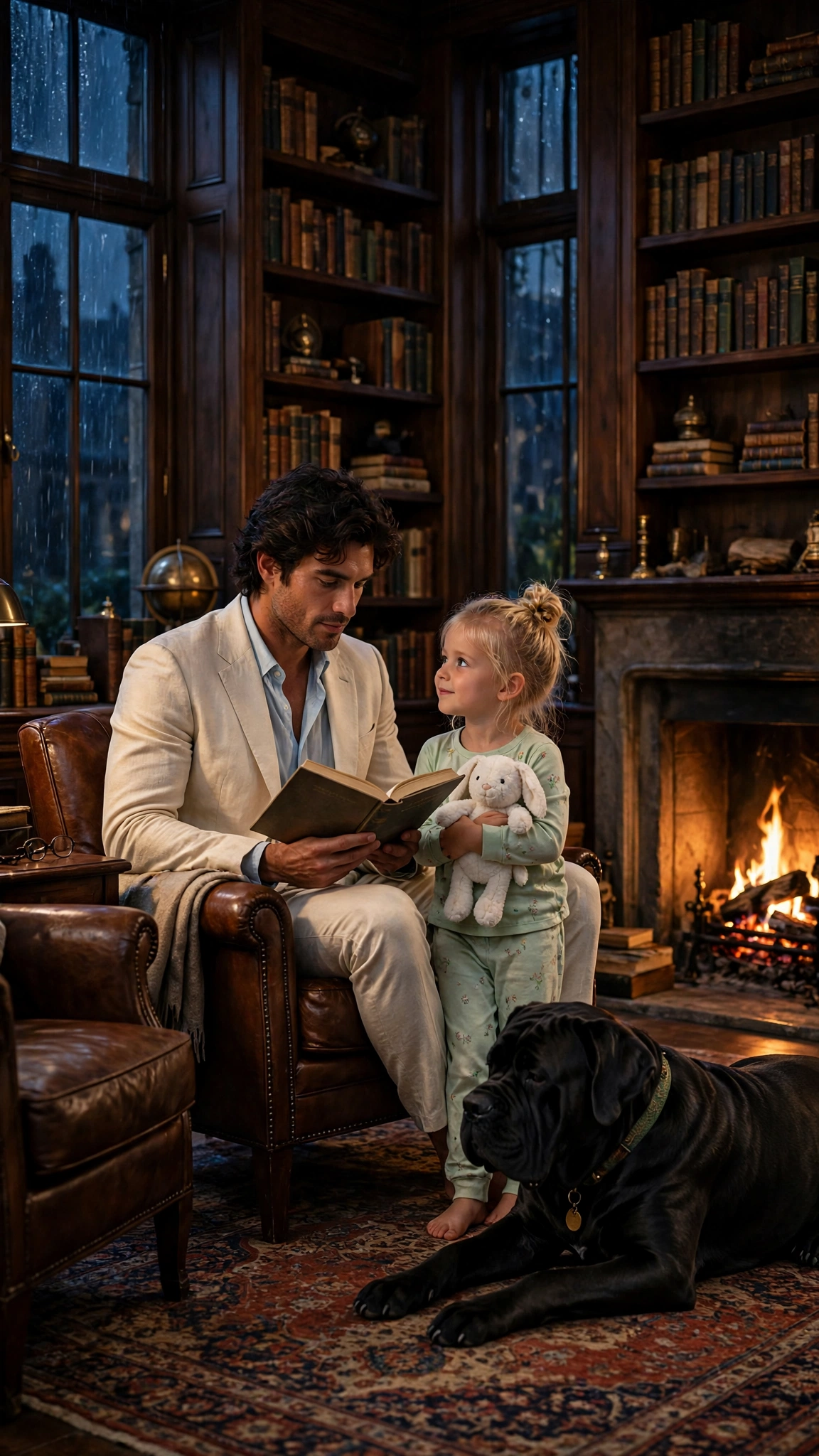
He sat in his leather armchair, in his cream suit, and he put Millie on his lap, with the bunny in her arms and King lying at their feet, and he opened a book — not his book, but hers, a book of fairy tales with pictures of dragons and castles and brave little girls — and he read to her, slowly, in his deep voice, while the fire burned low and the rain drummed softly on the windows.
Millie listened with her head against his chest, and King listened with his chin on his paws, and Rosa, passing the library door with a tray of tea, stopped and looked in, and saw the three of them — the mafia boss, the little girl, and the great black dog — sitting together in the firelight, and she felt her eyes sting, because she had worked in this house for twenty years, and she had never once seen anything like it.
She set the tea down quietly, so as not to disturb them, and she went back to the kitchen, and she stood there for a moment with her hands on the counter, breathing slowly, thinking about her friend Renata, who had once told her, "If you love someone, you tell them the truth, even when it is hard. Especially when it is hard." Renata had been braver than anyone Rosa had ever known. And now, Rosa thought, her daughter was braver still.
Upstairs, later that night, Lorenzo carried Millie to bed himself — something he had not done in months — and he laid her down gently, and he pulled the blankets up over her shoulders, and he sat on the edge of the bed for a while, watching her breathe, the way he had done every night since she was born.
"Papa?" Millie murmured, half asleep. "Will King stay in my room? Forever?"
"Forever," Lorenzo said. "I promise. From tonight, King's bed is in your room. That is an order. If anyone asks, the dog is on duty."
"And will you read to me again tomorrow night?" Millie asked.
"Every night," Lorenzo said. "I promise you that too."
Millie smiled in her sleep, and her small hand tightened around the bunny, and Lorenzo bent down and kissed her forehead, and whispered, so softly that only the sleeping child and the dark room could hear him, "Goodnight, my little bird. Papa loves you. Mama loves you. And we will always, always stay."
He stood up, and he went to the door, and he looked back one more time at the small, peaceful scene: his daughter asleep in her green pyjamas, the bunny under her chin, and the great black dog lying across the foot of the bed like a guardian, his eyes half open, watching over them both.
Downstairs, Rosa was in the kitchen, making tea. King would come down later, when Millie was deeply asleep, to check on things, the way he always did. And outside, the rain drummed on the windows, and the house on the hill glowed warm in the dark, like a ship that had finally found its way home.
Lorenzo Moretti, the most feared man in the city, went downstairs to have tea with his housekeeper, and to plan a new bed for a dog, and to learn, at thirty-six years old, how to be a father.
He had spent three years believing that strength meant never bending, never yielding, never admitting he was wrong. Now he understood that his five-year-old daughter had been braver than he was, because she had walked downstairs in her pyjamas in the middle of the night and told the truth, and his dog had been wiser than he was, because he had stayed, and his housekeeper had been stronger than he was, because she had loved a child without ever asking to be loved back.
He looked at the library, at the leather armchair where he had sat every night for three years, reading his book, alone, and he thought about how strange it was that the answer had been lying at his feet all along, with his chin on his paws, waiting to be asked.
From that night on, the library was never empty again. Every evening, after supper, Lorenzo would go to the library with Millie on his lap and King at their feet, and he would read to her until she fell asleep, and then he would carry her upstairs to bed, and King would follow behind them like a shadow, and Rosa would come up later with a cup of warm milk, and the house would go quiet, and the rain would fall on the windows, and the family — the small, strange, brave family of a mafia boss, a little girl, a housekeeper, and a great black dog — would sleep in peace, knowing that someone was always watching over them.
And the knocking never came again.