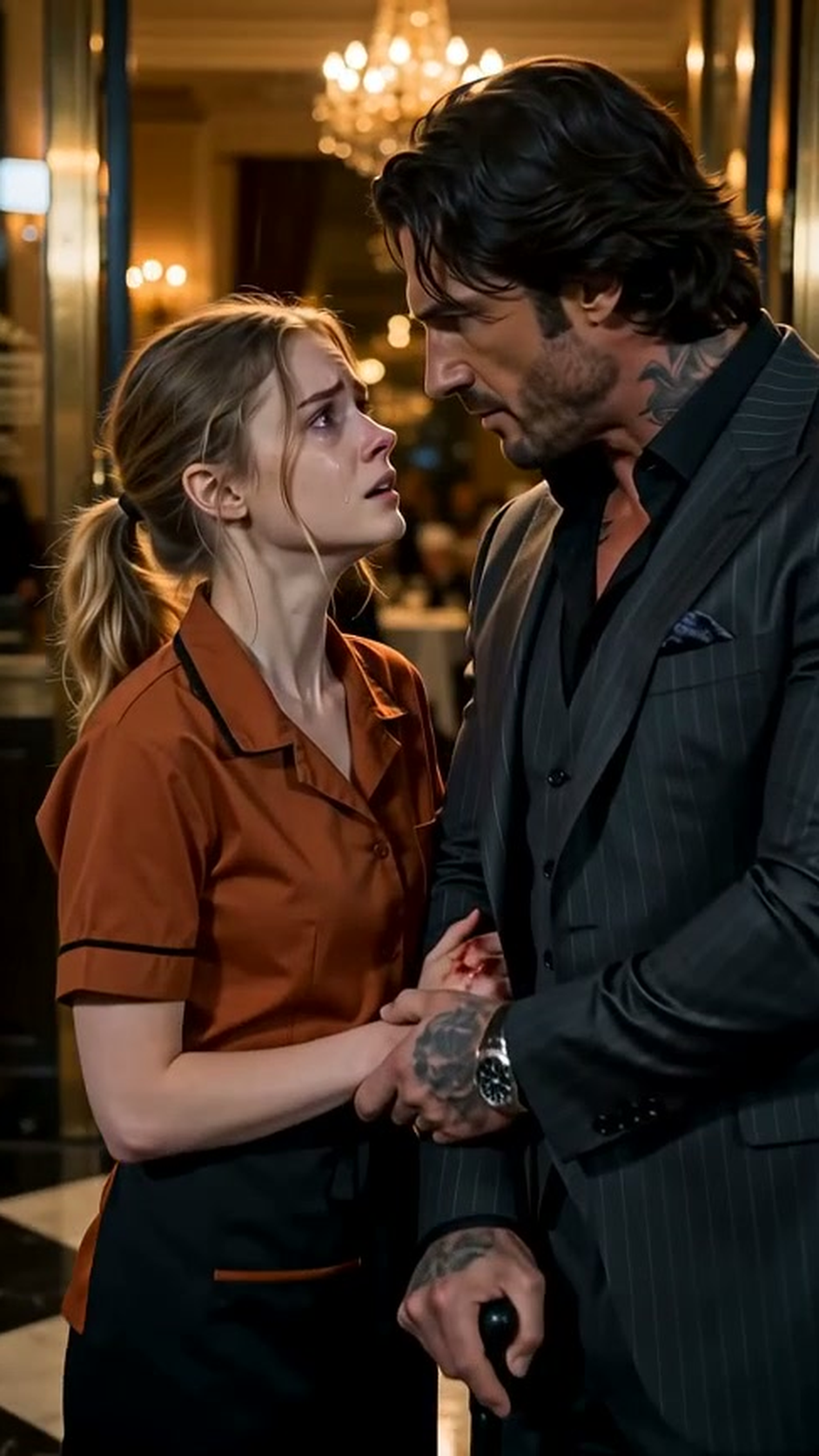
"You're fired. Get out!"
The words cracked across the marble entrance of Laura like a gunshot.
Rain hammered the awning above the most expensive French restaurant in New York, turning the pavement into black glass, and Naen Walker stood in the golden spill of its doorway with her eyes lowered and her whole body trembling. Her rust-orange waitress blouse was damp at the shoulders. Her black apron was still tied at her waist. And on her hands — hands she kept twisting together in front of her like she could hide them — were the faint, rust-brown traces of another man's blood.
David Kesler, the manager of Laura, stood over her with his finger leveled at her face like a weapon. Fifty-two years old, silver combed flat, burgundy tie knotted like a noose, he had the satisfied expression of a man who enjoyed doing this in public. Behind him, through the brass-framed doors, waiters froze mid-step. Two chefs in tall white hats exchanged a look and then suddenly found the floor very interesting.
"Please," Naen whispered. Her fingers, desperate and unthinking, caught the edge of the dark pinstripe sleeve beside her — the sleeve of the tall stranger standing at her shoulder, leaning on a black cane, one leg wrapped from ankle to knee in a thick white bandage. "Please… my little boy needs medicine."
The stranger's pale-gray eyes moved to David. Slowly — the way a tide turns, the way a storm decides — Roman shifted his weight on the cane and stepped between the manager and the girl, and his arm settled around her shoulders with the weight of a fortress wall.
"Don't speak to her like that," he said. His voice was low. It was not loud. It did not need to be.
David's laugh was ugly. "And who exactly are you?"
The camera of that moment — if God Himself had been filming — would have pushed in slowly on the stranger's face: the rugged jaw tightening, the tattoos curling like smoke up the side of his neck, the eyes going the color of a winter sea. He adjusted his grip on the cane. He looked at David Kesler the way a man looks at something already dead.
"The man who owns this restaurant."
David's pointing hand fell as if the bones had left it. All the color ran out of his face at once. "Mr. Roman… I didn't know."
But Roman was no longer looking at him. He had turned, gently, to the shaking girl at his side — and his face, that terrifying face, softened into something that made her heart stop altogether. Because now, finally, she recognized him too. The rain. The alley. The blood soaking through her fingers. The stranger she had held together with her own two hands, twelve hours and a lifetime ago.
He covered her trembling hand with his, warm and steady.
"You saved my life," Roman said softly. "Now let me save yours."
— TWELVE HOURS EARLIER —
The day Naen Walker almost lost everything began with a thermometer reading 101.8 and her son's small, hot hand wrapped around two of her fingers.
"Mommy," Leo mumbled, "the room is swimmy."
"I know, baby. I know." She pressed the cool washcloth to his forehead the way she had been doing since four in the morning, in the twenty-minute spaces between dozing upright in the kitchen chair. The apartment on the fourth floor of the walk-up in Astoria was one room pretending to be two, and it smelled faintly of the chicken soup she'd stretched from one carcass and a prayer. On the counter sat the enemy she'd been fighting all week: an orange pharmacy bag containing exactly nothing, because the pharmacy bag was empty, and beside it an inhaler that rattled with maybe — maybe — six puffs.
Six puffs between her five-year-old and the emergency room.
The clinic had said ear infection, both ears, and a chest that worried them. The prescription — antibiotics, a fever reducer that actually worked, and a refilled inhaler — came to ninety-four dollars and change. Naen had thirty-one dollars in her checking account, a uniform shift at Laura that started at five, and a landlord who had already slid one pink notice under her door this month like a valentine from hell.
Thomas had been dead four years this November. A paramedic — twenty-two years of other people's worst days survived in one piece, and killed in the end not by any of them but by black ice on the BQE, on a clear night, driving home. The pension was a widow's pension, which is to say a rumor of one. The life insurance was the kind a twenty-four-year-old buys because the man at the kitchen table won't leave without a signature, which is to say almost none at all. What Thomas had actually left her was Leo, a wedding ring she'd migrated to a chain when her fingers got too thin for it, and a talent — his talent, she'd absorbed it by osmosis over six years of marriage — for holding pressure on things that were bleeding and not panicking. Keep the pressure. Watch the clock. Talk to them so they stay. She had used it exactly once since the funeral, on a stranger's dog hit by a delivery bike. It had lived. She thought about that dog more often than she admitted.
Laura had been her miracle and she knew it. Four years ago she'd walked in off the street with a résumé printed at the library and a three-month-old in a carrier, and the manager before David — an old Frenchman named Besson who ran the place like a cathedral and had a soft spot the size of the Hudson for people who looked him in the eye — had hired her on the spot. Besson retired to Provence two years ago. David Kesler arrived from a hotel group with a spreadsheet where his soul should have been, and the cathedral got a collections department. He'd been pruning Besson's people ever since, one write-up at a time, the way you take down a forest: oldest trees first, the ones with roots, the ones with families.
She did the math the way poor people do math: constantly, fluently, and in her sleep. If she picked up the shift, tips on a rainy Friday at Laura could clear two hundred. If she called out, David Kesler would do what he'd been itching to do for months. David did not like waitresses with children. David did not like waitresses with emergencies. David believed, and had told her in the dry storage room in exactly these words, that "personal problems are a scheduling choice."
Her phone buzzed. Mrs. Delgado, from 3B, who watched Leo for forty dollars a week and all the leftover soup Naen's conscience could carry. I'm here, mija. Go. He's my boy too.
Naen kissed Leo's damp forehead three times — forehead, nose, chin, their ritual — and whispered the promise she made every single day and had never once broken. "Mommy's going to get your medicine tonight. Tonight, baby. Sleep, and when you wake up, it'll be here."
"You promise-promise?" His eyes were glassy slits.
"Promise-promise."
She put on the rust-orange blouse in the bathroom so the mirror wouldn't argue with her. She tied her light brown hair into a ponytail that was already escaping. She looked, she knew, exactly like what she was: twenty-six years old, four years a widow, running on caffeine and terror. The ponytail would have to be brave for both of them.
The rain started at three, the way the forecast had sworn it wouldn't.
By four-thirty it had become the kind of rain that rewrites the city — gutters running like rivers, umbrellas dying in the wind, every taxi in Queens suddenly and collectively extinct. Naen stood under the awning of a shuttered bodega with her uniform shoes already soaked through, watching the bus app count her life away: 5:12 arrival. Shift at 5:00. David's three-strikes speech, printed in her memory in red ink: One more late, Walker, and you're done. I don't care if the building's on fire.
She ran. That is the whole of it. A waitress with an empty pharmacy bag and a dying inhaler in her purse ran through the rain in Astoria, then through the subway steam of Manhattan, rehearsing apologies in descending order of dignity, and she cut — the way she always cut, the way that saved her eleven minutes — through the service alley behind Laura.
That's where she found him.
At first she thought it was a pile of dropped laundry, the way the mind protects itself. Then the pile moved — a hand, scrabbling weakly at the wet brick — and the rain washed a thin pink ribbon from beneath it into the gutter, and her mind stopped protecting her.
A man. A big man, folded against the dumpsters in a suit that cost more than her car, one leg bent wrong and dark with blood that was still coming. His face was gray-white. His eyes opened as her shadow fell over him — pale gray eyes, startlingly clear — and fixed on her with the focus of a drowning man watching a rope.
"Don't—" he rasped. Blood at the corner of his mouth. "Don't call— anyone."
"You're bleeding to death," Naen said, already on her knees in the filthy water, already pressing both hands down on the wound in his thigh where the blood pulsed warm and horrifying between her fingers. "So I'm going to call everyone. Hold still. Hold still — look at me. What's your name?"
Something in him — some iron discipline that pain couldn't dissolve — made him answer. "Roman."
"Roman. Okay. My name is Naen, and you're not dying in an alley on my shift." She got her phone out with her chin and shoulder, the way mothers do everything, and dialed 911 with bloody knuckles, and gave the address in a voice that only shook a little. Then she unwound the spare apron from her work bag — her clean apron, her presentation apron — and packed it hard against the wound and bore down with all her weight, and the stranger's hand came up, huge and tattooed and shaking, and closed around her wrist. Not to stop her. To hold on.
"Why," he said, barely a breath, "are you—"
"Because you're a person," she said fiercely, blinking rain out of her eyes. "Don't talk. Breathe with me. In— out— in—"
"Where—" The stranger's voice snagged on pain and came back thinner. "Where do you work. So I know. Where to—"
"You don't have to know anything," she said. "You have to breathe. In—"
"Tell me." Even half-dead, it was an order. Men like him, apparently, issued them the way other men issued apologies.
"Laura," she said, just to give his brain something to hold besides the pain. "The restaurant, right there, the gold doors. I'm the late one. I'm about to be the fired one, so if you live, you owe me a job, Roman, that's the deal. In — out — "
"Deal," he said, with something moving through his face that might, in a healthier man, have been a smile. "I keep… my deals."
"Then keep breathing. That's clause one."
Somewhere far away, a siren began to wail. Somewhere closer, her phone lit up on the wet ground with the time — 5:03 — and then 5:07 — and then, at 5:11, with a text from the restaurant's floor captain: David is asking for you.
Naen looked at her phone. She looked at the man bleeding under her hands. She thought of Leo's hot forehead, of the ninety-four dollars, of David Kesler's pointing finger — and she pressed down harder, and she stayed.
The paramedics came at 5:19. They took him fast and rough and professional, and one of them — a woman with kind eyes — said, "You kept the pressure perfect, honey. You probably saved his leg. Maybe more." And then he was gone, swallowed by the ambulance doors, and Naen Walker was alone in the alley in the rain, covered to the elbows in a stranger's blood, nineteen minutes late for the shift that was supposed to buy her son's medicine.
She washed her hands at the alley spigot until the water ran clear. It didn't matter. She could still see it under her nails, in the creases of her knuckles, when she pushed through the staff entrance at 5:24 — and ran straight into the broad, immaculate, burgundy-tied chest of David Kesler, who had been waiting for her. Smiling. With his watch in his hand.
"Walker," he said softly, almost happily. "My office. No—" His smile widened as he looked past her, toward the front of the house, toward the golden entrance and the arriving guests and the maximum possible audience. "No. Let's do this where everyone can see."