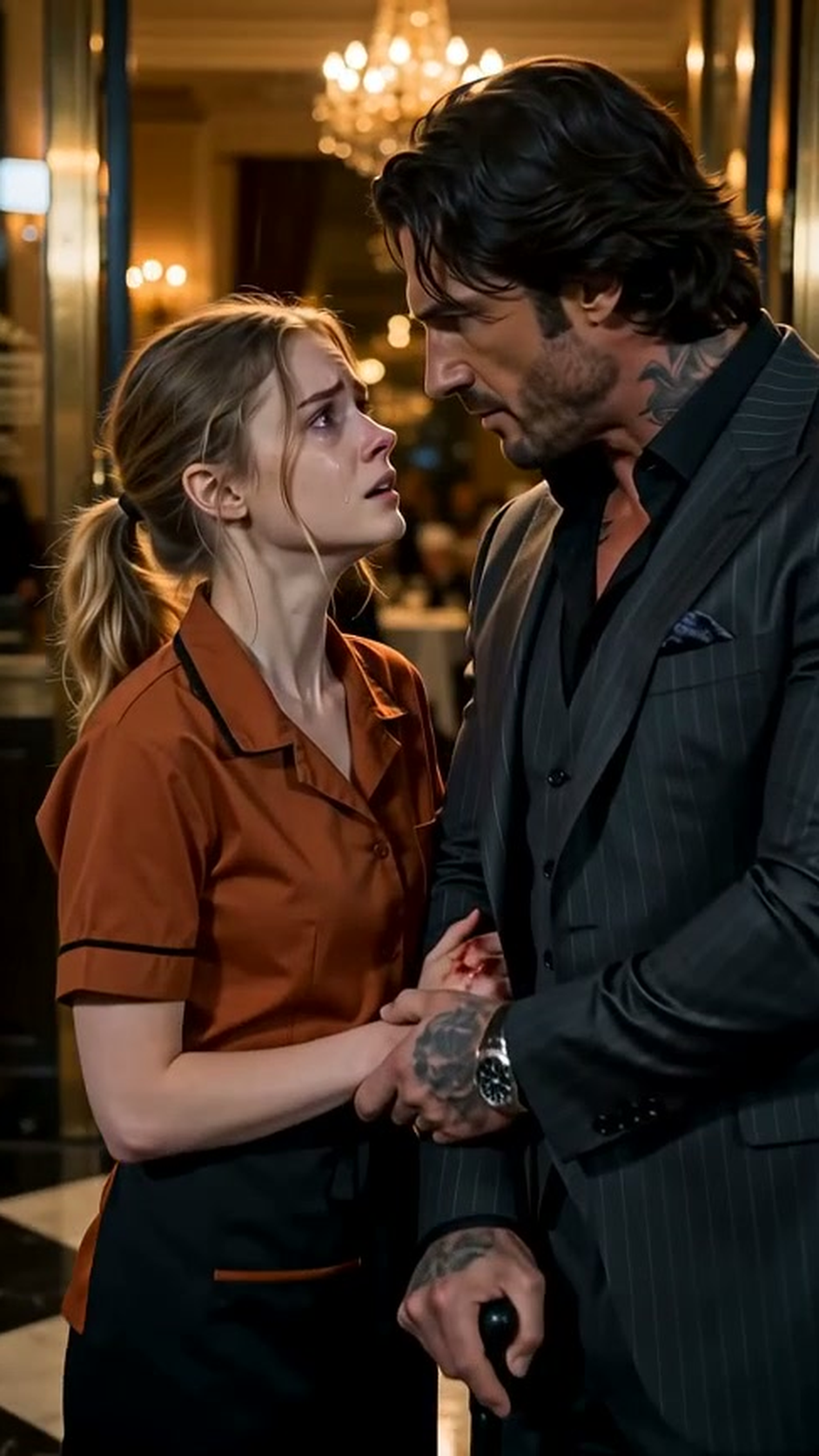
The surgeon at St. Vincent's told Roman Castellano that he had lost a great deal of blood, that the blade had missed the femoral artery by less than a centimeter, and that a tall man with a cane-shaped grudge would be spending the evening in a hospital bed whether he liked it or not.
Roman listened to all of this the way a wolf listens to weather. Then he said, "Marco."
Marco Bellini had served the Castellano family for nineteen years, first the father, then the son, and he had the two qualities the job required in equal measure: he forgot nothing, and he feared exactly one man in the world. He stepped out of the corner of the room where he'd been standing so quietly the medical staff had twice tried to take his blood pressure by mistake.
"Boss."
"The girl." Roman's hand — broad, tattooed across the knuckles, still not entirely steady — rose and pressed flat against his own chest, over the remembered weight of two small hands bearing down. "In the alley behind Laura. Waitress. Brown hair, ponytail, orange blouse. She held my leg together for eleven minutes and told me I wasn't allowed to die." The pale eyes opened. "Find her."
"Already did," Marco said, and something in his face did an unusual thing: it softened. "Naen Walker. Twenty-six. Works at Laura four years, best server on the floor by every account except her manager's. Widow. One kid — boy, five years old, sick at home in Astoria. She's got a late strike problem because the kid's been ill all month. And boss—" He hesitated, which Marco never did. "The manager. Kesler. He's been writing her up for it. Tonight she was nineteen minutes late because of you, and word from the floor is he's planning to make an example of her. In front of the Friday crowd."
"The medicine," Roman said. "The boy's. What does it cost — the whole of it, everything the clinic prescribed?"
Marco, who had clearly been waiting for the question with the answer ready, said, "Ninety-four dollars. And change."
For a moment the boss of the Castellano family said nothing at all. He lay in the hospital bed with the bandage round his leg and the IV in his arm and looked at the ceiling, and Marco — who had once watched this man negotiate a dock strike, a police raid, and a rival's funeral in the same week without a flicker — watched a muscle work in his jaw like something trying to get out of a locked room.
"Ninety-four dollars," Roman repeated at last, in a voice of great and terrible calm. "She had thirty-one in the bank. Marco. I want you to hear me. There is not a man in my organization who would have been out of this bed tonight for less than a hundred thousand. She spent — for a stranger — the difference between her son breathing and not breathing. Do you understand what I'm telling you?"
"I understand, boss."
"No," Roman said. "Nobody understands. That's the problem with the whole world."
He turned his head on the pillow, and the pale eyes that looked at Marco were not a sick man's eyes at all.
The room went very quiet. The heart monitor, which had been beeping along at a dignified pace, began to climb.
"Get my clothes," Roman said.
"Boss. The surgeon said—"
"Get my clothes, Marco. And my cane."
"Your leg—"
"My leg—" Roman swung it, with enormous, grinding control, over the edge of the bed, and the blood drained out of his face and he did not make a sound, "—has one job tonight, and so do you. Drive."
That was at 6:40 on a Friday evening, while the rain came down on New York like it had a grudge, and while Naen Walker stood in the service corridor of Laura with her back against the wall and David Kesler reading her personnel file aloud like a sentencing.
"Four years," David said, in the tone of a man savoring vintage wine. "And what do we have to show for it? Late in March. Late twice in April. Left early for a — what was it — a pediatric appointment." He let the file snap shut. "This is a restaurant, Walker, not a charity with a wine list. Do you know what table twelve spends in a month? More than you make in a year. And they were seated eleven minutes late tonight because the section was short a server. Eleven minutes, because you were—" his eyes traveled slowly, contemptuously, from her damp hair to the faint stains still shadowed under her thumbnails, "—doing whatever it is you do."
"I was saving a man's life," Naen said. Her voice shook. She hated that it shook. "He was stabbed. In our alley. I held his—"
"Oh, please." David laughed, one short bark. "A stabbed man. In the alley. And I suppose the police will back up this—" he waved a hand, "—novel you're writing. The police, Walker, who were never called to this restaurant, whose report does not exist."
"It does exist," she said. "I called 911. There's a record. There are paramedics, they—"
"Then it's very simple." He spread his hands, smiling, and she understood too late that she had walked into the exact middle of the trap he'd laid. "Produce it. Right now. Here. Because if you can't, you're not only late — you're a liar, and I get to fire you for cause, and for-cause doesn't get unemployment, does it, Walker? For-cause doesn't get a reference. For-cause doesn't get—" he leaned in, close enough that she could smell the mint on his breath, "—ninety-four dollars for medicine."
The corridor seemed to tilt. She had never told him that number. She had never told anyone that number — no. The clinic. The pharmacist had called the restaurant last week, when she'd begged them to hold the prescription until Friday, and David answered the floor phone when he wasn't supposed to, David, who collected other people's desperation the way other men collected stamps.
All the blood of that day — the stranger's, hot through her fingers; her own, drained of hope — seemed to arrive in her face at once. "You listened," she whispered. "That was a private call."
"There's no such thing as private on my floor."
The corridor door opened and shut with a hush of dining-room noise, and Jenna came through it at the quick, flat run of a hostess who has been trained never to run. Twenty-two, fearless in the way of girls who haven't yet learned what it costs, and the closest thing Naen had to a sister in the building. She took in the scene in one glance — the file, David's face, Naen's back against the wall — and her chin came up in a way that made Naen's heart hurt with love and terror both.
"Floor needs Walker on twelve, sir," Jenna said brightly, to the room at large, lying like a professional. "The Ashworth party's asking for her by name. Again. They tip thirty percent and they only let her—"
"The Ashworths," David said, "will survive their disappointment." He didn't look away from Naen. "You can go, Jenna."
"Sir, they specifically—"
"You can go." The temperature of the corridor dropped ten degrees. "Unless you'd like to be part of the discussion. I understand you also enjoy a certain… flexibility about the schedule. Single girls usually do, until they don't."
Jenna's mouth opened. Naen shook her head — once, tiny, desperate: no, not for me, not your job too — and Jenna, shaking with the effort of it, closed her mouth and went back through the door. But her hand, passing, brushed Naen's wrist and pressed it, hard, the way you press a friend's hand at a funeral: I saw. I know. Whatever happens, somebody saw.
It was the only kindness the building had managed all day, and it undid Naen more than David had. She had to look at the ceiling tiles for a count of three before she could trust her face again.
Behind her, the kitchen doors swung and kept swinging, and through them she could hear Laura at full Friday flood: the chime of glass, the low gold roar of rich people being happy in the warm and the dry. Jenna, the hostess, slipped past with a stack of menus and a face full of warning — Move, Naen, the floor manager's calling the section—
"She's not taking a section." David raised his voice. It was a voice trained in dining rooms; it carried exactly as far as he wanted it to, which was to the pass, to the bar, to the ears of every waiter who now found reasons to drift closer. "She's done taking sections. Ever."
"David—" Naen's throat closed around his name. Leo's forehead under the washcloth. The empty orange bag. The inhaler that rattled like a dying man's pocket change. "Please. Not tonight. I'll work doubles. I'll work the floor alone on Sundays, I'll take the sections nobody wants, I'll—"
"You'll take your apron off," David said pleasantly, "and you'll walk out the front." He smiled at the gathering staff, at the audience he had spent all evening assembling, one humiliation at a time. "The front, Walker. Past the tables. So everyone can see what late looks like at Laura. And when you're standing out there in the rain with your little bag—" he looked, once more, at her hands, and his lip curled, "—you can think about your priorities."
In a black car moving through the flooded streets at a speed that made Marco's knuckles white, Roman Castellano sat with his ruined leg stretched out and his cane across his knees and his eyes closed, and what he saw behind them was not the men who had come for him in the rain with a knife and a warning from the Sorin family. He saw two small hands, and an apron wadded against his thigh, and a girl's voice going in, out, in, like a tide he could breathe to — a girl who had spent the medicine money of her dying payday to buy a stranger eleven minutes of life, and who was, at that moment, being marched through his restaurant toward its front door by a man whose name Roman had never once, in nine years of ownership, had any reason to learn.
He had gone to the alley alone. That was the thing he would have to answer for, to Marco and to the mirror. Sixty years of Castellanos, and the family's first law was graven over the lintel of every business they owned: the boss is never alone, because the boss is never the target — the boss is the message. But it had been raining, and the new wine cellar at Laura had flooded in the morning, and he had wanted to see the damage himself and think about his father, who had laid that cellar's stone in 1968 and who had been dead eleven years that week. Sentiment. His father had a word for sentiment, and the word was target. So Roman had dismissed the car, and stepped out the service door into the alley with the rain on his shoulders, and the two Sorin men who'd been waiting since the lunch service — patient men, professionals, paid by the hour and then by the result — had come out of the steam like something the city itself had sent.
He'd put the first one through the dumpster lid. He wanted that remembered, later, when the leg allowed pride again. The second one had had the knife, and the knife had been faster than a fifty-percent blood supply of luck. Even then he'd nearly made the service door. What had stopped him — what had folded him down against the brick with his hand pressed useless to his thigh and the rain washing the red out of him in ribbons — was not the wound. It was the arithmetic. Run, and bleed out moving. Stay, and bleed out still, but slower, and with the cameras on the service door as witnesses for whoever avenged him.
And then a shadow, and the smell of cheap soap and rain, and a girl's knees hitting the wet ground beside him without one second of hesitation, and her hands — her whole weight — going down on the wound like she'd been born knowing where he was broken.
In thirty-eight years, Roman Castellano had been rescued by armies of paid loyalty. He had never once been rescued for free, by a stranger, at a cost she could not afford, for no reason except that he was a person. His whole philosophy of the world had a crack in it now, eleven minutes wide, and through the crack he could see light, and the light was a waitress's face in the rain saying breathe with me.
It rearranged a man. There was no other honest way to describe it.
Marco's phone lit up on the seat between them. He read it, and his jaw tightened. "Boss. He's doing it now. He's taking her out front. In front of the guests."
Roman opened his eyes.
"Then drive faster," he said.