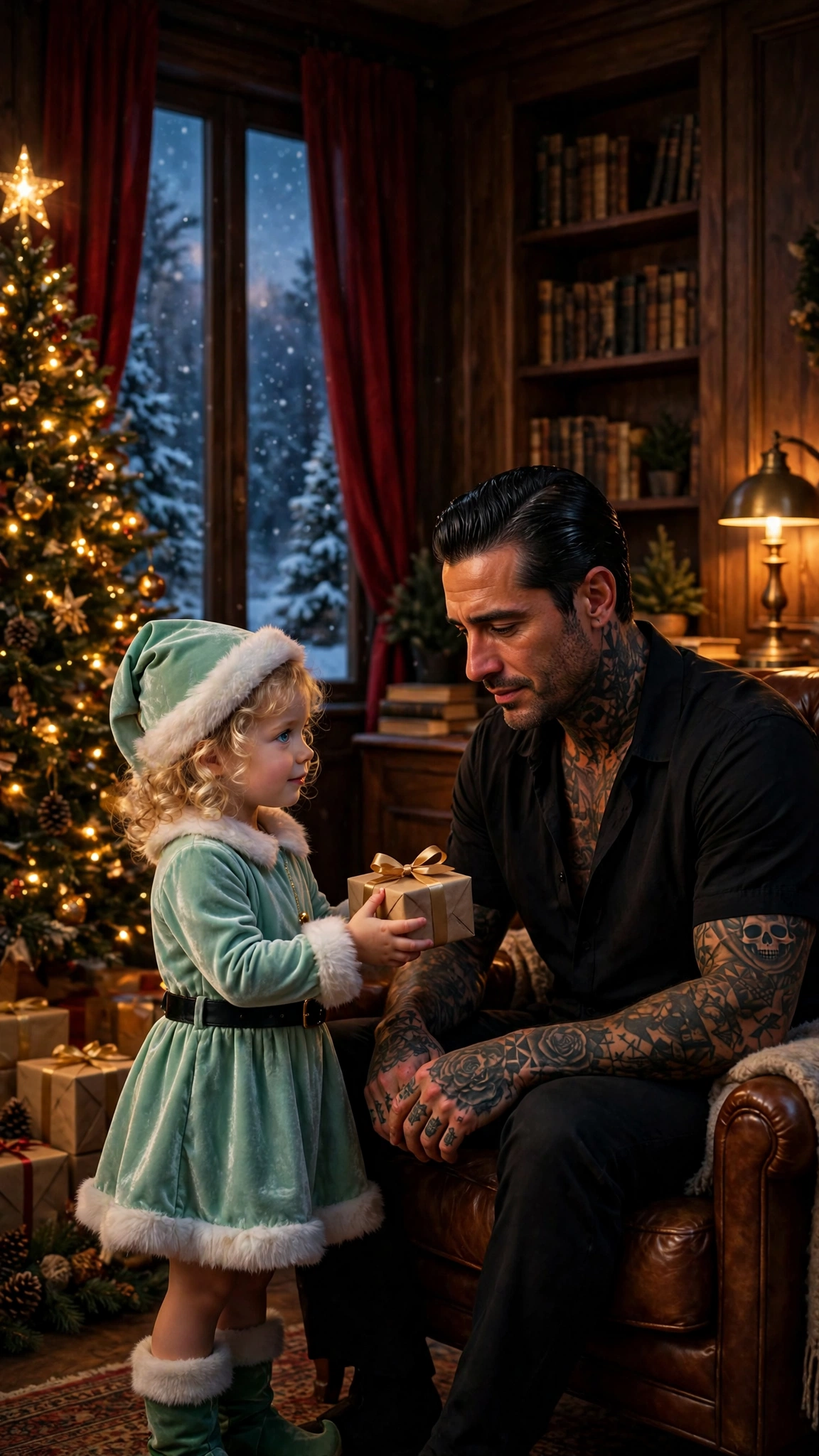
The snow had been falling on Chicago since noon, and by dusk it had covered the whole city in white.
Inside the study of the Moretti mansion, the snow made no sound at all. It fell past the tall windows in slow, fat flakes, and the pine trees in the garden stood black against the blue evening, and the red curtains hung still on either side of the glass, as if the room itself were holding its breath. The Christmas tree in the corner burned with small golden lights, and beneath it the presents lay in their paper and ribbon, untouched. On the shelves the books stood in their rows. On the desk the lamp burned low. And in the brown leather armchair by the fire sat Lorenzo Moretti, alone, with a glass of whiskey he had not touched, staring at nothing at all.
He was forty-five years old, and he was the most feared man in Chicago, or so the newspapers said, though Lorenzo had never read a newspaper about himself and did not care what they said. He was tall and broad, with slicked-back dark hair and a jaw that looked as if it had been carved from stone, and gray-brown eyes that could go soft in a single second when they landed on his daughter — and hard in a single second when they landed on anyone else. Tonight those eyes were not hard. Tonight they were empty, the way they always were at Christmas, and the black open-collar shirt he wore showed the tattoos that covered his neck and his chest and his forearms and his hands, dark ink that moved a little every time he breathed, and the silver watch on his wrist caught the firelight every time he lifted the glass and did not drink from it.
Two years. It had been two years since Elena had died, and two years since Christmas had meant anything at all in this house, and Lorenzo had given his orders that morning in the same voice he used for everything else: no party, no carols, no fuss. Christmas was just another day. The staff could have their supper in the kitchen if they wanted it. He would be in his study. He was not to be disturbed.
And then the study door opened.
It did not open loudly. It opened the way a door opens when the person on the other side of it is very small and very careful and very determined, a slow inch at a time, with one small hand flat against the wood. Lorenzo did not look up. He had told them not to disturb him, and he assumed it was Rosa with his supper, or one of his men with a message he did not want to hear.
"Daddy," said a small voice.
Lorenzo looked up.
In the doorway stood his daughter, Sophia Moretti, five years old, and she was dressed as an elf.
She wore a mint-green velvet dress with white fur trim at the collar and the hem, and a black belt with a gold buckle around her waist, and a matching green elf hat with white fur trim that sat crooked on her blonde curls, and green boots with white fur trim that came up to her knees. Her blue eyes were wide and serious. Her cheeks were pink from the cold of the hallway. And in both hands, held out in front of her like an offering, she carried a small box wrapped in brown paper and tied with a gold ribbon, the bow a little lopsided, the way a bow looks when a five-year-old has tied it herself and tied it three times before it looked right.
Lorenzo stared at her. For a moment the most feared man in Chicago did not look feared at all. He looked surprised, and then he looked sadder than he had looked a moment before, as if the sight of his daughter in her Christmas costume had reminded him of everything he had been trying not to remember all day.
"Sophia," he said. "What are you doing in here?"
Sophia did not answer at once. She took one small step into the room, and then another, her green boots silent on the thick rug, and she stopped in front of his armchair and held the box out toward him with both hands.
"Please don't be sad anymore," she said.
Lorenzo looked down at her, and for a second he could not speak at all. He set his whiskey glass down on the small table beside the chair with great care, the way a man might set down something that could break, and he leaned forward, his tattooed hands resting on his knees.
"Who let you in?" he asked, and his voice was quiet, but it was the voice of a man who is used to being obeyed, and the room seemed to get a little smaller around the sound of it.
Sophia looked at the door behind her, and then back at her father, and she said, in the clear, matter-of-fact voice of a child who has decided to tell the truth and be done with it, "The stairs."
"The stairs," Lorenzo repeated.
Sophia nodded. "The back stairs. The ones that don't squeak."
Lorenzo almost smiled. He did not know the back stairs did not squeak. He had never used the back stairs in his life. But his daughter, it seemed, knew his house better than he did, and she had used that knowledge to do the one thing he had forbidden anyone to do, which was to come into his study on Christmas Eve and disturb him while he sat alone with his sadness.
He looked at the box in her hands.
"What is that?" he asked.
Sophia held it out a little further, and her blue eyes were earnest, and there was nothing in them but honesty and hope.
"I made this just for you," she said.
Lorenzo took the box from her. It was light in his hands, lighter than he had expected, and the gold ribbon was tied in a bow that leaned to one side, and the brown paper was creased at the corners where small fingers had folded it too many times. He turned it over once, slowly, and he looked at his daughter, and he saw that she was watching his face the way a child watches a candle, waiting to see if it will catch.
Behind her, in the doorway, someone cleared their throat.
Rosa stood there, the housekeeper, her dark hair pulled back in its neat bun, her black-and-white maid uniform crisp, her white apron bright against the dark wood of the hallway. She had one hand pressed flat against her chest, and her face was pale, and behind her, half-hidden in the shadows of the corridor, stood Macy, the young kitchen maid, nineteen years old and new to the house, her hands twisted together in front of her apron, her eyes wide with terror.
Lorenzo looked from Rosa to Macy, and his face went still in the way it went still when he was deciding something, and Macy, who had been afraid of him since the first day she had come to work in this house, took one small step backward, as if the floor itself might open up beneath her.
"Macy!" Lorenzo said.
Macy flinched. She came forward one step, and then another, her knees shaking so hard that Rosa put a steadying hand on her shoulder, and she stopped in the doorway of the study with her head bowed, waiting for the words she was certain were coming, the words that would send her out of this house and back to the cold streets with no wages and no reference and no hope at all.
Lorenzo looked at her for a long moment. Then he looked down at the small box in his hands, and at his daughter in her elf costume, and at the Christmas tree burning gold in the corner of the room, and something in his face changed — not much, and not all at once, but enough that Rosa, who had worked in this house for twenty-two years and had seen every face her employer owned, drew in a sharp breath and held it.
"You're not fired," Lorenzo said.
Macy stared at him. Rosa stared at him. Sophia, who did not understand what fired meant but understood perfectly well that something good had just happened, smiled for the first time since she had come into the room.
Lorenzo held the box in his tattooed hands, and he did not open it yet, because some part of him — the part that had been a husband, once, and a man who had believed in Christmas, once — was afraid of what might be inside it, and some other part of him was afraid of what it would mean if there was nothing inside it at all.
But that was later. That was the end of the evening, and the beginning of everything else, and before any of it could happen — before the box could be opened, and the truth about what his daughter had made for him could come out into the firelight — there had been a morning. There had been a little girl waking up in a big house on a cold December day, and a photograph on a bedside table, and a music box that had not been opened in two years.
Three weeks earlier, on the first morning of December, Sophia Moretti woke to the sound of snow.
It was not a loud sound. Snow never is. It was the sound of the world going quiet all at once, the way it does when the sky fills up with white and the whole city of Chicago seems to hold still underneath it. Sophia lay in her bed for a while with her eyes closed, listening to the quiet, and then she opened them and looked at the window, where the snow was falling past the glass in slow, fat flakes, and she smiled, because snow meant Christmas was coming, and Christmas meant the tree, and the tree meant the presents, and the presents meant the thing she had been planning for three whole days.
She threw back her blankets and ran to the window in her bare feet, pressing her forehead against the cold glass. Below her, the garden of the Moretti mansion lay white and still, the bare branches of the old oak tree black against the sky, the stone paths vanished under a smooth white skin. And there, already at work in the cold with a shovel in his hands, was John Barone.
John was sixty-eight years old, and he had been the gardener of the Moretti house for forty years, which was longer than Sophia had been alive, longer than her father had been the boss of anything, longer, Rosa said, than some of the trees in the garden had been standing. He was a small man with a weathered face and hands like tree roots, and he wore the same dark green coat every winter, and he always had a red scarf around his neck that his own wife had knitted for him before she died. Sophia loved John. Everyone in the house respected John, but Sophia loved him, because John was the only grown-up in the mansion who always had time to answer her questions, and who never told her to run along, and who never looked at her the way the men in her father's study looked at her — as if she were something fragile that might break if they spoke too loudly.
Sophia pressed her palm flat against the window and waved, and John looked up, and he smiled, and he lifted his shovel in a wave of his own, and Sophia laughed, and the sound of her laughter was the first warm thing in the cold white morning.
"Sophia!" Rosa called from the hallway. "Breakfast! And put on your slippers, child, the floors are freezing!"
Sophia ran to her slippers and then to the door, but before she left her room she stopped, as she did every morning, in front of the small table beside her bed. On the table stood a photograph in a silver frame, and in the photograph a young woman with blonde hair and a bright, laughing face held a baby wrapped in a white blanket. The woman was beautiful in the way that mothers in photographs always are, and the baby was small and pink and asleep, and the woman was looking down at the baby as if the baby were the most wonderful thing she had ever seen.
"Good morning, Mummy," Sophia whispered, the way she did every morning.
Her mother, Elena Moretti, had died when Sophia was three years old, and Sophia did not remember her voice, and she did not remember her smell, and she did not remember the way her arms had felt around her. But she remembered the photograph, and she remembered the stories Rosa told her, and she remembered the music box.
The music box sat beside the photograph, small and dark and made of polished wood, with a tiny brass key on its side. It had belonged to her mother. It played a tune that Sophia knew by heart, a slow, sweet melody that sounded like rain on a window, and when she was very small she had believed that the music was her mother's voice, singing to her from wherever mothers go when they cannot stay.
That morning, for the first time in two years, Sophia opened the music box.
She did not know why she did it. Later, when her father asked her — and he would ask her, many times, in many different ways — she would not be able to explain it. She only knew that the snow had made the morning feel different, and that Christmas was coming, and that she had been thinking about what to give her father for Christmas, and that her father's face, when he looked at the photograph of her mother, was always sad in a way that made Sophia's chest hurt.
So she opened the music box, and the little tune began to play, and inside, beneath the tiny velvet lining, she found a folded piece of paper.
It was a page of sheet music, old and soft at the edges, and across the top, in looping, careful handwriting, were the words "Silent Night." The page was covered in notes, and in the margins, in the same handwriting, were small pencil marks — a circle here, a star there, the marks of a woman who had played this song a hundred times and loved it more every time. And folded inside the sheet music, as if someone had hidden it there a very long time ago, was a small star cut from gold paper, old and creased, with one point bent a little where it had been pressed flat for years.
Sophia stared at the star for a long time, the music box still playing its slow, sweet tune, the snow still falling past her window, and she felt something settle in her chest, something warm and certain and entirely her own.
She did not know what the star was. She did not know why her mother had hidden it inside the sheet music, or why her father had never spoken of it, or why Rosa, when she came in with the breakfast tray and saw the star in Sophia's hands, went so pale that she nearly dropped the tray.
But Sophia knew one thing, with the absolute certainty that only a five-year-old can feel: her mother had left her a map. And Christmas was coming. And her father — her big, sad, frightening, beloved father — deserved a Christmas present that would make him smile the way he used to smile in the photograph, before everything went quiet.
She folded the sheet music carefully and put it back in the music box, and she put the little gold star in the pocket of her dress, and she ate her breakfast without complaining about the porridge. And when Rosa asked her what she was thinking about, Sophia smiled, and said, "Nothing," in the bright, innocent voice that Rosa had learned, over five years of raising this child, never entirely to trust.
That afternoon, when the snow stopped and the sun came out pale and thin over Chicago, Sophia put on her coat and her boots and her red mittens, and she went down into the garden to find John Barone, and to ask him about a star made of gold paper, and a song called "Silent Night," and whether he knew anything about a present that could make a sad man smile again.
John Barone listened to her with his shovel resting against the old oak tree, and his weathered face went very still, and for a long moment he said nothing at all. And then he looked up at the great dark house, at the windows of the study on the ground floor, and he said, very quietly, "Come with me, little one. And don't tell anyone. Not yet."
That was how it began. Not with the gift, and not with the box, and not with the silence that fell over the study like snow. It began with a star in a music box, and a little girl who missed her mother, and an old gardener who had kept a secret for forty years and had finally, at long last, found someone brave enough to hear it.