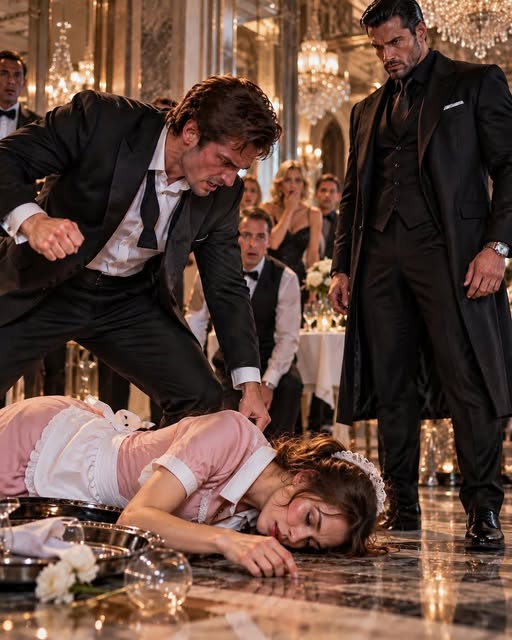
Four weeks after the assault, Amelia stood outside the Lantern Diner and stared through its locked front door.
The familiar red neon sign was dark.
A handwritten notice explained that regular service had been temporarily suspended while the ownership and financial disputes were resolved.
Someone had taped a small paper heart beneath it.
Inside the heart were three words.
WE MISS AMELIA.
She reached toward the glass.
For nearly four years, this restaurant had been the center of her world.
She knew which floorboards creaked near the kitchen.
She knew which customers needed decaf coffee but hated admitting it.
She knew Angela kept emergency chocolate beneath the register for employees having particularly terrible days.
And she knew Vincent always pretended not to notice when the cooks packed extra food for struggling neighborhood families.
Now the chairs were upside down on the tables.
The coffee machine was silent.
And the place where she'd almost lost her life looked abandoned.
Maya Sullivan stood beside her.
“Are you sure you're ready?”
Amelia nodded.
Her concussion symptoms had improved, although headaches and fatigue still returned unexpectedly.
She was continuing her follow-up care and counseling.
Some mornings she felt almost normal.
Other mornings, hearing a man's angry voice in a grocery store sent her heart racing.
Recovery, she had discovered, did not follow a convenient schedule.
But she was tired of letting Derek Lawson decide where she could go.
“I need to see it,” she said.
Maya unlocked the door using a key Angela had provided.
They stepped inside.
The restaurant smelled faintly of lemon cleaner and old coffee.
Amelia walked toward the counter.
She stopped at the place where Derek had stood.
The memory arrived without warning.
His voice.
His hand reaching toward her.
The sudden pain.
For a moment, she couldn't move.
Maya stayed beside her without speaking.
Amelia stared at the floor.
“This is where I fell.”
“Yes.”
“I thought I'd be stronger than this.”
“You're standing here,” Maya answered. “That counts.”
Amelia took a shaky breath.
She moved toward the counter and rested her hand against it.
Then she looked toward the office.
“Derek wanted the blue folder.”
Maya nodded.
“That's what you told the police.”
“Then I want to know what was inside it.”
The police had completed their initial examination of the diner office, but several items remained in evidence.
Among them were the contents of the recycling box discovered by Angela.
The box had contained ordinary receipts, outdated menus, shredded drafts, and several torn pages from Lawson Development correspondence.
One page referred to the Harbor Crown project.
Another listed contractor account numbers.
A third contained a handwritten notation in blue ink.
PHELPS — SERVICE ENTRANCE — 7:55
Detective Vega had immediately recognized the significance.
The bakery camera showed an unidentified man entering the Lantern's rear door at almost exactly that time.
Investigators had compared the footage with available records from Lawson Development's security division.
One person matched the approximate build and clothing.
Howard Phelps.
Derek Lawson's private investigator and internal security adviser.
Vega had not relied on the image alone.
She obtained additional records through lawful investigative procedures.
Building access data showed a credential associated with a contractor used by Lawson Development had been activated that evening.
A company vehicle's location records placed it near the diner.
And a maintenance request submitted under a false contractor name appeared to have been created from a Lawson Development office computer.
None of those details proved the entire conspiracy by itself.
Together, they established a trail.
The Lantern's camera recording unit had not simply malfunctioned.
Someone had entered the building shortly before the assault, accessed the equipment area, and interfered with its recording capability.
The investigators were now trying to determine exactly who had directed the operation.
And Howard Phelps was becoming increasingly difficult to locate.
At Lawson Development headquarters, Derek was furious.
He slammed a folder onto his desk.
“Where the hell is Howard?”
His assistant stood near the doorway.
“He hasn't returned my calls.”
“Then call again.”
“Sir, I've tried six times.”
Derek swept a paperweight from his desk.
It struck the carpet.
“Unbelievable.”
His assistant flinched.
Derek noticed and immediately composed himself.
“I'm sorry. It's been a difficult morning.”
She said nothing.
“Find him.”
After she left, Derek called Nikki.
The call went straight to voicemail.
He tried again.
Nothing.
Derek paced.
Two men.
Two men who owed their careers to him.
And suddenly both had disappeared.
His attorney entered without knocking.
“Derek, we need to discuss the investigation.”
“Not now.”
“Now.”
Derek turned.
Graham Whitlock placed several documents on the desk.
“The authorities have requested additional records related to the contractor payments.”
Derek's face tightened.
“Give them what they're entitled to.”
“That's what we're doing. But we also need to talk about the old settlement.”
“What about it?”
“The former warehouse workers are asking questions.”
Derek laughed sharply.
“Of course they are.”
“Some of them say they never received the compensation allocated to them.”
“Then the trust administrator should answer.”
“The trust administrator appears to have been connected to your development division.”
Derek's expression changed.
“Be very careful what you're implying.”
Whitlock held his gaze.
“I'm not implying anything. I'm explaining the problem.”
Derek moved toward the windows.
For years, he had believed control was simple.
Money bought silence.
Silence created safety.
And anyone who refused to cooperate could be replaced.
But now people were speaking.
A waitress.
A former employee.
A detective.
Possibly his own father.
Derek turned.
“Can we settle the assault case?”
Whitlock nodded cautiously.
“Your criminal exposure isn't something you can simply purchase your way out of. There may be civil claims we can discuss through counsel, but you need to stop contacting witnesses.”
“Offer her a million dollars.”
“Derek—”
“Five million.”
Whitlock stared at him.
“She won't take it.”
Derek's face darkened.
“Everybody takes money.”
His attorney quietly closed the folder.
“That's what you keep saying.”
Amelia met Leah Navarro on a rainy Thursday afternoon.
Leah was thirty-nine, with dark hair, tired eyes, and the dignified posture of someone who had spent years holding herself together for other people's sake.
Her husband, Miguel, had died in the warehouse fire four years earlier.
He had been thirty-four.
They had two children.
At the time of his death, their youngest daughter was only three.
Leah arrived at Maya's office carrying a worn envelope filled with hospital paperwork, letters, and old settlement notices.
Amelia rose when she entered.
“Mrs. Navarro?”
“Leah is fine.”
“I'm Amelia.”
Leah studied the faint remaining bruising near her cheek.
“I saw what that man did to you.”
Amelia looked down.
“I'm sorry you had to see it.”
Leah shook her head.
“You don't need to apologize for what somebody else chose to do.”
They sat.
Maya explained that investigators were reviewing the waterfront settlement fund and that Leah was under no obligation to discuss her family's private circumstances.
But Leah wanted to speak.
“After Miguel died, the lawyers told us there would be compensation,” she began.
Her hands tightened around the envelope.
“Not enough to bring him back. Nothing could do that. But enough to keep us from losing our home.”
Amelia listened.
“I received eighteen thousand dollars initially. They said the rest would come after administrative processing.”
“Did it?”
Leah shook her head.
“No.”
“What happened?”
“They stopped returning my calls.”
Her voice remained steady.
“I cleaned offices at night. I sold my wedding jewelry. My son gave up a scholarship program because I couldn't pay for transportation.”
Amelia felt tears gathering.
Leah continued.
“For years, I thought the delays were ordinary legal problems. Then I saw the news about the old settlement fund.”
She opened the envelope.
Inside was a letter bearing the name of a charitable trust.
The letter claimed a much larger amount had been allocated to Leah's family.
Amelia stared at it.
“You never received that?”
“No.”
Maya took careful notes.
Leah leaned forward.
“I don't care whether the money was taken by a billionaire or a mob boss. I want somebody to explain why my children were left struggling while men in expensive suits congratulated themselves for helping us.”
Amelia reached across the table.
Leah took her hand.
For a moment, neither woman spoke.
Then Amelia said something she hadn't fully understood until that instant.
“This isn't just about what Derek did to me anymore.”
Leah nodded.
“No. It never was.”
The investigation gained momentum after Detective Vega obtained an unedited recording of the assault.
The video came from an elderly customer who had been sitting two booths away.
Mrs. Evelyn Pryce had begun recording when Derek started shouting at Amelia.
She had intended to document the disturbance in case the restaurant needed help proving what happened.
Her hands shook during the recording.
The image briefly slipped toward the floor.
But the important moments were visible.
Derek moving toward Amelia.
Amelia attempting to retreat.
Her defensive hand.
The single punch.
Her collision with the counter.
The cup falling.
Her collapse.
Then Derek's laughter.
The video also captured Angela yelling for an ambulance.
And, a few seconds later, Vincent entering.
When Vega watched the footage, she remained silent for nearly a minute afterward.
Then she replayed the opening.
There was no ambiguity.
Amelia had not attacked Derek.
She had not lunged at him.
She had not behaved aggressively.
She had tried to get away.
And he had struck her anyway.
Mrs. Pryce had been reluctant to come forward because she feared publicity.
But when she learned that Amelia was being accused of misconduct, she contacted the detective through her grandson.
“I should have brought it sooner,” Evelyn said.
Vega shook her head.
“You've brought it now. That's important.”
The detective documented the recording's origin and arranged for the original file to be preserved.
For the first time since Amelia's assault, investigators had direct visual evidence of the physical attack.
But the video contained something else.
Something that had been overlooked.
Just before Derek moved toward Amelia, Nikki turned his head toward the rear hallway.
His expression changed.
Then, as Derek reached for Amelia's access card, Nikki stepped away from the counter.
Vega paused the image.
Zoomed carefully using forensic tools.
And studied the movement.
A few seconds later, someone briefly appeared near the hallway entrance.
Only part of a dark jacket was visible.
The figure disappeared before the punch.
The image wasn't clear enough to identify the person.
But it gave the investigators another point to compare against the bakery footage.
The suspected financial operation and Derek's violent confrontation had occurred within minutes of each other.
And the timing was becoming harder to dismiss as coincidence.
Vincent's world was also changing.
He had begun cooperating with an independent review of the waterfront settlement.
Claire warned him that full disclosure could expose him to serious legal consequences.
Vincent understood.
For years, he had protected his reputation by revealing only what others could prove.
Now he was doing the opposite.
He authorized the production of his relevant business records.
He identified people who had managed the old warehouse partnership.
And he acknowledged that he had signed a confidential arrangement without adequately ensuring that the workers' families received the compensation intended for them.
It was humiliating.
It was frightening.
And for the first time in years, it felt necessary.
One evening, he sat in his study reviewing photographs from the old warehouse.
His late wife Sofia appeared in one of them.
She was standing beside him at a neighborhood fundraiser, laughing at something outside the frame.
Vincent traced the edge of the photograph.
Sofia had always believed he could become a better man.
She had also refused to excuse his mistakes.
“You can't buy your way into being decent, Vincent,” she once told him. “You have to be decent when it costs you something.”
He had loved her for that.
And resented her for it.
Because she had seen through every excuse he offered himself.
Now her words returned with an almost unbearable clarity.
His cellphone rang.
Claire.
“Vincent, we need to talk.”
“About Lawson?”
“About you.”
He straightened.
“What happened?”
“Federal investigators have asked for additional documents concerning the warehouse settlement and related financial transfers.”
Vincent closed his eyes.
“Am I a target?”
“We don't know the full scope yet.”
“Should I be worried?”
“Yes,” Claire said quietly. “You should.”
He looked at Sofia's photograph.
Then he answered.
“Give them what the law requires. And don't conceal anything on my behalf.”
The next week, Amelia decided to speak publicly.
Not through a sensational interview.
Not through a confrontation outside Derek's office.
She worked with Maya to prepare a short statement about her experience.
She stood in front of the Lantern's shuttered windows, with Angela beside her and Jonah waiting nearby.
A local journalist named Rowan Brooks recorded the statement after agreeing not to ask questions about Amelia's private medical information or ongoing investigative details.
Amelia wore a simple blue sweater.
Her hair was tied back.
She held a folded piece of paper, but after a few seconds she lowered it.
“My name is Amelia Hart,” she began.
“I'm twenty-nine years old. I've worked as a waitress at the Lantern Diner for almost four years.”
She paused.
“I was assaulted while doing my job.”
Her voice trembled.
But she continued.
“I didn't deserve it. I didn't provoke it. And I didn't steal money from anyone.”
Angela quietly wiped her eyes.
Amelia looked directly into the camera.
“Since that night, strangers have called me a liar and a criminal. I've been frightened to leave my apartment. My family has received threats.”
She inhaled.
“But I know I'm not the only person who's ever been treated this way.”
Her voice steadied.
“There are people who work hard every day and still feel powerless when someone wealthier decides their dignity doesn't matter.”
She glanced toward the diner.
“I don't want revenge. I want the truth. I want accountability. And I want people to remember that the person serving your coffee is a human being.”
She stopped.
The journalist lowered the camera.
For several seconds, nobody spoke.
Then Jonah stepped forward and embraced his sister.
The recording was published that evening.
Within days, it reached an audience far beyond Brooklyn.
Restaurant workers shared their experiences.
Former Lawson Development employees began contacting journalists and investigators.
Residents of the neighborhood organized a peaceful gathering outside the diner.
Many held handwritten signs.
OUR NEIGHBORS ARE NOT DISPOSABLE.
JUSTICE FOR AMELIA.
SAVE THE LANTERN.
Not everyone believed her.
Some continued spreading the false financial allegations.
But Amelia no longer felt completely invisible.
And that mattered more than any number on a screen.
At 10:32 p.m. on Friday, Detective Vega received a call from Howard Phelps's attorney.
Howard wanted to speak.
He had retained counsel.
He understood that investigators were examining his connection to the camera system and contractor access.
And he was prepared to discuss a possible cooperation arrangement through the appropriate legal channels.
Vega agreed to meet him.
The interview took place the following afternoon.
Howard looked exhausted.
His expensive suit was wrinkled.
He sat with his hands folded on the table.
His attorney advised him carefully before he spoke.
Howard admitted that Derek had instructed him to arrange access to the Lantern's service entrance.
He acknowledged contacting a security contractor and requesting a temporary interruption of certain monitoring functions.
He insisted that he had not personally struck Amelia and had not anticipated Derek's violence.
Vega didn't let him hide behind that distinction.
“You knew unauthorized activity was being prepared inside the restaurant?”
Howard looked down.
“Yes.”
“And you helped arrange access?”
“Yes.”
“Why?”
Howard swallowed.
“Because Derek told me the building was going to become company property anyway.”
Vega waited.
Howard continued.
“He wanted documents taken from the office. He wanted records modified. I told him that was illegal.”
“What did he say?”
Howard looked up.
“He said rich people don't get arrested over paperwork.”
Vega wrote down the statement.
Then she asked about the old settlement.
Howard hesitated.
His attorney spoke quietly to him.
Finally, Howard nodded.
“Derek used some of the funds as temporary financing. He said the accounts would be replenished before anyone noticed.”
“Were they?”
“No.”
“Did Arthur Lawson know?”
“I don't know.”
“Did Vincent Castellano know?”
Howard shook his head.
“I never saw anything proving Castellano knew the money was diverted. But his signature was on the original settlement.”
Vega studied him.
“And the false transfer attributed to Amelia?”
Howard's expression changed.
“That was designed to create a financial irregularity inside the Lantern's records.”
“Who designed it?”
Howard looked toward his attorney.
Then answered.
“Derek approved it.”
Vega remained quiet.
Howard added one final detail.
“There should be a backup authorization file in the old Lawson accounting archive.”
“Where?”
“The financial compliance office. It includes the approval chain.”
Vega leaned forward.
“Who approved the transaction?”
Howard's answer was almost a whisper.
“Derek Lawson.”
Two weeks later, investigators executed court-authorized searches of several Lawson Development offices.
Financial records were preserved.
Computers were examined.
Company employees were interviewed.
The investigation was now large enough to attract attention from federal authorities reviewing the historical settlement transfers.
Arthur Lawson suspended Derek from his executive responsibilities pending an independent corporate review.
Derek responded by accusing his father of betrayal.
“You're destroying your own company!”
Arthur stood across from him in the boardroom.
“No, Derek. I'm trying to find out what you did with it.”
Derek pointed toward the windows.
“I built Harbor Crown.”
“You borrowed against it.”
“I made the company profitable.”
“You put people at risk.”
Derek laughed.
“Don't pretend you're innocent, Dad. You taught me everything.”
Arthur's face went pale.
For a long moment, neither man spoke.
Then Arthur answered.
“I taught you that winning mattered. I should have taught you that some victories aren't worth having.”
Derek's expression twisted.
“Save the speeches.”
He walked out.
Arthur remained alone.
He had finally understood that protecting his son's reputation had only encouraged him to become more dangerous.
But recognizing the truth did not erase the years he'd spent ignoring it.
That evening, Vincent called Amelia.
She answered after several rings.
“Hello?”
“It's Vincent.”
“I know.”
He hesitated.
“I saw your statement.”
Amelia looked out her bedroom window.
“And?”
“You were brave.”
She was quiet.
Vincent continued.
“I spoke with some of the families affected by the warehouse fire.”
“Leah Navarro?”
“Yes.”
“How did it go?”
“Badly.”
Amelia waited.
“I apologized,” Vincent said. “She told me apologies don't pay rent or bring back her husband.”
Amelia closed her eyes.
“She was right.”
“Yes.”
Vincent took a breath.
“I'm working with independent administrators to determine what compensation is still owed. Whatever my legal responsibilities turn out to be, I intend to meet them.”
Amelia felt tears rising.
“That matters.”
“Does it change how you feel about what I did?”
She considered the question.
“Not yet.”
Vincent accepted the answer.
“Fair enough.”
For a moment, the old warmth between them returned.
Then Vincent said, “There's something you should know.”
Amelia stiffened.
“What?”
“Investigators are examining my involvement in the old settlement. I may face charges.”
Her heart sank.
“Even if Derek stole the money?”
“My failure to verify what happened doesn't automatically make me innocent of everything connected to that agreement.”
Amelia sat down.
“Mr. C…”
“I don't want you defending me because I helped you.”
“I wouldn't.”
“I know.”
He paused.
“That's one of the reasons I'm proud of you.”
After they ended the call, Amelia sat in the dark for a long time.
She wanted Vincent to be innocent.
She wanted Derek to be punished.
She wanted the diner reopened and her life restored.
But justice was becoming more complicated than she had imagined.
It wasn't simply a question of identifying one villain.
It was a question of whether everyone involved would be held responsible for the choices they had made.
And then, just before midnight, the breaking news alert appeared on her phone.
VINCENT CASTELLANO UNDER FEDERAL INVESTIGATION IN HISTORIC WATERFRONT SETTLEMENT CASE
Amelia stared at the screen.
Moments later, another message arrived.
This one came from an unknown number.
Castellano won't be able to protect you much longer.
Beneath it was a photograph.
Jonah leaving school.
Amelia's blood ran cold.
She immediately called Detective Vega.
Because the investigation might have exposed Derek Lawson's secrets.
But someone was still trying to frighten her into silence.
And the final battle had only just begun.