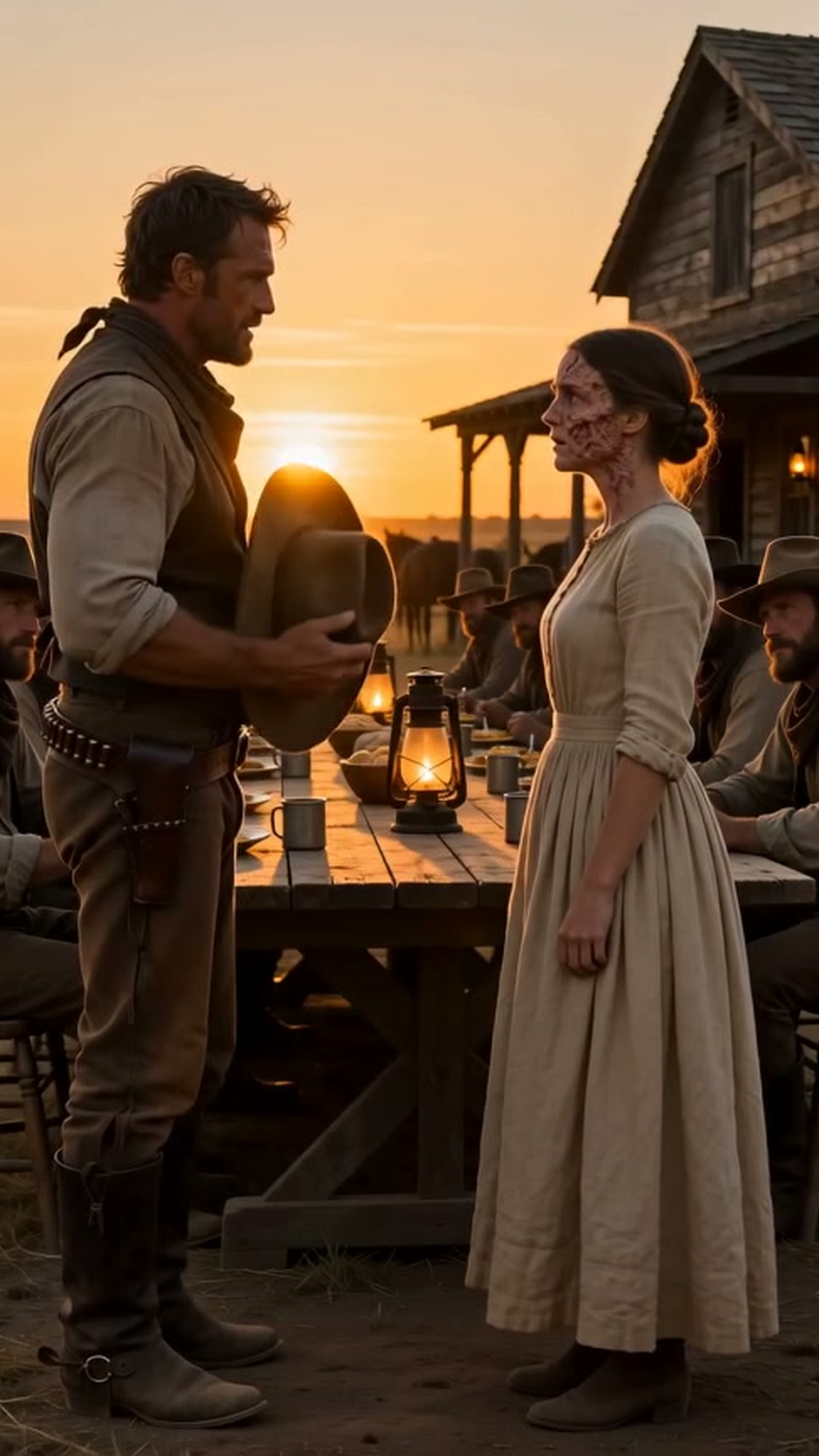
"No one marries a scarred girl…"
Coulter let the words stand there between them a moment, in the lantern light, exactly as she had said them that morning — and then he picked them up the way a man picks up a tool he intends to repair something with.
"That's the sentence you brought with you from Missouri," he said. "I've been turning it over all evening, Edith, and I've concluded Missouri's a liar." His voice stayed low and even, a voice for horses and hard news. "Out here we bury folks next to what the country did to them, and nobody with sense reads a face for the whole story. I read hands. Yours fed fourteen men tonight like it was nothing, and bound a boy's cut, and stopped a fight with a coffeepot." A pause. "I wrote in that advertisement that appearance was of no importance, and I meant it so plain I didn't know how to say it plainer. If you'll stay — not as a bargain struck off a newspaper. As a beginning. I'd like the chance, over time, to change your mind about that sentence."
The yard was utterly silent. Somewhere down the table a tin cup settled against wood and sounded, in the stillness, like a bell in a church.
Edith had prepared, over four days of train and ten years of rehearsal, for contempt, for dismissal, for the widower's daylight bargain. She had prepared nothing at all for this. She stood with her empty hands folded in front of her like a girl at a recitation, and she did the only thing her whole education had ever actually taught her to do: she negotiated for the right to earn it.
"Mr. Grady," she said, and was proud that it came out steady, "a woman who marries a man off one supper is a fool, and a man who asks it is in a hurry, and hurry is a bad foundation. I'll make you a different offer, and it's the only one I've got." She took a breath. "I'll stay the summer as your cook, at the wage in your letter, and keep your house, and earn my place at this ranch the way I'd earn it anywhere. You'll have the same summer to look at the whole of the bargain —" her chin came up; she made herself say it — "including the parts you haven't seen in lamplight yet, sir, the temper and the opinions and the rest. And at the end of it, if either of us wants the thing ended, it ends. No harm. No debt. You pay my fare home like your letter said, and we shake hands. That's fair dealing. It's the only kind I'll have."
Down the table, somebody — it was Rafe — exhaled and murmured, "Lord, she's a Grady already," and got shushed by four men at once.
Coulter considered her the way he had considered the horizon that morning: completely, and without hurry. "Done," he said. "One condition."
"Name it."
"The cook on this ranch sits at the table." He nodded toward her small plate, still standing by the kitchen door where the help stands. "My father set that rule before I was born. Gus sat. You'll sit. A person who feeds this outfit doesn't eat standing in a doorway like she's apologizing for the food." Something that was almost a smile moved in his face and was gone. "That's house law, Miss Mayburn. Summer bargain or no."
Edith looked at the long table, at thirteen men suddenly finding the grain of the wood fascinating, at the empty place near the middle where no one had thought to leave room because no one had known there would be a person to leave it for.
"Then I'll sit, Mr. Grady," she said. "House law is house law."
He put his hat back on, which the table seemed to understand as adjournment, and the evening broke up into lanterns and low voices and men saying ma'am as they passed her with their plates, every one of them, even Judd — who said it twice, to make sure it registered.
* * *
She set about the summer the way she set about a kitchen: everything in its place, everything accounted for.
Within a week the house smelled of soap and coffee instead of dust and mouse. Within two, the pantry was inventoried on a slate in her clean hand — flour, salt, coffee, dried apples, beans, and a column for what was wanted, which she kept the way her father had kept lumber tallies, honest to the ounce. The men learned that supper was at six and that a man who came to her table with dirty hands was sent to the pump by Amos before she saw him, because Amos had appointed himself the border guard of her dignity and ran the post like a customs house.
The first supper she sat, she sat like a woman defusing something — at the very edge of the bench, near the middle, where Ben had loudly announced a place was kept. By the fourth supper she had a place the way other people have a place, and by the sixth, men were passing her the platter first out of an instinct none of them examined, and Pierce had begun eating at the far end with his hat pulled lower, which Amos noticed and filed.
It was on one of those evenings, the dishes done and the yard going blue, that Coulter found her on the porch with the darning, and asked her — with the air of a man who has been carrying a question at the bottom of a bucket for some days — how it had happened. Not whether it hurt. Not what the doctors said. Just: "Will you tell me how it happened, Edith? Not tonight if you don't want. Sometime."
So she told him, there in the blue dusk, the whole of it: the stovepipe joint, the painted-shut window, Sam at six in the corner, her mother at the door that was already a wall of fire, saying go, go, with her hands. She told it the way she had told it perhaps three times in her life, all the way through, and when she got to the part about the fire taking its price she touched the side of her face once, lightly, the way you'd touch a sleeping animal.
"The doctor said the scars would fade to half," she said. "They faded to this. Ruth said it was God's editing. Sam says—" her voice did something then, and steadied — "Sam says it's the receipt for his life, and I got charged for it, and he'd pay it back with interest if the world took installments. He's sixteen. He writes me every week. The letters take nine days and they're mostly about a girl named Pearl and a mule, but he writes."
Coulter was quiet a while. The dark came down the way it does on the plains, all at once and then slowly.
"My wife died in the room at the end of the hall," he said at last. "Six years this winter. Her name was Mary. I keep the door shut because I don't know the ceremony for opening it." He turned his hat once in his hands. "I expect there's a quantity of things on this ranch that have been shut a long time waiting on a ceremony, Edith. I didn't know that till this summer."
He did not touch her hand. He did not have to. She sat with the darning in her lap and did not pick it up again for some minutes, and the not-touching was, in its way, the most respectful and the most intimate thing that had yet passed between them.
Redemption, on a ranch, is mostly carpentry. In the second week Edith found the wobbly bench at the table — the one that had dumped Ben in the dirt twice — taken apart and re-pinned, solid as a church. Nobody admitted to it. But she had seen Judd's knife work on a gate hinge in May, and she knew the hand, and at supper she said, to the table at large, "Whoever mended the bench has my thanks. It's good work," and Judd Harlow examined his coffee with the ferocity of a man reading scripture and said, "Ain't nothing, ma'am," in the voice of a boy confessing at last to the crime of having been raised better than he'd lately acted. Amos caught her eye over the platter and permitted himself, very slightly, to look satisfied.
And in the third week, because paper was the thing she was best at after gravy, she asked Coulter — plainly, at breakfast, while he was working through the ranch accounts with the slowness of a man wading — whether the books might go faster in another hand.
He looked up. The ledger in front of him was a battlefield of his fence-post figures, half of them overwritten, the bank's letters stacked beside it like unopened weather.
"You'd take that on?" he said. "It's ugly work. My father kept these books forty years and I keep them like I'm mad at them."
"I kept my father's accounts from the time I was fifteen," Edith said. "Paper doesn't frighten me, Mr. Grady. It mostly just wants to be read in order."
He pushed the ledger across the table with the air of a man setting down a weight he'd carried so long he'd forgotten it was optional. "Then read it in order."
It took her four evenings. The ranch, reduced to columns, was a better story than Coulter had been telling himself and a worse one. Better: the herd was sound, the beef contracts with the railroad buyers were real, the grass was worth more than the debt. Worse: the nine-hundred-dollar note was not the original note. It had been renewed twice, and at the second renewal — signed by Coulter in Lincoln the previous fall, in a lawyer's office, in a hurry, with Beck's man pouring the coffee — the interest had near doubled and a clause had crept in that tied the note not just to the herd but to the water. To Alder Creek itself. To the senior right of 1851.
"That clause wasn't read aloud," Coulter said, when she showed him, and his face had gone the color of old ashes. "I'd swear it before a judge. It wasn't in the summary they gave me."
"It may still not hold, if the original filing is what I think it is," Edith said. "The 1851 right — where's the recorded instrument? If the county has it, the bank clause can't swallow what your father recorded before this bank existed. But there should be a copy here. In the deed box. With the original survey."
The deed box lived in the study, in a cabinet under the window — iron-bound oak, heavy as a coffin lid, locked with a key Coulter wore on his watch chain. He unlocked it that night with Amos standing by, and the two of them and Edith went through thirty years of a family's paper by lamplight: deeds, the marriage lines, a tintype of a woman with ink on her fingers, bills of sale, the survey of 1851 with its chain-and-compass bearings, folded and refolded into softness.
The recorded copy of the water-right filing — the one document that outranked every claim in the county, the paper Harlan Beck had been asking after in Lincoln — was not there.
The folder that should have held it was there. The string that should have tied it was there, neatly knotted around nothing.
Coulter stood very still with the empty folder in his hand.
"Gus kept this box," Amos said slowly. "I kept it after. Nobody—" He stopped. His old eyes went to the window above the cabinet, and Edith followed them, and felt the nape of her neck go cold in the warm room.
The window latch — brass, seldom touched, filmed with the dust of years — had a bright scratch across it, fresh as a signature.
Someone had been in the study. Someone had known exactly which paper, out of thirty years of paper, was worth stealing.
"The county recorder has the original entry," Edith said, thinking aloud the way she did over accounts. "A theft here doesn't erase the record there. But if somebody files a challenge — if Beck's lawyers claim the right lapsed, or was sold, or was never recorded — then the fight turns on who can produce paper first and loudest. A stolen copy muddies the water for months. And your note's due in—"
"Five weeks," Coulter said.
"Five weeks," she agreed quietly. "Which is time enough to muddy a great deal of water."
Amos closed the deed box with a care that was itself a kind of anger. "There's a short list of who knew that box," he said. "Family. Gus. Me. And anybody who's been watching this house close enough to learn its habits since January." He didn't say the name. He looked at Coulter, and Coulter looked back, and the name stood in the room anyway, unsaid, in a pair of boots too good for its wages.
Outside, the yard was dark and ordinary. A horse stamped in the corral. Somewhere beyond the creek, unconcerned and patient as weather, Harlan Beck was waiting for the first of June.