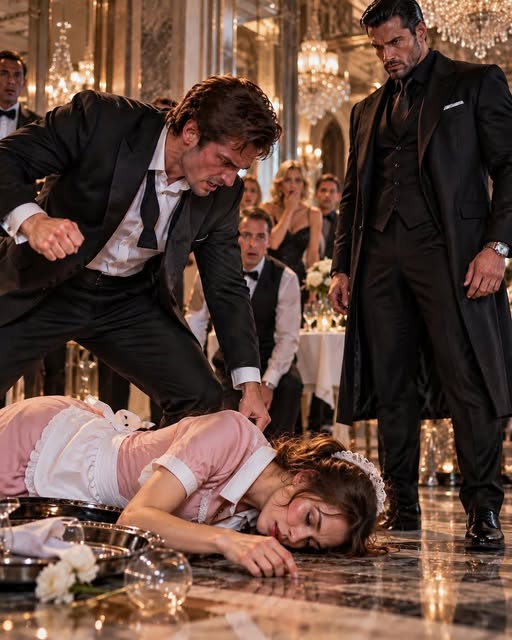
Six months after Derek Lawson punched Amelia Hart, he stood before a judge.
His expensive suit was perfectly pressed.
His hair was neatly combed.
His expression was composed.
But for the first time in his adult life, he was not the most powerful person in the room.
He had been charged with assault-related offenses, financial crimes connected to the alleged misuse of Amelia's credentials, and attempts to intimidate witnesses.
Separate investigations into Lawson Development's historical financial transactions were also continuing.
The company that once featured him on magazine covers had removed him from its leadership.
His father had publicly acknowledged failures in corporate oversight.
Several former employees were cooperating with investigators.
And the woman Derek had once dismissed as an insignificant waitress was seated only a few yards away.
Amelia wore a navy-blue dress.
Her hair was pulled back.
She sat beside Maya Sullivan, her hands folded carefully in her lap.
The faint scar near her lip was barely visible.
But the effects of the assault had not vanished.
She still experienced occasional headaches.
She still startled when people moved suddenly toward her.
And she still remembered the humiliating feeling of lying helpless on a floor while someone laughed.
Yet she had come.
Not because she wasn't frightened.
But because she refused to let her fear decide the rest of her life.
Angela sat behind her.
Jonah was beside Angela.
Leah Navarro had traveled across Brooklyn to attend.
And at the far end of the courtroom sat Vincent Castellano.
He wore a charcoal suit instead of his usual black.
He had arrived alone.
No bodyguards.
No dramatic entrance.
No one stepped aside for him.
For once, Vincent was simply another man waiting to see whether the justice system would work.
Amelia looked over her shoulder.
Their eyes met.
Vincent gave a small nod.
She returned it.
Then the court officer called everyone to rise.
The judge entered.
And Derek Lawson's trial began.
The prosecutor, Assistant District Attorney Rebecca Hale, opened with a simple statement.
“This case begins with an act of violence, but it does not end there.”
She stood before the jury.
“The evidence will show that the defendant assaulted an employee who refused to grant him unauthorized access to her workplace. It will also show that her identity was later used as part of an effort to manipulate financial records and discredit her.”
Derek stared ahead.
Hale continued.
“The defendant believed he could intimidate people into obedience. When that failed, the prosecution alleges he used money, influence, and deception to avoid accountability.”
She paused.
“But the evidence does not become less important because the defendant is wealthy. Nor does a witness become less credible because she works for a controversial employer.”
Amelia felt Maya gently touch her arm.
The prosecutor turned toward the jury.
“The witnesses and records will tell you what happened. We ask you to evaluate them carefully.”
When the defense rose, Derek's attorney pursued a different strategy.
He acknowledged that a physical confrontation had occurred.
But he argued that the prosecution was presenting unrelated business disputes as proof of an elaborate criminal scheme.
He suggested that Derek had reacted badly during a heated argument.
He challenged the reliability of certain witnesses.
And he reminded the jury that allegations about the waterfront settlement were separate from the charges they had been asked to decide.
It was a restrained argument.
Much more restrained than anything Derek himself wanted to say.
But Derek had finally learned that his lawyer was not being paid to flatter him.
He was being paid to defend him against evidence that could cost him his freedom.
Angela Morales testified first.
She described the night of the assault.
The insults.
Derek demanding access to the office.
Amelia trying to remain calm.
Then the sudden punch.
Angela's voice trembled when she described kneeling beside Amelia.
“Her eyes were closed. I called her name, but she wouldn't answer.”
The prosecutor asked, “What did the defendant do?”
Angela looked toward Derek.
“He laughed.”
The courtroom fell silent.
“Did he attempt to help her?”
“No.”
“Did he ask whether she was breathing?”
“No.”
“What did he say?”
Angela swallowed.
“He challenged everybody else in the restaurant. Like hurting her made him powerful.”
Derek shifted in his chair.
His attorney objected to the last characterization.
The judge instructed the jury to consider Angela's account of what she observed rather than her interpretation of Derek's state of mind.
Angela nodded.
Then she continued.
She described Vincent's arrival.
How he looked at Amelia before speaking to Derek.
How he asked whether an ambulance had been called.
How he did not threaten or physically attack Derek.
And how Derek's entire demeanor changed when he recognized the restaurant owner.
“He went from acting like nobody could touch him,” Angela said, “to looking like he'd just realized somebody had been watching.”
The prosecutor allowed the words to settle.
Then she thanked Angela.
The jury watched the unedited cellphone recording that afternoon.
The lights were lowered.
A large screen displayed the familiar interior of the Lantern Diner.
Amelia sat very still.
She had agreed to be present after discussing it with Maya and her counselor, but she had not promised herself she would watch.
The video began with Derek shouting.
His voice filled the courtroom.
“Do you know who I am?”
Amelia heard her own voice answering.
“Sir, please step away.”
Then Derek moved toward her.
Amelia looked down at her hands.
She heard the impact.
The coffee cup shattering.
Angela screaming.
A chair scraping across the tile.
She closed her eyes.
Then Derek laughed.
The sound seemed even more awful inside the silent courtroom.
Someone in the gallery inhaled sharply.
The recording continued.
The bell rang.
Vincent entered.
Derek's smile disappeared.
And Vincent's low voice came through the speakers.
“You touched my waitress?”
Amelia opened her eyes.
She watched Derek retreat.
Watched him attempt to explain himself.
Watched Vincent raise one finger.
“Choose your next words carefully.”
The recording ended shortly afterward.
The lights came back on.
Nobody spoke immediately.
One juror was wiping her eyes.
Another stared at the defendant with an expression Derek refused to acknowledge.
The prosecutor approached the witness who had taken the video.
Mrs. Evelyn Pryce.
“Mrs. Pryce, did you alter this recording?”
“No.”
“Did anyone instruct you to record it?”
“No.”
“Why did you begin recording?”
“Because I was frightened that young woman was going to get hurt.”
“Did you know Derek Lawson personally?”
“No.”
“Were you paid to provide this video?”
“Absolutely not.”
“Thank you.”
Evelyn stepped down.
As she passed Amelia's row, the elderly woman briefly placed a hand over her heart.
Amelia smiled through her tears.
The following day, Nikki Russo took the stand.
He looked nothing like the polished finance executive who had entered the diner with Derek.
His face was drawn.
His suit was plain.
And before testifying, he had spent nearly an hour speaking with his own attorney.
Nikki had negotiated a cooperation agreement concerning his role in the falsified documents.
He was not being offered complete immunity.
His own misconduct remained subject to legal consequences.
But he had decided to testify truthfully.
The prosecutor began with his relationship to Derek.
“How long have you known the defendant?”
“Twenty-one years.”
“Were you friends?”
“Yes.”
“Did you work together?”
“Yes.”
“Did you trust him?”
Nikki hesitated.
“For a long time.”
The prosecutor asked him about the Harbor Crown development.
Nikki described the pressure to acquire the Lantern property.
The financing deadlines.
The conditional memorandum Vincent had signed.
And the later amendments prepared without proper authorization.
He explained how Derek had pressured employees to treat questionable paperwork as routine administrative work.
Then the prosecutor showed him a document.
“Do you recognize this?”
“Yes.”
“What is it?”
“A revised property agreement.”
“Was Vincent Castellano's signature on the revised agreement authorized?”
“Not to my knowledge.”
“Did you tell anyone?”
“I told Derek the amendment wasn't legitimate.”
“What did he say?”
Nikki looked toward his former friend.
“He told me to stop worrying about paperwork.”
The prosecutor continued.
“Did you know the recording system at the Lantern would be interrupted on the night of the assault?”
Nikki swallowed.
“I knew an unauthorized access operation was being prepared. I didn't know every detail.”
“Did you understand it involved the restaurant office?”
“Yes.”
“Why did you go with Derek?”
“He said he wanted to confront Castellano about the property.”
“Did he tell you he intended to punch Amelia Hart?”
“No.”
“Did you see him do it?”
Nikki closed his eyes briefly.
“Yes.”
“What did you do afterward?”
“I froze.”
“Did you call an ambulance?”
“No.”
“Did you help Amelia?”
“No.”
“Why not?”
Nikki stared at his hands.
“I was afraid of Derek.”
The prosecutor waited.
Nikki continued.
“And I was ashamed of how much I had already helped him.”
For the first time, Amelia saw him not as Derek's frightened companion but as a man forced to confront his own cowardice.
It did not erase what he had done.
But it explained why he had finally spoken.
Under cross-examination, Derek's attorney challenged Nikki's credibility.
“You admitted participating in falsified business documents?”
“Yes.”
“You initially concealed information from investigators?”
“Yes.”
“And you now hope your cooperation will reduce the consequences you face?”
“I hope the truth matters.”
“That wasn't my question.”
Nikki lowered his eyes.
“Yes. My cooperation may be considered.”
The defense attorney approached.
“So you have every incentive to blame Mr. Lawson?”
Nikki looked at him.
“I have an incentive to stop lying.”
“Isn't it true you personally circulated the disputed agreement?”
“Yes.”
“And isn't it true you failed to report the problem until after the assault?”
“Yes.”
“So why should this jury believe you now?”
Nikki was silent for several seconds.
Then he looked toward Amelia.
“Because when that woman hit the floor, I realized somebody could actually die because I was too scared to say no.”
He returned his gaze to the attorney.
“I should have come forward earlier. I didn't. That's my responsibility.”
The courtroom was quiet.
The attorney changed the subject.
But the answer remained.
Amelia had once believed courage belonged to people who were never frightened.
Now she was beginning to understand something different.
Sometimes courage was simply the decision to stop cooperating with a lie, even after the damage had already been done.
Financial investigators testified next.
They described the access logs.
The contractor account.
The administrative override.
The connection between the disputed transfer and Lawson Development's payment systems.
An examiner explained that Amelia's ordinary employee permissions did not allow her to approve the transaction.
The electronic records instead showed a higher-level authorization route linked to a Lawson-controlled account.
Another witness described how records from the company's archive had preserved approval data despite later attempts to modify related entries.
The prosecutor displayed the recovered authorization record.
APPROVED — D. LAWSON
Derek's attorney challenged whether those initials conclusively established who had performed the approval.
The examiner carefully explained the supporting access data, device records, and corroborating company documents.
The jury listened.
The evidence did not depend on a single signature or screenshot.
It depended on numerous independent records supporting the same sequence of events.
And with each witness, Derek's claim that Amelia had initiated the transaction became harder to sustain.
Howard Phelps also testified under the terms of his cooperation arrangement.
He admitted facilitating unauthorized access to the diner's service entrance.
He acknowledged that the recording equipment had been deliberately interfered with.
And he identified Derek as the person who had directed the operation.
When asked why he had followed those instructions, Howard gave an answer that sounded painfully familiar.
“Because I thought losing my job would ruin my life.”
The prosecutor looked at him.
“And did you consider what your actions might do to the employees inside the restaurant?”
Howard lowered his head.
“No.”
Amelia testified on the fourth day.
She walked toward the witness stand slowly.
Her heart was pounding.
She had rehearsed with Maya.
She had discussed the process with the prosecutor.
But nothing could prepare her for the moment she looked across the courtroom and saw Derek staring back.
For an instant, she remembered standing trapped against the diner counter.
The fear returned.
Then she heard Angela quietly cough behind her.
And remembered that she was not alone.
Amelia took the oath.
The prosecutor began gently.
“Miss Hart, where were you working on the evening of the assault?”
“The Lantern Diner in Brooklyn.”
“How long had you worked there?”
“Almost four years.”
“Did you know Derek Lawson before that night?”
“No.”
“Did you give him permission to enter the office?”
“No.”
“Did you physically attack him?”
“No.”
“Did you strike him?”
“No.”
“Did you attempt to leave the confrontation?”
“Yes.”
Amelia paused.
“He kept getting closer. I asked him to step away.”
“What happened next?”
“He reached toward my access card. I pulled back. Then he hit me.”
Her voice became quiet.
“I remember the counter. And then waking up in the hospital.”
The prosecutor waited.
“Did you authorize a transfer of one hundred eighty thousand dollars?”
“No.”
“Did you receive that money?”
“No.”
“Did anyone offer you money to falsely accuse Mr. Lawson?”
“No.”
“Why are you testifying today?”
Amelia looked toward the jury.
“Because what happened was wrong.”
She took a breath.
“And because I don't want anybody else to feel like they have to be rich or powerful before someone will believe them.”
The defense attorney approached carefully.
“Miss Hart, you worked for Vincent Castellano?”
“Yes.”
“You knew he had a reputation associated with organized crime?”
“Yes.”
“And he was generous to you?”
“He paid me fairly. He also helped when my mother was sick.”
“Could you have felt pressure to support him?”
Amelia considered the question.
“No.”
“Not even after he offered assistance with your hospital expenses?”
“No.”
“Why not?”
“Because he didn't ask me to lie.”
The attorney paused.
“Did you know Mr. Castellano was involved in a confidential financial arrangement with the Lawson family?”
“Not until after I was hurt.”
“So you were unaware of the business dispute?”
“I knew Derek wanted the diner property. I didn't know the details.”
“Could it be that you misunderstood why my client entered the restaurant?”
Amelia looked at him.
“I might not have understood all of his business reasons.”
The attorney nodded.
“But?”
Amelia's voice strengthened.
“I understood that I told him not to touch me.”
The attorney stopped.
She continued.
“And I understood that he punched me.”
There was complete silence.
The attorney glanced toward the judge.
“No further questions.”
Amelia stepped down.
As she returned to her seat, Jonah stood slightly to let her pass.
He whispered, “You did it.”
She squeezed his hand.
For the first time since the assault, she felt that her voice had returned to her.
On the final day of evidence, Arthur Lawson testified.
His appearance had caused intense interest.
He acknowledged that Derek had managed the Harbor Crown project.
He described the company's internal controls.
He admitted that he had previously protected his son from professional consequences.
Then the prosecutor asked about the historic waterfront settlement.
The judge had limited the evidence the jury could hear about that separate matter, allowing only information relevant to the disputed financial motive and authorization records.
Arthur answered accordingly.
He explained that the original settlement funds had been directed into a designated administration structure.
He testified that Derek's development division later obtained improper access to accounts associated with that structure.
Arthur did not pretend that he had exercised adequate oversight.
“I should have discovered the problems earlier,” he said.
The prosecutor asked, “Did you instruct Derek Lawson to use those funds for Harbor Crown?”
“No.”
“Did you authorize the falsified amendment to the Lantern acquisition memorandum?”
“No.”
“Did you authorize anyone to use Amelia Hart's credentials?”
“No.”
Arthur looked toward his son.
For several seconds, their eyes met.
Derek's expression was filled with hatred.
Arthur lowered his gaze.
“I spent years confusing loyalty with protecting someone from consequences,” he said.
The prosecutor asked him to confine his answer to the question.
Arthur nodded.
But the words had already been spoken.
Closing arguments began the following morning.
The defense emphasized gaps in certain witness recollections and argued that some of the financial evidence could be interpreted without concluding that Derek personally directed every act.
The prosecution returned to the simplest facts.
Amelia had refused unauthorized access.
Derek had punched her.
The recording showed it.
The witnesses confirmed it.
And the records supported the allegation that her credentials had been deliberately misused afterward.
The prosecutor stood before the jury.
“No amount of wealth changes what you saw in that diner.”
She gestured toward the exhibits.
“No reputation changes a timestamp. No corporate title transforms a forged authorization into a legitimate one.”
Then she looked toward Amelia.
“The defendant counted on the people around him being too frightened to challenge him.”
Her voice remained calm.
“But fear is not evidence. Influence is not innocence. And money is not permission.”
The jury retired to deliberate.
Hours passed.
Amelia sat in a nearby waiting room with Angela and Jonah.
Vincent remained in the courthouse hallway.
Maya periodically checked for updates.
By late afternoon, Amelia's anxiety had become nearly unbearable.
“What if they don't believe me?” she asked.
Angela took her hand.
“They saw the video.”
“But what if—”
“Sweetheart, you've told the truth. That's what you could control.”
Jonah nodded.
“And whatever happens, we're proud of you.”
Amelia leaned against her brother's shoulder.
For once, she allowed someone else to be strong for her.
Shortly before five o'clock, Maya entered the room.
Her expression was difficult to read.
Amelia stood.
“What happened?”
“The jury sent a note.”
“What does it say?”
“They have reached verdicts on some counts, but they're still discussing one of the financial charges.”
Amelia's stomach tightened.
“Is that bad?”
“Not necessarily. It means they're working through the evidence.”
Maya paused.
“And there's something else.”
Amelia waited.
“Derek's attorney has requested a meeting with the prosecutor. They may want to discuss a resolution before the remaining verdict is returned.”
Angela frowned.
“After everything?”
Maya nodded.
“The defense may be reassessing its position.”
Amelia looked toward the courtroom doors.
For six months, Derek had denied responsibility.
He had blamed her.
Threatened her.
Publicly humiliated her.
And used his influence to turn her life upside down.
Now, with the verdict approaching, he wanted a discussion.
Amelia took a slow breath.
“What does he want?”
Maya hesitated.
“One proposed condition involves limiting further public discussion of certain financial records.”
Amelia stared at her.
“Another secret?”
“That's one of the concerns.”
Amelia looked at Angela.
Then Jonah.
Then toward the hallway where Vincent stood waiting.
She remembered Leah Navarro describing the money her family never received.
The years Vincent had remained silent.
The thousands of people who had watched her statement.
And the promise she had made to herself when she returned to the Lantern.
She turned back to Maya.
“I won't support an agreement that requires the people who were hurt to hide what happened.”
Maya nodded.
“I'll make sure your position is conveyed. The prosecutor and court will make the legal decisions.”
A few minutes later, the courtroom doors opened again.
The court officer stepped into the hallway.
“All parties, please return to the courtroom.”
Amelia's heart began pounding.
She looked toward Derek.
He was standing beside his attorney, his face pale, his jaw clenched.
For the first time since she'd met him, he looked like a man who had run out of people to blame.
Amelia entered the courtroom.
The jury followed.
The foreperson held a piece of paper.
And the judge asked the question everyone had been waiting to hear.
“Has the jury reached its verdict?”