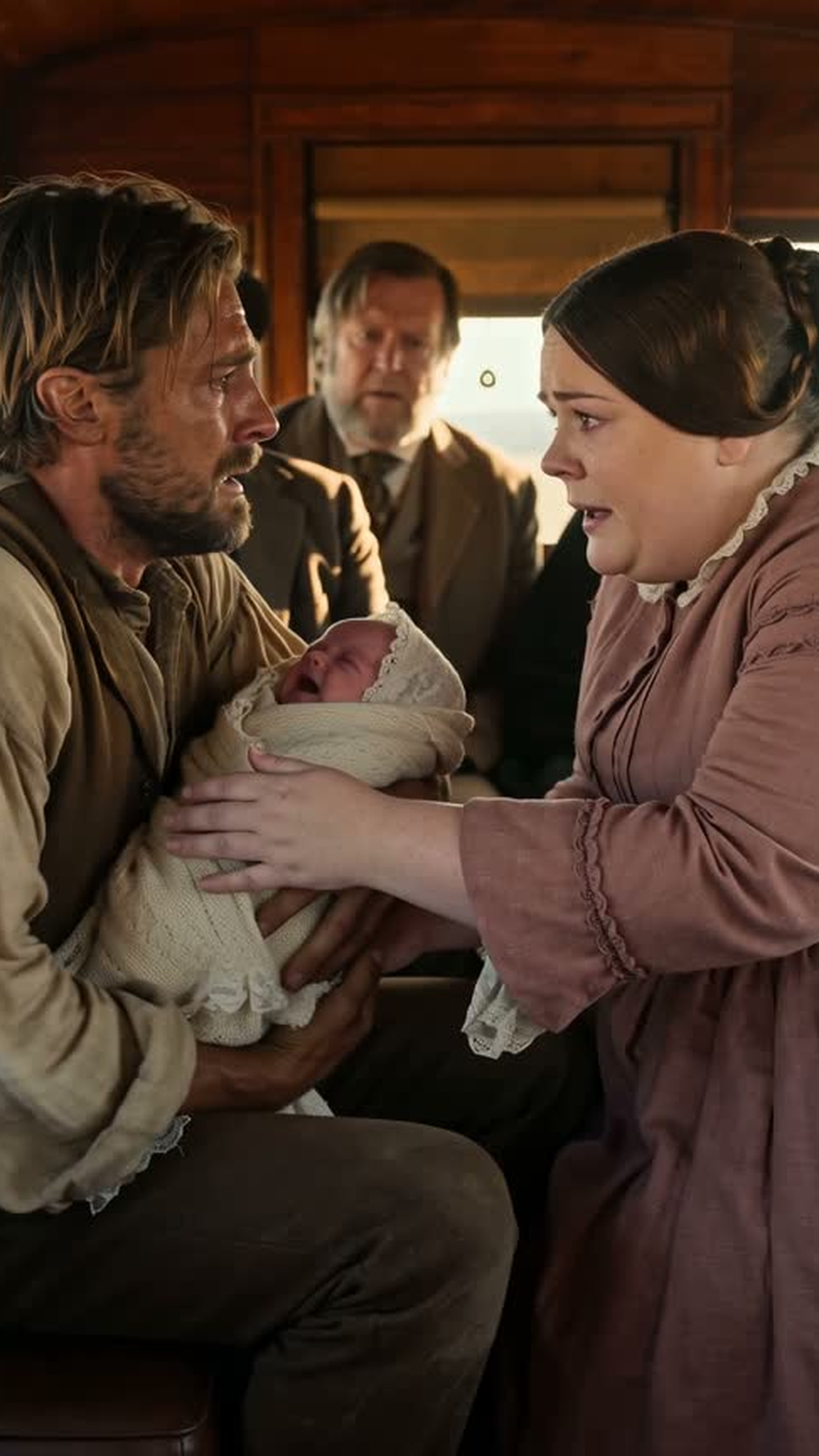
"I'm asking anyway," Caleb said.
They stood in the yard with the heat coming off the adobe and his son crying in real earnest now, and he said it plainly, the way he'd been raised to ask for anything that mattered — standing up, looking at the person, no decoration on it.
"I'm asking you to nurse my son tonight, Mrs. Moore, and on the coach tomorrow, and at whatever stops there are between here and Fort Collins. I'll pay you what a nurse costs — more. I'll pay what you ask. When we get there, my sister has a woman with twins who can take over, and you'll be free of us with my gratitude for the rest of your life. But between here and there, he has no one else on this earth. I've done the arithmetic every way there is. It comes out the same every time."
Eliza looked at the crying baby. Samuel's face was red with the effort of it — and beneath the effort, unmistakable to any eye that knew newborns, the exhaustion waiting underneath like deep water under thin ice.
"You understand it won't be once," she said. "Every three hours. All night. He'll take from me and sleep on me and smell of me, and in two days he'll know my heartbeat better than—" She stopped. Started again, quieter. "Better than is wise. For either of us."
"I know," Caleb said. "I know what it costs. I can see what it costs. I am asking anyway, because the alternative is I bury him between here and Fort Collins, and Mrs. Moore — I have buried all the family I can bury this year. I have nothing left in me for another grave. Not his. Please."
The word *please* from that man was not a small thing. Eliza heard it land and looked down at her own empty hands, and then she did the bravest thing she had done in fifteen days of brave, terrible days: she opened them.
"Give him to me," she said.
It was the second time she had said it. It would not be the last time she said it in her life, but it was the time that changed everything, because the first time had been instinct and this time was a decision.
* * *
The way station fed its guests beans, salt pork, and coffee strong enough to stand a spoon in, and that evening the little party from the broken coach sat at Rosa's long table with the hostlers and the soldiers and ate like people who had survived something together, which they had. Pritchard entertained the table with the history of his sample case. Mrs. Henderson, thawed by Rosa's cooking and the day's events into something almost like an aunt, asked Eliza sensible questions about her people, her farm, her plans in Fort Collins — and when Eliza spoke of the boarding house and the cousin's kitchen job, the old lady nodded the nod of a woman filing information away for later use.
Caleb mostly watched his son sleep in the crook of Eliza's arm at the table — she had not put him down since the yard; he would learn, eventually, that she barely put him down for two days — and tried to understand how a day that had begun as the worst of his life had become something he was afraid to be grateful for, because grief and gratitude in the same hour feel dangerously like betrayal.
Before the meal, in the yard, Caleb tried to settle the practical part like a businessman, because practical things were the only ground he was steady on. He named a figure for the nursing that was generous to the edge of foolish, and Eliza listened with her arms folded and then shook her head slowly, and what she said rearranged something in him.
"What happened in the coach was not work, Mr. Warren, and I won't have it paid for. That was a hungry child and a woman with milk, and if there's a ledger for that it's kept somewhere higher than either of us. From tonight — " she nodded toward the station house, toward the little room, toward the work of the coming night "—from tonight, I'll take a nurse's wage and be glad of it, because I'll be earning it at three in the morning like anybody's hired nurse. But you will not pay me for the coach. And one more thing. In front of other people, I am his nurse that you hired. That is the story, and it's a respectable story, and it protects him and it protects me, and you'll keep to it even when—" She stopped herself. "Just keep to it."
"Yes, ma'am," Caleb said, and meant it, and filed away the unfinished sentence to look at later.
Later, washing up at the basin outside the kitchen door in the last of the light, Eliza found Mrs. Henderson beside her with a towel and an expression that had traveled a long way since the morning.
"I owe you an apology, Mrs. Moore," the old lady said, with the stiffness of a woman unaccustomed to the garment. "And I owe that young man one. I sat in judgment in that coach before I knew a single fact. It's a habit of age and I despise it in others." She dried her hands very thoroughly. "I had a daughter who died at six weeks, in '48. My first. I've never said that to a stranger in my life. I find I want to say it to you, because you said what you said in that coach — about your girl — out loud, in front of people, like it was a fact of the world and not a shame to be hidden. It was well done. It was bravely done."
Eliza's eyes filled. "What's her name?" she asked. "Your daughter."
"Alice," said Mrs. Henderson, startled into a smile that was mostly grief and a little wonder. "Nobody has asked me that in twenty years. Alice."
"Clara," Eliza said. "Mine was Clara."
The two women stood in the yard of a way station in the middle of the plains and said their dead daughters' names to each other in the twilight, and it did not fix anything, and it was not nothing. It was during the meal that the rider came in from the fort road with the news that laid itself over the table like a hand over a lamp. The wheelwright had a broken leg of his own — thrown from a buggy on the very road they were to travel — and there would be no wheel and no axle until his partner came out from Fort Collins, which would be tomorrow, late. And the rider, helping himself to coffee at Rosa's invitation, reported that the creek crossings east were running high and fast from the melt and the rains in the high country, and that a freight wagon had lost a mule in the second crossing two days past.
"Coach that size can make it," he said, "if the driver knows the ford and the water ain't rose more. But it'll be a wetting, and it'll be a fight."
The table absorbed this in the manner of frontier people, which is to say nobody exclaimed and everybody calculated. Caleb calculated the longest: a day lost, at least; a river to fight at the end of it; and between him and Fort Collins a three-week-old boy with nothing to spare. He looked down the table at Eliza, who was looking back at him over the head of his sleeping son, and he saw on her face the exact mirror of his own thought, and it steadying him more than any reassurance could have: *Whatever the road does, we are two now. The boy has two of us.*
When the lamps were lit, Rosa installed Eliza in the little room off the kitchen, with its narrow bed, its door that closed, its hook for a dress. The cradle problem was solved in the frontier manner: a drawer from Rosa's dresser, emptied, lined with the ivory blanket, set on the floor close beside the bed where Eliza could reach it without rising.
"Tonight he sleeps by you," Rosa said, in the tone of a woman stating the course of a river. "Babies who have been hungry dream of it. He will wake afraid. You will be there. Bueno." And she went out and shut the door with enormous gentleness.
Eliza stood in the small room in her loosened dress with a stranger's baby asleep in a drawer at her feet and her dead daughter's name suddenly so close behind her teeth that she had to press her knuckles against her mouth to keep it in.
*Clara,* she thought. *Oh, Clara. Look what the world has done. It has put another one in my arms because it took you out of them — and I am supposed to be grateful, and I am, and that is the worst of it, that I am.*
She lay down. Before she did, out of some instinct older than the grief, she took from her carpetbag the small white cap she had knitted for Clara — the one thing she had kept — and she stood a long time with it in her hands, and then she folded it, once, and laid it along the edge of the drawer where Samuel slept, not on him, not as a claim, just near; the way you set a place at a table for someone whose chair will stay empty, because the setting of it is itself a kind of love and the not-setting of it would be a kind of lie. Then she lay down in the narrow bed in the little room off a stranger's kitchen, a hundred miles from the grave, and slept the way soldiers sleep — lightly, armed, one hand's reach from the drawer.
The station settled. Somewhere a horse stamped, a soldier laughed once, far away, and the windmill turned and turned in the dark.
Samuel woke at ten, hungry and indignant, and she fed him in the lamplight with her eyes closed and her tears running silent into her hair, because he was not Clara and because he was warm and alive and working so hard at living, and those two things had to be allowed to be true at the same time or she would break. He woke again at one, and fed, and this time she talked to him while he did — nonsense, weather, the names of things — the way she had talked to Clara, the way mothers have talked in the dark since the world began. He woke again toward four, fussing before he was fully awake, and she lifted him out of the drawer still half asleep herself, and settled him, and felt him latch with the confidence of a baby who has learned that the world answers —
— and then her hand, moving by habit across his back, stopped.
Heat. Not warmth — heat, radiating through the little flannel like a coal through cloth. She sat up properly in the dark, wide awake in an instant, and put her palm flat against his chest and felt his heart going too fast under it, light and fluttering and wrong, and his skin was dry, and his cry when it came was not hungry this time. It was thin and bewildered, the cry of a child whose body has become a frightening place.
"Fever," Eliza said aloud, to the empty room.
She was already on her feet, already wrapping him, already reaching for the door — because a baby who has barely eaten in three weeks of life does not have anything to spare for a fever to burn, and she knew, the way she knew everything about that night, exactly how little time there might be. Clara had gone from fussy at supper to gone by morning. *Not again,* Eliza thought, with a ferocity that lifted the baby and the lamp and her whole heart in one motion toward the bunk-room door. *Not this one too. Not while I'm standing here. You will have to come through me.*