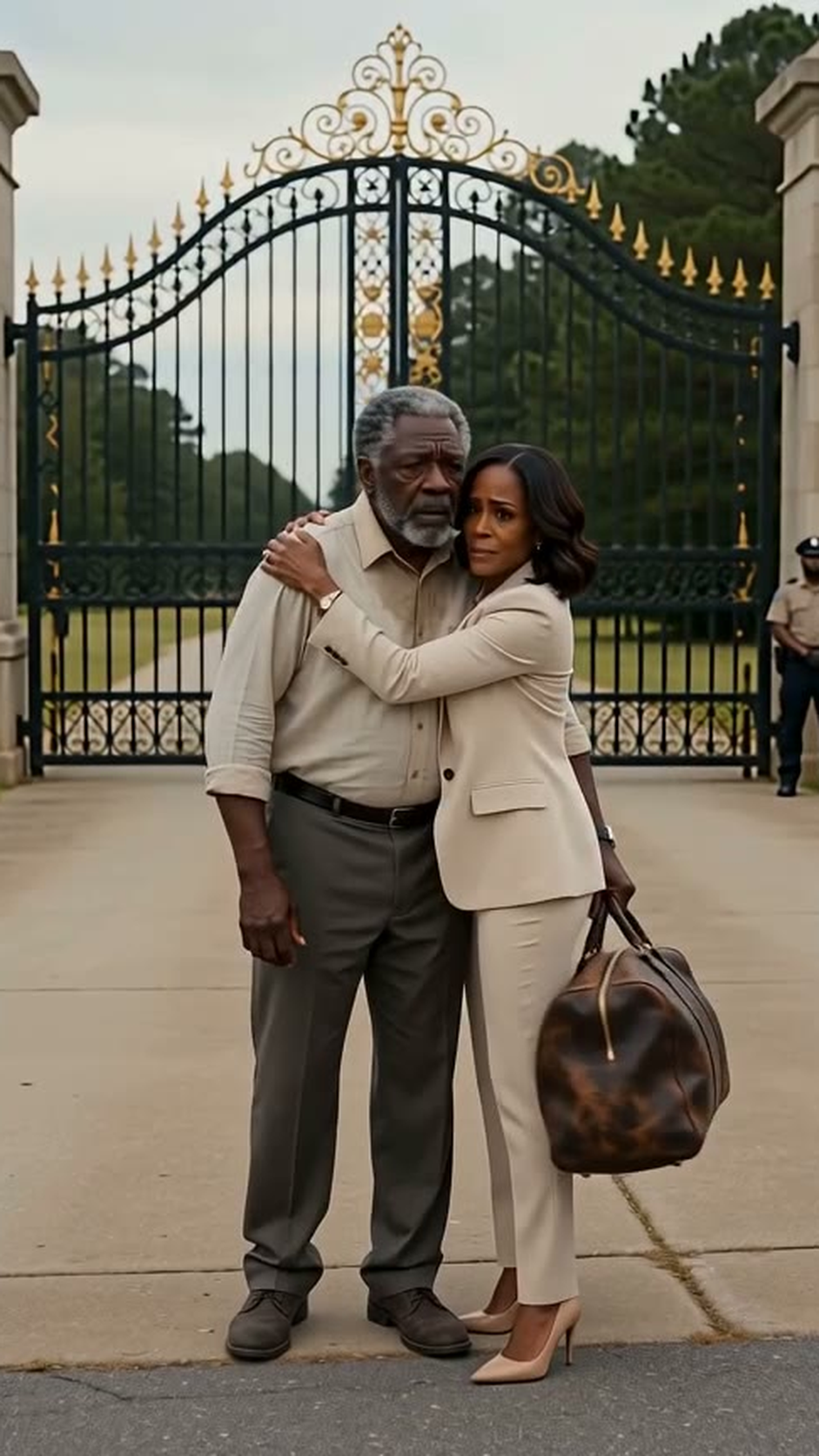
Aaron Crawford missed his bus.
He stood in the depot doorway a long time with his ticket in his hand and the northbound breathing its diesel out into the cold, and then he walked back inside, past his brother, past Melanie, and picked up his father's leather bag off the floor.
"You've carried enough of my weight," he said. "I'll carry the bag."
The four of them drove home in two cars through a darkening state — Gerald in Kenneth's passenger seat, because neither of his sons would discuss any other arrangement; Aaron in the back of Melanie's, with the bag at his feet and his envelope of ticket money refolded around a future he hadn't planned past 3:40 in the afternoon. Nobody spoke much. There was a point, an hour in, where Kenneth's car pulled alongside at a light and Melanie watched father and eldest son ride in perfect silence, two profiles staring forward, matching jaws, and thought: well. It's a start. A terrible, necessary start.
The lights of the Crawford house were all on.
Harlan Pierce stood in the Crawfords' front hall in a cashmere coat with his hands folded, a man so completely composed he seemed to lower the temperature of rooms, and Julian beside him looked like a man who had been arguing in a car for forty miles — hair wrecked, eyes red, jaw set at an angle that suggested the argument was not finished and he intended to win it. Giselle sat on the stairs in a silk robe with her engagement ring turning and turning on her finger. She looked up when the door opened. She looked at her father first.
Then she looked at the man standing behind him, and the ring stopped turning.
"Hi, Gigi," Aaron said quietly. "You look—" His voice failed him entirely. "You look like Mom."
What happened in the Crawford dining room that night took three hours and one pot of coffee and could not have been shortened by a single minute.
Aaron did it standing, at first, at the end of the table where the letter had lain — the table where his father had been voted into a shed — and he told it the way he'd told it at the depot window, except this time he told all of it: Rusk, the stamp, the transfers, the kitchen table five years ago, the promises, the running. He had brought his own evidence against himself in a oilcloth folder out of his duffel: five years of money-order receipts, a lawyer's accounting of every victim repaid with interest, dates, names, amounts — the paper trail of a man serving a sentence nobody had imposed. He set it in front of Harlan Pierce like an exhibit, because old habits of judgment recognize judges.
"One question," Harlan said, before Aaron had finished. He had the stillness of a man who had asked questions for a living in rooms where the answers cost people decades. "The debt. The man Rusk. If you're confessing to Tuesday's crime, young man, I want to know whether there's a Friday still out there waiting to be collected — because a wedding is not the place to discover it."
Aaron didn't look away. "Paid in full by the second winter, Judge. Every cent, out of wages, before I sent the victims a dollar — he had to be finished first or nobody was ever safe. He died in a car wreck outside Memphis two years ago." A flicker of something that, in a different man, might have been satisfaction. "The devil collected that one himself. There's nothing outstanding on me anywhere except the law, sir. The law can have its turn with my compliments."
"And why now?" Harlan asked. "Five years of silence held. You could have run that bus out of the state tonight and been a rumor by Christmas."
Aaron looked down the table at his father, sitting quiet with his hands folded, a man being discussed in his own dining room like weather — and his answer came out plain as a nail going in. "Because he's done paying. Whatever it costs from Monday morning on is mine, and I've taken long enough to send the invoice to the right address."
Kenneth said almost nothing for the first hour. He sat with both forearms on the table and his father's portrait-facing profile and listened to his entire adult life being re-explained to him. Once, when Aaron described the night at the kitchen table — Gerald refusing, Gerald deciding — Kenneth made a sound and got up and went to the window, and stood there with his back to the room and his shoulders going, and Melanie watched Giselle reach out, automatically, and take their father's hand where it lay on the table beside her, and hold it like a woman overboard holding a rope, and not appear to notice she had done it.
At some point in the second hour, Giselle got up without a word and left the room, and Kenneth half-rose to follow her, and Gerald — without looking up — said "Let her," in the tone of a man who knows the geography of his own children. She was gone eleven minutes. She came back carrying the portrait from the wall above the sideboard, the big gilt-framed Margaret, laughing, mid-sentence, twenty years young — and she set it on the empty chair at the table's far end, propped like a guest, like a witness, like the fourth vote the family had been missing all evening.
"She should be in the room for this," Giselle said to no one in particular, savagely, wiping her face with the back of her wrist. "She was in the room for all of it the first time. Carry on."
It was Kenneth, finally, in the third hour, who turned in his chair and spoke to his father directly for the first time since the bus station — not loud, not composed, a man setting down a box he's carried so long his arms have forgotten the shape of empty.
"At Mom's funeral," he said, "the director asked if the family wanted a moment alone with her before they closed it. I said the family was all there. I said it standing twenty feet from a telephone with your number on the approved list, Dad. I have thought about that sentence every day since you—" He stopped. Worked. "I am not asking you to absolve it. I don't think it absolves. I just need it in the record of this family that I said it where you could hear it."
Gerald reached across the corner of the table and put his hand over his eldest son's, and held it there — the same hand that had slammed that table three weeks before, gone still at last under his father's.
"You told people what I gave you to tell them, son," Gerald said. "A man doesn't get to hand his children a loaded story and then bill them for carrying it. That's on the giver. Put it down, Kenneth."
Gerald tried twice to take the floor and soften his son's account of him. The second time, Aaron turned on him with a gentleness more devastating than any shout:
"Dad. You don't get to confess for me twice. Sit down."
Gerald sat down.
It was Harlan, at the end, who spoke the way other men breathe. He had listened without a single interruption, turning the oilcloth pages one at a time.
"Young man," he said to Aaron, "on Monday morning you will surrender yourself, with counsel, and you will tell the district attorney what you have told this room. I will make some telephone calls — not to fix anything. To make sure the right people are in the room when you say it. The money's repaid; that matters. The five years are spent; that will matter more, though God forgive the arithmetic. What the law does with you after that is the law's business." He closed the folder. "It is not mine. I want that understood."
"Yes, sir," Aaron said.
"Then I'll tell you what IS my business." The old judge rose, and for the first time that night his composure cracked open along a seam of pure, banked rage — not at anyone in the room, but at something older and colder. "I have known of your father by reputation for thirty years, Crawford Properties, a man whose word closed deals money couldn't. When I heard the news five years ago I believed it, like everyone. When my son told me he wanted to marry into this family, I checked what remained to be checked, and I decided I could hold my nose about the unfortunate chapter." His voice dropped. "This afternoon a photograph reached me through a reporter I have known since he was a stringer with acne, and I sat in my car outside this house composing the speech that would end this engagement, because I do not attach my family's name to disgrace."
He looked at Gerald. He looked at the oilcloth folder.
"There is no disgrace in this room. There's a crime, and it has an owner, and he's standing up and owning it — five years late and at ruinous cost, but I have sentenced men who did less with better lawyers." He turned to Julian. "Son?"
Julian Pierce crossed the room, took Giselle's other hand — she was still holding her father's with the first — and said, "I already told him in the car. I'm not marrying a woman who has to hide her father to be acceptable to me. I'd never respect either of us again." And Giselle made a sound that was not dignified at all, and put her face down into the tangle of hands on the table, and wept like a child of six.
Before the old judge left, he did one more thing, and he did it standing, hat in hand, in the Crawfords' doorway, with the air of a man paying a call he should have paid years ago.
"Gerald. When the confession is filed, there'll be a petition to vacate your conviction. It should have a good lawyer's name on it and it should not take five years to move. My old firm will carry the costs of that filing, if you'll permit it. Call it a wedding present to the family."
Gerald considered him for a moment with the level gaze of a man who has been given charity in institutions and knows the taste of it. "Call it a loan, Judge," he said. "Crawfords pay their debts. It just occasionally takes us a while to get the address right."
Harlan Pierce laughed — a real laugh, startled out of him — and put out his hand, and the two old men shook on it like a fence line being agreed.
Later — much later — after the Pierces had gone home and the house had settled into the bruised quiet of a place where the bleeding had stopped, Melanie found Gerald in the doorway of the guest room. Not the shed. Melanie had put clean sheets on the guest room bed at some point in the proceedings without asking anyone's permission, and the house had simply accepted it as fact.
He was sitting on the edge of the bed holding the folded chapel program, turning it over and over.
"You should have told me there'd be a test," he said, and she realized he was joking, or building a road toward joking, which was more.
"There's one tomorrow," she said. "Wedding rehearsal. Family's expected." She let the words sit. "All of it."
He nodded slowly. "Then I'll need a suit."
The knock came at midnight, soft as moths. Melanie, not quite asleep on the couch where she'd gone to let Kenneth have the bedroom to think in, opened the front door to find Giselle on the porch in her robe and slippers, bare-faced, holding something folded in tissue with both hands like an offering.
"I have something to ask him," Giselle said. "And Melanie — I have no right at all to ask it."