The trouble was that kindness, practiced daily, becomes visible — and in the Moretti house, everything visible belonged to Mrs. Gable.
It began with the laundress, a stout Ukrainian widow named Marta, who took Nora aside by the ironing tables with her hands still moving, out of lifelong habit, through a pile of the old man's shirts.
"You feed him," Marta said. It was not a question. "The shirts. His collars — before, always the food down the front, from the girls rushing. Now, clean. Somebody feeds that man careful, like a baby bird, and it is not the nurse, because I see the nurse's car and it is one hour, no more." She pressed a shirt flat with enormous tenderness. "I say nothing. Marta says nothing for thirty years, that is how Marta is alive. But I tell you one thing, little mother." Her eyes went to Nora's belly. "Signora Gable counts everything. The butter. She will count the butter, one day."
She counted it nine days later.
It was not the butter, in the end. It was the weight. The agency nurse — a new one, a young man with a tablet and a bored expression — weighed Giovanni at his monthly check, frowned, weighed him again, and said, in the hearing of the day room door and therefore of the whole corridor: "Huh. He's gained three pounds."
Three pounds. Three pounds of mashed potato and stolen custard and Bruno's soft rolls torn small, in a man whose chart had sloped downward for a year. It might as well have been a gunshot. By supper the whole staff knew, and by supper Mrs. Gable knew that the whole staff knew, and Nora stood at her place in the servants' hall line at six the next morning with her hands folded and her heart like a fist, and watched the gray head come down the row, pencil first.
"Don Giovanni has gained weight," Mrs. Gable said pleasantly, to the room at large, when she reached the end of the line. "His digestion is delicate. Unauthorized feeding could kill him. Whoever has taken it upon themselves to interfere with his medical regime" — she let the silence do the work — "will not merely be dismissed. They will be reported to the agency for endangering a helpless man, and the agency will report them to the police." Her gaze moved along the faces, unhurried. "Am I understood?"
"Yes, ma'am," the line murmured.
Nora said it with the rest, looking at the floor, feeling the baby turn over slowly inside her like something surfacing.
She stopped going for two days.
On the third day, wheeling her cart past the day room at the dead hour with her eyes straight ahead — obeying, obeying, being good, being safe — she heard a sound from inside the room.
It was not a word. He could not make words; that had been taken from him with nearly everything else. It was a breath, shaped. A thin, cracked exhalation, repeated — the sound a man makes when he has exactly one sound left to him and he is spending it.
He had heard her cart. He knew the cart. He knew the squeak of its left wheel the way you know a voice.
Nora stood in the corridor with her hands on the linen and her whole life balanced on the squeak of that wheel, and thought about the police, and the agency, and two hundred and eleven dollars, and a baby with no one in the world but her.
Then she thought about the word refused, written in black ink, lying about a starving man.
She pushed open the door.
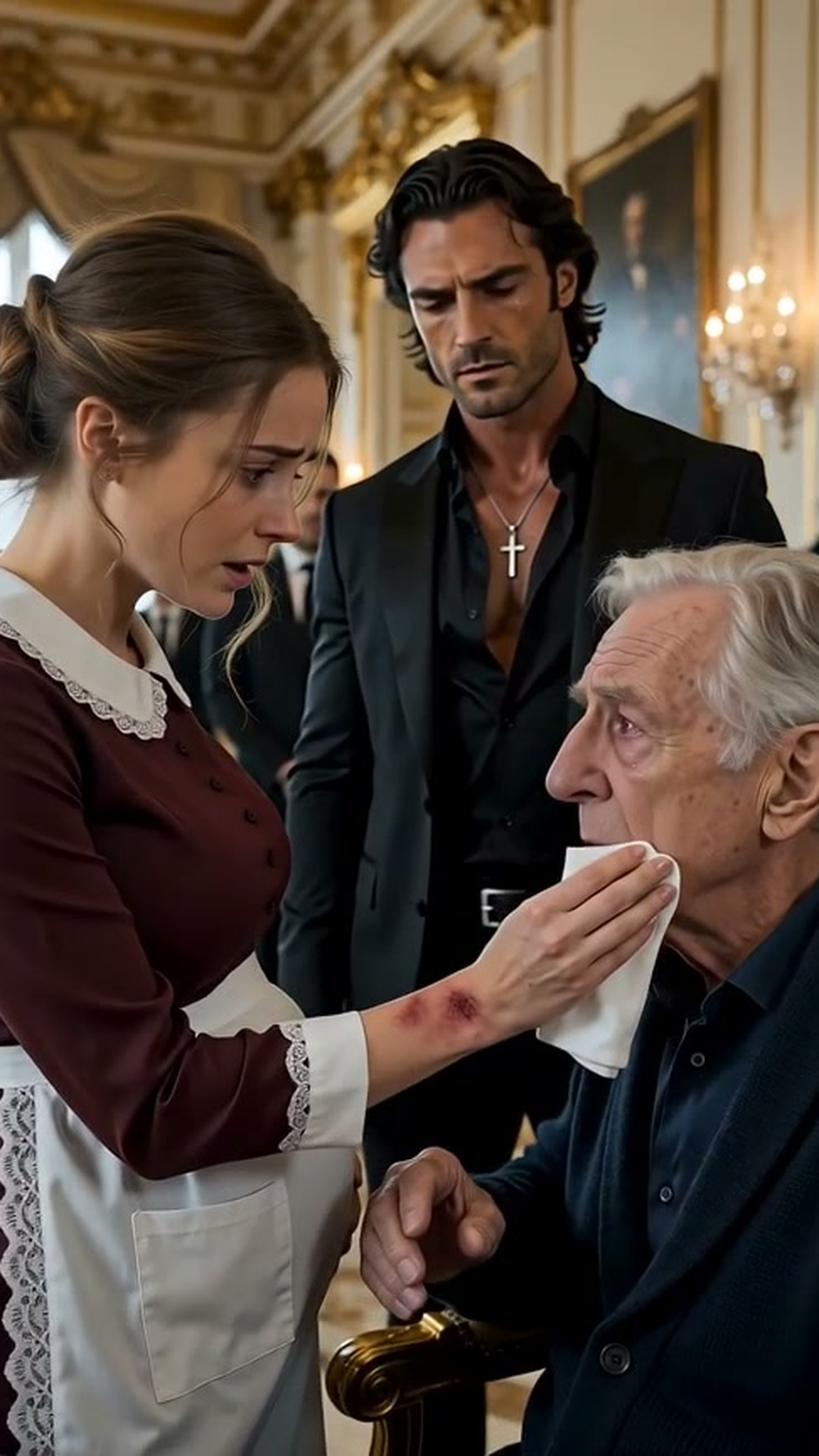
He was thinner already — three days, and something in his face had gone out like a lamp turned down. His eyes fastened on her and filled so fast it frightened her, and she was across the room before she knew she had moved, kneeling, her handkerchief already out, her own eyes streaming.
"I'm here," she said. "I'm here, I'm here. I was afraid. I'm sorry. I was afraid and I left you, and it will never happen again, do you understand me? Never. Let her do her worst."
His fingertip tapped against her wrist — once, twice, again, again — and she fed him, that day, with the door unlatched, in the open, like a soldier.
That was the day she stopped stealing and started documenting in earnest.
She did not know, yet, the half of what there was to document. She learned it in layers, the way you learn a house is on fire floor by floor.
She learned that the specialists' reports — the famous specialists, the car with the driver — were filed by Gable and never once read aloud to the staff who might have acted on them; that the great television in the day room had a broken remote and had played the same channel, unwatched and unwatched-for, since spring; that the physiotherapist whose visits Lorenzo paid for twice a week had been turned away at the gate so many times by Gable's orders — the old man is resting, the old man is agitated, the old man refuses — that he had stopped coming altogether, and his invoices, Nora saw with her own eyes on the one occasion she dusted the housekeeper's office, were still being submitted.
She learned that the evening nurse's hour was habitually cut to twenty minutes, and signed for sixty.
She timed her own rounds against the kitchen clock after that, and wrote the times down too — who came up the back stairs and when, how long the day room door stood open, the rattle of the medicine trolley and how soon it rattled away again. Facts, she was learning, had a weight that feelings did not. Feelings could be called hysterical, could be called a pregnant girl's fancies. A column of times in a steady hand could only be called true.
And she learned — last, and worst, on a Thursday, when a relief nurse she'd never seen, a tired woman in her fifties with a Birmingham accent, came out of Giovanni's room holding his medication tray and shaking her head — she learned about the pills.
"Half the blister's still full from Tuesday," the nurse said to the corridor generally, annoyed, professional, unaware she was speaking to a girl who would remember every syllable on her deathbed. "His heart tablets. And the evening dose from yesterday, still in the cup. Whoever's been signing these off—" She looked at Nora and stopped, reading something in her face. "You just do the linen, love?"
"Yes," Nora said. "I just do the linen."
"Then you didn't hear it from me." The nurse lowered her voice. "Skipped heart medication, on a man with his history? That's not laziness. That's a countdown."
That night, Nora did not sleep. She lay in the narrow bed under the eaves with her notebook on her knees and copied out everything she had, in order, with dates, in her neat hand: the feeds, the refusals-that-weren't, the physio at the gate, the signed-for hours, the pills. Page after page. Evidence, she understood now — that was the word for what she had been keeping all along, without daring to name it. Not kindness. Evidence.
She wrote until the letters blurred. And then, on the last page, she wrote the thing she had not known she knew until her pencil formed it:
He is being killed slowly by inches, in a house full of people, and everyone is paid to look away. If I am dismissed I will take this book to Mr. Moretti himself, wherever he is, and if they will not let me near him I will give it to the police and then to the newspapers, and let them make of me what they like.
She had one more piece of evidence, though she did not yet know it was evidence, and it came to her by accident on the last day of the cellar rota's shadow — the day before the knock.
She was polishing the silver in the pantry, a job given to girls Gable wished to keep where she could see them, when the agency's area manager came through on his quarterly inspection — a smooth man in a gray suit who was shown the house the way you show a buyer a horse, at the trot, from the good side. Nora heard them through the pantry door, Gable's voice smooth as poured cream.
"Don Giovanni is a very challenging case, Mr. Pruitt. The family is devoted — oh, entirely devoted — but the gentleman refuses care. It is in all our records. We do everything. Everything. Some patients simply decline, you know. It is a sadness for everyone."
"And the staff turnover?" the man asked, mildly. "Three this month, the agency said."
"Girls today," said Gable, with a sigh that deserved an award. "They find the work melancholy. Watching a great man decline. The sensitive ones leave."
The door closed on the rest. Nora stood in the pantry with a silver spoon in her hand and polish on her fingers, and she wrote that conversation down too, word for word, that night, because by then she wrote down everything, the way a drowning woman inventories the boat. We do everything. The sensitive ones leave. She underlined leave twice.
Because that was the machinery of it, finally laid bare for her: not cruelty with a whip, which can be pointed at, but cruelty with a filing system. A great house, an absent son, a woman who had understood that if you controlled the records, you controlled reality — that a man who could not speak existed only as other people described him, and she had made herself his only description. Refused his lunch. Refused his medicine. The sensitive ones leave. It was all there in the black book and the gray man's clipboard, a whole human being edited down to a set of excuses for why no one needed to look at him.
"Somebody looked," Nora wrote at the bottom of the page, and her hand shook with something that wasn't fear anymore. "That's the entry you didn't plan for, madam. Somebody looked, and somebody can hold a pencil, and it's all in here."
She closed the notebook. Outside her little window, the estate lay dark and enormous and unaware, and somewhere below her an old man was lying in the dark too, in a room that locked from the outside by rota and routine, with his evening medicine in its cup where the nurse who never stayed the hour had left it, and his whole life narrowed to the sounds of a house deciding, night after night, that he could wait until morning.
There was a knock at her door.
Nora's whole body went cold. It was past midnight. Staff did not knock at other staff's doors at midnight; staff did not do anything at midnight except sleep and be invisible.
She hid the notebook inside the detergent manual, slid the manual into the linen press in the corner — her hands did it before her mind had finished being afraid — and opened the door with her face arranged.
Tessa stood there in her nightdress, barefoot, shaking.
"She's done the rota for next week," Tessa whispered. "Nora. She's put you on nights. Cellar and laundry, nights, all week, starting tomorrow. A woman six months— in the cellar, on your feet, all night, with the damp—" Tessa's eyes were full. "It's because of the weight. She knows it's somebody and she thinks if she breaks the new girls one of us will tell. She'll break you first, because you're—" She stopped.
"Because I'm the one with something to lose," Nora said quietly.
"Run," Tessa whispered. "Tonight. I'll say I never saw you. The agency has other—"
"No." Nora looked at the frightened girl, and then past her, down the dark corridor toward the stairs that led, eventually, to a room where an old man lay alone in the dark with his heart medicine sitting untouched in a cup, counting — she knew this now, she knew it in her bones — counting the hours by the sounds of a house that had forgotten him. "No, Tessa. I'm not running."
"What will you do?"
Nora put her hand, very gently, over the swell of her belly, where her child — Daniel's child, the last of him — slept in the dark, safe, for now.
"I'm going to finish the book," she said.