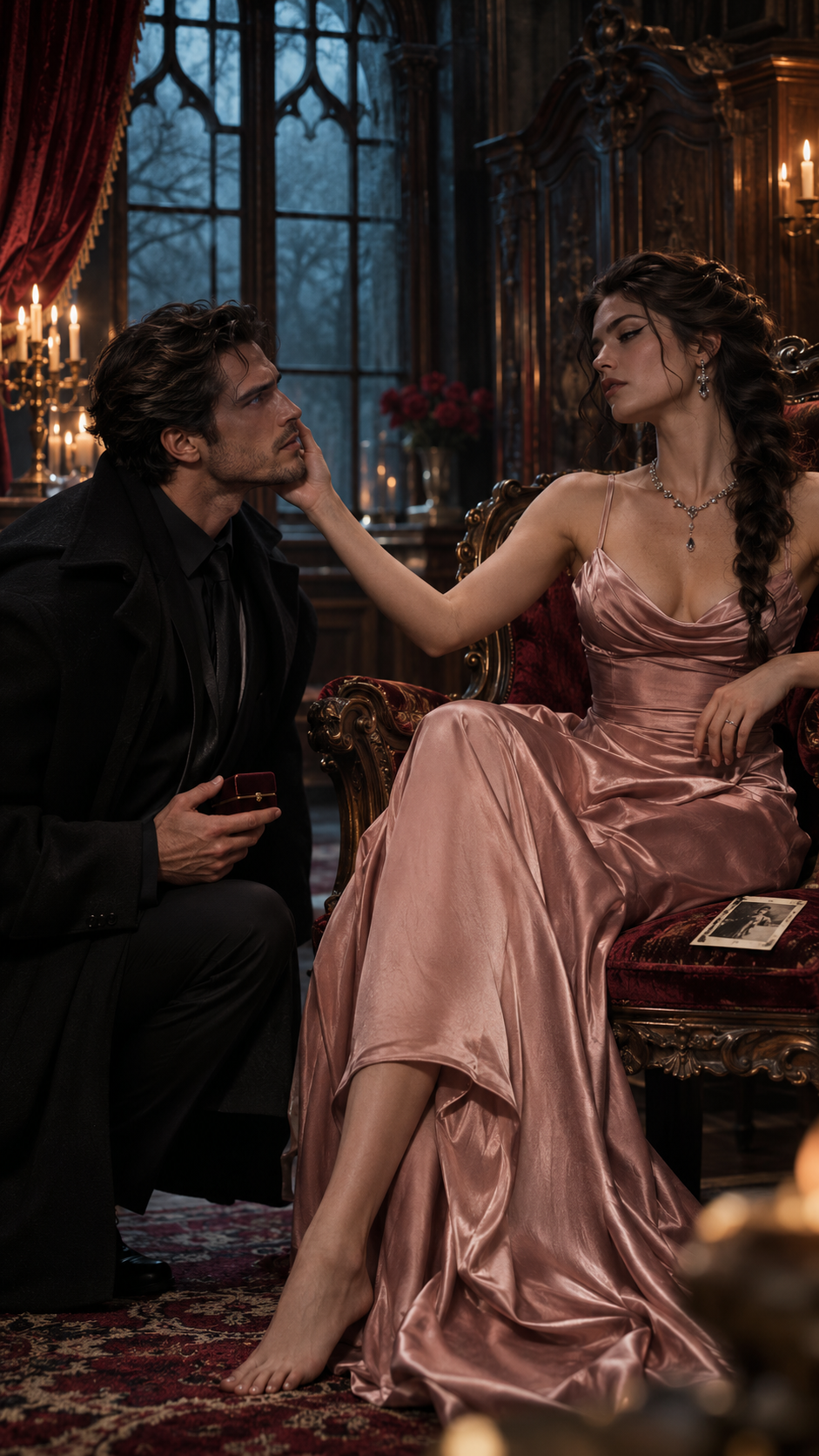
The silver car stopped beneath the black stone arch at Ashcombe House, and Elias Moretti stepped into the mist with a wedding ring locked inside his fist.
He was thirty-two, six feet two, broad-shouldered beneath his black coat, and accustomed to rooms becoming quiet when he entered them. Tonight, the silence waiting beyond the estate doors felt different. It did not belong to fear. It belonged to a woman who had decided he would answer her questions.
He crossed the courtyard without an umbrella. Cold mist gathered in his dark hair and along the shoulders of his suit. Through the tall windows, candlelight warmed the old house, turning the glass gold against the blue night.
The door to the vintage room stood open.
Adeline Laurent sat alone in the carved wooden chair beside the mirror. She wore a pale pink silk satin gown with a full skirt, her bare feet resting on the dark rug. Her long brown hair had been gathered into a French twisted braid that fell over one shoulder. Diamond earrings caught the candlelight. A delicate necklace rested against her throat. Black eyeliner made her gaze appear even more direct.
She did not rise.
On the chair beside her lay an old photograph album opened to two pictures: Nico as a boy beside a piano, and Nico at twenty-five, smiling beside Adeline on the conservatory steps. The edges were worn from being handled too often.
Elias stopped in the middle of the room.
“You came,” Adeline said.
“You asked me to.”
“I asked you to come alone.”
“I did.”
She glanced toward the door. “No guards?”
“Not inside the house.”
“Then you have learned one thing.”
He looked at the photograph. His jaw tightened.
Adeline's hand rested on the chair arm. “You know why I called you.”
“Yes.”
“Say it.”
He opened his fist just enough to reveal the small burgundy ring box. He did not open it.
“I know what happened to Nico.”
“No,” she said quietly. “You know what someone wants you to believe happened to Nico.”
Elias took one step closer.
“I know the M-17 authorization carried my father's approval.”
“Your father's name appeared on it.”
“And mine.”
“Your name was used.”
He lowered his eyes to the box.
Adeline watched him for a long moment. Then she leaned forward and touched his face with the tips of her fingers. His cold blue eyes flickered. Her expression remained controlled, almost severe, but her hand moved to his chest and rested above his heart.
He trembled once.
“Do not mistake this for forgiveness,” she said.
“I don't.”
“Do not mistake it for a proposal.”
“I would never.”
“Then why are you holding that ring?”
“Because I have carried it for eight months, and I no longer know where else to put it.”
Her hand remained against his chest.
“Then kneel,” she said. “Not to ask me to marry you. Kneel because you owe the truth a lower place than your pride.”
Elias lowered himself onto one knee.
He did not open the box.
For a moment, the room contained only the sound of the candles and the distant wind pressing against the windows.
Adeline looked down at him.
“Now tell me what you did.”
***
Eight months earlier, Elias had believed the worst thing waiting for him in his father's study was another argument about succession.
The Moretti family headquarters occupied the upper floors of a stone building overlooking the Schuylkill River in Philadelphia. The public offices were respectable: shipping, property management, private security, and charitable foundations. The private offices were quieter, guarded by people who understood that the family name carried a history no brochure would describe.
Elias had inherited the organization at twenty-eight, after his father stepped back from daily operations. Vittorio Moretti remained its patriarch, a man whose sixtieth birthday was approaching and whose influence could still make a boardroom change its mind.
Elias had tried to make the family legitimate. He had sold two companies, closed an offshore account network, and ordered an internal review of every contract connected to the old security division. His father called it sentimental housekeeping.
“You're dismantling what kept us alive,” Vittorio told him that morning.
“I'm dismantling what can put us in prison.”
Vittorio stood by the window in a charcoal suit. At sixty, he remained tall and handsome, with silver hair, a straight back, and an expression that rarely revealed whether he was pleased or offended.
“You speak as if the family is a criminal enterprise.”
“I speak as if prosecutors have files.”
“Prosecutors always have files.”
“And now they have a reason to read them.”
Vittorio turned. “You have become cautious.”
“I have become responsible.”
“Those are not the same thing.”
Elias placed a folder on the desk. “The M-17 transfer authorization needs an explanation.”
His father's expression did not change, but his attention sharpened.
“Where did you find that?”
“In the archived security orders.”
“Those records are incomplete.”
“Then help me complete them.”
Vittorio did not touch the folder. “M-17 was an emergency relocation order.”
“It was issued on the night Nico Laurent was killed.”
A silence followed.
Vittorio moved toward the desk. “Nico was not a member of this family.”
“He was Adeline's son.”
“Adopted son.”
Elias's expression hardened. “That distinction meant nothing to her.”
“It meant everything to the people who needed to understand the risk.”
“What risk?”
“Your wife was asking questions about the foundation accounts. Nico was helping her. He had access to records that were not his responsibility.”
“He was an auditor.”
“He was an amateur.”
“He was twenty-five.”
“And now he is dead.”
The words were delivered without emotion. Elias felt them land like a door closing.
He opened the folder. The first page carried an M-17 reference, a route change, and an emergency authority code. The sealed annex described the movement as a targeted removal, the cold internal language of a hit. Vittorio's name appeared beside the approval line. Elias's own initials were typed in the authorization field.
“I did not sign this,” Elias said.
“You approved the emergency protocol.”
“Not this order.”
“You delegated authority.”
“To whom?”
Vittorio looked at the folder. “The security office.”
“Which person?”
“Elias, there are things you do not understand about how this family survived.”
“Then explain them.”
His father closed the folder.
“Not here.”
Elias stared at him. “Nico was killed after this order was issued. I want to know who changed the route.”
“You want a clean answer to an ugly event.”
“I want the truth.”
Vittorio's gaze turned cold. “Truth is often the luxury of people who did not have to make the decision.”
Elias left without another word.
He called Adeline from the elevator. She did not answer. He sent a message saying he needed to see her. She replied only: *Not until you know what you are asking me to forgive.*
He had not understood the sentence then.
He understood it now.
***
Nico Laurent had been adopted by Adeline when he was twelve, after a difficult period in which she had become the only adult who consistently showed up for him. He grew into a thoughtful, disciplined young man with dark curls, a quick smile, and an inconvenient habit of asking for source documents whenever someone offered him an explanation.
Adeline had been a concert pianist before the Moretti marriage. She left the stage after a hand injury and later built a small music scholarship program. Nico became the person who helped her manage its accounts. He was not impressed by the Moretti fortune, and he never pretended to be.
Elias remembered a dinner at Ashcombe when Nico had asked why a charitable foundation needed three layers of private companies to pay for a music room.
“Because the world is complicated,” Elias had answered.
“Then the paperwork should make it less complicated,” Nico replied.
Adeline had smiled into her glass.
Elias had liked the young man. He had not understood how much until he was gone.
The official report said Nico's car had left the approved route during a storm and collided with a barrier outside the city. The report was short. The vehicle records were incomplete. The driver was listed as unidentified. Adeline had been told the death was immediate.
Elias had been told the same.
Then, six days after the funeral, a copy of the M-17 authorization appeared on his desk.
The order carried Vittorio's approval and Elias's initials. It redirected Nico's vehicle from the planned route to a private road controlled by a Moretti security contractor.
Elias had not signed it.
He knew his own signature. He also knew the initials were not quite right.
He had asked his chief of staff, Silas Vane, to trace the file. Silas had been with the family for twenty years and had served Vittorio before Elias took over. He was fifty-four, neat, soft-spoken, and so careful with words that even a compliment sounded like a legal disclaimer.
“It's an old emergency order,” Silas said. “The original has been archived.”
“Who entered the route change?”
“The system lists the security office.”
“Which person?”
“I'll need to check.”
“Check now.”
Silas looked at him. “Your father's birthday gala is tonight. Perhaps this can wait until tomorrow.”
“It cannot.”
“Understood.”
But Silas did not return with an answer.
***
Before the gala, Elias had visited Nico's office in the Civic Trust building. The desk had been cleared, but a pencil mark remained on the wall where Nico had measured a shelf. A stack of music scholarship applications sat in a box, each one annotated in his careful handwriting.
Elias had taken the box to the car. He had intended to deliver it to Adeline, but he had not found the courage to enter Ashcombe.
He had kept the box in his study for six months.
When Adeline later asked whether he had anything of Nico's, Elias had said no.
That lie, more than any argument, had helped end their marriage.
The Moretti sixtieth birthday gala took place at the Bellgrave Hotel, in a ballroom decorated with white roses, crystal chandeliers, and black-and-gold banners. The guest list included judges, property developers, donors, politicians, and people who preferred not to appear in photographs.
Elias arrived without Adeline.
Vittorio stood at the center of the ballroom receiving congratulations. He wore a black tuxedo and a silver watch. His smile was practiced, his posture immaculate.
When Elias approached, his father lifted a glass.
“There he is. The future of the family.”
“The future needs to speak with you.”
“Not tonight.”
“Tonight.”
Vittorio's smile remained in place for the guests. “You are making a scene.”
“Then answer the question.”
Silas appeared at Vittorio's shoulder. “Perhaps we should move to the private salon.”
Elias looked at him. “You had a day to find the original M-17 file.”
“I am still tracing it.”
“Then why did you tell me it was archived?”
“Because it was.”
Vittorio placed a hand on Elias's arm. “Enough.”
Elias stepped away.
“Did you authorize the route change that killed Nico Laurent?”
Nearby conversations faltered. A woman with a champagne flute stopped mid-sentence. Two board members exchanged a glance.
Vittorio's expression hardened.
“Not here.”
“Did you?”
“I authorized an emergency security transfer. I did not authorize anyone to kill a young man.”
“Who changed the route?”
“I don't know.”
“Who used my initials?”
Vittorio's eyes narrowed. “You signed the emergency delegation.”
“I signed a policy. Not an order to move Nico.”
“You were responsible for the system.”
“And you controlled the security office.”
The ballroom had become quiet enough for the string quartet to be heard clearly.
Vittorio lowered his voice. “Think carefully about what you are accusing me of.”
“I am thinking about the man Adeline buried.”
“Adeline should have stayed away from our affairs.”
Elias's face changed.
“Do not speak about her.”
“Then stop bringing her into a family matter.”
“She is my wife.”
“She is a weakness you have mistaken for a virtue.”
Elias looked at his father and saw something he had not wanted to see: not grief, not regret, but irritation that the subject had become public.
He turned to Silas.
“Bring me the original order.”
Silas hesitated.
Vittorio answered for him. “There is no original.”
Elias looked back at his father.
“Then what did you sign?”
Vittorio leaned closer. “I signed what I was told would protect this family.”
“By whom?”
The older man did not answer.
Elias left the ballroom. Outside the hotel, cold rain had begun to fall. He called Adeline again.
This time she answered.
“Elias?”
“I need to see you.”
“Why?”
“Because I think my father was connected to Nico's death.”
A long silence followed.
Then Adeline said, “Come to Ashcombe.”
“Tonight?”
“Tonight.”
He heard her take a breath.
“And bring the ring.”
He looked down at the small box in his hand.
“Why?”
“Because if you are going to tell me the truth, you should bring everything you have been hiding.”
The call ended.
Elias stood beneath the hotel awning, the rain shining on the pavement. He had expected anger. He had expected accusations. He had not expected the ring.
When he opened the car door, Silas was waiting beside the rear wheel.
“Sir,” Silas said. “There's something you should know before you go to Ashcombe.”
Elias looked at him.
“What?”
Silas glanced toward the hotel entrance.
“The M-17 order was not the only document changed that night.”
“What else was changed?”
Silas lowered his voice.
“The death report.”
Elias felt the night tilt.
“Who changed it?”
Silas swallowed.
“The person who signed the final authorization was not your father.”
“Then who?”
Silas looked toward the dark street.
“I think you should ask the man who brought Nico's body home.”
Elias stared at him.
There had been no body returned to Adeline. There had been a closed coffin, a brief identification, and a funeral arranged by the family.
“Who brought him home?” Elias asked.
Silas opened his mouth.
A phone rang inside his coat.
He looked at the screen, and the color left his face.
Elias took one step toward him.
“Silas. Who brought Nico home?”
Silas answered the call.
He listened for three seconds.
Then he looked at Elias and whispered, “Father Anselm.”