“Grandfather, don't open it yet.”
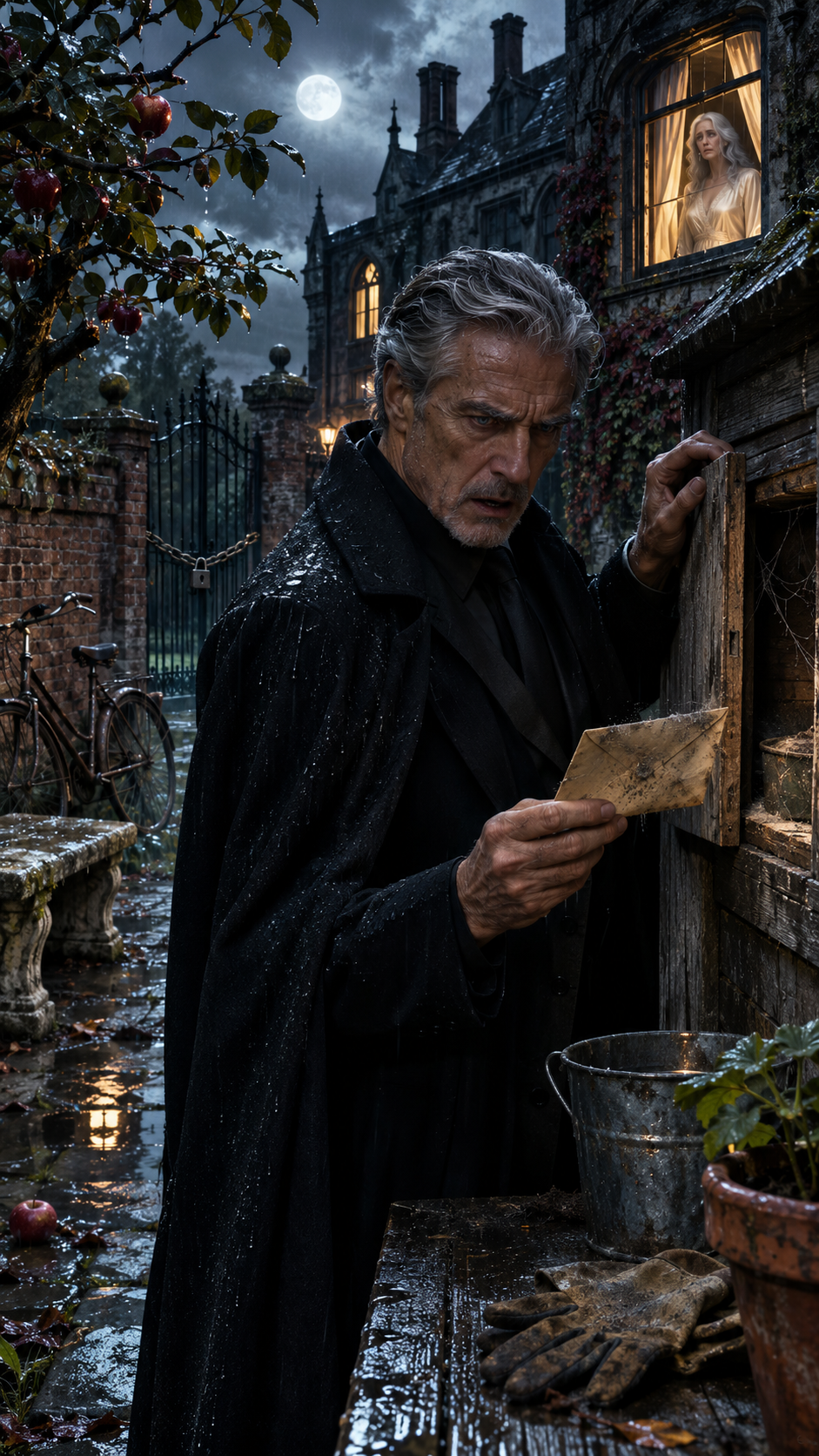
Adrian Moretti stopped with one hand resting against the weathered wooden door of the gardener's shed.
Behind him, the magnificent ballroom of Moretti Mansion glowed with crystal chandeliers, golden candlelight, and the reflections of hundreds of expensive diamonds. Guests in black evening suits and elegant gowns had gathered for the annual Moretti Foundation benefit. Champagne glasses stood on silver trays. A string quartet played beneath the vaulted ceiling.
But none of that mattered anymore.
His three-year-old granddaughter sat beside him on the stone garden bench, holding a dusty envelope between her small hands.
“Where did you find that, sweetheart?” Adrian asked.
Sophia Moretti wore a tiny black suit, a white shirt, black tights, and little red shoes. A red ribbon held her hair away from her face.
She looked at the envelope, then at the old shed.
“It hides behind the wall, it hides behind the wall…”
Adrian's expression changed.
“What did you say?”
Sophia pointed toward the shed.
“Grandma showed me.”
The old man's fingers tightened.
“Which grandma?”
“The pretty one.”
A strange silence settled over the garden.
The ballroom doors stood open behind them. Several guests had followed Adrian outside, including his son Matteo and daughter-in-law Isabella. They had been laughing only minutes earlier. Now they watched from the terrace, uncertain whether they should approach.
Adrian slowly turned toward the mansion.
One upstairs window was illuminated.
A woman stood behind the glass.
She had long silver hair falling over a white silk nightgown. Her face was pale, almost translucent, and her sad eyes were fixed on him.
Adrian stopped breathing.
For a moment, the garden disappeared.
He saw the woman who had raised him. The woman whose funeral he had attended thirty-one years earlier. The woman whose photograph still occupied the center of his private study.
His mother.
Evelyn Moretti.
“Impossible,” he whispered.
The woman did not move.
She simply watched him.
Then the curtains shifted, and the window became empty.
“Papa?” Matteo called from the terrace.
Adrian did not answer.
He turned back toward the shed.
The wooden structure had stood at the far end of the garden for generations. Its redbrick foundation was covered in moss, its roof sagged slightly, and its narrow door had been secured with an old iron latch.
Nobody had entered it in years.
Adrian had ordered the entire garden restored twice, yet he had never instructed anyone to demolish the shed.
He had never thought about why.
“Stay behind me,” he told Sophia.
She nodded obediently.
Adrian pulled the iron latch.
The door opened with a long, unpleasant creak.
Inside, the air smelled of damp wood, soil, and old leaves. A metal bucket stood beside a shelf. Gardening gloves lay on a workbench. An empty terracotta pot rested beneath a small window.
Everything looked ordinary.
Except for the back wall.
Sophia pointed.
“There.”
Adrian approached the wooden boards.
He ran his fingers over the surface. One section sounded different when he tapped it.
Hollow.
He pressed against the panel.
Nothing happened.
Then he noticed a small brass screw beneath a strip of peeling paint.
He turned it.
A narrow section of the wall shifted outward.
Behind it was a compartment.
Adrian stared into the darkness.
A small wooden box rested inside, covered in dust and cobwebs.
He removed it carefully.
His hands were steady, but his face had become pale.
On the lid, someone had carved two initials.
E.M.
Evelyn Moretti.
“Papa, what is it?” Matteo asked from the doorway.
Adrian did not respond.
He opened the box.
Inside lay a yellowed envelope, a small silver key, and an old photograph.
The photograph showed a young woman standing beside Evelyn beneath the apple tree.
Adrian recognized his mother immediately.
The other woman had his eyes.
His exact blue eyes.
He turned the photograph over.
A date had been written on the back.
September 14, 1995.
Thirty-one years earlier.
And beneath the date were four words.
For my two children.
Adrian's breathing became uneven.
“Two children?” Matteo repeated.
Adrian unfolded the letter.
The handwriting was unmistakable.
He had seen it on birthday cards, school notes, and the letters his mother used to leave beside his breakfast when he was a boy.
The first sentence nearly made him drop the paper.
My dearest Adrian, if you are reading this, then your father has succeeded in keeping the truth from you for thirty-one years.
The garden seemed to grow colder.
Adrian read the next line.
Your sister is alive.
His eyes moved to the photograph.
For thirty-one years, he had believed his younger sister Alessandra had died in a tragic accident.
For thirty-one years, he had accepted the closed coffin, the funeral, and his father's explanation.
Now his mother's handwriting told him that everything he remembered was a lie.
He looked toward the upstairs window again.
The pale woman had returned.
This time, she was standing with one hand against the glass.
Her expression was not frightening.
It was pleading.
“Mother,” Adrian whispered.
Then the letter slipped slightly in his fingers.
Because beneath the first paragraph, Evelyn had written something even more terrible.
Your father did not let me die alone.
—
Thirty-one years earlier, Adrian Moretti had been a very different man.
He was thirty-four years old, already powerful, already feared, and already accustomed to entering rooms where conversations stopped when he appeared.
He had inherited the family's business interests from his father, Vittorio Moretti, who remained the unquestioned authority behind the Moretti name.
Adrian was the eldest son.
He had been raised to understand that the family came before everything.
Love was secondary.
Happiness was optional.
His mother had always disagreed.
“Adrian, a family is not a business,” Evelyn had told him many times.
She had been a beautiful woman, with silver hair that began turning gray unusually early, gentle eyes, and a quiet strength that never required anyone's permission.
She had loved gardening, classical music, and the old mansion.
Most of all, she had loved her children.
Adrian had been her first.
Alessandra had been her second.
But Alessandra had disappeared when she was twenty years old.
Vittorio told Adrian that his sister had died in a boating accident while traveling abroad.
There had been a closed funeral.
There had been flowers.
There had been a priest.
And there had been no body.
Adrian had questioned the circumstances, but his father had shown him a death certificate and instructed him never to reopen the matter.
“Some tragedies do not require investigation,” Vittorio had said.
Adrian had believed him.
He regretted that belief more than anything he would ever do.
At the time, he was occupied with expanding the family's legitimate businesses. He managed shipping contracts, commercial properties, and several charitable foundations.
He rarely visited his mother.
When he did, their conversations were often brief.
Evelyn wanted him to marry for love.
Adrian believed marriage was a responsibility.
Evelyn wanted him to leave the family business.
Adrian believed leaving was impossible.
She wanted him to become a man who could sleep peacefully.
He had no idea how to do that.
The last time they had spoken before her death, she had stood in the conservatory holding a cup of tea.
“You look tired,” she said.
“I am busy.”
“You have been busy for fifteen years.”
“Mother, I have responsibilities.”
“And I have a son.”
He had kissed her forehead.
“I will visit next Sunday.”
She smiled sadly.
“Promise me something, Adrian.”
“What?”
“If someone ever tells you that the truth is too expensive, ask yourself who is collecting the price.”
He had not understood.
He had not asked her to explain.
And the following week, she was dead.
—
That afternoon, Adrian found an old photograph in his private study.
It showed himself at twenty-eight, standing between Evelyn and Alessandra.
Alessandra had been twenty-two, with long chestnut hair and bright green eyes.
She was laughing.
Evelyn had one arm around her daughter and the other around Adrian.
It was the last photograph Adrian remembered taking with both of them.
He stared at it for several minutes.
Then his son entered.
“Father, the foundation dinner is tonight. The trustees have arrived.”
“Cancel my attendance.”
Matteo frowned.
“You never cancel the annual benefit.”
“I have other matters.”
“Is something wrong?”
Adrian placed the photograph face down.
“No.”
Matteo knew his father well enough to recognize the answer as a warning.
“Father, you've been looking at that picture all afternoon.”
Adrian said nothing.
Matteo walked closer.
“Is this about Aunt Alessandra?”
The old man looked up sharply.
“Why would you mention her?”
“Because you never talk about her. Not once in my entire life have you told me what she was like.”
Adrian's expression hardened.
“She died before you were born.”
“That isn't what I asked.”
The two men stared at each other.
Then Adrian turned toward the window.
“Your grandmother was the kindest person in this house.”
Matteo waited.
“And your grandfather was a man who believed kindness was a weakness.”
“Were they unhappy?”
Adrian's jaw tightened.
“I don't know.”
It was the first time Matteo had heard his father admit ignorance.
“Perhaps,” Matteo said gently, “you should find out.”
Adrian looked at him.
For a moment, something vulnerable appeared in his cold blue eyes.
Then it disappeared.
“Prepare for the dinner.”
Matteo nodded and left.
Adrian returned to the photograph.
He turned it over.
On the back, in Evelyn's handwriting, were three words.
Never forget Alessandra.
He placed the picture in his desk.
Adrian remained in his study long after Matteo had left.
The photograph lay on his desk.
He had placed a glass paperweight over one corner to keep it from curling, although the room had no open windows.
He stared at the faces of his mother and sister.
Then he opened the bottom drawer.
Inside was an old leather notebook that had belonged to Evelyn. He had found it among her belongings after her funeral but had never bothered to read it.
He turned the pages carefully.
Most contained ordinary household notes.
A list of groceries.
A reminder about the gardener.
A recipe for almond cake.
Then he found an entry dated September 2, 1995.
Alessandra called today. She sounded happy. Daniel has found a little house with a garden. She says the windows need painting, but she doesn't mind. I wish I could visit.
Adrian read the entry again.
His mother had known his sister was alive.
He turned the page.
Adrian asked about his father today. I wanted to tell him everything, but I couldn't find the courage. He looks so much like Vittorio when he becomes angry. I must remember that he is still my little boy.
Adrian closed the notebook.
He had never considered that his mother might have been afraid of him.
The thought was unbearable.
A knock sounded.
“Come in.”
Isabella entered carrying a cup of tea.
“Matteo said you were looking for something.”
Adrian nodded toward the notebook.
“My mother's diary.”
She placed the cup beside him.
“Are you finding what you expected?”
“No.”
“What are you finding?”
He looked at the photograph.
“That she was trying to reach me.”
Isabella sat opposite him.
“Perhaps she knew you weren't ready.”
“I was thirty-four years old.”
“Being an adult doesn't mean knowing how to hear something painful.”
Adrian studied his daughter-in-law.
She had never been frightened of him, something he appreciated more than he admitted.
“Do you think I was a bad son?”
Isabella considered the question.
“I think you were a son who believed his father had all the answers.”
“And that makes it better?”
“No. But it explains something.”
She leaned forward.
“You can spend the rest of your life punishing yourself for not knowing. Or you can honor your mother by doing what she wanted you to do.”
Adrian looked toward the window.
“What did she want?”
“To have her children together.”
He nodded slowly.
Isabella stood.
“Tonight, when Sophia comes to you, don't spend the evening looking at business reports.”
A faint smile appeared on his face.
“I'll try.”
After she left, Adrian opened the diary again.
On the final page, a sentence had been written in larger letters.
The garden shed is where the truth waits.
He stared at it.
Then he checked the date.
September 14, 1995.
The exact date of his mother's death.
He closed the diary and looked toward the garden.
For the first time, he wondered whether the place he had ignored for thirty-one years had been the place his mother had been waiting for him all along.
—
The day everything changed in the present had begun with an ordinary family breakfast.
Adrian had been seated at the long dining table, reading financial reports, when Sophia climbed into the chair beside him.
She had been fascinated by his silver wristwatch for months.
“Grandpa, does your watch know when it's bedtime?”
“It knows when it's time to work.”
“That's boring.”
Adrian looked at her.
Then, unexpectedly, he smiled.
“Perhaps.”
Sophia reached for a strawberry.
Her mother, Isabella, watched from across the table.
“She's been talking about the garden again,” Isabella said.
Adrian lowered his papers.
“What about it?”
“She says an old lady lives in the upstairs window.”
Matteo looked up.
“She's three. She imagines things.”
“I know,” Isabella replied. “But she describes the same woman every time.”
Adrian returned to his report.
“Children have vivid imaginations.”
Sophia swallowed her strawberry.
“She has pretty white clothes.”
The old man's hand stopped.
“Who does?”
“The lady.”
Adrian looked at her carefully.
“What lady, Sophia?”
“The grandma in the window.”
A moment passed.
Then Sophia asked, “Why doesn't she come downstairs?”
Nobody answered.
Adrian folded his newspaper.
“Perhaps she is busy.”
Sophia considered that.
Then she returned to her breakfast.
Adrian did not.
He remembered his mother's white silk nightgown.
He remembered the way she used to stand beside the upstairs window every evening, watching the garden while he came home from work.
He remembered promising to visit her on Sunday.
And he remembered never getting that chance.
—
—
At seven that evening, the Moretti Foundation benefit began.
The mansion was filled with guests.
Politicians, business owners, lawyers, philanthropists, and old family acquaintances moved through the ballroom.
Adrian wore his black suit, black tie, and long black coat.
At sixty-five, he remained remarkably fit and imposing. His gray hair was neatly combed, his shoulders broad, and his cold blue eyes capable of silencing an entire conversation.
He had spent decades mastering the art of showing no emotion.
That evening, however, his attention kept drifting toward the garden.
Sophia was playing with Isabella near the terrace.
Then the little girl disappeared from her mother's side.
A moment later, she returned holding something.
An old envelope.
Adrian recognized the dust and the yellowed paper.
He had no idea where she had found it.
“Grandpa,” she whispered.
And the night began again.
Now, standing beside the hidden compartment, Adrian finally understood that his mother had left him something more important than money or property.
She had left him a choice.
But before he could understand what that choice meant, the final line of the letter caught his attention.
If you want to know what happened to me, find the man who kept the clock running after I stopped breathing.
Adrian slowly raised his head.
There was only one person who had been in the mansion that night.
One man who had served his father for decades.
One man who still lived on the estate.
Enzo Bellini.
The old steward.
Adrian turned toward the garden entrance.
“Matteo.”
“Yes, Father?”
“Find Enzo.”
Matteo looked at the letter.
“What should I tell him?”
Adrian folded the paper.
“Tell him that after thirty-one years, I finally know my mother was telling the truth.”
He looked toward the illuminated window.
“And tell him I want to know why he helped bury her.”