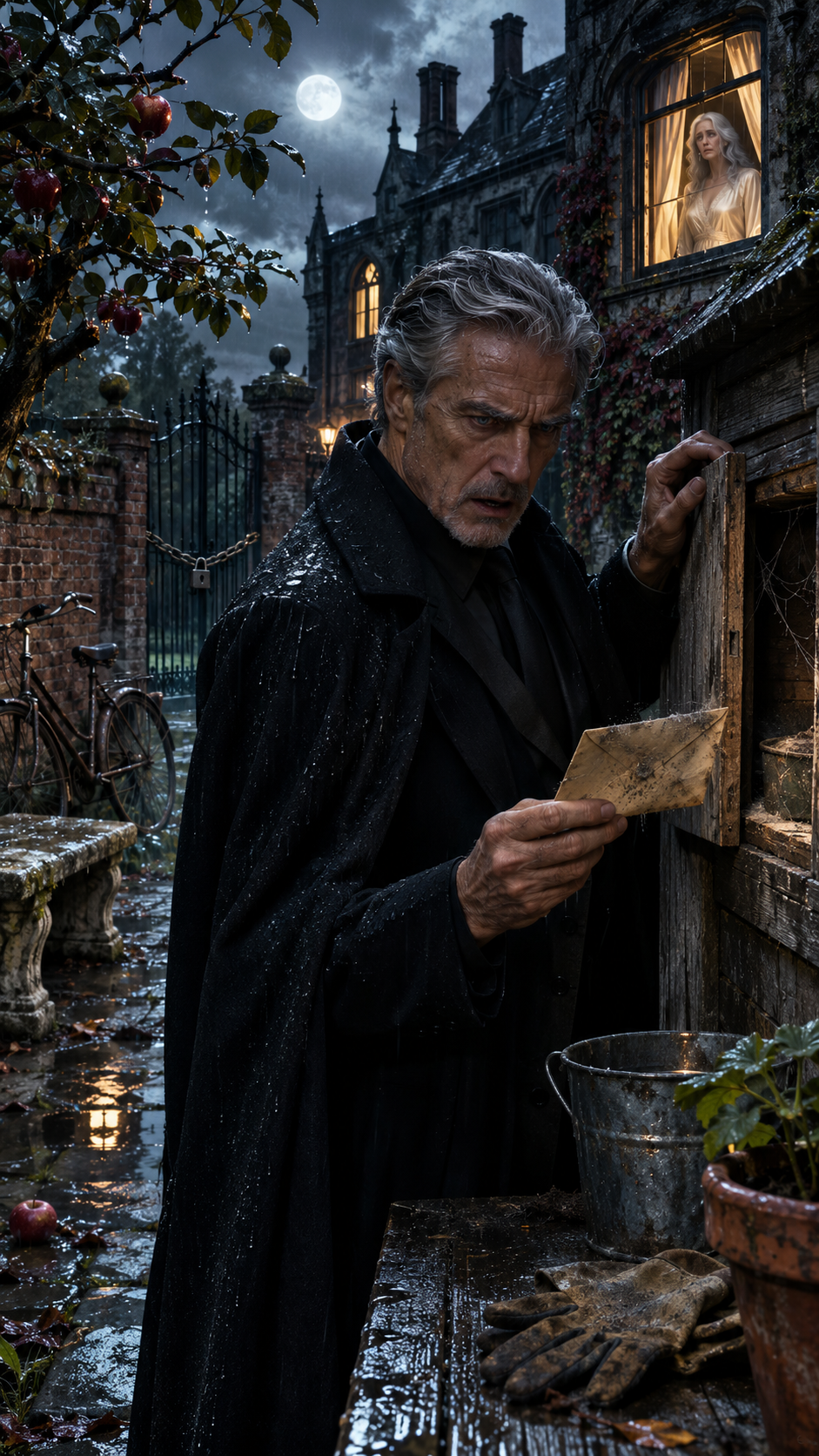
Enzo Bellini had worked for the Moretti family for fifty-two years.
He had entered the mansion as a young man with little money and a great deal of ambition. He had become its steward, caretaker, and eventually the person who knew every room, every locked cabinet, and every family habit.
He was seventy-two now.
His hair was almost entirely white, his back slightly bent, and his hands marked by decades of gardening and household work.
He had never been a particularly talkative man.
But he had always been loyal.
At least, that was what Adrian had believed.
When Matteo found him in the old kitchen, Enzo was polishing a silver serving tray.
“Mr. Bellini.”
The old steward looked up.
“Mr. Matteo.”
“My father wants to see you.”
“Is something wrong?”
Matteo hesitated.
“He found something in the garden.”
Enzo's hand stopped.
“What did he find?”
“A letter.”
The tray slipped slightly against the cloth.
For the first time in many years, Enzo looked genuinely frightened.
“From whom?”
Matteo studied him.
“My grandmother.”
Enzo closed his eyes.
“Oh, Mrs. Moretti.”
“Did you know about it?”
The old steward placed the tray on the counter.
“I have been waiting for this day.”
Matteo frowned.
“Waiting for what?”
Enzo looked toward the kitchen window.
Outside, rain tapped against the glass.
“For someone in this family to ask the right question.”
—
Adrian waited in the library.
The room was enormous, with dark oak shelves, leather furniture, and a fireplace that had not been used since his father's death.
A portrait of Vittorio Moretti hung above the mantel.
The old patriarch appeared stern and dignified, with dark hair, a strong jaw, and eyes that seemed permanently suspicious.
Adrian had inherited his father's face.
He hoped he had not inherited everything else.
Enzo entered quietly.
“Sir.”
Adrian remained standing.
“Close the door.”
Enzo obeyed.
Adrian placed the letter on the desk.
“Do you recognize this?”
The old steward looked at it.
His face changed.
“Yes.”
“Did you know my mother wrote it?”
“Yes.”
“Did you know it was hidden in the gardener's shed?”
Enzo swallowed.
“Yes.”
Adrian moved around the desk.
“Then explain why I spent thirty-one years believing she had nothing left to say to me.”
Enzo lowered his head.
“Because I was afraid.”
Adrian walked closer.
“Of whom?”
“Your father.”
“Vittorio is dead.”
“I know.”
“Then your fear should have died with him.”
Enzo looked up.
“Fear does not always understand when the person who created it is gone.”
Adrian stared at him.
He had expected denial.
He had expected confusion.
He had not expected an admission.
“Start talking.”
Enzo took a breath.
“Your mother asked me to help her hide something in the garden shed. She said she would return for it after speaking with you.”
“When?”
“September 1995.”
“The month she died.”
“Yes.”
Adrian's expression became colder.
“What was she hiding?”
“A letter. A photograph. Documents.”
“About Alessandra?”
“Yes.”
Adrian looked toward the photograph on his desk.
“My sister was alive?”
Enzo nodded.
“I never believed she had died.”
Adrian's voice became dangerously quiet.
“You knew?”
“I suspected. Then I learned the truth.”
“And you said nothing?”
Enzo's eyes filled.
“I am sorry.”
“Sorry?”
Adrian struck the desk with his palm.
The sound echoed through the library.
“You watched me bury my mother. You watched me attend a funeral for a sister who was alive. You watched me spend thirty-one years believing I had lost both women. And you are offering me an apology?”
Enzo did not move.
“I have no defense.”
“Then give me the truth.”
The old steward looked at the letter.
“Your mother wanted to tell you everything. She had discovered that Alessandra was living under another name. She had been corresponding with her secretly for years.”
Adrian closed his eyes.
“How long?”
“Since 1987.”
The year Alessandra disappeared.
“She had helped her escape?”
“Yes.”
“From whom?”
“Your father.”
Adrian slowly opened his eyes.
Enzo continued.
“Miss Alessandra had fallen in love with a young accountant named Daniel Bell. Your father wanted her to marry a man whose family had business connections with the Morettis. She refused. He considered her refusal an insult.”
“Alessandra was twenty years old.”
“She was an adult, sir. But your father never accepted that.”
Adrian turned toward the window.
He remembered Alessandra's laughter.
Her arguments with Vittorio.
The way she used to hide in the garden when their father became angry.
He remembered her telling him that she wanted a life of her own.
He had dismissed her concerns.
He had told her to be patient.
He had told her their father knew best.
“Did she leave with Daniel?”
“Yes.”
“Where did they go?”
“Providence, Rhode Island, eventually.”
Adrian turned sharply.
“You know where she is?”
Enzo nodded.
“I know where she lived. I don't know whether she still lives there.”
“Why didn't my mother tell me?”
“She tried.”
Adrian said nothing.
Enzo continued.
“Your father intercepted several letters. He made sure you never received them.”
“Why?”
“Because he believed your sister's return would threaten the family's reputation and the arrangements he had made.”
Adrian's face hardened.
“My father made arrangements involving my sister's life?”
“Yes.”
“Did he force her to leave?”
Enzo hesitated.
“He made it clear that she would never be allowed to choose her own future while she remained in this house.”
Adrian walked to the fireplace.
He stared at the portrait.
His father had always taught him that control was the foundation of power.
Now he was beginning to understand what that lesson had cost.
—
Enzo did not leave the library immediately.
He remained beside the door, turning his cap between his hands.
“Sir, may I tell you something about Mrs. Moretti?”
Adrian looked up.
“You have already had thirty-one years to tell me things.”
“I know.”
“Then make this worth my time.”
Enzo nodded.
“Your mother used to come to the kitchen every Thursday morning.”
Adrian frowned.
“Why?”
“She liked preparing breakfast herself. She said the kitchen was the only room where everyone was allowed to make mistakes.”
Adrian almost smiled.
“That sounds like her.”
“She would make too much food. Always too much. Then she would ask me to put two extra plates on the table.”
“For whom?”
“For Miss Alessandra and you.”
Adrian looked at him.
“Even after Alessandra disappeared?”
“Yes.”
“Why?”
“Because she believed her children would return.”
Enzo walked toward the window.
“Sometimes she would sit at the kitchen table with the two plates in front of her. She would leave them there for hours.”
Adrian looked down.
“How long did she do that?”
“Until your father ordered the servants to stop setting the plates.”
The old steward swallowed.
“She cried that day, sir. Not loudly. She simply removed the plates herself.”
Adrian stood.
“Why didn't anyone tell me?”
“You were working in the city. Your father told us not to disturb you with household matters.”
“Household matters?”
Enzo lowered his eyes.
“Your mother considered her children the most important part of the household.”
Adrian walked to the fireplace.
He remembered countless evenings when he had returned home late and found his mother waiting in the drawing room.
He had assumed she was simply unable to sleep.
Now he wondered how many times she had waited for him to sit down and talk.
“Did she ever speak about me?”
“Every day.”
“What did she say?”
“That you worked too hard. That you never ate properly. That you needed someone who could make you laugh.”
Adrian shook his head.
“She was always trying to arrange my life.”
Enzo smiled sadly.
“She was trying to give you one.”
The old steward reached into his pocket.
He removed a small folded photograph.
“I kept this.”
Adrian took it.
It showed Evelyn standing in the kitchen, holding a cake. Alessandra was beside her, laughing, while Adrian stood behind them with an expression of exaggerated annoyance.
On the back, Evelyn had written:
Thursday breakfast. The children came home.
Adrian stared at the photograph.
“Where did you find this?”
“Your mother gave it to me.”
“When?”
“Shortly before she died. She told me to keep it safe.”
“Why?”
“She said that one day you would need to remember what the family looked like before it became afraid of itself.”
Adrian placed the photograph beside the letter.
“Thank you, Enzo.”
The old steward looked surprised.
“You don't have to thank me, sir.”
“No. But I should have listened to you more often.”
Enzo lowered his head.
For the first time, Adrian saw something other than fear in the old man's expression.
He saw grief.
And perhaps, finally, a little hope.
—
Later that night, Adrian sat alone in his mother's old bedroom.
The room had remained almost untouched since her death.
The curtains were cream-colored. A small piano stood near the window. A silver-framed photograph rested on the bedside table.
Evelyn was smiling in it.
She looked younger than Adrian remembered.
On the dresser stood a glass perfume bottle and a small jewelry box.
He opened the box.
Inside were two pearl earrings, a silver bracelet, and a folded piece of paper.
The paper contained a handwritten list.
Adrian's birthday.
Alessandra's favorite music.
The apple tree.
The garden bench.
The shed.
He read the words several times.
His mother had left herself reminders.
Little details.
Things that had mattered to her.
At the bottom, she had written:
If they cannot find their way back to each other, the garden will remember.
Adrian sat down.
He had not cried at her funeral.
He had not cried when he saw her coffin.
He had not cried when the priest spoke about a life devoted to kindness.
He had believed that tears were an unnecessary luxury.
But now his eyes burned.
“I'm sorry, Mother,” he whispered.
The room remained silent.
Then a soft melody drifted through the hallway.
The piano.
Adrian turned.
The instrument was in the bedroom.
Nobody was there.
Yet one key sounded again.
A single note.
Then another.
He stood.
“Who's there?”
No answer came.
He approached the piano.
A small music box rested on top of it.
He remembered it.
Evelyn used to wind it every evening when he was a child.
He lifted the lid.
A tiny ballerina turned slowly while a familiar melody played.
Beneath the velvet lining, he noticed a small folded card.
He removed it.
The handwriting was his mother's.
For Adrian, when he finally learns to listen.
He unfolded the paper.
Your father will tell you that Alessandra abandoned us. That is not true. She left because I helped her leave. I would do it again.
Adrian read the sentence twice.
Then he noticed a second line.
But there is another truth you must discover. I was not the only person your father silenced.
He sat very still.
A knock sounded at the door.
Matteo entered.
“Father?”
Adrian folded the note.
“Come in.”
Matteo looked at the music box.
“Was that hers?”
“Yes.”
“Mother used to tell me stories about it.”
Adrian looked up.
“Your mother?”
“My mother, Elena. She said Grandmother Evelyn loved music and wanted you to learn piano.”
Adrian's expression softened.
“She tried.”
“Why didn't you?”
“Because I was busy learning other things.”
Matteo sat opposite him.
“Father, what are you going to do?”
Adrian looked at the note.
“I am going to find my sister.”
“And after that?”
“I don't know.”
Matteo nodded.
For once, he did not challenge his father's answer.
He simply placed a hand on his shoulder.
“You don't have to know everything tonight.”
Adrian looked at his son.
He realized how rarely they had touched without a practical reason.
For years, he had mistaken distance for authority.
He did not want Sophia to grow up remembering him as a man who could command everyone except himself.
“Matteo.”
“Yes?”
“If you ever discover something terrible about me, promise you won't hide it from your daughter.”
Matteo looked surprised.
“I promise.”
Adrian nodded.
“Good.”
—
The following morning, Adrian returned to the garden.
The rain had stopped.
Water clung to the apple tree's leaves, and the stone bench remained damp.
He stood before the gardener's shed.
Enzo waited nearby.
“Did you know about the second note?” Adrian asked.
“No, sir.”
Adrian handed him the paper.
Enzo read it.
His expression grew troubled.
“Your mother was afraid of something.”
“What?”
“I don't know.”
Adrian looked at the shed.
“Then we find out.”
He opened the hidden compartment again.
The wooden box had a false bottom.
Beneath it was a small envelope containing several pages.
One was a letter from Alessandra.
Another was an old photograph.
The last was a handwritten list of dates.
Adrian examined the letter.
It was addressed to Evelyn.
Mother, Daniel and I are safe. Please tell Adrian that I never stopped loving him. I wanted him to come with us, but I know he was not ready to leave Father. I hope one day he will understand.
Adrian lowered the paper.
His sister had not abandoned him.
She had been waiting for him.
He looked at the photograph.
It showed Alessandra standing beside a man with dark hair and a gentle smile.
On the back was a name.
Daniel Bell.
Beneath it, another line had been written.
September 14, 1995. The night Mother promised to bring us home.
Adrian's fingers tightened.
“Enzo.”
“Yes, sir?”
“What happened on September fourteenth?”
The old steward looked toward the mansion.
His expression became almost unbearable.
“That,” he said, “is something you must ask your uncle.”
“Salvatore?”
Enzo nodded.
“Your father's younger brother was the last person to see your mother alive.”
Adrian stared at him.
“Why have I never heard that?”
“Because he told everyone he had left the mansion before midnight.”
“And?”
Enzo lowered his voice.
“He lied.”
Adrian looked toward the upper window.
A pale figure stood behind the curtains.
Evelyn.
She was watching the garden.
Her eyes seemed to move from the shed to the mansion, then back to her son.
Adrian took one step forward.
“Mother?”
The figure raised her hand.
Then she disappeared.
Adrian turned to Enzo.
“Bring my uncle here.”
Enzo hesitated.
“Sir, there is something else.”
“What?”
“Your uncle has been keeping a diary for thirty-one years.”
Adrian's eyes narrowed.
“Where?”
“In his private room.”
“Then why haven't we taken it?”
Enzo looked toward the house.
“Because he has finally decided to destroy it.”