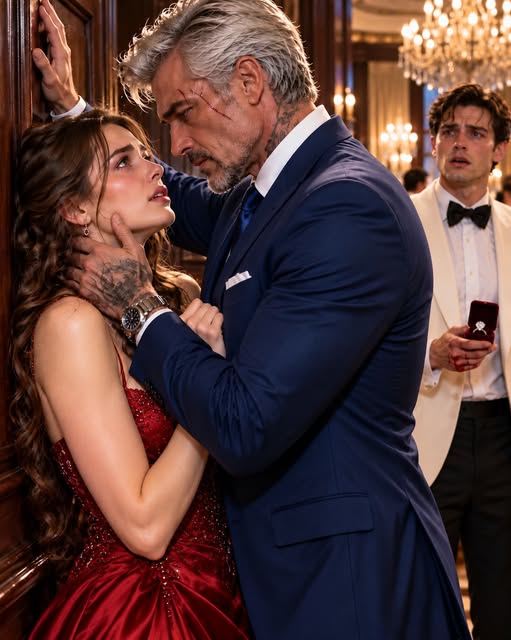
“Because I wanted you instead.”
The words escaped my mouth so quietly that, for one impossible second, I hoped Vincent Marlowe hadn't heard them.
But he had.
His silver-gray eyes locked onto mine, and the expression that crossed his face was unlike anything I had ever seen. Vincent Marlowe was a man who could silence an entire boardroom without raising his voice. He was fifty-one years old, worth hundreds of millions of dollars, and powerful enough that businessmen twice his wealth watched their words around him.
Some people called him a businessman.
Others called him the last true mafia king of New York.
I had never known which description frightened me more.
Until that night.
Because Vincent Marlowe was standing less than a foot away from me, his broad shoulders blocking the warm chandelier light, one tattooed hand braced against the mahogany wall beside my head. His other hand had been resting gently against my cheek.
And I had just confessed that I was in love with him.
The problem wasn't our twenty-two-year age difference.
The problem wasn't his dangerous reputation, the scar cutting through his left eyebrow, or the dark tattoos disappearing beneath the expensive collar of his navy suit.
The problem was that, twenty minutes earlier, I had rejected his son's marriage proposal in front of two hundred guests.
And now his son was standing outside the study door.
Listening.
My name is Claire Bennett.
I was twenty-nine years old when I destroyed the future three people thought they understood.
And despite everything that followed, I would eventually learn that the most unforgivable thing I did that night wasn't falling in love with the wrong man.
It was waiting too long to tell the truth.
But I'm getting ahead of myself.
To understand why Vincent Marlowe was looking at me as though I had just placed a loaded gun between us, you need to understand what happened before that confession.
You need to understand the ring.
The party.
And the one decision that brought all of us to the edge of losing everything.
Three hours earlier, I had stood in front of the full-length mirror in my apartment, trying to convince myself that tonight would be ordinary.
The red evening gown had cost more than I normally spent on clothes in six months.
Evan had bought it.
“Wear this tonight,” he'd told me the previous afternoon, smiling that beautiful, confident smile I'd fallen for nearly two years earlier. “I want everyone to see how lucky I am.”
I should have recognized the warning.
Instead, I smiled back and pretended my stomach hadn't tightened.
Evan Marlowe was thirty, handsome, charming, and almost painfully determined to be the kind of man people loved. He had his father's dark eyes, though his hair was brown rather than silver, and none of Vincent's scars or tattoos.
Where Vincent could make silence feel threatening, Evan filled silence with laughter.
Where Vincent watched people carefully, Evan trusted them too easily.
And where Vincent seemed to have accepted that the world was full of dangerous men, Evan still believed he could persuade those men to become better.
That was one of the reasons I had fallen in love with him.
Yes, I had loved Evan.
I need to make that clear.
Our relationship hadn't begun as a lie.
We met at a charitable fundraiser for the Marlowe Foundation, where I was presenting architectural plans for the renovation of a neglected historic community center in Brooklyn.
Evan had approached me after my presentation, asking more questions about preservation techniques than any wealthy donor had bothered to ask.
At the end of the evening, he requested my phone number.
Our first date was at a small Italian restaurant where he accidentally spilled sparkling water across the table.
He laughed at himself.
I laughed with him.
For months, being with Evan felt wonderfully simple.
He listened when I talked about my work. He remembered that I hated lilies but loved peonies. He brought coffee to my office when deadlines kept me there until midnight.
When my professional license was finally approved for the restoration project I'd been chasing, he celebrated as though I'd won the lottery.
He made me feel seen.
Or at least, I believed he did.
But somewhere along the way, something changed.
Not suddenly.
Not dramatically.
There was no single evening when I looked at Evan and stopped loving him.
Instead, our relationship slowly became a collection of expectations.
Evan began talking about the house we'd buy, the events we'd attend, the future the Marlowe name could give us. He spoke with such enthusiasm that I struggled to interrupt him.
When I hesitated, he assumed I was nervous.
When I changed the subject, he assumed I was being shy.
And when I told him that I didn't want to make decisions about marriage yet, he kissed my forehead and said, “You think too much, Claire.”
I started wondering whether love was supposed to feel like being carried toward a destination you'd never actually chosen.
Then I met his father properly.
Vincent Marlowe wasn't a stranger to me.
I'd seen him in newspapers and financial magazines. I'd heard Evan mention him with equal measures of admiration and frustration.
But our first real conversation happened eleven months before the party.
It was raining heavily that afternoon.
I'd spent nearly two hours at Marlowe Holdings defending a restoration budget against three executives who believed historical details were unnecessary expenses.
By the end of the meeting, one executive suggested replacing original limestone with inexpensive synthetic panels.
I refused.
He laughed.
“Miss Bennett, you're an architect, not an artist. Learn to compromise.”
Before I could answer, a voice spoke from the doorway.
“She's the only person in this room who seems to understand what we're paying for.”
Everyone stood.
Vincent walked into the conference room carrying a black folder.
I remember his silver hair, the scar near his eyebrow, and the unusual stillness that followed him.
He glanced at the plans spread across the table.
Then he looked at me.
“Explain why the original materials matter.”
He didn't ask politely.
He didn't ask rudely, either.
He simply expected an answer.
So I gave him one.
I explained how the building had survived almost a century, how the exterior details told the neighborhood's history, and how careless renovations would destroy what made the place worth saving.
For ten uninterrupted minutes, Vincent listened.
When I finished, he looked at the executives.
“Give her the budget.”
One man protested.
Vincent turned his head.
“Did I ask for another opinion?”
Nobody spoke.
Then he looked back at me.
“Good work, Miss Bennett.”
He walked out.
I should have forgotten that conversation.
Instead, I remembered something about it that unsettled me.
Vincent hadn't rescued me because I was dating his son.
He hadn't smiled, flirted, or tried to impress me.
He had listened.
Really listened.
And over the following months, I realized how rarely I felt that kind of attention in my own relationship.
I hated myself for noticing.
By the evening of the party, I knew two things.
I couldn't marry Evan.
And I couldn't continue pretending that my feelings for his father were harmless.
What I didn't know was that Evan had already invited two hundred people to witness a proposal.
The Marlowe estate stood behind enormous iron gates in Westchester County, its illuminated windows glowing against the October darkness.
Luxury cars lined the circular driveway.
Security men in black suits watched the entrance.
Inside, crystal chandeliers glittered above marble floors, and a string quartet played near a staircase wide enough for five people to walk side by side.
Evan met me beneath the central chandelier.
His white dinner jacket fit him perfectly, and his dark hair fell slightly across his forehead.
When he saw me, he stopped walking.
“Wow.”
I smiled weakly.
“Is that a good wow?”
“That's an I'm-the-luckiest-man-alive wow.”
He kissed my cheek.
Then he noticed my expression.
“You okay?”
I almost told him.
Right there.
With guests arriving and champagne glasses clinking around us, I almost took his hand and admitted that something between us had changed.
But Evan looked so happy.
And I was a coward.
“Just nervous,” I said.
He squeezed my hand.
“Don't be. Tonight's going to be perfect.”
Those words would haunt me for months.
Across the ballroom, I noticed Vincent standing beside a group of investors.
He wore a tailored navy suit, a white shirt, and a dark blue tie. His hair was swept neatly backward, and his tattooed hands rested calmly at his sides.
He looked up.
Our eyes met.
Only for a second.
Vincent gave me a brief, polite nod.
Then he returned to his conversation.
There was nothing inappropriate about the exchange.
Nothing anyone could reasonably question.
Yet I felt something inside my chest tighten.
I looked away immediately.
A few minutes later, I made my second mistake.
I convinced myself that if I avoided Vincent for the rest of the night, everything would somehow become manageable.
Then Evan climbed onto the small platform beside the orchestra.
And the music stopped.
“Can I have everyone's attention?”
Evan's voice carried through the ballroom.
Conversations faded.
A spotlight illuminated the platform.
I felt every muscle in my body go cold.
Evan smiled at me.
“Claire, sweetheart, come up here.”
I didn't move.
A woman beside me laughed gently.
“Go on! He's talking to you.”
I forced my legs to carry me forward.
The applause began before I reached him.
Evan took both my hands.
“I've spent most of my life trying to figure out what matters,” he said. “My father taught me that success means building something that lasts.”
He glanced toward Vincent, who stood near the staircase.
“But Claire taught me that the most important thing you can build is a life with someone you love.”
The room erupted in appreciative murmurs.
My throat tightened.
“Evan,” I whispered.
He continued.
“Before you, I thought I knew exactly what my future would look like. Then you walked into my life and made it better than anything I imagined.”
His eyes shone.
And in that moment, I realized something terrible.
He meant every word.
He genuinely believed I was the woman he would spend the rest of his life with.
I was about to destroy that belief.
Evan reached into his jacket pocket.
The small red velvet box appeared in his hand.
I recognized it immediately.
Not because I'd seen the box before, but because Evan had once described the ring inside.
His mother's engagement ring.
Grace Marlowe had died years earlier, leaving behind a son who still missed her fiercely and a husband who almost never spoke about losing her.
Evan had told me that his mother wore the ring every day.
Someday, he'd said, he wanted to give it to the woman he married.
Now he opened the box.
A brilliant diamond caught the chandelier light.
Then Evan lowered himself onto one knee.
Two hundred people gasped.
“Claire Bennett,” he said, smiling through nervous excitement, “will you marry me?”
For one terrible second, I couldn't breathe.
I looked at the ring.
At Evan.
At the crowd already raising phones to record us.
Then, without meaning to, I looked toward Vincent.
He wasn't smiling.
His expression was unreadable.
But something in his eyes changed when he saw my face.
He knew.
Not what I was hiding.
Not why I was afraid.
But he knew I wasn't happy.
“Claire?” Evan whispered.
I turned back.
Tears blurred my vision.
“Please stand up.”
A few guests laughed uncertainly.
Evan's smile faltered.
“Baby?”
“Please,” I repeated. “Stand up.”
He slowly rose.
His hand remained extended, the open red box resting in his palm.
“I don't understand.”
My voice shook.
“I'm sorry.”
The room went completely silent.
Evan stared at me.
“What?”
“I can't marry you.”
It was astonishing how four words could change the temperature of an entire room.
Someone dropped a glass.
I heard it shatter behind me.
Evan's face drained of color.
“You're joking.”
I shook my head.
“I'm so sorry.”
He looked around the room, searching for an explanation, perhaps hoping I'd arranged an elaborate surprise.
But nobody moved.
“Nineteen months,” he whispered. “We've been together nineteen months.”
“I know.”
“Then why?”
I opened my mouth.
Nothing came out.
Because what could I possibly say?
Because I love your father?
Because I've been lying to myself?
Because I'm terrified that if I marry you, I'll spend the rest of my life pretending to be someone I'm not?
“It's not something I can explain here,” I whispered.
Evan's expression hardened with humiliation.
“You couldn't tell me before tonight?”
That question cut deeper than anything else.
Because he was right.
“I should have.”
His eyes filled with tears.
For one second, I thought he might beg.
Instead, he closed the ring box.
Then he stepped away from me.
“I don't know who you are right now.”
I watched him walk through the stunned crowd.
Nobody applauded.
Nobody laughed.
And I stood beneath a chandelier worth more than my childhood home, feeling poorer than I'd ever felt in my life.
I fled into a side corridor.
The mansion seemed endless, a maze of polished wood, antique paintings, and heavy doors that muffled the distant sounds of the party.
I didn't know where I was going.
I only knew I couldn't bear another person asking whether I was all right.
I reached a dark mahogany door and pushed it open.
The room beyond smelled faintly of leather and cedar.
A private study.
Books lined one wall. Large windows overlooked the estate's gardens. A decanter sat untouched beside a stack of business documents.
I closed the door and pressed my palms against my eyes.
“God, Claire. What have you done?”
“That's what I'd like to know.”
I spun around.
Vincent stood in the doorway.
His expression was controlled, but the muscles along his jaw were tense.
“Mr. Marlowe—”
“Vincent,” he corrected automatically.
He entered and closed the door behind him.
For a moment, neither of us spoke.
Then he asked, “Are you hurt?”
I blinked.
“What?”
“Did my son do something to you?”
“No.”
“Did he threaten you? Pressure you?”
“Never.”
Vincent exhaled slowly.
“Then help me understand why you humiliated him in front of two hundred people.”
His words stung because they were fair.
“I didn't know he was going to propose.”
“Perhaps not. But you knew something was wrong before tonight.”
I looked down.
“Yes.”
“And you said nothing.”
“Yes.”
He crossed the room, stopping several feet away.
“Evan loves you.”
“I know.”
“He was going to give you his mother's ring.”
My eyes filled again.
“I know that too.”
Vincent's voice lowered.
“Then why, Claire?”
I couldn't answer.
He studied me for a moment.
“You aren't afraid of marrying him,” he said slowly. “You're afraid of telling him why you can't.”
I stared.
Vincent noticed everything.
That was one of the things I admired about him.
And one of the things that made standing in front of him unbearable.
“Please don't do this,” I whispered.
“Do what?”
“Look at me like you already know the answer.”
“I don't know the answer.”
He stepped closer, then stopped when I instinctively retreated.
My back brushed the wooden wall.
Vincent immediately paused.
“Claire?”
I looked up.
“I need you to understand that I never intended to hurt him.”
“Then tell me the truth.”
“I can't.”
“Why?”
“Because once I say it, I can't take it back.”
Something shifted in his expression.
He raised one tattooed hand, bracing it against the wall above my shoulder as he leaned down to hear me.
His other hand briefly touched my cheek, a gentle gesture that startled both of us.
I could have moved away.
I didn't.
My fingers closed lightly around his wrist.
His watch felt cool beneath my fingertips.
“Claire,” he said quietly, “what is going on?”
I had imagined confessing my feelings a hundred times.
Never like this.
Never while wearing the dress his son had bought me.
Never minutes after destroying a proposal that should have been one of the happiest moments of Evan's life.
And certainly never while Vincent stood close enough for me to see the pale scar above his eye.
But the truth had become too heavy to carry.
I swallowed.
“Evan asked why I couldn't marry him.”
Vincent waited.
“I tried to explain, but I couldn't say it in front of everyone.”
“Say what?”
“That I didn't want the life he was offering.”
Vincent's eyes narrowed slightly.
“Because?”
I felt the tears slip down my cheeks.
“Because I wanted you instead.”
He went utterly still.
His fingers loosened against my cheek.
Then he withdrew his hand as if the contact had suddenly become something dangerous.
“Claire.”
My name sounded like a warning.
“I know,” I whispered. “I know how awful this is.”
Vincent stepped back.
“You don't understand what you're saying.”
“Yes, I do.”
“No.”
He shook his head, his composure finally cracking.
“My son—”
“I know who he is.”
“He trusts me.”
“I know.”
“He loves you.”
“I know!”
My voice broke.
“I know all of it, Vincent. That's why I've spent months trying to make these feelings disappear.”
He looked away.
For the first time since I'd met him, he seemed unable to find words.
Then the study door creaked.
A white dinner jacket appeared in the opening.
Vincent turned sharply.
And my entire world stopped.
Evan stood in the doorway.
His face was pale.
His dark eyes were fixed on his father.
The little red engagement-ring box trembled in his hand.
He had heard me.
Not part of the conversation.
Not enough to misunderstand.
Everything that mattered.
“You should've told me,” he whispered.
My knees nearly gave way.
“Evan—”
He looked at me.
“I tried yesterday,” I said, remembering the conversation I'd begun and abandoned while he was planning tonight's surprise.
Evan gave a small, devastated laugh.
“You tried?”
Tears slipped down my face.
“I didn't know how.”
He looked from me to Vincent.
Then back again.
And something in his expression changed.
“Did you know?” he asked his father.
Vincent didn't hesitate.
“No.”
Evan studied him.
“Not even a little?”
“I knew Claire was unhappy tonight. I did not know why.”
Evan stepped forward.
I instinctively reached toward him, but stopped when he recoiled.
“Don't,” he said.
Then he turned to his father.
His hand closed around Vincent's suit lapel.
Vincent caught his forearm, not roughly, just enough to steady him.
“Evan.”
“No. Don't say my name like that.”
The words shattered against the walls.
Evan's eyes filled with tears.
“You didn't know she wanted you.”
Vincent remained silent.
Evan's fingers tightened.
“But you wanted her.”
The room seemed to stop breathing.
The small red box slipped from Evan's other hand.
It struck the polished wooden floor.
The lid opened.
Grace Marlowe's diamond ring shifted inside, catching one brief flash of chandelier light.
I covered my mouth.
Vincent released his son's arm.
Evan stared at the ring.
Then, slowly, he looked up.
“Dad,” he whispered. “Please.”
Vincent's face changed.
Not with anger.
Not with the cold confidence that had made powerful men fear him.
With something infinitely more frightening.
Grief.
Evan's voice barely rose above the silence.
“Tell me you don't love her.”
Vincent looked at his son.
Then he looked at me.
His jaw tightened.
For one long, unbearable moment, nobody moved.
Finally, he drew a breath.
His lips parted.
And I realized the next words out of Vincent Marlowe's mouth would determine whether his family survived the night.