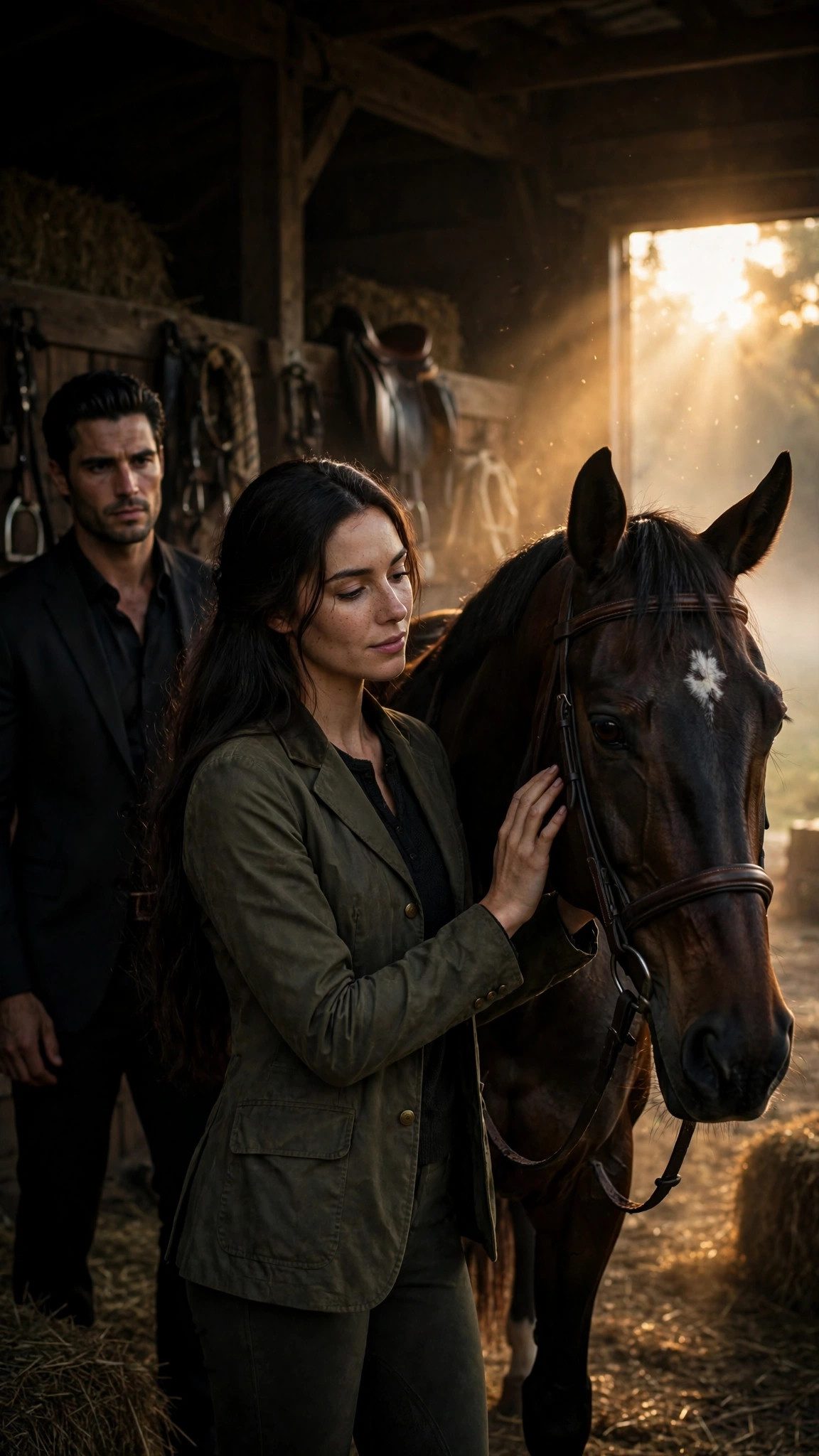
I woke before dawn and dressed in the dark, my hands steady even though my stomach was not. By five-thirty I was in the back room of the main barn, the room Ellis used for storing harness and medicine, the room Roman had chosen because no one went there before seven. I had cleaned it the night before, swept the floor, laid a folded blanket over the old wooden treatment table, and set out my oils and towels in a neat row. The air smelled of leather and hay and cold morning.
At six o'clock exactly, the door opened, and Roman came in.
He was dressed simply, for him: dark trousers, a black shirt with the sleeves rolled to the elbows, no tie, no jacket. He looked younger without the suit, and more tired, too. The lines around his eyes were deeper in the lamplight. He closed the door behind him and stood there for a moment, looking at the table the way a man looks at a dentist's chair.
"Six o'clock," he said. "You are punctual, Miss Peyton."
"My father used to say that horses don't wait for people who are late, and neither does pain," I said.
A flicker of something crossed his face. It might have been a smile. It was gone before I could be sure.
"Tell me what to do," he said.
"First, I watch you walk," I said. "Walk to the door and back, slowly, the way you normally walk. Don't try to walk well. Walk the way you always walk."
He did. I watched from the side, the way I had watched a hundred horses, counting the rhythm. Left, right. Left, right. The right step was shorter. The right foot turned outward. The pelvis tilted. When he reached the door and turned, his right leg hesitated for a fraction of a second before it took his weight, as if it were asking permission.
"Now sit," I said, pointing at a chair I had set by the wall. "Sit the way you normally sit."
He sat down slowly, lowering himself with his arms braced on the chair, his face tightening as his hips bent. He perched on the edge of the seat rather than sitting back, his weight forward, his right leg extended slightly in front of him.
"You don't sit," I said. "You perch. You've been perching for eight years."
"I stand because it hurts less," he said. "Sitting is worse. Sitting puts pressure on the nerve, or so Avery says."
"Or sitting puts pressure on a hip that hasn't moved properly in eight years," I said. "Lie down on the table. On your back."
He hesitated. I could see it in his shoulders, the tension that came from lying down in front of another person, from being vulnerable, from giving up control. Roman Bellori did not lie down in front of people. He stood. He always stood.
"I won't do anything without telling you first," I said quietly. "And if you say stop, I stop. That's the rule. You are in charge of this, Mr. Bellori. Not me."
He looked at me for a long moment, and then, slowly, he lay down on the table.
I started the way my father had taught me: with my eyes, not my hands. I looked at the way he lay, at the tilt of his pelvis against the blanket, at the way his right leg fell outward naturally while his left leg stayed straight. I looked at the muscles of his thighs and his lower back, at the places where the body had built itself up to compensate and the places where it had wasted away from disuse.
Then I put my hands on him.
I started at his feet, feeling the warmth of his skin, the tension in his calves. His right calf was tighter than his left, the muscle hard and corded, as if it had been bracing itself for years. I moved up to his knees, his thighs, and then, carefully, to his hips.
The difference was there the moment my hands found it.
His right hip was higher than his left, and the muscles around it were locked tight, a wall of tension that had been holding the joint in place for eight years. When I pressed gently on the front of the joint, his whole body flinched, and his breath caught.
"Here?" I asked.
"Yes," he said through clenched teeth. "There. That's where it lives."
I moved my hands to his lower back, feeling the muscles there, and they were tight too, but it was a different kind of tight. The back was tight because it was working too hard. The hip was tight because it was protecting something.
"Mr. Bellori," I said, keeping my voice calm and steady, the way I would talk to a frightened horse, "I need you to tell me about the accident again. Not the crash. The hospital. After the crash. What did they do to your hip?"
"Nothing," he said. "They didn't do anything to my hip. They set my collarbone. They took pictures of my spine. My hip wasn't broken. It wasn't even bruised, as far as I remember. The pain was in my back."
"Your hip wasn't broken," I repeated. "But was it examined? Did anyone move it? Did anyone test it?"
He was quiet for a moment, staring up at the rafters. "I don't think so. I was in a neck brace. They were worried about my spine. Nobody touched my hip."
I nodded, and I put my hands back on his hip, and I moved his right leg very gently, just a few inches, feeling for the place where the joint stopped moving freely. It stopped early. Much earlier than it should have. A healthy hip moves smoothly through a wide arc. His hip hit a wall halfway through, and behind that wall I could feel the resistance, the scar tissue, the joint that had been guarding itself for eight years.
"Your hip was injured in the crash," I said. "Not broken. But injured. The joint was wrenched, the tissues around it were torn, and because nobody ever examined it, nobody ever treated it. So it healed wrong. The scar tissue formed, the muscles locked down to protect it, and your body learned to move around it instead of through it. And for eight years, your back has been doing the work your hip was supposed to do, and that's why your back hurts."
Roman was silent. I could feel his breathing under my hands, slow and controlled, the breathing of a man who is trying very hard not to hope.
"Can you fix it?" he asked at last.
"I don't know," I said honestly. "I know how to treat a hip like this in a horse. I know the work is slow, and gentle, and it takes days, not minutes. I know that if I force it, I could make it worse. And I know that your hip has been guarding itself for eight years, and it won't trust me in one morning."
"Five days," he said. "You said five days."
"Five days," I agreed. "Today is Day One. Today I only release the muscles. I don't touch the joint itself. I warm the tissues, I loosen the guarding, I teach your body that my hands are not a threat. Tomorrow I do a little more. Each day a little more. On the fifth day, if the joint is ready, I ask it to move the way it used to move. And then we find out."
"And if it isn't ready on the fifth day?"
"Then we wait," I said. "We don't force it. We give it another day, or another week. The joint decides, Mr. Bellori. Not me. Not you. The joint."
He exhaled slowly, and some of the tension went out of his shoulders. "You sound like my father," he said quietly. "He used to say that a man can't force a horse to trust him. He can only show up every day until the horse decides."
"Your father was right," I said.
I worked on him for an hour that first morning. I warmed the muscles around his hip with my hands and with the liniment, slow circles, patient pressure, never forcing, never rushing. I worked on his lower back too, releasing the muscles that had been overworking for years, and I could feel them letting go under my hands, a little at a time, like a fist unclenching.
When I finished, he sat up slowly, and then he stood, and he took a step, and then another, and his face changed. It was a small change. His stride was not suddenly normal. His hip was not suddenly healed. But the tightness in his jaw was gone, and his shoulders had dropped half an inch, and he stood there in the middle of the barn looking down at his own feet with an expression I had never seen on his face before.
"It feels different," he said. "Lighter. Like something loosened."
"That's Day One," I said. "That's all Day One does. It loosens."
He nodded, and he reached for his shirt, and as he buttoned it, he said, "Same time tomorrow. And Miss Peyton, remember the conditions. No one knows."
"No one knows," I agreed.
But someone did know, or someone suspected. That afternoon, as I was leading Sovereign back from the round pen, I saw Garrett Sloan standing at the corner of the barn, watching the back room door. He had been there a while, I could tell, because there were two cigarette butts on the ground by his boots, and he was looking at the door the way a man looks at a door he wants to open.
He saw me, and he straightened up, and he gave me a slow smile that did not reach his eyes.
"Morning, sweetheart," he said. "You look busy. What were you doing in the back room so early?"
"Sovereign's treatments," I said, the lie coming out smoothly because I had rehearsed it. "Cold water on his shoulder. It has to be done before the sun is up."
"For an hour?" Garrett asked. "With the door closed?"
"With the door closed because the cold air makes it worse," I said. "Horses don't like drafts on a sore shoulder. You'd know that if you spent any time with them."
He laughed, but his eyes stayed narrow. "You know, I asked around about you. Your father owed the boss a lot of money. A lot of money for a horse trainer's daughter to pay off. I'd hate to see you lose this job because you got ideas above your station."
"I don't have ideas, Mr. Sloan," I said. "I have horses. And right now I have a colt that needs his cold water, so if you'll excuse me."
I walked past him, and I felt his eyes on my back all the way to the stable, and I knew that Garrett Sloan was going to be a problem. I just didn't know yet how big a problem.
That night, Roman sent a message through Ellis: same time tomorrow, and bring the notebook. He wanted to know what I had written about his hip.
I sat up late in my cottage, writing it all down: the measurements, the observations, the plan for five days. Day One: release the muscles. Day Two: deeper work on the hip flexors and the scar tissue. Day Three: gentle mobilization of the joint itself. Day Four: exercises to retrain the pelvis. Day Five: the full adjustment, if the joint was ready.
I wrote it all down in my father's notebook, on the page after the entry about the mare Clover, and underneath the plan I wrote the words my father had underlined twice.
Five days was how long it took a guarded joint to trust again.
I just hoped five days would be enough for a guarded man, too.
After I finished writing, I could not sit still. I put on my coat and walked out into the dark yard, past the silent barns, to Sovereign's stall. He was dozing, his head low, one hind leg cocked in sleep, and when I slipped inside and laid my hand on his neck, he woke just enough to blow warm air across my face and go back to sleep.
I stayed there for a while, listening to him breathe, thinking about the difference between what Dr. Avery did and what I did. Avery looked at pictures. He looked at scans and numbers and images on a screen, and the pictures told him the spine was the problem, so he treated the spine. I looked at a body moving through space, at the way weight shifted and strides shortened, and the movement told me the hip was the problem.
Neither of us was guessing. We were just listening to different things. But a body is not a picture. A body is a thing that moves, and if you want to know what is wrong with it, you have to watch it move.
As I walked back to my cottage, I glanced up at the main house. A light was still burning in the study on the second floor. Roman was awake, too. I wondered if he was standing at the window, the way he always stood, or if he was sitting down, testing the loosened muscles, feeling the difference the way I had seen him feel it that morning.
I wondered if he was afraid to hope, the way I had been afraid to hope when my father died and the debt came due and I thought my life was over. Hope had felt like a luxury then, something for people whose lives were not already decided for them. But here I was, at Bellori Ridge, with my hands on the most feared man in Chicago, and hope was the only thing I had to offer him.
I went inside and locked my door, and I lay down in the dark, and I thought about Day Two. Deeper work on the hip flexors. The scar tissue around the joint. The exercises to retrain the pelvis. Each day a little more. Each day a little closer to the moment when the joint would either let go or refuse.
And I thought about Garrett Sloan, standing at the corner of the barn with two cigarette butts at his feet, and I thought about Dr. Avery, who had been certain for eight years, and I thought about the twelve armed men who followed Roman everywhere, and I understood something I had not understood that morning.
I was not just treating a hip. I was touching the one thing Roman Bellori had never let anyone touch: his weakness. And in his world, weakness was the most dangerous thing a man could show.
If I was right, I would give him back something he had lost eight years ago. If I was wrong, I would have seen him weak for nothing, and a man like Roman does not forget being seen weak.
There was no going back now. There had been no going back since the moment on the gravel path when I had said the words out loud. All I could do was show up every morning at six o'clock, the way my father's notebook said to do, and do the work, one day at a time, and trust that the body would tell me the truth.
Five days. That was the plan. Four more to go.