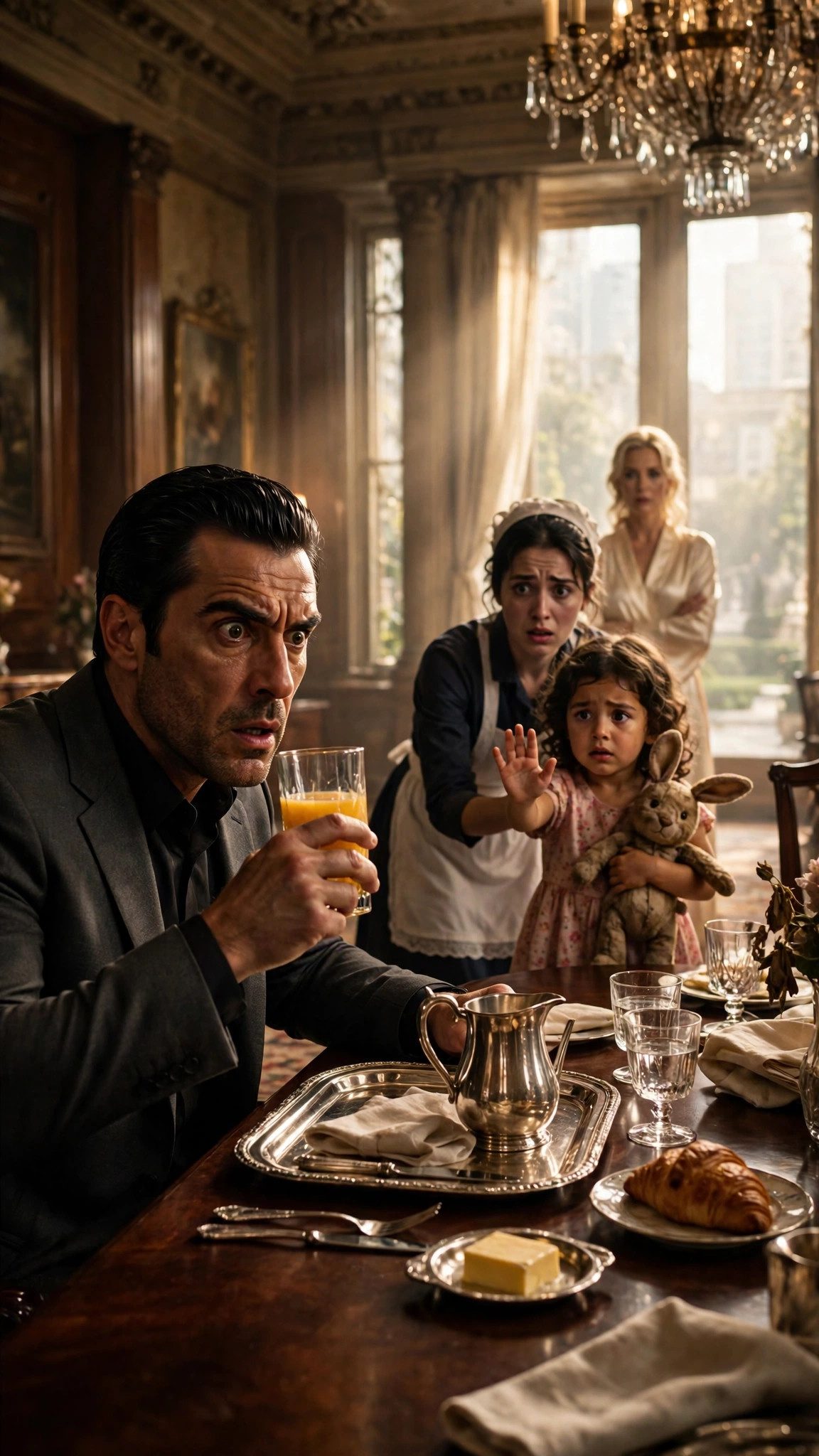
"Your orange juice smells terrible!"
The words cut through the dining room just as Dominic Moretti raised the crystal glass toward his mouth.
His hand stopped halfway.
At the other end of the long mahogany table, four-year-old Lily stood behind her mother's apron, clutching a worn stuffed rabbit. Her brown eyes were fixed on the orange liquid.
"Lily!" Elena whispered.
The young housemaid went pale. She caught her daughter's shoulder and pulled her backward, nearly knocking the silver serving tray from the table.
"I'm terribly sorry, Mr. Moretti. She doesn't know what she's saying."
Dominic didn't move.
He was forty-one, dressed in a charcoal-gray suit, his dark hair combed neatly back. Men who controlled shipping terminals, warehouses, and half the unofficial freight routes through Chicago had learned to measure their words around him.
Apparently, nobody had explained that to Lily.
He looked at the little girl.
"What did you say?"
Elena tightened her hold on her daughter's shoulder.
"Please, sir. She's only four."
Dominic set his newspaper aside.
"I'm asking Lily."
The child glanced up at her mother, then back at him.
"It smells bad."
"Bad how?"
Lily wrinkled her nose.
"Like Daddy's old medicine."
The room became still.
Dominic slowly lowered the glass until its base touched the table.
"What medicine, sweetheart?"
"The one that made Mama say we shouldn't touch his things."
Elena's face lost its color.
"That's enough, Lily."
Dominic studied the woman standing beside his chair. Elena Rossi had worked at the estate for three months. She was thirty-two, quiet, dependable, and almost painfully careful never to attract attention. She lived in a modest room in the staff wing with her daughter because she'd been unable to afford separate housing after becoming a widow.
Until this morning, Dominic knew little else about her.
He looked back at Lily.
"Do you smell it now?"
She nodded.
"Even from there?"
"Yes, sir."
Dominic moved the glass slightly away from his plate.
"Then I won't drink it."
Lily seemed relieved.
Elena lowered her eyes.
"Thank you for being understanding, sir. I'll bring another glass."
"No need."
He offered Lily a small smile.
"You have a very good nose."
She hugged her rabbit.
"Daddy said so."
Elena hurried her daughter toward the side door. Dominic watched them leave. The instant the door closed, his smile disappeared.
He stared at the orange juice. Freshly squeezed. No visible sediment. Nothing unusual about its color. Yet something about the child's words had disturbed him.
Like Daddy's old medicine.
Dominic had spent twenty years surviving threats that arrived through business deals, phone calls, and men waiting outside expensive restaurants. He knew how to recognize an enemy. He had never considered that death might arrive in a breakfast glass.
Three months earlier, Elena Rossi had arrived at the iron gates of the Moretti estate with one suitcase, one small daughter, and one worn stuffed rabbit. It was late September, and the wind off Lake Michigan had already turned sharp. The housekeeper, Mrs. Delgado, had met them at the service entrance and looked Elena up and down with the practiced eye of a woman who had seen a hundred girls come through that door.
"You've worked in a house before?" Mrs. Delgado asked.
"Two years for a family in Evanston," Elena said. "Before that, a hotel. I clean well, I cook plain food, and I don't gossip."
"And the child?"
"She stays with me. She's quiet. She won't be trouble."
Mrs. Delgado had glanced at Lily, who was hiding half behind her mother's skirt, one brown eye peering out.
"We'll see," Mrs. Delgado said.
Elena had not told Mrs. Delgado everything. She had not said that her husband, Marco Rossi, had died eleven months earlier, after two years of a failing heart that no doctor in their neighborhood clinic could fix. She had not said that the medicine bottles still sat in a paper bag at the bottom of her suitcase because she could not bring herself to throw them away. She had not said that she had sold nearly everything they owned to pay for the funeral, and that the room in the staff wing was the first roof over their heads that did not leak.
She did not need to say any of it. The estate had a way of learning what it needed to know.
Dominic Moretti had approved the hire without meeting her. He approved most household hires that way. The estate ran on routine: breakfast at seven, the newspapers ironed flat, the cars washed before nine, the gardeners gone by noon. He liked routine. Routine meant nothing surprised him.
What surprised him, three months into Elena's employment, was how little he noticed her. She was good at her work in the way that made work invisible. His shirts appeared pressed. His study stayed dusted. The silver never tarnished. He passed her in hallways and she stepped aside with her eyes lowered, and he forgot her face within seconds.
Lily was harder to forget. The child had a way of appearing in doorways at the exact moment Dominic was thinking about something else, staring at him with enormous brown eyes, and then vanishing before he could decide what to do about it. Once he found her in the library, sitting on the floor with a picture book, her rabbit tucked under her arm. She looked up at him without fear.
"Are you the boss of this house?" she asked.
"Something like that," Dominic said.
"My daddy was the boss of our house," she said. "Now Mama is."
Dominic had not known what to say to that, so he had nodded and left the room.
Vanessa Laurent had laughed when he told her about it that evening. Vanessa was beautiful in the calculated way of women who knew exactly how much attention they commanded. Blonde hair, green eyes, a laugh that arrived precisely on time. In six weeks, she would become Mrs. Dominic Moretti. The wedding was to be the event of the season: four hundred guests, the garden tented in white, a string quartet flown in from New York.
"You should be careful," Vanessa had said, swirling her wine. "Children get attached. Next thing you know she'll be calling you Uncle Dominic."
"She's four," Dominic said.
"Exactly. Four-year-olds are very good at getting what they want."
He had not thought about it again. He had other things to think about. The shipping terminals were under pressure from the Falcone family, who had been circling his freight routes for a year. A warehouse in Cicero had caught fire under circumstances no one could explain. Two of his drivers had been offered double pay to quit. Dominic Moretti was a man who understood threats. He understood rivals, and police, and men with guns.
He did not understand why, for nearly three weeks, he had been waking up with a dull headache behind his eyes.
At first he blamed the long hours. He was sleeping five hours a night, sometimes four. Then the dizziness started — brief, barely a second, when he stood up too fast. Then the fatigue, a heaviness in his limbs by mid-afternoon that coffee could not fix. He told himself it was stress. He told himself it was age. He was forty-one, not twenty-five. Men slowed down.
He did not tell anyone. Dominic Moretti did not complain about his health. He had watched his own father die at fifty-three, a heart attack at the breakfast table, and he had decided long ago that he would not be a man who talked about his body.
But on the morning Lily stopped him from drinking his orange juice, the headache was worse than it had ever been, and the glass in his hand felt heavier than it should have.
High heels clicked against the marble floor.
Vanessa Laurent entered wearing a cream silk robe, her blonde hair falling over one shoulder. She kissed his cheek.
"Good morning, darling."
Dominic barely acknowledged her.
Vanessa glanced toward the kitchen.
"That maid really needs to control her child. I heard the little girl making a scene."
"She noticed something about the juice."
Vanessa laughed softly.
"Children notice everything. Most of it isn't worth listening to."
She reached toward the glass.
Dominic caught her wrist. Not roughly. Just firmly enough to stop her.
"Leave it."
Vanessa blinked.
"Dominic?"
He released her.
"I'm not hungry."
She studied his face.
"Something wrong?"
Dominic picked up his phone.
"Business."
"Already?"
"I have a call to make."
Vanessa's smile thinned.
"Of course. I'll be in the garden."
She kissed his temple. Dominic waited until her footsteps disappeared. Then he dialed a number.
"Raphael."
His security chief answered immediately.
"Yes, boss?"
"Come to the dining room. Alone."
Ninety seconds later, Raphael Costa entered through the side door. Broad-shouldered, thirty-eight, and dressed in an unremarkable black suit, Raphael had served Dominic for twelve years. He took one look at the untouched glass.
"What happened?"
Dominic pointed toward it.
"Preserve that."
Raphael frowned.
"Why?"
"A child said it smelled wrong."
For several seconds, Raphael simply stared. Then he looked at Dominic's expression. He stopped questioning.
"I'll have it examined."
"By an independent laboratory. Keep the sample documented, and don't allow anyone in the household to handle it."
Raphael nodded.
"Who brought it?"
"Elena Rossi."
"The new maid?"
"Yes."
"Anyone else touch it?"
Dominic looked toward the garden doors.
"That's what I want to know."
Raphael carried the glass away. Dominic remained seated. On the polished table, a small ring of condensation marked where it had stood. He stared at that circle until his phone vibrated.
A message from Raphael.
One question, boss. Have you been feeling unusually tired lately?
Dominic's fingers went cold. Because for nearly three weeks, he had been waking with a dull headache, occasional dizziness, and a fatigue he couldn't explain. He had blamed long hours. He had blamed stress. He had blamed everything except the orange juice.
Then another message appeared.
I'm arranging a medical examination. Don't eat or drink anything else prepared for you until we know.
Dominic rose. Through the tall windows, he could see Vanessa laughing beside the rose garden. Behind her, Elena was pushing Lily on a small wooden swing.
His fiancée. His housemaid. A little girl who had just saved him from taking another sip.
Dominic watched all three. And for the first time in years, he realized that the person trying to kill him might already be living under his roof.
That night, Dominic did not sleep. He sat in his study long after the house had gone quiet, a glass of water from a sealed bottle on the desk beside him, and looked at the portrait of his father that hung above the fireplace.
His father had died at fifty-three, at the breakfast table, with a fork still in his hand and the morning newspaper folded beside his plate. The doctors had called it a heart attack. There had been no warning. One morning he was arguing about freight rates, and the next morning he was gone. Dominic had been twenty-four. He had inherited an empire before he had learned how to run it, and he had spent the next seventeen years making sure no one ever saw him weak.
He had never once considered that his father's heart attack might not have been natural. His father had enemies. Everyone in their world had enemies. But a heart attack was a heart attack. It was the kind of death that asked no questions.
Now Dominic was asking questions.
He thought about the headaches. The dizziness. The fatigue that had crept over him like a slow tide. He thought about how carefully it had been done — not enough to kill him quickly, not enough to raise an alarm, just enough to wear him down a little more every day. Whoever had done this understood poison the way Dominic understood shipping routes: as a system, patient and invisible.
He picked up his phone and sent Raphael a single message: Watch the house tonight. Every door. Every window. No one comes in, no one goes out.
Then he poured the water down the sink, locked the study door, and sat in the dark, listening to the old house settle around him.
In the staff wing, Elena Rossi sat on the edge of the small bed and brushed Lily's hair with slow, careful strokes. Lily was already in her nightdress, her rabbit tucked under her arm, her eyes heavy with sleep.
"Mama," Lily whispered, "why did the boss look sad?"
Elena's hand paused. "What do you mean, baby?"
"When I told him about the juice. He looked sad. Not angry. Sad."
Elena set the brush down. "I don't know, baby. Maybe he was surprised."
"Is the juice really bad?" Lily asked. "Is someone sick?"
Elena looked at her daughter — four years old, all brown eyes and tangled hair — and felt the familiar weight settle on her chest. How did you explain poison to a child? How did you explain that the man who owned the house might have been dying in it, one glass at a time?
"The juice smelled like Daddy's medicine," Elena said carefully. "And Daddy's medicine was very strong. It was medicine for a sick heart. If a person who isn't sick drinks it, it can make them very sick."
Lily nodded, as if this made perfect sense. "So I helped him. Like when I help you carry the laundry."
"Yes, baby. You helped him."
"Good." Lily yawned. "I like helping."
Elena tucked the blanket around her daughter and kissed her forehead. "Go to sleep now."
But after Lily's breathing slowed, Elena sat awake in the dark and stared at the suitcase in the corner. The paper bag was still there, at the bottom, with Marco's bottles inside. She had kept them because throwing them away had felt like throwing away the last piece of him. Now those bottles were the most dangerous things in the house.
Someone had opened one. Someone had taken a month's worth of tablets. Someone had walked into her room — her room, where her daughter slept — and stolen her dead husband's medicine.
Elena pulled the blanket up to her chin and listened to the house. Somewhere above her, in the main part of the estate, a floorboard creaked. She did not sleep for a long time.