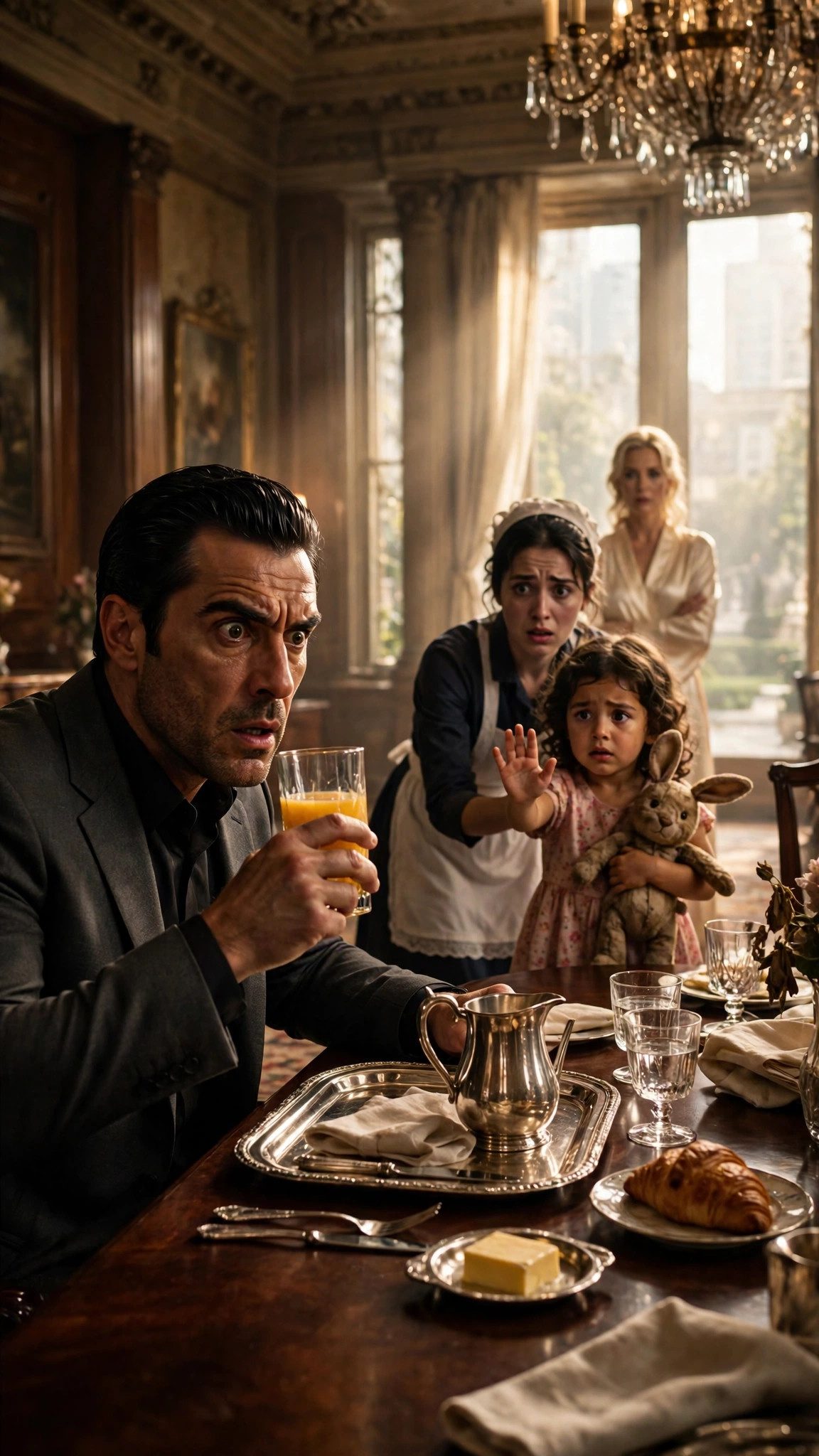
Raphael Costa did not take the glass to a hospital. He did not take it to a police laboratory, and he did not take it to any doctor Dominic's family had ever used. He took it to a small private laboratory on the second floor of an unmarked building on the West Side, where a chemist named Dr. Ingrid Bauer owed Dominic's father a debt from a time nobody talked about anymore.
"How fast?" Raphael asked.
"For you? Tomorrow morning," Dr. Bauer said. She was a thin woman in her sixties with steel-gray hair and hands that never shook. "But I can tell you one thing now. Whatever is in here, it isn't juice."
"What do you mean?"
She held the glass up to the light. "Fresh orange juice is cloudy. It has pulp, it has texture. This is too clear at the edges. Something has been dissolved in it. Something that doesn't belong."
Raphael left the glass with her and drove back to the estate through streets that were already filling with morning traffic. He had served Dominic Moretti for twelve years. He had guarded him through a war with the Falcone family that had left three men dead and a warehouse burned to its foundations. He had learned to read Dominic's face the way other men read weather.
This morning, Dominic's face had told him something Raphael had never seen there before: fear. Not of a rival. Not of a gun. Fear of his own house.
By noon, Dominic sat in his study with the door locked and a doctor he had never met before taking his blood pressure. Dr. Alan Mercer was a quiet man in his fifties with a graying beard and the calm manner of someone who had delivered bad news so many times that he had learned to do it gently.
"Your blood pressure is elevated," Dr. Mercer said. "Your pulse is irregular. Have you had any chest pain?"
"No."
"Dizziness?"
"Sometimes. When I stand."
"Headaches?"
"Every morning for three weeks."
"Fatigue?"
Dominic hesitated. "Yes."
Dr. Mercer wrote something in his notebook. "Mr. Moretti, I need to ask you a personal question. Has anyone in your household had access to your food and drink?"
"Everyone in my household has access to my food and drink. That's what a household is."
"Has anyone new joined the household recently?"
Dominic thought of Elena Rossi, three months in the staff wing, quiet and careful. He thought of Vanessa, who had moved half her wardrobe into the east bedroom in September. He thought of the new gardener, the new driver, the girl who polished the silver on Tuesdays.
"Several people," he said.
Dr. Mercer drew three vials of blood and labeled them with steady hands. "I'll have these tested tonight. If someone has been dosing you with something, the blood will tell us. But I want you to understand something. If the juice was poisoned, and if you've been drinking it every morning, then this has been happening for a while. Whoever did this was patient. They wanted you weak, not dead. Not yet."
"Weak for what?" Dominic asked.
"That," Dr. Mercer said, "is not a medical question."
After the doctor left, Dominic stood at the study window and watched the garden. Vanessa was walking the paths with her phone pressed to her ear, laughing at something someone had said. She moved through his garden the way she moved through his house: as if she already owned it.
Elena was on her knees near the rose beds, pulling weeds with her bare hands. Lily sat beside her on the grass, arranging fallen petals into a careful row. The little girl looked up at the window — straight at him, as if she had known he was watching — and waved her stuffed rabbit at him.
Dominic did not wave back. He stepped away from the window.
That evening, Raphael returned with a preliminary answer and a face that told Dominic everything before he spoke.
"It's poison," Raphael said. "A heart medicine. Digoxin, or something very close to it. In a large dose it stops the heart. In small doses, every morning, it does exactly what you've been feeling. Headaches. Dizziness. Exhaustion. Irregular pulse. Dr. Bauer says the dose in that glass was not small. It was enough to do real damage. If you had drunk all of it, you might have collapsed before lunch."
Dominic sat down slowly. "How much is in the blood work?"
"Dr. Mercer called an hour ago. Your blood shows the same compound. Low levels, but present. Consistent with daily dosing for about three weeks."
Three weeks. Dominic counted backward. Three weeks ago, Vanessa had hired a new personal maid, a quiet girl named Carla, to help with the wedding preparations. Three weeks ago, Elena had started serving his breakfast directly, because Mrs. Delgado had hurt her wrist. Three weeks ago, the Falcone family had made a new offer for the Cicero warehouse — an offer Dominic had refused.
"Who had access to the juice?" Dominic asked.
Raphael opened his notebook. "The oranges are squeezed in the kitchen at six thirty every morning by the cook, Mrs. Alvarez. The glass is poured and placed on a silver tray. Elena carries the tray to the dining room. She is alone with it for perhaps two minutes. The tray passes the hallway, the pantry, and the garden doors."
"Anyone else?"
"Vanessa was in the kitchen at six forty this morning. Mrs. Alvarez says she came in to choose flowers for the table. She stood near the counter for a few minutes."
"She chooses flowers every morning."
"Yes," Raphael said. "But Mrs. Alvarez also says something else. She says Elena asked her a strange question last week. She asked whether the medicine in the staff wing — her late husband's medicine — could be dangerous if a child swallowed it."
Dominic felt the room tilt slightly. "Elena's husband had heart medicine?"
"Marco Rossi died of a failing heart eleven months ago. He was on digoxin for two years. Elena still has his bottles in her room. She never threw them away."
The pieces assembled themselves in Dominic's mind with a terrible neatness. A maid whose husband died of a heart condition. The same medicine in the dead husband's bottles. A woman who served his breakfast every morning. A woman who had access, and motive — or at least, a past that made motive easy to imagine.
"Search her room," Dominic said quietly. "Do it while she's at dinner service. Don't frighten the child."
Raphael nodded and left. Dominic poured himself a glass of water from the sealed bottle in his study — the only drink he trusted now — and drank it standing at the window. Outside, the garden was turning gold in the evening light. The estate looked peaceful. It looked like a home.
It had never felt less like one.
At nine o'clock, Raphael came back with a paper bag and a look Dominic had seen only twice in twelve years: the look of a man who had found exactly what he was afraid of finding.
"In her room," Raphael said. "In the bottom of her suitcase. Three bottles of digoxin. One of them is open, and the count is short. About a month's worth of tablets is missing."
Dominic stared at the bag. "Could she have taken them herself? For her own heart?"
"She has no prescription. Her medical records show no heart condition. And there's more." Raphael set a small notebook on the desk. "Mrs. Alvarez keeps a kitchen log. Every morning, someone initials the tray when it leaves the kitchen. For the past three weeks, the initials are Elena's. Every single morning. Before that, the initials were Mrs. Delgado's."
"And Vanessa's maid?"
"Carla says she saw Elena standing at the tray in the hallway yesterday morning, doing something with her hands. She says Elena looked startled when she saw her."
Dominic closed his eyes. He thought about the little girl on the swing, waving her rabbit at the window. He thought about Lily's voice: It smells like Daddy's medicine before he died.
A child who knew the smell of her father's medicine would know it anywhere. A child who had watched her mother handle those bottles for two years would know exactly what they were.
"Where is Elena now?" Dominic asked.
"In the staff wing with the child. I've posted a man at the door. Not to frighten them. To make sure they don't leave."
"And Vanessa?"
"She's in her room. She asked me twice what was happening. I told her nothing."
Dominic stood up. "Bring Elena to the small sitting room. Not the study. The sitting room. And bring Lily too — I don't want the child left alone to imagine things."
Ten minutes later, Elena Rossi stood in the sitting room with her daughter pressed against her side. She was still wearing her work apron. Her hands were shaking. Lily clutched her rabbit and stared at Dominic with wide brown eyes.
"Mr. Moretti," Elena said, "whatever this is, I swear to you—"
Dominic raised a hand. "Elena. I need you to listen to me, and I need you to tell me the truth. Your husband's medicine. Digoxin. Is it in your room?"
Her face went white. "Yes. I kept his bottles. I couldn't throw them away. But I never—"
"One bottle is open. A month's worth is missing."
Elena's knees seemed to give way. She caught the arm of a chair. "I don't know anything about that. I haven't opened those bottles since Marco died. I swear it on my daughter's life."
"Then who did?"
"I don't know!" Her voice broke. "Someone must have gone into my room. Anyone could have. The staff wing doors don't lock properly. Mrs. Delgado has said so for years."
"Did you ask Mrs. Alvarez whether the medicine was dangerous?"
Elena's eyes filled with tears. "Lily found a tablet on the floor last week. Under my bed. I didn't know how it got there. I asked Mrs. Alvarez if it could hurt her. That's all. I was afraid for my daughter."
Lily tugged at her mother's apron. "Mama, don't cry."
Dominic looked at the little girl. Her face was pale, her rabbit held tight against her chest. She had saved his life that morning, and now her mother was standing in his sitting room accused of trying to take it.
"Raphael," Dominic said, "take them back to their room. They're not to leave the estate. No one is to speak to them except through you."
"Boss—"
"Do it."
After they were gone, Dominic sat alone in the sitting room for a long time. The evidence was neat. Too neat, a small voice in his head said. But Dominic Moretti had built his life on evidence, and the evidence said the woman who served his breakfast had the poison, the access, and the opportunity.
And yet.
He kept thinking about the morning. About the way Elena had gone pale — not with guilt, but with terror. About the way she had pulled Lily backward, as if the child had said something dangerous. About the way Vanessa had reached for the glass without hesitating, and laughed, and called it nothing.
He kept thinking about one more thing. At breakfast, before Lily spoke, Vanessa had said something. Dominic tried to remember the exact words. She had glanced toward the kitchen and said, "That maid really needs to control her child."
She had not seemed surprised that the child was making a scene. She had seemed annoyed. Annoyed that the scene was happening at all.
Dominic picked up his phone and called Dr. Mercer.
"Doctor. One question. If a child found a single tablet on the floor, and the mother asked whether it was dangerous — would that mother be a woman planning to poison someone?"
There was a pause. "No, Mr. Moretti. That would be a frightened mother."
Dominic ended the call. He walked to the window. In the staff wing, a single light burned in a small window. Elena's room. He imagined Lily asleep with her rabbit, and Elena sitting awake beside her, afraid.
He had spent twenty years learning to recognize his enemies. Tonight, for the first time, he was not sure he was looking at one.
The next morning, Raphael went to the kitchen before anyone else was awake and found Mrs. Alvarez already there, kneading dough with flour on her forearms.
"Mrs. Alvarez," he said, "I need you to tell me about the tray. Every detail. Who pours the juice, who carries it, where it goes."
The cook wiped her hands on her apron. "I squeeze the oranges at six thirty. I pour the glass myself. I put it on the silver tray with the toast and the jam. Then Elena takes it. She carries it down the hallway, past the pantry, past the garden doors, to the dining room. Two minutes, maybe less."
"Does the tray ever stop?"
"Only if someone stops her. To talk. To ask a question."
"Has anyone stopped her? In the past three weeks?"
Mrs. Alvarez thought about it. "Miss Vanessa stops her sometimes. To tell her the flowers are wrong, or the napkins are wrong. Small things. She likes things a certain way."
Raphael wrote it down. "And the garden doors? Are they ever open in the morning?"
"In the summer, yes. This time of year, no. Too cold."
"Thank you," Raphael said. "And Mrs. Alvarez — if you remember anything else, anything at all, you come to me. Not to anyone else. To me."
The cook nodded, and Raphael left her to her dough.
That same morning, Dominic nearly fell in his office.
He had stood up too fast from his desk, reaching for a shipping manifest, and the room tilted sideways. He caught himself on the edge of the desk, his fingers white around the wood, and stood there breathing hard until the world came back into place.
His shipping manager, a man named Ortiz who had worked for the family for thirty years, was standing in the doorway with a folder in his hands. He had seen it.
"Boss?" Ortiz said. "Are you all right?"
"I'm fine," Dominic said. He straightened his tie and took the folder. "Low blood sugar. I skipped breakfast."
Ortiz did not believe him. Dominic could see it in the older man's eyes. But Ortiz had worked for the Moretti family long enough to know when not to ask a question, and he asked nothing.
After Ortiz left, Dominic sat down and pressed his palms flat against the desk. His hands were shaking. He had not told anyone about the dizziness — not Raphael, not the doctor, not even himself, really. He had filed it away with the headaches and the fatigue, under the heading of things a busy man ignores.
Now he knew what it was. It was poison, taken a little at a time, every morning, in a glass he had trusted. And it was getting worse.
He opened his desk drawer and took out a small notebook. In it, he wrote three words: Three weeks. Daily. Morning.
Then he closed the notebook and went back to work, because Dominic Moretti had survived twenty years by working through pain, and he was not going to stop now.