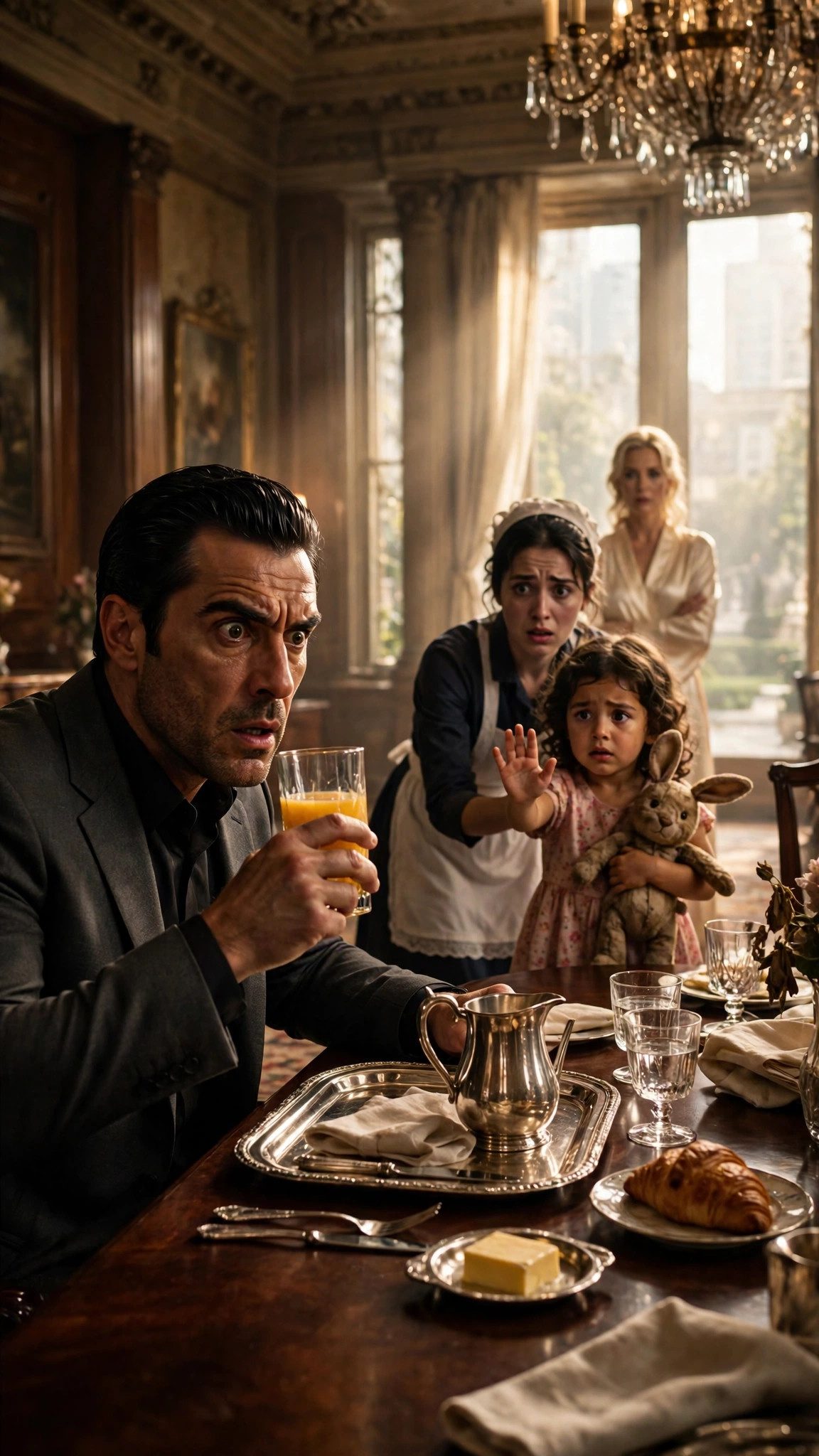
The morning after the party, the estate was quiet in a way it had never been quiet before.
The chandeliers were dark. The flowers from the engagement party wilted in their vases. The string quartet's sheet music still lay on the stands in the corner of the great hall, and no one had come to collect it. Four hundred guests had gone home with a story they would tell for years, and the house that had held them was left to deal with what came next.
Dominic woke at seven, as he always did, and for the first time in a month, his head did not hurt.
He sat on the edge of his bed and waited for the dizziness. It did not come. He stood up, and the room stayed still. He walked to the window and looked out at the garden, and his limbs felt like his own again.
Dr. Mercer arrived at eight. He took Dominic's blood pressure, listened to his heart, and drew blood for another test.
"Your pulse is steadier," Dr. Mercer said. "The poison leaves the body slowly, but it leaves. No more doses means no more damage. In a month, your blood should be clean. In two months, you should feel like yourself again."
"And if I had kept drinking it?" Dominic asked.
Dr. Mercer did not hesitate. "Another month, perhaps two, and your heart would have stopped. It would have looked natural. That was the plan."
Dominic nodded. He had known it, but hearing it said aloud made it real in a different way.
Downstairs, Raphael was dealing with the rest of it. Carla had been taken by the police the night before, and by morning she had told them everything: the false reference, the money Vanessa had paid her, the instruction to lie about Elena at the tray. The pharmacy in Cicero had surrendered its records. The Delaware company had been traced to Anthony Falcone, and Anthony Falcone had been arrested at dawn, trying to board a plane at O'Hare with two suitcases full of cash.
Vanessa Laurent was in a cell downtown, charged with attempted murder. Her lawyers were already talking, but the evidence was not the kind that lawyers could talk away: laboratory reports, pharmacy records, a false prescription in a dead man's name, a witness who had confessed, and four hundred people who had watched her hand glow under an ultraviolet lamp.
Dominic did not go to see her. He had nothing to say to her, and he knew she had nothing to say to him that would be true.
Instead, he went to the staff wing.
Elena opened the door before he knocked. She had been waiting. Her eyes were red, but she was dressed for work, her apron clean, her hair pulled back. Lily stood behind her, holding her rabbit, watching Dominic with the careful attention of a child who had learned that adults could be unpredictable.
"Elena," Dominic said, "I owe you more than an apology. I owe you your name back."
She shook her head. "You don't owe me anything, Mr. Moretti."
"I do. The whole house believed you did it. The whole city will hear that you didn't, but that isn't enough. I want you to hear it from me, in person, with no one else in the room." He looked at her directly. "You did not poison me. You never poisoned anyone. A woman who kept her dead husband's medicine because she couldn't bear to throw it away is not a poisoner. She's a widow who loved her husband. I was wrong to doubt you, and I was wrong to let this house doubt you."
Elena's eyes filled with tears. She pressed a hand to her mouth and nodded, unable to speak.
"There's more," Dominic said. "Mrs. Delgado is retiring at the end of the month. I want you to take her place. Housekeeper of the estate. Your own rooms — not the staff wing, but the housekeeper's apartment on the second floor, with a bedroom for Lily and a window that looks at the garden. Double your pay. And a promise: no one in this house will ever speak to you the way they spoke to you this week, or they will answer to me."
Elena stared at him. "Mr. Moretti, I don't know what to say."
"Say yes," Dominic said. "Or say no. It's your choice. But I want you to know that the offer is real, and it doesn't come with conditions. You don't owe me anything for it. Your daughter already gave me more than I can repay."
Lily tugged at her mother's apron. "Mama, does this mean we get to stay?"
Elena looked down at her daughter, then back at Dominic. "Can I ask you something first?"
"Anything."
"Why did you believe me? In the end. When everyone else believed the worst."
Dominic thought about it. He thought about the sitting room, and the little girl with the rabbit, and the question he had asked himself that night: who had tried to kill him, and who had saved him.
"Because your daughter told me the truth twice," he said. "Once with her nose, and once with her words. And because a woman who cries when her child coughs doesn't poison a man's breakfast. I should have seen that sooner. I'm sorry I didn't."
Elena wiped her eyes with the corner of her apron. "Then yes," she said quietly. "Yes, I'll stay."
That afternoon, Dominic called a meeting of the entire household staff in the great hall — the same room where, the night before, four hundred guests had watched his fiancée led away by the police. The staff stood in a nervous row: the cooks, the gardeners, the drivers, the maids, Mrs. Delgado with her hands folded in front of her.
Dominic stood before them and spoke plainly, the way his father had once spoken to men before a difficult job.
"Four days ago, a child in this house saved my life," he said. "Three days ago, this house accused her mother of trying to take it. The accusation was false. Elena Rossi is innocent. The person who poisoned me was Vanessa Laurent, and she is in police custody. Anyone who repeats the old accusation — to anyone, inside this house or outside it — will leave this house the same day. Is that understood?"
The staff nodded. Mrs. Delgado, who had worked for the Moretti family for thirty years and had seen everything, wiped her eyes with a handkerchief and nodded hardest of all.
After the meeting, Mrs. Alvarez, the cook, came to Elena in the kitchen and hugged her so hard that Elena's feet nearly left the floor.
"I never believed it," Mrs. Alvarez whispered. "Not for one minute. But I was afraid to say so. Forgive me."
"There's nothing to forgive," Elena said.
But there was something else, something Elena did not say to Mrs. Alvarez, or to Dominic, or to anyone — not yet.
That evening, after Lily was asleep, Elena sat in her small room and looked at the suitcase in the corner. The bottles were gone now, taken by the police as evidence. The suitcase was empty except for a folded sweater of Marco's that she had kept, and a photograph of him holding Lily on the day she was born.
She had come to the estate to survive. She had stayed because she had nowhere else to go. Now Dominic Moretti was offering her a home, a position, a future — and she did not know whether she could accept it.
Because the truth was this: she had watched a man nearly die in his own house, at the hands of a woman he was going to marry. She had watched her daughter save him twice. And she had watched Dominic Moretti, the most feared man in Chicago, crouch down in a doorway and hold a stuffed rabbit as if it were made of glass.
Elena Rossi had spent eleven months grieving a husband who had died too young. She had not expected to feel anything again except fear and tiredness. But sitting in her small room, looking at Marco's photograph, she felt something she had not felt in a long time.
She felt safe.
And that frightened her more than anything that had happened that week — because safe was the one thing she had stopped believing in, and now a man she barely knew was offering it to her, and she did not know whether she was brave enough to take it.
Outside her window, the garden was dark. In the main house, a single light burned in Dominic's study. He was awake, as he always was, working late, carrying the weight of an empire on shoulders that were finally healing.
Elena watched that light for a long time before she blew out her candle and went to sleep beside her daughter.
On Mrs. Delgado's last day, she called Elena into her office and pressed a heavy ring of keys into her hands.
"These are the keys to the house," Mrs. Delgado said. "Every room, every cupboard, every door. A housekeeper holds the keys, but she also holds something more. She holds the trust of everyone who lives here. If the staff trusts you, the house runs. If they don't, it falls apart."
Elena looked at the keys in her hands. They were warm from Mrs. Delgado's grip.
"I don't know if I can do this," Elena said.
"You already did it," Mrs. Delgado said. "You did it the morning you stood in the sitting room and told the truth when the whole house wanted you to be guilty. That's what a housekeeper does. She tells the truth, even when it's hard."
Mrs. Delgado hugged her then, a fierce, quick hug, and then she picked up her suitcase and walked out of the estate for the last time, toward a small house in Florida and a retirement she had earned thirty times over.
The same week, Dominic called a meeting of his captains — the men who ran his terminals, his warehouses, his routes. They gathered in the study, eight men in dark suits, and they waited to hear what their boss would do about the Falcones.
They expected a war. Dominic Moretti had always answered an attack with an attack. That was the rule of their world.
Dominic surprised them.
"No retaliation," he said. "Anthony Falcone is in a cell. His money is frozen. His organization is falling apart on its own. We don't need to burn anything down. We need to be better than that now."
One of the captains, a man named Sal, frowned. "Boss, with respect — if we don't answer, they'll think we're weak."
"They'll think what they want," Dominic said. "But I spent three weeks being poisoned in my own house because I was too busy looking for enemies outside it. I won't make that mistake again. From now on, we protect what's inside. The house. The people in it. That's the priority."
The captains looked at each other. Then, one by one, they nodded.
After the meeting, Raphael stayed behind. "Boss," he said, "that's not like you."
"Maybe I'm not like me anymore," Dominic said. "Maybe that's a good thing."
That night, Lily slept in her new bedroom for the first time. The room had a window that looked at the garden, and a small bed with a white blanket, and a shelf where Elena had placed the photograph of Marco, holding Lily on the day she was born.
Lily arranged her fallen petals on the new windowsill in a careful row, just as she had done on the old one. Then she climbed into bed, tucked her rabbit under her chin, and looked up at her mother.
"Mama," she whispered, "is this room really ours?"
"Yes, baby," Elena said. "It's ours."
"And nobody can take it away?"
Elena kissed her forehead. "Nobody can take it away."
Lily yawned, her eyes already closing. "Good," she murmured. "I like this room. It smells like flowers."
Elena sat beside the bed until her daughter's breathing slowed, and then she went to the window and looked out at the garden. The roses were dark shapes in the moonlight. In the main house, a single light burned in Dominic's study.
She thought about Marco, and about the life she had lost, and about the life she was building now in a house that had once accused her of murder. She thought about the man in the study, who had apologized to her, and offered her a future, and meant it.
For the first time in eleven months, Elena Rossi did not feel like a widow surviving. She felt like a woman beginning.
A week later, on a bright Tuesday morning, Dominic came down to breakfast and found something he had never seen in his dining room before: a family.
Elena was at the stove — not serving, but cooking, because Mrs. Alvarez had given her the morning off and she had decided to make pancakes. Lily sat at the long mahogany table in her nightdress, her rabbit propped up in the chair beside her like a guest, a smear of flour on her cheek.
"Good morning," Elena said, and she smiled at him — not the careful smile of an employee, but the easy smile of a woman in her own kitchen.
"Good morning," Dominic said. He sat down at the table, and Lily immediately pushed a plate toward him.
"Mama made pancakes," Lily announced. "I helped. I stirred."
"You stirred very well," Elena said.
Dominic cut into a pancake. He ate it slowly, tasting it properly, the way a man tastes food when he has not been afraid of it. It was the first breakfast in a month that he had eaten without wondering what was in it.
"Is it good?" Lily asked, watching him with enormous brown eyes.
"It's the best pancake I've ever had," Dominic said, and he meant it.
Lily beamed. "Mama, he likes them!"
Elena laughed — a real laugh, unguarded and warm — and Dominic realized, sitting at his own table in his own house, that he had not heard that sound in his home before. He had heard music, and conversation, and the clink of glasses. He had never heard laughter that sounded like it belonged there.
He ate two pancakes. He drank his coffee. He drank his orange juice — poured from a carton Elena had bought herself at the market that morning, because the estate's oranges were still under Raphael's watch — and when Lily leaned over and sniffed his glass, the way she did every morning now, out of habit and out of love, she declared it smelled fine, and Dominic believed her.
It was an ordinary morning. It was the most extraordinary morning of his life.