Three months later, on a morning in early spring, Dominic Moretti stood in the garden of his estate and watched the sun come up over the rose beds.
His blood was clean. Dr. Mercer had said so the week before, holding up the laboratory report like a man presenting a prize. No trace of digoxin. His pulse was steady. His headaches were gone. He slept seven hours a night now, and he woke without the heaviness that had dragged at his limbs for a month.
The estate had changed too. Mrs. Delgado had retired to a small house in Florida, and Elena Rossi — Mrs. Rossi, the staff called her now, with a respect that had not been there before — ran the household with a quiet competence that surprised everyone, including Elena herself. The housekeeper's apartment on the second floor had a bedroom for Lily with a window that looked at the garden, and Lily had covered the windowsill with fallen petals arranged in careful rows.
The Falcone family had not come back. Anthony Falcone was awaiting trial, and his organization had gone quiet, the way organizations go quiet when their leader is in a cell and their money is frozen. Dominic had not needed to threaten anyone. The city had watched what happened at the engagement party, and the city had understood.
Vanessa Laurent had pleaded guilty. She would spend years in prison, and when she came out, the world she had tried to buy her way into would not want her back. Dominic had not gone to the sentencing. Raphael had gone, and he had come back and said only, "It's done, boss." That was enough.
But the biggest change in the house was not the staff, or the garden, or the quiet that had settled over the shipping terminals. The biggest change was Dominic himself.
He had spent twenty years building walls around his life: walls of money, walls of men with guns, walls of routine. He had told himself the walls were what kept him alive. A four-year-old girl with a stuffed rabbit had proved him wrong. What had kept him alive was not a wall. It was a child who had paid attention, and a woman who had raised her to be brave.
He had thought about that every day for three months. He had thought about it while Elena served his breakfast — real breakfast now, prepared by Mrs. Alvarez under no guard at all, because there was no one left to guard against. He had thought about it while Lily did her lessons at the kitchen table, sounding out words with her finger, her rabbit propped up beside her like a classmate. He had thought about it while Elena laughed in the garden, a sound he had never heard before the poison, because Elena had not laughed in his house until she felt safe in it.
This morning, he was going to do something about it.
He found Elena in the kitchen, checking the list for the day. She was wearing a simple gray dress, her dark hair pulled back, a pencil behind her ear. She looked up when he came in, and she smiled — the quick, unguarded smile she had only recently learned to give him.
"Mr. Moretti," she said. "Breakfast is almost ready."
"Elena," he said, "I need to talk to you. Not as your employer. As a man."
She set the pencil down. "All right."
He took a breath. Dominic Moretti had negotiated with shipping magnates and rival families and men who carried guns into his office. He had never been as nervous as he was standing in his own kitchen, talking to his housekeeper.
"Three months ago, your daughter saved my life," he said. "Twice. She did it because you raised her to pay attention, and to speak up, and to be brave. I have spent twenty years surrounded by people who were paid to protect me, and none of them did what Lily did. None of them did what you did — you stood in my sitting room, accused of a terrible thing, and you told the truth anyway."
Elena's eyes filled with tears. "Mr. Moretti—"
"Dominic," he said. "Please. Just for this conversation. Dominic."
"Dominic," she whispered.
"I am not asking you to marry me because I owe you something," he said. "I'm not asking because Lily saved me, or because you were wronged in my house. I'm asking because in three months, this house has felt more like a home than it ever did in twenty years, and the reason is you. You and Lily. The way you hum while you work. The way she leaves petals on the windowsill. The way this house smells like soup and clean sheets instead of money and fear."
He reached into his pocket and took out a small box. It was not a large diamond. It was not the kind of ring Vanessa would have wanted. It was a simple gold band with a single small stone, the kind of ring a man gives a woman when he wants her to know he sees her — not her usefulness, not her gratitude, but her.
"Elena Rossi," he said, "will you marry me? Not to save you. Not to save me. Because I love you, and because I want to spend the rest of my life in a house that smells like home."
For a long moment, Elena did not speak. Then she began to cry — not the frightened tears of the sitting room, but the tears of a woman who had spent eleven months believing her life was over, and had just been told it was beginning.
"Yes," she said. "Yes, Dominic. Yes."
From the doorway, a small voice said, "Mama, why are you crying?"
Lily stood in the doorway in her nightdress, clutching her rabbit, watching them with wide brown eyes.
Elena knelt down and opened her arms. Lily ran into them, and Elena held her tight.
"These are happy tears, baby," Elena said. "Mr. Moretti — Dominic — just asked me to marry him. And I said yes."
Lily looked at Dominic. She considered him with the serious attention of a four-year-old judge.
"Does this mean you're going to be my daddy?" she asked.
Dominic crouched down until his eyes were level with hers. "If you'll have me," he said. "I would like that very much."
Lily thought about it for a moment. Then she held out her rabbit.
"You can hold him if you want," she said. "He's brave. And now you're part of our family, so you have to be brave too."
"I will," Dominic promised. "I promise."
The wedding was held in the garden, six weeks later, under the same white tent that had been ordered for a different wedding, for a different woman, in a different life. There were no four hundred guests. There were forty: the staff of the estate, Raphael and his wife, Dr. Mercer, Mrs. Alvarez with tears in her eyes, and a string quartet — the same quartet, who played the same songs, but this time the music sounded like it meant something.
Lily was the flower girl. She wore a white dress with a sash the color of spring leaves, and she carried a basket of rose petals in one hand and her rabbit — dressed in a tiny white bow tie for the occasion — in the other. She scattered the petals with great concentration, and when she reached the end of the aisle, she turned around and scattered them all over again, just to be sure.
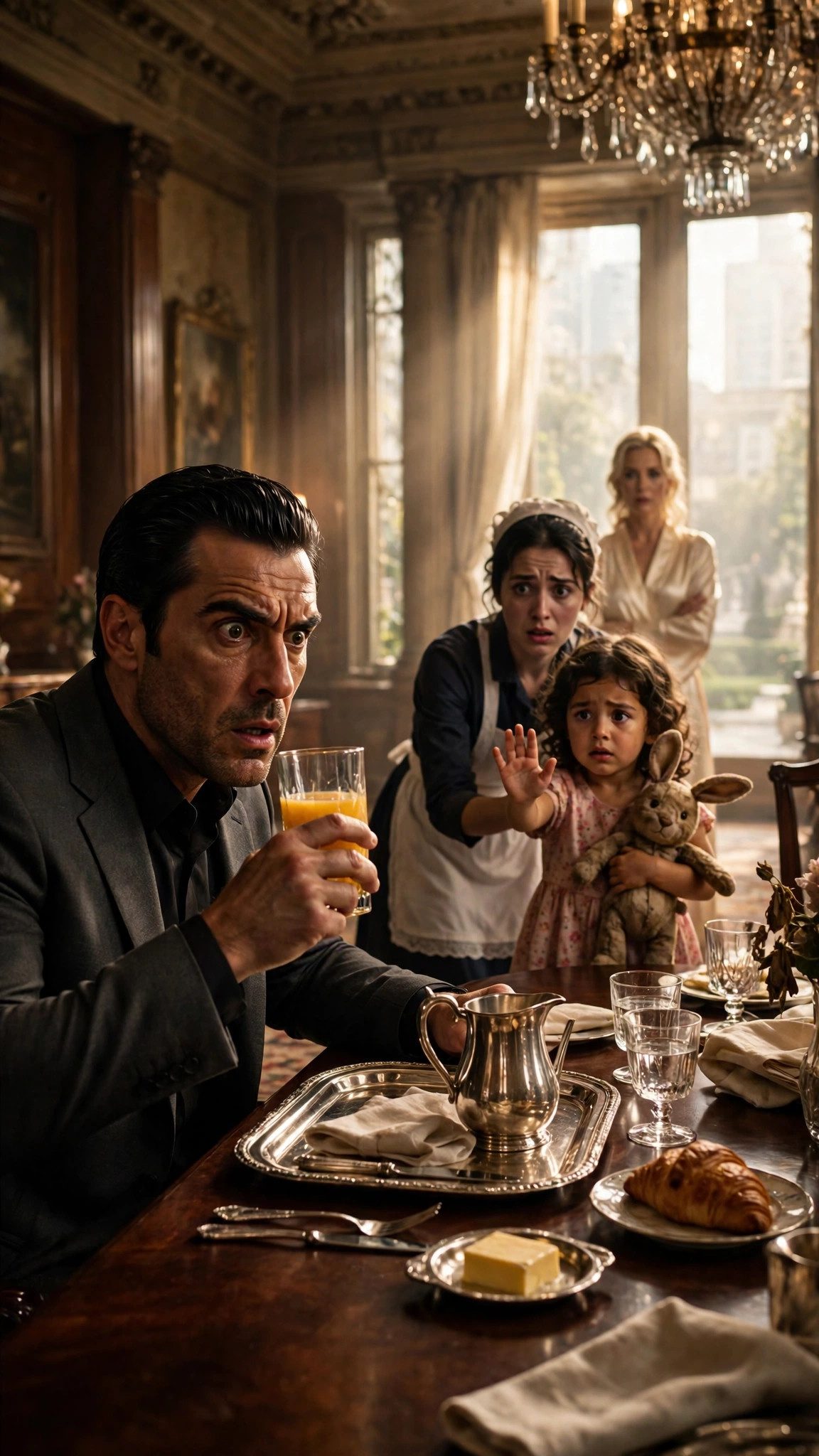
Dominic stood at the altar in a charcoal-gray suit, the same color he had worn on the morning Lily stopped him from drinking his orange juice. When Elena walked toward him down the aisle of white petals, in a simple ivory dress with her dark hair loose around her shoulders, he thought she was the most beautiful woman he had ever seen. Not in the calculated way Vanessa had been beautiful. In the way a person is beautiful when they have survived something terrible and chosen to be happy anyway.
The vows were simple. Dominic promised to protect her and Lily, to be honest with her, and to never again mistake silence for safety. Elena promised to love him, to trust him, and to remind him — gently, when he needed it — that the people in his house were his family, not his staff.
When the ceremony ended, the guests cheered, and Lily threw the rest of her petals into the air like confetti, and Raphael caught her and swung her up onto his shoulders, and she laughed so hard that her rabbit nearly fell off.
At the wedding breakfast, served at a long table in the garden under the morning sun, a waiter brought Dominic a crystal glass of freshly squeezed orange juice.
Dominic picked it up. He held it to the light, the way he had once held it in the dining room, and he smiled.
Lily, sitting beside him in her white dress, leaned over and sniffed the glass with great ceremony.
She looked up at him, her brown eyes bright, and announced to the whole table, "It smells fine."
The table erupted in laughter. Dominic laughed too — a real laugh, deep and unguarded, the laugh of a man who had spent twenty years surviving and had finally learned how to live.
He raised his glass. "To Lily," he said. "The little girl who saved the mafia boss from his own house."
"To Lily!" the guests cried, and they drank, and the sun shone on the garden, and the house that had once been full of suspicion and fear was full, at last, of something else.
It was full of home.
And in the years that followed, whenever anyone asked Dominic Moretti how he had survived the poison, the betrayal, and the woman who had tried to kill him in his own house, he always gave the same answer.
"A four-year-old girl told me my orange juice smelled terrible," he would say. "And I listened."
And beside him, Elena would smile, and Lily — who was five, then six, then seven, and growing taller every year — would hold up her rabbit and say, "Daddy said I have a very good nose."
She did. She always had.
And the house that had once tried to kill its master became the safest place in Chicago — because in it lived a man who had learned to listen, a woman who had learned to trust, and a little girl who had never been afraid to speak the truth.
At the wedding, after the vows and the cheers and the petals, the string quartet played a slow song, and Dominic took Elena's hand and led her to the small clear space in the garden where the guests had left room for dancing.
He was not a good dancer. He had never been a good dancer. He had spent twenty years avoiding dance floors at parties, standing at the edge of the room with a glass in his hand, watching other people dance. But Elena put her hand on his shoulder, and she smiled up at him, and she said, "Just follow me," and he did.
They danced slowly, under the white tent, while the sun went down and the lanterns came on one by one. The guests watched, and some of them cried, and Mrs. Alvarez cried the hardest of all, dabbing at her eyes with a handkerchief and telling anyone who would listen that she had known all along.
Lily fell asleep halfway through the dance, curled up on Raphael's shoulder with her rabbit tucked under her chin, her white dress wrinkled and her basket of petals empty. Raphael held her carefully, the way a man holds something precious, and he did not move until the song ended.
When the music stopped, Dominic kissed his wife — his wife, at last, truly his wife — and the garden erupted in applause, and the lanterns glowed, and the night smelled of roses and summer and new beginnings.
One year later, on a bright morning in early summer, Dominic Moretti drove his stepdaughter to her first day of school.
Lily was five now, taller by two inches, her brown hair in two neat braids that Elena had tied that morning with ribbons the color of spring leaves. She wore a new dress, new shoes, and a backpack that was far too big for her — and inside the backpack, zipped into the front pocket where no teacher could see it, was her rabbit.
"Are you nervous?" Dominic asked as they pulled up to the school gates.
Lily considered the question with great seriousness. "A little," she admitted. "What if nobody likes me?"
"They'll like you," Dominic said. "You're the bravest person I know."
She looked at him. "Braver than you?"
"Braver than me," he said.
Lily grinned, and she climbed out of the car, and she walked through the school gates without looking back — except once, at the very last moment, when she turned and waved, and Dominic waved back, and he stood there watching until she disappeared inside.
He drove home through streets that were already filling with morning traffic, and he thought about the year that had passed. His annual checkup had been the week before, and Dr. Mercer had declared him healthier than he had been at forty. The shipping terminals were thriving. The Falcone organization was gone. The house was full of laughter, and soup, and the sound of a small girl's footsteps on the stairs.
At home, Elena was waiting in the garden with two cups of coffee. She handed him one, and they sat together on the stone bench beneath the roses, and they did not speak for a while. They did not need to.
"Do you ever think about it?" Elena asked finally. "That morning. The juice."
"Every day," Dominic said. "And every day I'm grateful."
"For what?"
"For a little girl with a good nose," he said. "And for her mother, who raised her to use it."
Elena smiled, and she leaned her head against his shoulder, and the sun shone on the garden, and the house stood quiet and safe around them.
That Sunday, at breakfast, Lily came to the table in her nightdress, her rabbit under her arm, and she sniffed Dominic's orange juice with great ceremony, the way she had done at the wedding, and the way she did now every Sunday, because it had become a family joke.
"It smells fine," she announced.
"Are you sure?" Dominic asked, pretending to be worried. "Sniff it again. Very carefully."
Lily sniffed it again, even more carefully, her nose wrinkled in concentration. "It smells fine," she declared. "It smells like oranges."
"Then I'll drink it," Dominic said, and he did, and Elena laughed, and Lily laughed, and the morning went on the way mornings were supposed to go: ordinary, and safe, and full of light.
THE END