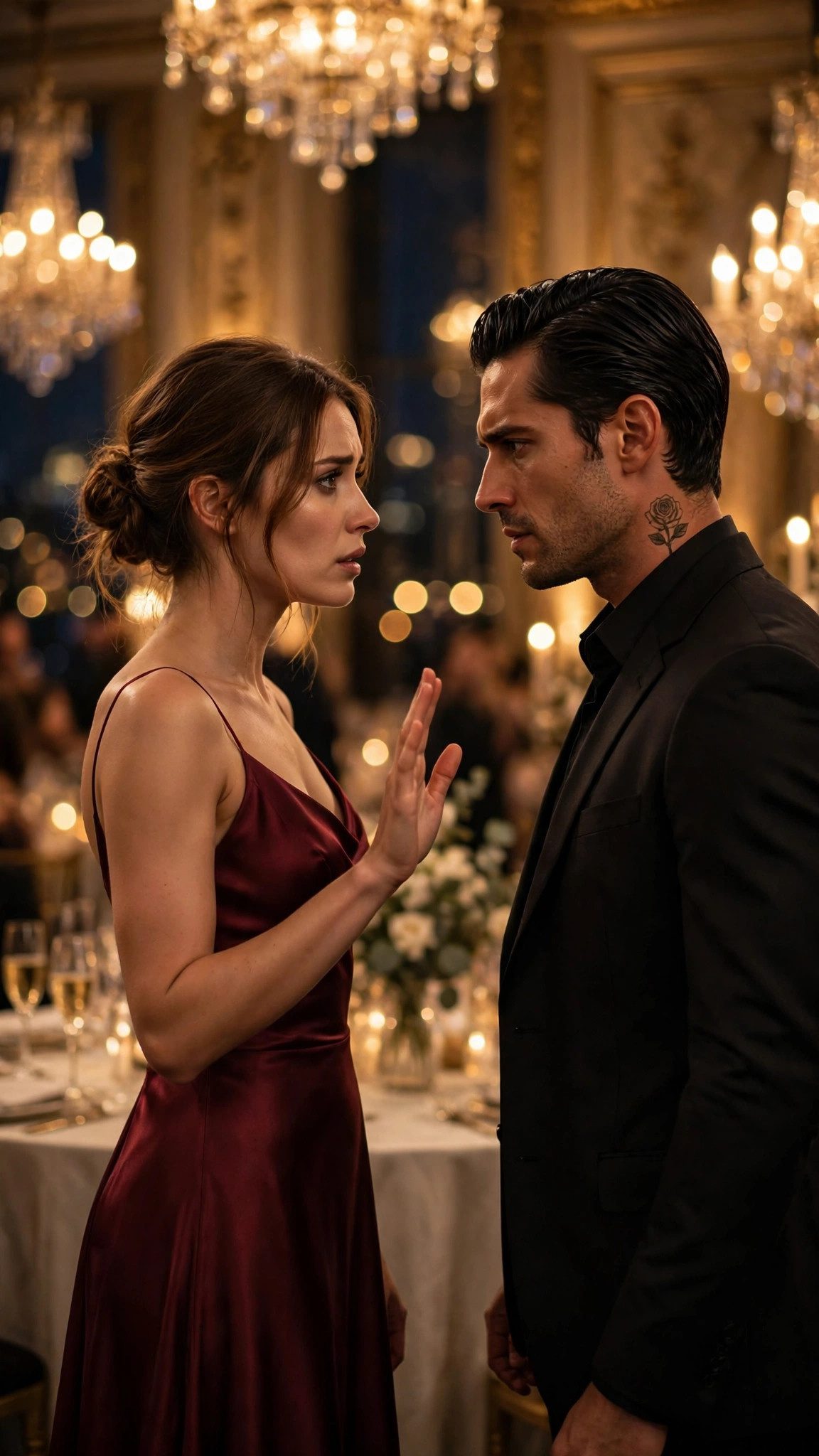
The first time I noticed the black SUV, I told myself I was imagining things.
It was a Tuesday, my day off, and I was walking home from the grocery store with two bags of food and a paperback novel I had bought on impulse, and there it was, parked across the street from my building, engine running, windows tinted so dark I couldn't see inside. I told myself it was nothing. People parked on my street all the time. The city was full of black SUVs.
The second time, it was Thursday, and I was coming home from a twelve-hour shift at 7 a.m., so tired I could barely see straight, and there it was again, in a different spot, but the same car. Same dark windows. Same feeling at the back of my neck, like someone was watching me.
The third time, I stopped pretending.
I crossed the street and walked straight up to the driver's window and knocked on it, hard, with my knuckles. The window rolled down, and a man looked out at me. He was young, maybe thirty, with a shaved head and a scar through his eyebrow, and he did not look surprised to see me.
"Can I help you?" I asked him.
"Just waiting for someone," he said.
"Who?"
He smiled, and the smile did not reach his eyes. "A friend."
"For three days? In front of my building?"
"Nice neighborhood," he said. "Quiet."
I took a photograph of his license plate with my phone, holding it up so he could see me do it. His smile faded.
"Tell your friend," I said, "that I am a nurse, and I am very good at remembering faces. And the next time I see this car, I am calling the police."
He rolled the window up. The SUV pulled away from the curb and disappeared around the corner, and I stood there on the sidewalk with my heart hammering and my grocery bags cutting into my hands, and I thought: this is Gabriel's world. This is what it costs to be near him.
I called Gabriel that night. Not the driver. Not a note. I called him directly, on the number he had given me the night I stayed in his apartment, the number he had said to use "if anything ever feels wrong."
"Something feels wrong," I told him. "There's a car. A black SUV. It's been outside my building for three days."
There was a pause. Then his voice, very calm, very controlled, the way it had been in the trauma bay. "Are you safe right now?"
"Yes. I'm inside. The door is locked."
"Stay inside. I'm sending Enzo. He'll be there in ten minutes. Don't open the door for anyone else."
"Gabriel—"
"Hannah." His voice was low and steady. "Stay inside."
Enzo arrived in eight minutes. He was older than the other men, maybe fifty-five, with grey at his temples and a calm, watchful face, and he knocked on my door and said, "Miss Mercer, Mr. Veseri sent me. May I come in?"
I let him in. He checked every room of my little apartment — the bedroom, the bathroom, the fire escape window, the closet — with the calm efficiency of a man who had done this a hundred times. Then he sat down at my kitchen table and said, "Tell me about the car."
I told him. The three days. The driver. The scar through his eyebrow. The license plate photograph on my phone.
Enzo looked at the photograph for a long time. "This is Rinaldi's man," he said finally. "Dominic Rinaldi. He runs the shipping docks on the south side. He and Mr. Veseri have had a disagreement for some years."
"A disagreement," I said. "He shot him."
"Yes," Enzo said simply. "He did. And he will try again. Men like Rinaldi do not stop after one failure. They stop when they are stopped."
"Why does he want Gabriel dead?"
Enzo folded his hands on the table. "Mr. Veseri owns the import licenses Rinaldi needs. Without them, his business is worth nothing. With them, it is worth a fortune. Rinaldi offered to buy them. Mr. Veseri refused. Rinaldi offered again, with more money, and with threats. Mr. Veseri refused again. So Rinaldi hired a man with a gun."
"And the police?"
"The police have a photograph of a car and a man in a mask. Rinaldi has lawyers. It is not so simple." Enzo looked at me. "Mr. Veseri will protect you, Miss Mercer. That is why I am here. From tonight, there will be a man outside your building. Not Rinaldi's man. Ours."
"I don't want a man outside my building," I said.
"I understand. But Mr. Veseri does not ask about these things. He decides."
There it was again. He decides. He never asks. It was the first time someone else had said it out loud, and hearing it from Enzo made it sound less like a quirk and more like a rule — a rule Gabriel Veseri lived by, the way other men live by their religion.
"Why doesn't he ask?" I said. "Why does he never ask anyone anything?"
Enzo was quiet for a long time. He looked out my kitchen window at the dark street below, and when he spoke, his voice was softer than I had expected.
"Because of his brother," he said. "Marco. He was twenty-four years old. Gabriel asked him to deliver a package for him — a routine thing, an envelope, nothing dangerous, or so Gabriel thought. Marco was shot on the way home. He died in Gabriel's arms, on the sidewalk, in the rain."
I put my hand over my mouth.
"Gabriel has never asked anyone for anything since that night," Enzo said. "Not a favor. Not a question. Not a chance. He gives orders. He makes decisions. He acts. But he does not ask, because the last time he asked, his brother died. Do you understand?"
I understood. I understood too well. It explained everything — the car in the rain, the coffee, the dinners, the way he decided what I ate and where I sat and when I went home. He was not being controlling. He was being careful. He had decided, somewhere deep inside himself, that asking was dangerous, and that the only safe way to love someone was to take care of them without ever asking them for anything in return.
It also explained why he would never say what he felt. Why he would never tell me he loved me. Why he would never, ever ask me to be his.
"Thank you for telling me," I said quietly.
Enzo stood up. "Mr. Veseri would not want you to know that story. But I think you should know it. You are the first person in nineteen years who has asked him how he feels. That means something to him. More than he can say."
After Enzo left, I sat alone in my kitchen for a long time, and I thought about Marco Veseri, twenty-four years old, dying in the rain because his brother asked him to deliver an envelope. And I thought about Gabriel, who had carried that guilt for fourteen years, and who had turned it into a rule: never ask. Never risk anyone again.
And I thought about myself, and how I had spent six weeks falling in love with a man who would never ask me for anything, and I wondered what that meant for me. Could I love a man who would never ask? Could I build a life with a man who decided everything and asked nothing?
I didn't know. But I knew one thing: I was not afraid of Dominic Rinaldi. I was afraid of something else — that Gabriel Veseri would spend the rest of his life protecting me from the world, and never once ask me if that was what I wanted.
The next day, the hospital board called me in.
Mr. Whitfield's office was on the top floor of the administration building, all dark wood and leather and quiet money, and he sat behind his desk in a grey suit and looked at me the way a man looks at a problem he wishes would solve itself.
"Miss Mercer," he said. "Thank you for coming. I won't take much of your time. I simply wanted to discuss a matter of hospital policy."
"Of course, Mr. Whitfield."
"It has come to the board's attention," he said, folding his hands, "that you have developed a personal relationship with a patient. A former patient. A donor, in fact. Mr. Gabriel Veseri."
I kept my face calm. "Mr. Veseri was my patient for three days, six weeks ago. I have not treated him since."
"And yet," Whitfield said, "his car waits outside the hospital every morning. His men stand in our corridors. He sends you coffee. He sends you dinner. The other nurses have noticed, Miss Mercer. The donors have noticed. And I must ask you, as a matter of professional conduct, whether this relationship is appropriate for a nurse of this hospital."
My hands were shaking under the desk, but my voice was steady. "Mr. Whitfield, I saved Mr. Veseri's life. After that, he sent a car, because it rained. He sent coffee, because I work twelve-hour shifts. If the board has a policy against gratitude, I would like to see it in writing."
Whitfield's eyes narrowed. "Be careful, Miss Mercer. Mr. Veseri is a generous donor. The hospital values his support. But the board also values its reputation. A nurse who becomes involved with a powerful donor is a story the press would enjoy very much."
"Are you threatening my job, Mr. Whitfield?"
"I am advising you to be discreet," he said. "That is all."
I left his office with my head high and my hands shaking, and I went back to the emergency department, and I worked the rest of my shift without stopping, because stopping would mean thinking, and thinking would mean admitting that Whitfield was right about one thing: the whole city was watching. The whole city knew. And the whole city was waiting to see what Gabriel Veseri's nurse would do.
That night, I came home to find my apartment door unlocked.
I knew I had locked it. I always locked it. I stood in the hallway for a full minute, my key in my hand, my heart hammering, and then I pushed the door open, slowly, and I looked inside.
Nothing was broken. Nothing was stolen. The television was still there. My laptop was still on the table. My grandmother's nursing pin was still in its little box on the dresser — but the box was open, and the pin had been moved, laid out neatly on top of my pillow.
And beside it, on the white pillowcase, was a single red rose.
Not Gabriel's rose. Gabriel's roses came in paper cups, with thorns, and no note. This rose had been laid there carefully, deliberately, like a message.
We know where you sleep.
I called Gabriel. I called Enzo. I called the police. And then I sat on my kitchen floor with my back against the cabinets, and I cried for the first time since the night Gabriel Veseri was wheeled into my trauma bay — not because I was afraid of Dominic Rinaldi, but because I finally understood the price of being near a man like Gabriel.
The price was this: your life was no longer your own. Your door could be opened. Your pillow could hold a stranger's rose. And the man you loved would send guards and cars and dinners, and he would decide everything, and he would never once ask you if you were all right.
He would never ask. That was the rule. And I was beginning to understand that the rule was going to break us both.
The next morning, I went to the police station.
Detective Alvarez was a woman in her forties, with tired eyes and a kind voice, and she listened to everything I told her — the SUV, the driver with the scar, the license plate photograph, the unlocked door, the rose on my pillow — and she wrote it all down in a notebook, and she did not once make me feel foolish for being frightened.
"Miss Mercer," she said, when I had finished, "I want you to understand something. Dominic Rinaldi is a dangerous man. We have been investigating him for three years. We know he ordered the shooting of Mr. Veseri. We know it the way you know a patient is sick before the tests come back — we can see all the signs, but we don't have the proof yet. And until we have the proof, he walks free."
"So what do I do?" I asked.
"You do what you're doing," she said. "You stay alert. You lock your door. You call us the moment anything feels wrong. And you let Mr. Veseri's men do their job. I know you don't like the guards, Miss Mercer. But right now, the guards are the reason Rinaldi's men haven't tried anything worse than a rose on a pillow."
She walked me to the door. "One more thing," she said. "Mr. Veseri has been cooperating with us. Quietly. For two years. He's given us more information about Rinaldi's organization than any witness we've ever had. Whatever else he is, Miss Mercer, he's not a man who sits back and waits. He's trying to end this. The right way."
I thanked her, and I went back to the hospital, and I worked my shift, and in the middle of the afternoon, a little girl was brought into the emergency department with a broken arm. She was seven years old, with curly hair and a missing front tooth, and she had fallen off the monkey bars at school. Her name was Emma, and she was brave in the way only seven-year-olds can be brave — which is to say, she was terrified, and she was trying very hard not to show it.
"Will it hurt?" she asked me, while I was setting up the X-ray.
"A little," I said honestly. "But I'll be right here the whole time. And I'll tell you everything I'm doing before I do it. Deal?"
"Deal," she said. And then, while I was wrapping her arm, she said, "Are you the nurse who takes care of the scary man?"
I paused. "What scary man?"
"The man with the men in suits," Emma said. "My mommy saw them in the hallway. She said he's a bad man. Is he a bad man?"
I thought about Gabriel — about the man who had almost smiled at me in the break room, and the man who couldn't sleep, and the man who had knelt in the dark of his apartment and said the silence was unbearable.
"No," I said. "He's not a bad man, Emma. He's a man who got hurt, and who is trying very hard to be better. And do you know what? He's scared too. Just like you. Just like everyone."
Emma considered this. "Even grown-ups get scared?"
"Especially grown-ups," I said.
She smiled then, her missing-tooth smile, and she said, "Then I'm not scared anymore. If grown-ups can be scared and still be brave, then I can be brave too."
She drew me a picture before she left — a stick figure nurse with brown hair, holding the hand of a tall stick figure man with a rose on his neck. She gave it to me, and I taped it to the inside of my locker, next to my grandmother's photograph.
That night, I thought about Emma, and about Detective Alvarez, and about the rose on my pillow, and I understood something I hadn't understood before. Gabriel Veseri was not the only one who was afraid. I was afraid too. And being afraid didn't make me weak. It made me careful. It made me brave in the way Emma was brave — terrified, and trying very hard not to show it, and doing the right thing anyway.