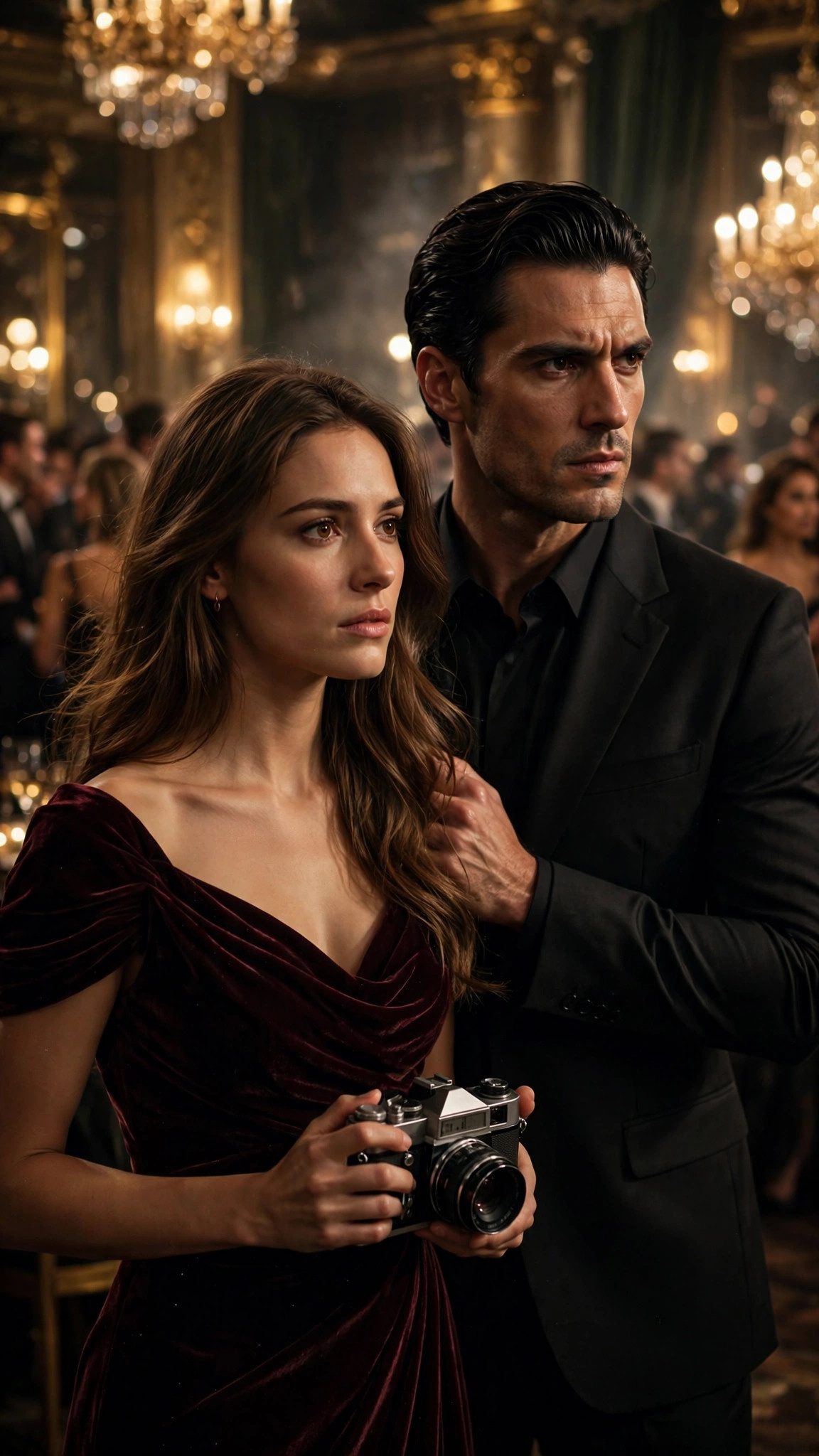
The man who announced that someone like me did not belong in his nightclub had been talking for less than ten seconds when the most feared mafia boss in Chicago turned toward him and said, "Stand up."
I was twenty-seven years old, three weeks out of Detroit, wearing the only good dress I owned, and holding a camera I could not afford to lose. I had walked into the Velvet Room on Rush Street because a friend of a friend had told me the light there at midnight was worth photographing, and because I was tired of being afraid of rooms I had not been invited into. The man blocking my path was broad, drunk, and certain of himself. He looked at my dress, at my camera, at the small scar on my left knee from a childhood bicycle accident, and he decided, in front of two hundred people, that I was nobody.
"Someone like you doesn't belong here," he said, loud enough for the bartenders to hear. "This is a private club. Go take your little pictures somewhere else."
Before I could defend myself, before I could even decide whether to answer him or simply turn around and walk out with whatever dignity I had left, a voice cut through the music. It was not loud. It did not need to be loud. It was the kind of voice that made an entire room stop moving, the way a city stops moving when the power goes out.
"Stand up," King Moretti said.
He had been sitting at the corner table with his back to the wall, the way men who have enemies sit, and I had noticed him the moment I walked in, the way you notice a fire in a dark room. He was thirty-nine years old, tall, dark-haired, and dressed in a black suit that fit him like it had been sewn onto him by someone who loved him or feared him. He stood up slowly, and the drunk man turned around, and the whole nightclub seemed to hold its breath.
King Moretti crossed the floor without hurrying. He stopped two feet from the man who had insulted me, and he looked at him the way a man looks at a locked door he is deciding whether to open or break down.
"She's with me," he said. "Touch her and you're done."
The drunk man opened his mouth. Nothing came out. King Moretti did not raise his voice, did not touch him, did not do any of the things I had expected a man like him to do. He simply waited, and the silence did the work for him. The drunk man sat down. The music started again. And King Moretti turned to me, and for the first time in three weeks, I felt like the world had stopped trying to push me around.
"Are you all right?" he asked.
I thought that was the moment my life finally changed for the better. I had no idea that being seen with him would soon make me the target of people willing to kill for a photograph.
My name is Harper Bennett. I am twenty-seven years old, and three weeks before that night in the Velvet Room, I packed two suitcases and left Detroit after the most humiliating birthday of my life.
I had come home carrying a chocolate cake I had bought for myself. It was a small cake, the kind with too much frosting and a single candle, because I had told myself that thirty was still far away and twenty-seven deserved at least one candle. I had bought it on my lunch break from the little photography studio where I worked, and I had carried it home through the rain, holding it against my chest so the box would not get wet. I was already imagining the evening: Derek would come home from work, he would see the cake, he would laugh at me for buying my own birthday cake, and then he would kiss me and tell me he had a real surprise waiting. That was the evening I had planned in my head, and I had planned it so carefully that I could taste the frosting already.
Instead, I found my boyfriend in bed with my roommate.
I stood in the doorway of my own bedroom with a wet cake box in my hands, and I watched Derek Lawson, the man I had lived with for two years, the man I had once believed I would marry, scramble for his clothes while Tessa, my roommate of three years, my friend since college, pulled the sheet up to her chin and looked at me like I was the one who had done something wrong.
He did not apologize. That is the part I remember most clearly, even now. He did not say he was sorry. He did not say it was a mistake. He looked at me standing there with my birthday cake, and he blamed me for our relationship falling apart.
"You've been distant for months," he said, buttoning his shirt with shaking hands. "You care more about that camera than you care about us. Don't stand there like you're the victim, Harper. You pushed me away."
I put the cake down on the dresser. I did not throw it. I did not scream. I think some part of me had known for a long time, and the knowing had simply been waiting for proof. I looked at the two of them, and I looked at the little apartment we had shared, with its crooked bookshelves and its dying plants and its photographs of me and Derek on the wall, photographs I had taken myself, and I understood something that should have been obvious years earlier. I had spent years trying to please someone who had never appreciated me. I had shrunk myself down, again and again, to fit inside a life that had no room for me.
So I left.
I did not leave that night. I left three days later, after I had found a sublet in Chicago, after I had packed two suitcases, after I had taken the photographs off the wall and put them in a drawer where I would never have to look at them again. I left the cake in the refrigerator. I never found out whether anyone ate it.
Chicago was supposed to be a fresh start. I told myself that on the drive in, the way people tell themselves things they are not sure they believe. I brought my camera, because my camera was the only thing I had never doubted, and I rented a little apartment above a bakery on the North Side, and I began photographing city streets, cafés, and strangers whose stories nobody bothered to notice. I photographed an old man feeding pigeons in Millennium Park. I photographed a woman laughing into her phone on the train. I photographed the way the light came through the windows of a laundromat at seven in the morning. I was not making much money. I was not making any money at all, some weeks. But I was free, and I was looking at the world through a lens again, and that felt like breathing after a long time underwater.
Then I met King Moretti.
I did not know who he was at first. That is the truth, and I will not pretend otherwise. I knew he was wealthy. I knew he was dangerously handsome, in the way that a storm is beautiful when you are watching it from inside a house. I knew he was surrounded by men who watched every doorway before he entered a room. At first, I thought he was just another businessman with expensive tastes, the kind of man Chicago is full of, men in suits who own restaurants and buildings and other men's time.
I met him properly the second time, at a restaurant on the river, where I had gone to photograph the dining room for a travel magazine that paid almost nothing. He was sitting alone at a table by the window, and when I raised my camera to take a picture of the room, he looked up, and our eyes met, and he smiled. It was a small smile, careful, like a man who does not smile often and is not sure he is doing it right.
"You have a good eye," he said, when I came closer to apologize for pointing my camera in his direction. "Most people photograph what they want to see. You photograph what is actually there."
I stayed for one drink. That was all. One drink in a crowded restaurant, one conversation about light and patience and the city at night, and that was all it took to become someone's obsession. Not his obsession. Someone else's. I did not know that yet. I thought I had simply met an interesting man who liked my photographs.
I should have walked away. I know that now. But I did not walk away, because he did not feel dangerous to me. He felt calm. He felt like a man who had already decided what mattered to him, and who did not waste time pretending otherwise.
Three days after the restaurant, I was photographing the street outside a hotel on Michigan Avenue when I saw a man I recognized from the newspapers. Marcus Blake. Fifty-two years old, silver hair, a suit that cost more than my rent for a year. A corrupt businessman, the kind whose name appeared in articles about city contracts and investigations that never seemed to go anywhere. I raised my camera without thinking, the way a photographer does, and I took his picture. He was standing in an alley behind the hotel, taking a thick envelope of cash from a restaurant employee, and he looked up, and he saw me.
He recognized who I was and why I was there. I do not know how he knew my name. I do not know how he knew I had been seen with King Moretti. But his face changed, and fear flooded my body, and I ran. I ran back to my apartment with my camera clutched to my chest, telling myself no one would notice or care, telling myself a photograph of a man taking money was not worth anyone's life.
But later that evening, I attended the annual Moretti family dinner in the same building, the same hotel, because King had invited me, and I had said yes, and I had not known what I was saying yes to. The place was filled with wealthy businessmen, beautiful women, and security guards who seemed to recognize everyone. The chandeliers threw gold light across white tablecloths. The air smelled like money and lilies and expensive wine. And that was when my camera captured the most dangerous image of my life.
I saw Marcus Blake standing a few feet from King, pointing at my camera and telling him something was hidden inside it. I froze. The room went quiet around me, or maybe it only felt quiet, the way the world goes quiet before a car crash. Then King Moretti crossed the restaurant and stopped in front of me.
He studied the screen of my camera, his expression unreadable. Then he called over one of his security men and said a single name.
"Blake."
Two men rushed toward us. The rest of the room watched as Marcus tried to attack me and snatch the camera, but King's security stopped him before he could touch me. Marcus's face was red, his hands were shaking, and he was shouting something about his reputation, about his lawyers, about what would happen to me if that photograph ever saw the light of day.
Then everyone left in silence. Everyone except King, Marcus, and me.
King turned toward Marcus and said, "Do you now understand why you should have stayed in jail?"
Then he glanced at the last photo on the camera, the photo I had taken earlier that day of Marcus receiving cash from a restaurant employee. King's eyes narrowed. His voice dropped to something cold and quiet.
"You're going to erase it, aren't you?" Marcus asked, and there was fear under the anger now.
King took my camera from my hands, gently, like it was something breakable, and his expression darkened as he looked at the photograph again. Then he looked at me, and his voice was steady and certain, and I believed every word of it.
"I'm going to pay for it," he said. "I promise you this: I won't let anyone hurt you or the people you love."
Then he ordered details to be sent to his apartment, and he told his men to take the damage in full, and I understood, standing there in that silent dining room with my camera in his hands, that this was not just a favor. This was a declaration.
King Moretti had gone to war with the man who had threatened my life.
But this battle was not over. Two days later, someone left an envelope on my apartment door. It contained a black-and-white photograph. A photograph of King Moretti being dragged into an unmarked van.
I enlarged the photograph, searching desperately for something that might reveal where he was being held. And my heart nearly stopped.
Because I recognized that person. The man with his hands on King's shoulders, shoving him toward the open doors of the van, was Derek Lawson. My ex-boyfriend. The man who had destroyed my life in Detroit. He was here, in Chicago, working for Marcus Blake. And he had just helped kidnap the man who had stood between me and the world.
My hands were shaking so hard I nearly dropped the photograph. I locked the apartment door, all three locks, and stood with my back against it, listening to the hallway for footsteps that were not there. For a moment, the old fear came back, the fear I had carried out of Detroit, the feeling that I was small and that the world was large and that men like Derek would always find a way to take what they wanted from me.
Then I looked down at the camera on my kitchen table, the same camera that had started all of this, and something in me went quiet and hard. I had spent years trying to please someone who had never appreciated me. I had spent three weeks learning how to look at the world and see what was actually there. I was not going to hide in my apartment while the one man who had ever stood up for me was dragged into a van.
I picked up my phone, and I called the only number King had ever given me, the number of his head of security, a man named Sal, and when he answered, I told him exactly what I had found. "I have a photograph," I said, and my voice did not shake at all. "And I know where to start looking."