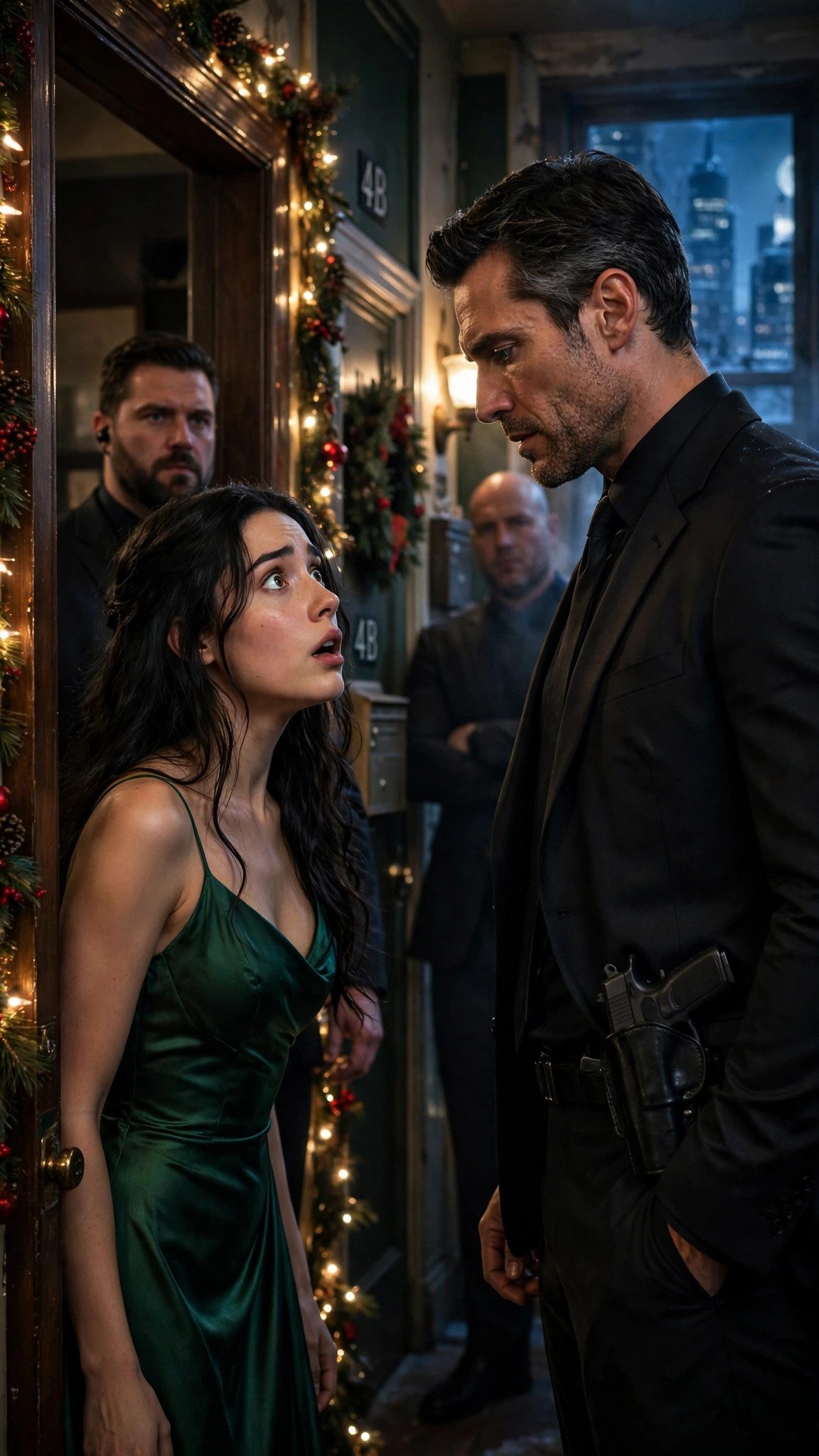
The elevator doors opened, and the penthouse went from silence to chaos in the space of a single breath.
I did not see what happened next. Cassian kept me down behind the sofa, his arm across my back, his body a wall between me and the room. I heard footsteps — too many, too fast. I heard Danny shout something I could not make out. I heard a crash, glass breaking somewhere near the bar, and then a sound I had never heard before in my life and hope never to hear again: the flat, hard crack of a gunshot, muffled by something, followed by another, and then silence.
It lasted less than a minute. It felt like an hour.
When it was over, Cassian lifted his head slowly, listening. Danny's voice came from the hallway, calm and steady: "Clear. Two down. One ran."
Cassian helped me up. My legs were shaking so badly I could barely stand, and he kept one hand on my elbow until I found my balance. The living room was a mess — the bar mirror cracked, a chair overturned, a dark stain spreading on the rug near the elevator that I refused to look at for more than a second.
"They came up the service elevator," Danny said, wiping blood from his knuckles with a handkerchief. "Cut the power to the floor first. Knew the layout. Knew the service code."
"Knew the service code," Cassian repeated, and his voice was very quiet. "Only my own people know that code."
Danny nodded. He did not say anything else. He did not need to.
Within twenty minutes, the penthouse was full of Cassian's men. I sat on the sofa with a blanket someone had draped over my shoulders and watched them move through the rooms like a tide coming in: men in dark suits checking windows, checking doors, sweeping the hallway with flashlights, speaking into radios in low voices. One of them — an older man with silver hair and a face like carved stone — came and stood in front of Cassian and said, "Boss, the building is locked down. Nobody in or out without your word."
"Thank you, Anthony," Cassian said. "Keep it that way."
Anthony Russo. I knew that name. I had typed it a hundred times in three years — on meeting agendas, on contracts, on the distribution lists for the board papers. Anthony Russo was Cassian's consigliere, his right hand, the man who had been with the Blackwood family since before Cassian was born. He looked at me for a moment, and his eyes were kind in a way I had not expected.
"Miss Whitmore," he said, "are you hurt?"
"No," I said. "I'm fine. I'm just — I'm fine."
He nodded, as if he had heard that exact sentence from frightened people many times before, and went back to his work.
I did not sleep that night. I do not think anyone in the penthouse slept that night. I sat by the fireplace long after the fire had burned down to embers, wrapped in the blanket, listening to the low murmur of men's voices from the other rooms, and I tried to make sense of what had happened to my life.
By morning, the penthouse looked almost normal again. The rug had been replaced. The bar mirror was covered with a cloth. The chair was upright. If you did not know what had happened, you would never have guessed. That frightened me more than the mess had — the way this world could absorb violence and smooth it over before breakfast, like a lake smoothing over a stone.
Cassian found me in the kitchen at dawn. I had gotten up to make coffee because I needed something to do with my hands, and because the kitchen was the only room in the penthouse that felt anything like a normal place. He stood in the doorway in a fresh suit, his hair damp from a shower, and watched me for a moment before he spoke.
"You didn't sleep," he said.
"Neither did you," I said.
He came into the kitchen and sat at the small table by the window. Outside, the city was waking up. Delivery trucks rumbled past below. The sky was the color of pearl.
"Elara," he said, "last night, in the car, you said you didn't know anything. I need you to think about that again. Not about what you think you know. About what you remember. Anything. Anything at all that struck you as strange in the last six weeks. A name. A number. A document that didn't look right."
I poured the coffee slowly, giving myself time to think. Six weeks. What had happened six weeks ago? The shipments had started going missing, Cassian had said. Routes had started leaking. Men had started getting arrested at exactly the wrong time.
"I remember a manifest," I said slowly. "About six weeks ago. A shipping manifest for a warehouse in New Jersey. The cargo was listed as restaurant equipment — ovens, refrigerators, that kind of thing. But the payment attached to it was enormous. Far too much for restaurant equipment. I remember thinking it was a typo, and then I remember thinking it wasn't my job to think about it, so I filed it and moved on."
Cassian's eyes sharpened. "Which warehouse?"
"Harborline Logistics," I said. "In Newark. The manifest came through the legal department, and it was countersigned by two people. One of them was you. The other one—" I closed my eyes, trying to picture the paper. I had handled thousands of papers in three years. But this one, for some reason, I could see clearly: the heavy paper, the blue ink, the two signatures at the bottom. "The other one was Marcus Hale."
"Marcus Hale," Cassian repeated. His voice did not change. But his hand tightened around his coffee cup.
"Head of security," I said. "He's one of the six people with access to your calendar. Isn't he?"
Cassian nodded slowly. "He's been with me for eight years. He runs my security. He knows every route, every safe house, every code. If anyone could feed Silas Kane what he needs, it's Marcus."
"But it might not be him," I said quickly. "A signature doesn't mean—"
"No," Cassian agreed. "It doesn't. But it's a thread. And right now, a thread is more than I have."
He stood up and walked to the window, looking out over the city he owned and the empire he had inherited, and for the first time, he told me how he had become the man he was.
"My father died when I was twenty-eight," he said. "Not a heart attack, the way the newspapers said. A hit. Ordered by Silas Kane's father, in a war over the docks that had been going on since before I was born. I was in London that week, closing a deal for the legitimate side of the business, and by the time I flew home, my father was in the ground and the family was falling apart. Men were leaving. Territory was being taken. Anthony came to me and said, 'Your father built this. You are the only one who can hold it.'"
He turned back to me. "I was twenty-eight years old, and I had never fired a gun in my life. But I learned. I learned fast. And for twelve years, I have held this family together with my own two hands, and I have never once let anyone take what is mine."
"And now someone is trying," I said.
"And now someone is trying," he agreed. "And they are using you to do it. Because they know something about me that I did not know about myself until last night."
"What?" I asked.
"That you matter to me," he said simply. "That if they took you, it would break me in a way that losing a shipment never could. I have spent twelve years making sure no one could find a weakness in me. And then I hired a secretary who remembers every document she files, and I let her sit outside my office for three years, and I never once realized that she had become the one thing in my life I could not afford to lose."
I stared at him. The kitchen was quiet except for the hum of the refrigerator. The coffee in my cup had gone cold.
"Mr. Blackwood," I said, and my voice shook, "I think you should know something. About that manifest. There was a second one. A week later. Same warehouse, same cargo, same enormous payment. And that one was countersigned by Anthony Russo."
Cassian went very still.
"Anthony has been with my family for forty years," he said.
"I know," I said. "I'm not saying it's him. I'm saying the manifests passed through both of them. And I'm saying that if I were looking for the man who sold me to Silas Kane, I would start by asking who had access to the manifests, the calendar, the service codes, and my home address — and then I would ask which of those men was in the building last night when the power went out."
Cassian looked at me for a long moment, and then, slowly, he smiled. It was not a cold smile. It was the smile of a man who has just found a weapon he did not know he had.
"Elara Whitmore," he said, "you may be the most dangerous person in this penthouse. And you don't even know it."
Before the sun rose, Cassian came back into the kitchen and set a phone down on the table in front of me. It was a plain black phone, new, with no contacts and no history.
"Call your mother," he said.
I stared at him. "What?"
"Your mother calls you every Sunday at six o'clock," he said. "It's Saturday now. If you don't call her tomorrow, she'll call the building manager. And the building manager will tell her that men were watching your apartment, and that you left in a convoy of black SUVs, and she will spend the rest of her life worrying. So call her. Tell her you're safe. Tell her you're staying with a friend in the city. Tell her whatever you need to tell her — but tell her something."
I picked up the phone. My hands were shaking. "You remember that? About my mother? About the Sunday calls?"
"I remember everything you tell me, Elara," he said simply. "That's my job. Just like remembering is yours."
I called my mother. It was just after five in the morning in Ohio, and she answered on the second ring, her voice thick with sleep and instantly worried.
"Elara? Baby, is everything all right? It's five in the morning."
"I'm fine, Mom," I said, and my voice cracked, just a little, on the word fine. "I'm sorry to wake you. I just wanted you to know that I'm safe. I'm staying with a friend in the city for a few days. Work stuff. Nothing to worry about."
There was a pause. My mother had raised me alone after my father died when I was twelve, and she had a way of hearing the things I did not say.
"Elara Whitmore," she said, "are you in trouble?"
"No, Mom," I said. "I'm not in trouble. I'm just — I'm with someone who is taking very good care of me."
"Is it a man?" she asked, and despite everything, I almost laughed.
"Yes, Mom. It's a man."
"Is he kind to you?"
I looked across the kitchen at Cassian, standing by the window with his back to me, giving me privacy the way a gentleman gives a lady privacy, and I thought about the gun under his jacket, and the hand that had grabbed mine in the hallway, and the way he had stood between me and the dark.
"Yes, Mom," I said. "He's kind to me."
"Then that's all I need to know," my mother said. "Call me tomorrow. Six o'clock. Don't be late."
"I won't," I said. "I love you, Mom."
"I love you too, baby. Be safe."
I hung up. Cassian turned around.
"Thank you," I said.
"For what?"
"For remembering," I said. "For knowing that she would worry. For giving me the chance to tell her I'm safe."
He nodded, and he did not say anything, because there was nothing to say. And then he did something that surprised me: he went to a closet in the hallway and came back with a folded stack of clothes — a soft sweater, a pair of dark trousers, clean socks.
"These are from the guest room," he said, setting them down on the table. "They'll be too big for you, but they're clean. The guest room is the second door on the left. There's a bathroom. Get some rest, Elara. You've been awake for almost twenty hours. Tomorrow, we find the traitor. But tonight — tonight, you sleep."
I took the clothes. The sweater smelled faintly of cedar and clean laundry. It was the kindest thing anyone had done for me in a very long time.
"Mr. Blackwood," I said.
"Cassian," he corrected. "When we're alone, it's Cassian."
"Cassian," I said, testing the name, feeling how strange and how right it sounded in my mouth. "Thank you. For coming to my door tonight."
"There was nowhere else I would have been," he said.
I went to the guest room. I changed into the too-big clothes. I lay down on a bed softer than any bed I had ever slept in, and I stared at the ceiling, and I listened to the quiet sounds of the penthouse — the murmur of men's voices, the hum of the city far below, the soft ticking of a clock I could not see.
And for the first time since the knock on my door, I felt something I had not expected to feel.
Safe.
Outside, the sun rose over Manhattan, and the city turned to gold. And for the first time since the knock on my door, I felt something other than fear.
I felt useful.