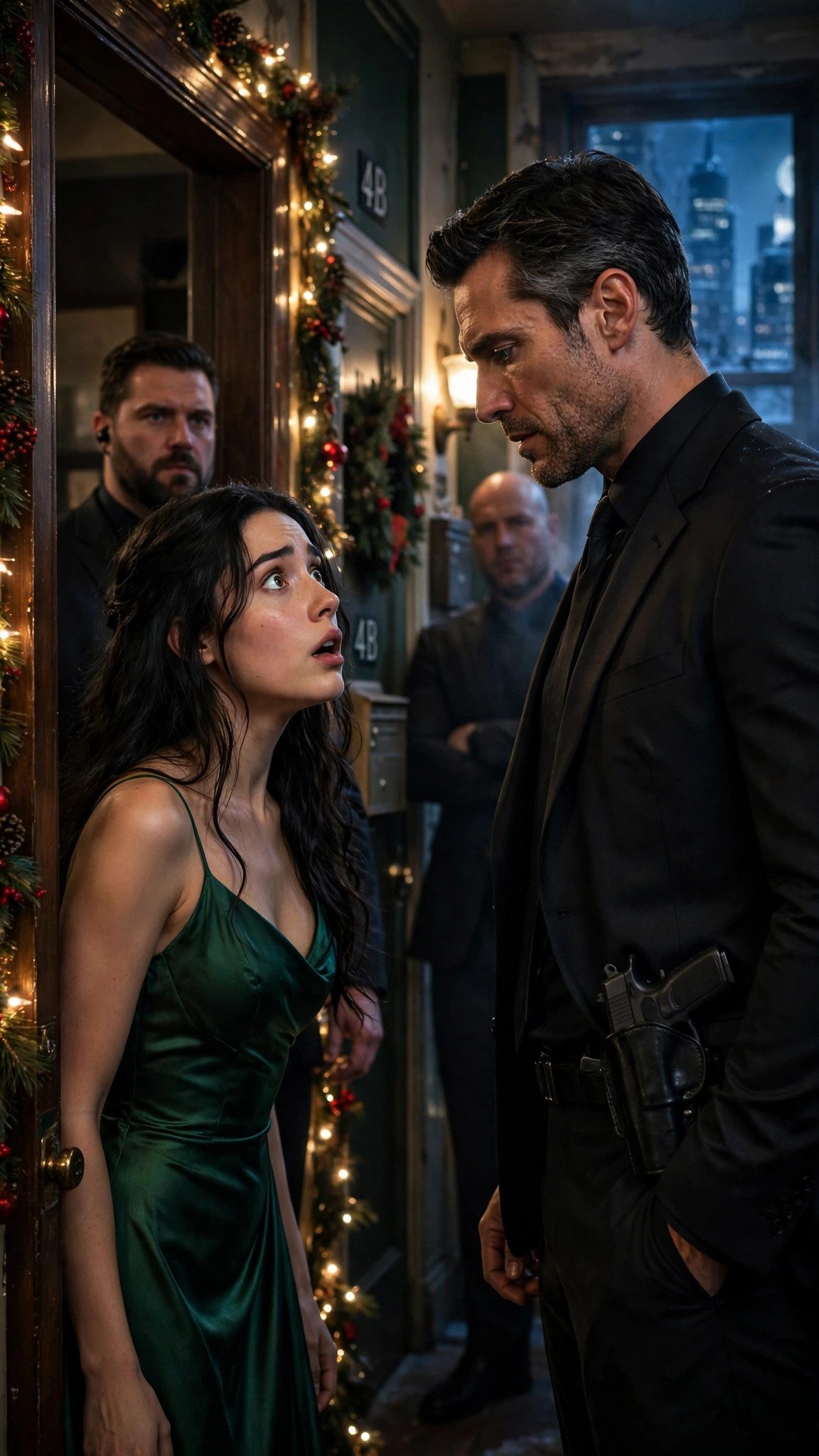
The trap was Elara's idea.
That was the part Cassian would remember later, when he told the story to Anthony in the quiet hours after it was all over. Not that his men had caught a traitor. Not that a gun had been drawn in his own penthouse. But that the idea had come from his secretary — the woman who had spent three years filing papers and answering phones, and who understood, better than any of his soldiers, how information moved through his organization.
"If the traitor is one of the six people with access to my calendar," I said, "then he will be watching for a new opportunity. He will be waiting for the next shipment, the next meeting, the next piece of information worth selling. So we give him one."
Cassian was sitting across from me at the kitchen table, his second cup of coffee going cold between his hands. Outside the window, the city glittered in the morning light. Inside the penthouse, the air was still thick with the smell of smoke from the fireplace and the tension of a night no one had slept through.
"We give him a fake shipment," I said. "A manifest for Harborline Logistics, just like the real ones. Same warehouse, same cargo, same enormous payment. But this time, the shipment doesn't exist. The only thing that exists is the paper. And we watch to see who touches it."
Cassian studied me for a long moment. "And if he doesn't touch it?"
"Then we learn something anyway," I said. "Because the only people who will see that manifest are the six people with access. If none of them touches it, then the traitor isn't one of the six. And if one of them does—"
"Then we have him," Cassian finished.
Anthony Russo, who had been standing by the window with his arms crossed, turned around. "It's a good plan," he said slowly. "But it's dangerous. If Hale is the traitor, and he realizes the manifest is fake, he'll know we're hunting him. A cornered man is the most dangerous kind."
"Then we don't give him time to realize," I said. "We make the manifest real enough to sell and fast enough to act on. The shipment leaves tonight. If he wants to sell it, he has to move today."
Cassian looked at Anthony. Anthony looked at Cassian. And in that silent exchange, the way men who have worked together for decades communicate without words, the decision was made.
"Do it," Cassian said to me. "Make the manifest."
I had never forged a document in my life. But I had filed thousands of them, and I knew exactly what a real Harborline manifest looked like: the weight of the paper, the blue ink, the layout of the boxes, the signature lines at the bottom. I sat at Cassian's desk with a blank form from the legal department and I built a lie so carefully that even I almost believed it.
Cargo: restaurant equipment, forty-two crates, Newark warehouse. Payment: four hundred and eighty thousand dollars. Date: tonight, eleven P.M. Route: the same route the real shipments always took, down the highway to the docks.
And at the bottom, two signature lines. One for Cassian. One for the countersigner.
Cassian signed it without hesitation. Then he looked at me, and he said, "Now we wait."
The waiting was the worst part.
We placed the manifest in the locked courier case, the same way the real ones always arrived. We sent it through the normal channels, to the normal distribution list, at the normal time. And then we sat in the penthouse, and we watched the security cameras, and we waited to see who would come for it.
The first person to touch the case was Victor Lang, the family lawyer. He opened it, read the manifest, frowned, and put it back exactly where he found it. He made a phone call — to his wife, I learned later, to tell her he would be late for dinner.
The second was Elena Voss, the financial manager. She photographed the manifest with her phone — which made Cassian's jaw tighten — but when Danny checked her phone an hour later, the photograph was attached to an email to the accounting department, with a note: "Payment looks high. Please verify against the Harborline contract."
The third was Danny himself, who carried the case from the office to the penthouse without opening it.
The fourth was Cole, who did not touch it at all.
The fifth was Anthony Russo, who read it twice, folded it carefully, and put it back.
And the sixth — the sixth was Marcus Hale.
He came at four o'clock in the afternoon, dressed in his usual dark suit, his face calm and professional, the way it always was. He walked into the office, picked up the courier case, and carried it to the copy machine in the hallway. He made a copy of the manifest. He folded the copy and put it in his inside jacket pocket. And then he put the original back in the case, closed the lid, and walked out of the room as if nothing had happened.
The security camera caught all of it. Every second. Every movement.
Cassian watched the footage on the monitor in his office, and I watched his face, and I saw the exact moment when eight years of trust died in his eyes.
"Marcus Hale," he said quietly. "My head of security. The man who knows every code, every route, every safe house. The man I trusted with my life."
"And with mine," I said.
He turned to look at me. "Elara, I need you to listen to me very carefully. Marcus knows this penthouse. He knows the service elevator code. He was here last night — or his men were — and he knows that we know something is wrong. If he has already sold the fake manifest to Silas Kane, then Kane's men will be at the docks tonight at eleven, waiting for a shipment that doesn't exist. And when they realize it's a trap—"
"They'll come here," I finished.
"They'll come here," he agreed. "And Marcus will be with them. Because the only way to save himself now is to finish what he started."
Anthony stepped forward. "Boss, we should move her. Now. A safe house in Connecticut. My men can have her there in two hours."
"No," Cassian said.
"Boss—"
"No," Cassian said again, and his voice was iron. "If we move her, Marcus will know we have him. He will disappear, and we will never find him, and Silas Kane will simply buy another man inside my organization. This ends tonight. Here. With Marcus Hale walking through that door, believing he is coming to finish the job — and finding us waiting for him instead."
He turned to me. "Elara, I am asking you to trust me. I am asking you to stay in this room, behind that door, and let my men do their work. Can you do that?"
I looked at him. I looked at the camera monitor, where Marcus Hale's face was frozen in the act of folding a stolen manifest into his pocket. And I thought about the emerald dress hanging in my closet, and the women who had laughed at me, and the three years I had spent being invisible.
"I can do that," I said. "But I have one condition."
"Name it," Cassian said.
"When this is over," I said, "I want a gun of my own. Not because I want to shoot anyone. Because I never want to stand behind a sofa again while other people decide whether I live or die."
Cassian stared at me for a long second. And then, to my complete surprise, he laughed. It was a short, rough sound, the first real laugh I had ever heard from him.
"Done," he said. "When this is over, I will teach you myself."
It was six o'clock in the evening. The trap was set. The manifest was sold. And somewhere in the city, Marcus Hale was making a phone call to Silas Kane, telling him that the Blackwood shipment would be at the docks at eleven, and that the secretary — the girl who knew everything — would be alone in the penthouse, unprotected, waiting to be taken.
He was wrong about the last part.
But he was right about one thing: tonight, everything would end.
The hours between six and eleven moved like water through sand — slow, and then suddenly gone.
Cassian's men took their positions quietly, the way professionals do. Danny stationed himself in the hallway by the service elevator, the same elevator the intruders had used the night before. Cole took the stairwell. Anthony positioned four men in the apartment below, and two more on the roof. Every exit was covered. Every entrance was watched. The penthouse, which had felt like a fortress that morning, now felt like a cage with the door standing open, waiting for the animal to walk in.
I sat in the bedroom with the door locked, just as Cassian had asked me to. I had a phone in my hand — a new one, given to me by Danny, with only one number programmed into it. Cassian's. "If anything goes wrong," Danny had said, "you call him. You don't call the police. You don't call anyone else. You call him."
I sat on the edge of the bed, fully dressed, my shoes on, my heart beating so hard I could hear it in my ears. Through the wall, I could hear the low murmur of men's voices, the occasional click of a radio, the sound of the city far below. I thought about my apartment. I thought about my mother, who lived in Ohio and called me every Sunday and had no idea that her daughter was sitting in a mafia boss's penthouse waiting for a traitor to come through the door. I thought about the emerald dress, and I thought about how strange it was that a dress had been the beginning of all of this — a dress, and a laugh, and a decision to go home early.
At 10:47 P.M., my phone buzzed. One word from Cassian: "Ready."
At 10:58, I heard the service elevator ding.
At 11:02, I heard footsteps in the hallway. Not the heavy, hurried footsteps of the night before. Slow footsteps. Confident footsteps. The footsteps of a man who believed he was walking into a room full of people who had no idea he was coming.
"Marcus," Cassian's voice said from the living room, calm and clear. "You're early. The shipment isn't until eleven."
There was a pause. I pressed my ear against the bedroom door, my hands shaking.
"Boss," Marcus Hale's voice said. "I came to check the perimeter. The docks—"
"The docks are empty, Marcus," Cassian said. "There is no shipment. There never was. The manifest was fake. Elara made it. And you sold it to Silas Kane four hours ago, for what? How much did he pay you for my secretary's life?"
Silence. A long, terrible silence.
And then Marcus laughed. It was not a nervous laugh. It was the laugh of a man who has been caught and has decided, in that instant, that he no longer cares.
"Two million," he said. "Two million dollars, and a seat at Kane's table when he takes your territory. Which he will, Cassian. Not tonight, maybe. Not this month. But soon. Because you made the same mistake your father made."
"And what mistake was that?" Cassian asked.
"You trusted people," Marcus said. "You trusted me. You trusted Anthony. You trusted that girl in there." His voice rose, and for the first time, I heard the anger underneath the calm. "Do you know what your father did to my brother, Cassian? Do you know what happened to Daniel Hale, twelve years ago, on the night your father died?"
I heard Cassian's sharp intake of breath. "Your brother was killed in the war with the Kanes."
"Your brother?" Marcus said. "No. My brother was killed by your father's men, in a warehouse in Newark, because he asked too many questions about a shipment that didn't add up. The same kind of shipment you just faked, Cassian. The same kind of money. Your father had him killed to protect the family. And I have spent eight years inside your organization, waiting for the chance to do the same to you."
The bedroom door was locked, but I could hear everything. I could hear Marcus moving across the living room. I could hear Danny's voice, sharp: "Don't move." I could hear the sound of a gun being drawn.
"Marcus," Cassian said, and his voice was low and dangerous. "Put the gun down."
"I came here to finish this," Marcus said. "Kane's men are at the docks. They'll know in ten minutes that the shipment is fake. And when they do, they'll come here. And by the time they arrive, I'll have the girl, and you'll have a choice: your territory, or her life."
I heard the bedroom door handle rattle. I stumbled backward, my heart pounding, and the door burst open — not kicked, but opened with a key, a key Marcus Hale had as head of security, a key that opened every door in the building.
He stood in the doorway, a gun in his hand, his face twisted with twelve years of hatred.
"Hello, Elara," he said. "You're coming with me."
I did not think. I did not plan. I did what three years of working for Cassian Blackwood had taught me to do: I paid attention, and I acted.
Marcus was standing in the doorway, his gun pointed at me. But his eyes flicked, for half a second, toward the hallway behind him — toward Cassian's voice, toward the sound of Danny moving. And in that half second, I did the only thing I could do.
I threw the phone at his face.
It was not a weapon. It was a phone, small and light, and it bounced off his cheekbone without doing any real damage. But it startled him. His gun hand jerked upward. And in that instant, Cassian was there — not behind me, not in the living room, but in the doorway, moving faster than I had ever seen a man move, his hand closing around Marcus's wrist, twisting, the gun clattering to the floor.
What happened next took less than five seconds, but I remember every frame of it.
Cassian drove Marcus backward out of the doorway and into the living room. Danny was there, and Cole, and Anthony, and suddenly the room was full of men, and Marcus was on the floor with Danny's knee in his back and Cole's gun at his head, and Cassian was standing over him, breathing hard, his suit torn at the shoulder, his face like stone.
"It's over, Marcus," Cassian said. "Your brother's death was a tragedy. But you didn't avenge him tonight. You sold an innocent woman to a man who would have killed her. And that is something I will never forgive."
Marcus looked up at him, blood trickling from his nose, and he smiled. "Then kill me," he said. "It's what your father would have done."
Cassian was quiet for a long moment. The room was quiet. I stood in the bedroom doorway, shaking, watching the man I worked for decide the fate of the man who had tried to sell me.
"No," Cassian said at last. "I'm not my father. And you're not worth a bullet. Danny — take him to the police. The manifests, the photographs, the phone records. Give them everything. Let him spend the rest of his life in a cell, thinking about his brother, instead of dying like a martyr."
Danny hauled Marcus to his feet. As they led him toward the elevator, Marcus turned his head and looked at me, and his eyes were full of something I did not expect: not hatred, but envy.
"You don't know what you have," he said to me. "A man who would burn his whole empire down for you. I waited twelve years for someone to care about me that much. Nobody ever did."
And then the elevator doors closed, and he was gone.
Cassian turned to me. His suit was torn. There was a cut on his cheek. And his eyes — his dark, cold, impossible eyes — were looking at me the way they had looked at me in the hallway of my apartment building, at nine o'clock at night, when he had said: "You're coming home with me."
"Elara," he said. "Are you hurt?"
I looked down at my hands. They were shaking. But they were empty, and they were mine, and I was alive.
"No," I said. "I'm fine. I'm just — I'm fine."
And then, because I had been holding it together for what felt like a lifetime, I started to cry.