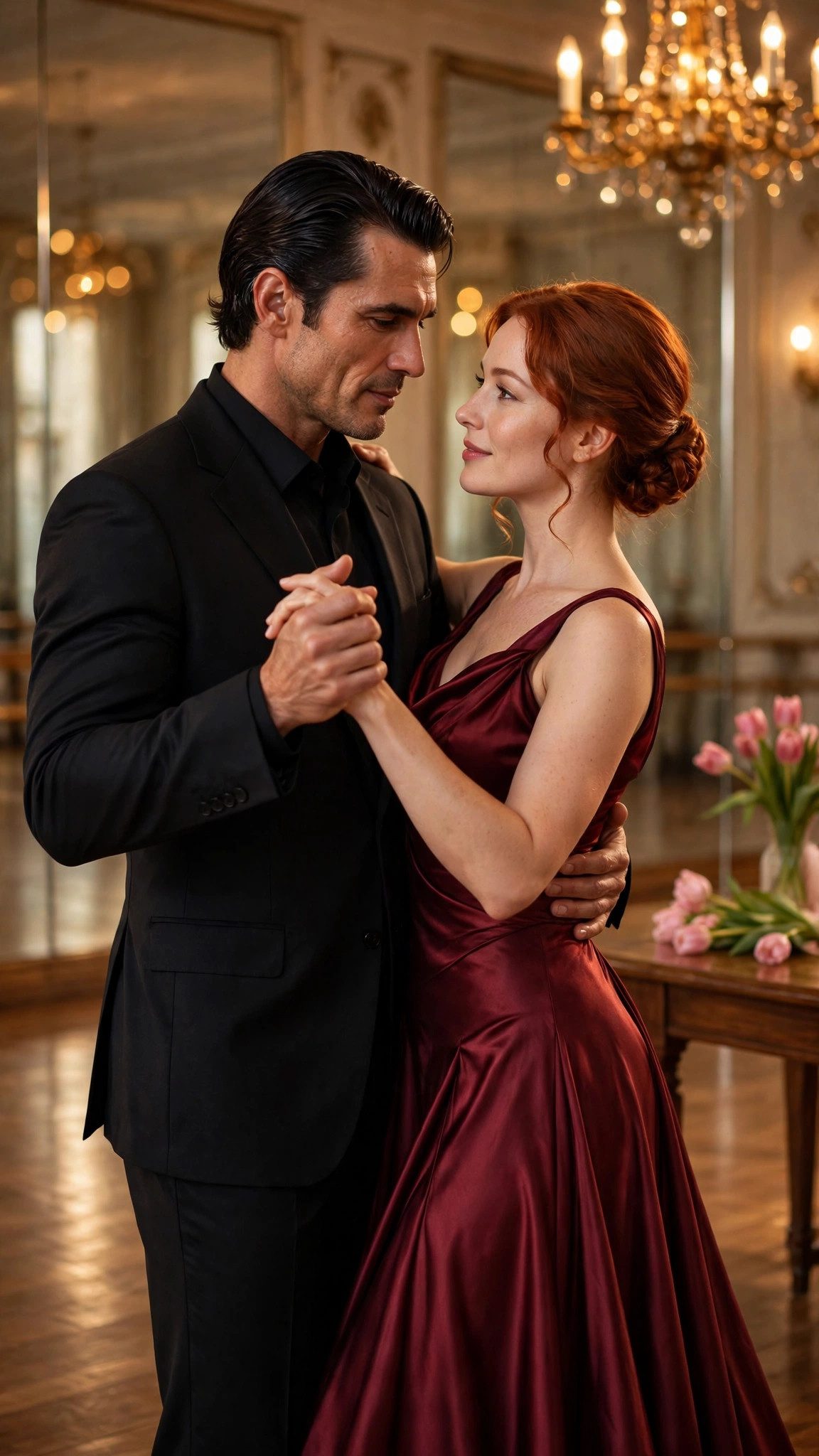
The next morning, someone threw a brick through my studio window.
I found it when I arrived at seven, as always, with my key in my hand and a bunch of fresh tulips from Jenna's shop in my arms. Glass glittered across the polished wooden floor like spilled diamonds. The brick lay in the middle of the room, wrapped in a sheet of paper, and on the paper, in block capital letters, someone had written: SELL. BEFORE IT GETS WORSE.
My hands shook so hard I nearly dropped the tulips. I set them down on the table by the mirror — the mirror that was now cracked in a spider's web from the corner — and I stood there in the cold morning air coming through the broken window, and I did what I always do when I am afraid.
I started to clean.
I swept the glass into a dustpan, shard by shard. I picked up the brick and set it on the table. I called the glazier, and I called Jenna, and I called the police, who came and took a report and told me, with the weary kindness of men who have seen this a hundred times, that there was not much they could do about a brick with no fingerprints and no witnesses.
By nine o'clock, Gabriel was standing in my doorway.
He did not knock. He did not call. He simply appeared, the way he always did when something had gone wrong — as if the city itself had told him. He looked at the broken window. He looked at the brick on the table. He looked at the glass I had swept into a neat pile by the door. And his face went very still, in the way I had learned to recognize: the stillness of a man deciding exactly how much damage he was about to do to someone.
"Who did this?" he asked. His voice was quiet. That was the most frightening thing about it. It was quiet.
"Vincent Castellano," I said. "Or one of his men. The note says sell."
He picked up the brick. He turned it over in his hands. He read the note twice. Then he set it down again, very carefully, as if it were made of glass instead of the thing that had broken my glass.
"Go home, Claire," he said.
"No," I said.
"Go home. Let me handle this."
"No," I said again, and I folded my arms, and I stood in the middle of my broken studio, and I looked him in the eyes. "This is my studio, Mr. Moretti. My floor. My mirrors. My tulips. You do not get to send me home from my own studio."
Something moved in his face then. It might have been respect. It might have been frustration. It might have been both.
"Then stay," he said. "But do not leave this building alone. Not today. Not until I tell you it is safe."
"Your men are already outside," I said. "They have been outside for a week. They did not stop a brick."
"My men were watching the street," he said. "From now on, they will watch the building. All of it. The roof. The back door. The alley." He turned to Sal, who had appeared in the doorway behind him without a sound. "Double the men. No one comes near this block without my knowing about it."
"Yes, Mr. Moretti," Sal said, and vanished.
Gabriel stayed. He did not dance that day. He stood by the broken window with his arms folded while the glazier worked, and he watched the street, and every few minutes his phone buzzed and he stepped outside to take a call in a low voice, and every time he came back, his face was a little harder.
At noon, Jenna came over from the flower shop with a tray of coffee and a plate of pastries, and she looked at the broken window and the men outside and Gabriel standing guard like a statue, and she said, very quietly, so only I could hear, "Claire. Who is that man?"
"My student," I said.
"Your student," she repeated, in a tone that said she did not believe me for one second. "Claire, honey, students bring apples. That man looks like he brings funerals."
"He brings tulips," I said. "And he is learning to waltz."
Jenna looked at Gabriel. Gabriel looked at Jenna. Jenna decided, very wisely, to go back to her flower shop.
That afternoon, while the glazier fitted the new glass, Gabriel finally spoke about Castellano. He told me the whole story, in short, flat sentences, the way a man tells a story he has told himself a hundred times and still does not like.
Vincent Castellano was a developer. That was what his business cards said. In reality, he was a front for the Castellano family — a smaller family, hungry, always looking for a way to grow. For two years he had been buying up the west side block by block, turning old storefronts into warehouses, laundries, and storage units that nobody ever seemed to use but everybody understood. My block was the last piece he needed. The building my studio was in — a beautiful old brick building with a dance studio on the ground floor, a flower shop next door, and apartments above — stood in the way of his warehouse.
"He offered the landlord three times the market price," Gabriel said. "The landlord refused. He is an old man, and his father built this building, and he will not sell. So Castellano changed his approach. He started with the tenants. The bakery on the corner lost its lease. The tailor upstairs got a rent increase he could not pay. Now it is your turn."
"Why me?" I asked. "I am only a tenant. I do not own the building."
"Because you are the heart of this block," Gabriel said, and the way he said it — simply, as if it were obvious — made my throat tighten. "People come here for you. The flower shop sells tulips to your students. The bakery sells bread to your students' families. If your studio closes, the block dies a little, and Castellano can buy the rest of it for nothing."
I sat down on the bench by the mirror. My legs felt weak. "What does he want from me, exactly?"
"He wants you to leave," Gabriel said. "He wants you frightened enough to break your lease and go somewhere else. And if fear does not work, he will try something else. A fire, maybe. A flood. An accident." He looked at the broken window. "A brick is a beginning, Claire. It is not an end."
I thought about my studio. Eight years of mornings. Eight years of tulips and waltzes and nervous brides and retired couples. Eight years of building something that was mine, something no one could take from me — until now, when a man I had never met wanted to take it because it stood in the way of a warehouse.
"What do we do?" I asked. It was the same question I had asked him days before, in the hospital hallway, and it was the same question Rosa had answered for me: the way where nobody gets hurt, and the studio stays yours.
"We do what I should have done a week ago," Gabriel said. "We make sure he understands that this building is protected. Not by my men standing outside. By something he cannot frighten, cannot buy, and cannot break."
"What is that?" I asked.
He did not answer. Not then. He only looked at me for a long moment, and then he looked at the new glass in the window, and the tulips on the table, and the polished floor, and he said, very quietly, "I will tell you on Friday. At the lesson. Bring your grandmother's patience, Miss Donovan. You will need all of it."
He left then, and Sal and the men stayed outside, and I locked up that night and went home and sat in my kitchen with a cup of tea, and I thought about the brick on my table and the note that said SELL. BEFORE IT GETS WORSE.
I thought about leaving. I will not pretend I did not. I thought about packing up my sound system and my mirrors and my tulips and finding a little studio somewhere else, somewhere quiet, somewhere no one wanted to turn into a warehouse. It would have been easy. It would have been safe.
But then I thought about Rosa, in her hospital bed, counting the days until her eightieth birthday party, when her grandson would waltz with her. I thought about the retired couple who had learned to waltz in my studio after fifty years of marriage. I thought about the nervous bride who had cried through her first lesson and then danced at her wedding like she had been born to it.
And I thought about Gabriel Moretti, who had walked into my studio furious and had stayed to learn to count one-two-three, and who was standing guard over my broken window like it was his own.
I was not going to leave. Not for Vincent Castellano. Not for a brick. Not for anything.
On Thursday, Rosa came home from the hospital.
Gabriel brought her to the studio himself, in the afternoon, with her wrist in its cast and her pink purse on her lap and her bright smile firmly in place. She looked at the new window glass and the swept floor and the fresh tulips, and she nodded with satisfaction, as if she had inspected the premises and found them acceptable.
"Good," she said. "Now. Gabriel. Lesson."
And so we danced — Rosa watching from the bench, Gabriel counting under his breath, me calling out the steps — one-two-three, one-two-three — while the late light came through the new glass and turned the mirrors gold. And for one hour, there was no brick, no Castellano, no black cars outside. There was only music, and a man learning to be gentle, and an eighty-year-old woman who had known all along that this was what he needed.
When the lesson ended, Rosa patted my hand and said, "Friday, dear. Something important is happening on Friday. Wear something nice."
"Rosa," I said, "what is happening on Friday?"
She smiled, bright and mysterious, and tucked her pink purse under her arm.
"You will see, dear," she said. "You will see."
The next morning, I went to see the landlord.
Mr. Abernathy was eighty-four years old, and he lived in a small apartment above the bakery on the corner, and he had owned our building for fifty years. His father had built it with his own hands, brick by brick, in 1948, and Mr. Abernathy had told me once, when I signed my lease, that he would rather die than sell it to a developer.
I found him in his kitchen, drinking tea from a chipped mug, reading the newspaper with a magnifying glass.
"Miss Donovan," he said, looking up. "I heard about the window. I am sorry. I have already called the glazier. He will send me the bill."
"Mr. Abernathy," I said, sitting down across from him, "a man named Vincent Castellano has been trying to buy this building."
"I know," Mr. Abernathy said calmly. "He has offered me five times what it is worth. In cash. He sent a lawyer, and then he sent a nicer lawyer, and then he sent a man who did not say he was a lawyer at all." He sipped his tea. "I told them all the same thing. My father built this building. My children were born in the apartment upstairs. My wife died in the bedroom at the end of the hall. This building is not for sale. Not for five times. Not for fifty times. Not while I am alive."
"And if he keeps pressing?" I asked.
Mr. Abernathy looked at me over his magnifying glass, and his old eyes were very steady. "Then he will find," he said, "that an old man who has nothing left to lose is a very stubborn creature. And Miss Donovan —" he reached across the table and patted my hand — "you are the best tenant this building has ever had. Your studio is the heart of this block. Whatever happens, you will always have a home here. I promise you that."
I left his apartment with tears in my eyes, and I walked back down the street to my studio, past Jenna's flower shop — where Jenna was standing in the doorway, pale, holding a letter — and I stopped.
"Jenna?" I said. "What is it?"
She held out the letter. It was from her landlord — a different landlord, a company, not Mr. Abernathy — and it said her rent was doubling next month, effective immediately, and that if she could not pay, she would have to leave by the first of the month.
"Claire," Jenna whispered, "I cannot pay double rent. The shop barely breaks even as it is. If I leave, I lose everything. The shop. The customers. All of it."
I took the letter from her hands and read it twice, and I felt a cold anger settle in my chest, the way ice settles on a window. This was Castellano's work. Not a brick this time. A letter. A rent increase. A quiet, legal, bloodless way to strangle a small business.
"Jenna," I said, folding the letter carefully and handing it back. "Listen to me. You are not leaving. I do not know how yet, but you are not leaving. This block is our home. Your shop. My studio. Mr. Abernathy's building. We are not going anywhere."
That afternoon, when Gabriel came for his lesson, I told him about Jenna's letter. He listened without interrupting, his face growing darker with every word, and when I finished, he said only, "I see."
"What does that mean?" I asked. "What are you going to do?"
"It means," he said, "that Castellano is not only after the building. He is after the block. He is squeezing every tenant, one by one, until the whole street is empty and he can buy it all for nothing." He looked at me, and his eyes were hard. "And it means I should have acted sooner. I waited too long. I will not wait any longer."
He did not dance that day. He stood by the window with his phone, making call after call in a low voice, and every few minutes Sal appeared in the doorway with a message, and Gabriel nodded, and Sal vanished again. I taught my empty studio to the mirrors, and I waited, and I thought about Jenna's letter, and Mr. Abernathy's kitchen, and the brick on my table, and I understood, finally, that this was not only about my studio anymore. It was about all of us — the flower shop, the bakery, the tailor upstairs, the old man whose father had built the building with his own hands. Castellano wanted the whole block. And Gabriel Moretti, who had walked into my life a month ago wearing a ten-thousand-dollar suit, was the only person standing between him and it.