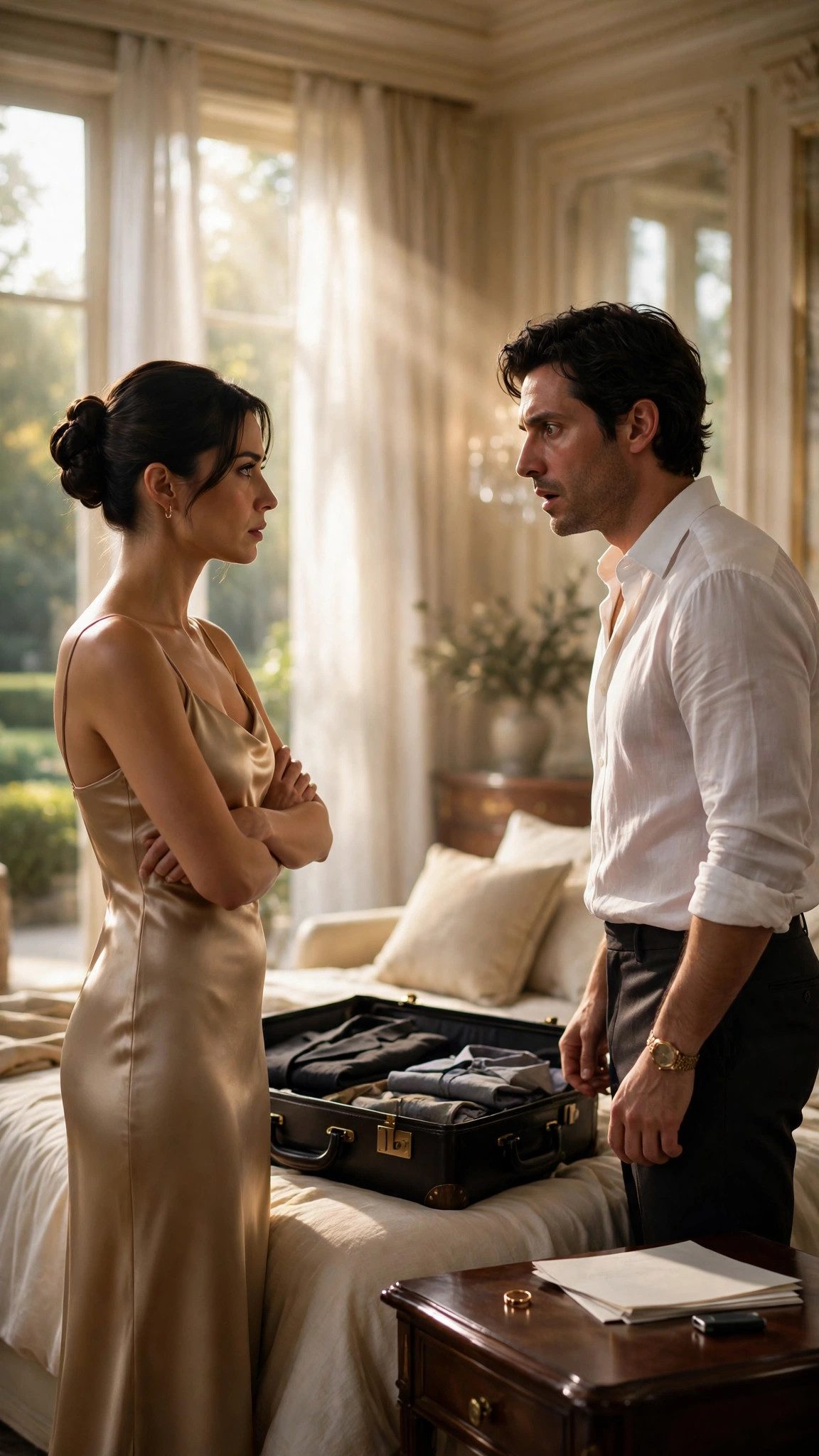
We stayed in Harbor Springs for three months.
Three months of mornings by the lake and evenings by the wood stove. Three months of therapy on Tuesdays, in a small office in town with a woman named Dr. Alvarez who asked us hard questions and did not accept easy answers. Three months of Vincent learning to tell the truth, and me learning to believe him again, one day at a time.
It was not easy. There were days when I woke up and looked at him across the breakfast table and felt nothing but anger, anger at the three years and the receipt and the photographs, anger that rose up in me like a wave and threatened to drown everything we were building. On those days, I would go for a walk along the lake, and I would come back, and Vincent would be waiting for me, and he would not ask me where I had been, and he would not tell me I was imagining things. He would make me tea, and he would sit with me in silence, and he would wait until I was ready to talk.
There were days when Vincent woke up and looked at himself in the mirror and did not recognize the man looking back at him. He told me about it one night, sitting by the fire, his voice low and rough.
"I spent my whole life being the man my father wanted me to be," he said. "Cold. Untouchable. Afraid of nothing. And I was good at it. I was very good at it. But I was not good at being your husband. I did not know how to be a husband, Claire. No one ever taught me. My father did not teach me. My mother died when I was young. I learned how to run an empire, but I never learned how to love a person and keep loving them, every day, even when it is hard."
"You are learning now," I said.
"I am trying," he said. "I will keep trying, for as long as it takes. For the rest of my life, if that is what it takes."
He kept his promises. He told me the truth about the business, all of it, over many long evenings by the fire. He told me about the hotels and the casinos and the shipping companies, and he told me about the underground empire, the part that did not appear on any balance sheet, and he did not hide anything from me. Some of what he told me frightened me. Some of it made me angry. But he told me, and I listened, and I understood, for the first time, the full weight of the life he had been carrying alone for so many years.
And then he did something I did not expect. He started to change the business. Slowly, carefully, the way a man dismantles a building one brick at a time so it does not collapse on the people inside. He sold the casino in Atlantic City. He closed the accounts that could not be explained. He told his men that the family was going legitimate, that the hotels and the shipping companies were the future, and that anyone who wanted to stay in the old business could leave with his blessing and a severance payment, but they could not stay and do it in his name.
"It will take years," he told me. "Maybe the rest of my life. But I am going to do it. I am going to build something our children can be proud of, if we ever have children. I am going to build something you can be proud of."
I did not say anything. I just took his hand, and I held it, and I knew that he meant it.
In the second month, Rosa came to visit. She arrived on a Tuesday morning with a basket of food and a suitcase, and she hugged me so hard I could barely breathe, and then she looked at Vincent and she said, "You look thinner, Mr. Vincent. You need to eat."
"I am eating, Rosa," he said, smiling. "Claire is teaching me to cook."
"She is a good teacher," Rosa said, and she went into the kitchen and she started making her red sauce, and for the first time in three months, the cottage smelled like home.
That night, after dinner, Rosa sat with me on the porch while Vincent washed the dishes inside, and she said, "He is different, Claire. I have worked for this family for thirty years, and I have never seen him like this. He is a man who has learned to be afraid, and it has made him a better man. Your grandmother used to say that a man who is not afraid of losing something does not deserve to keep it. Vincent is afraid now. He deserves to keep you."
In the third month, on a morning when the lake was calm and the sun was shining and the white roses Vincent had planted in a small garden behind the cottage were in bloom, Vincent asked me to walk with him to the end of the dock.
I knew what was coming. I had known for weeks. He had been nervous all morning, dropping things, forgetting what he was saying, checking his pocket every few minutes the way a man checks his pocket when there is something important inside it.
We stood at the end of the dock, with the water all around us and the sun on our faces, and Vincent took my hands in his, and he looked at me the way he had looked at me on our wedding day, as if I were the only thing in the world that mattered.
"Claire," he said, "seven years ago, I asked you to marry me, and you said yes, and I spent the next seven years taking that yes for granted. I thought that because you had said yes once, you would keep saying yes forever, no matter what I did. I was wrong. I know that now. So I am going to ask you again. Not because I have to. Because I want to. Because I want to marry you properly this time, the way you deserved to be asked the first time."
He knelt down on the dock, on one knee, in his good suit, not caring that the wood was wet, and he took a small velvet box out of his pocket, and he opened it.
Inside was a ring. Not my old wedding ring. A new ring, a thin gold band with a single diamond, small and perfect, and on the inside of the band, engraved in flowing script, were two words.
*My Claire.*
"I had it made the week after you left," he said. "I did not know if you would ever wear it. I did not know if you would ever speak to me again. But I had it made, because I wanted you to know that even when you were gone, even when I did not know where you were, I was thinking about you, and I was planning for the day I could ask you properly."
Tears ran down my face. I did not try to stop them. I had cried for three weeks in the shower, and I had cried in Rosa's arms, and now I was crying on a dock in Harbor Springs, Michigan, because the man I had loved for eight years was kneeling in front of me and asking me to marry him, and this time, he was asking me the right way.
"Yes," I said. "Yes, Vincent. I will marry you. Properly this time. On my terms, and on yours, and on no one else's."
He slipped the ring onto my finger, and it fit perfectly, and he stood up, and he took my face in his hands, and he kissed me, and the lake was calm and the sun was shining and the white roses were in bloom behind the cottage, and for the first time in three years, I felt like I was home.
We married again that summer, in a small church in Harbor Springs, with fifty guests and a cake Grace's mother had insisted on baking herself. Rosa cried through the entire ceremony. Grace stood beside me as my maid of honor, and when the priest asked if anyone objected, the only sound was the wind in the trees outside.
Vincent and I wrote our own vows. Mine were simple. I promised to love him, and to tell him the truth, and to never again be afraid to ask him the hard questions. His were simple too. He promised to love me, and to tell me the truth, and to never again forget that I was the one thing in his life he was afraid to lose.
After the ceremony, we stood on the dock where he had proposed to me, and we watched the sun set over the lake, and Vincent put his arm around me, and he said, "I spent my whole life being afraid of losing things. Money. Territory. Men. But I have never been afraid of losing a person, because I never had one worth losing. Until you."
"You said that on our first wedding night," I said.
"I know," he said. "And I meant it then. But I did not understand it then. I understand it now."
I leaned my head against his shoulder, and I looked out over the water, and I thought about the woman I had been seven years ago, the woman who had believed she had married her perfect match, and the woman I had been three years ago, the woman who had found a receipt in a jacket pocket and started keeping a notebook, and the woman I was now, standing on a dock in Michigan with a new ring on her finger and a husband who had finally learned to be afraid of losing her.
I had been all three of those women. And I had survived all three of them. And I was going to spend the rest of my life with the man beside me, not because I needed him, but because I had chosen him, freely, with my eyes open, knowing exactly who he was and exactly what he had done, and knowing that he had changed.
Vincent Moretti had spent his whole life being the most feared Mafia boss in Chicago, a man who could make dangerous men tremble with a phone call. But the thing he had never expected, the thing he had never prepared for, the thing that had nearly destroyed him, was losing his wife.
He had lost her. And then, against all odds, he had won her back. Not by force. Not by fear. Not by sending men to airports and hotels. By telling the truth, and by being afraid, and by asking her, properly, to choose him again.
And she had chosen him. Because that is what love is, in the end. Not a ring on a nightstand. Not a USB drive full of evidence. Not a marriage that lasts because one person is too afraid to leave.
One year after our second wedding, Vincent and I sat on the dock in Harbor Springs on a warm evening in June, and he cooked dinner for us on the small grill behind the cottage. His sauce had improved. It still needed salt, but I did not tell him. Some things are better left unsaid, and a husband who has learned to cook is a husband who deserves to believe his sauce is perfect.
My bakery job had grown into something more. June had retired in the spring, and I had bought the bakery with money Vincent had given me — not as a gift, but as a loan, with a contract and interest and a repayment schedule, because I had told him I would not take his money for free, and he had respected that. The bakery was mine. I decorated cakes for weddings in Harbor Springs, and on Saturdays, I taught a class for children, showing them how to pipe flowers out of icing, and the children called me Mrs. Claire, and I liked the sound of it.
Vincent's business had changed too. The Atlantic City casino was gone. The shipping company was clean, audited by accountants who reported to a board that included two people Vincent did not control. The hotels were thriving, and the Meridien in Chicago had a new rooftop garden, planted with white roses, because Vincent had told the gardener to plant them in memory of the garden he had once built for his wife and then forgotten to water.
The old necklace, the one with *My Claire* engraved on the back, sat in a drawer in our bedroom. I did not wear it anymore. I wore the new ring, the one Vincent had given me on the dock, and I wore it every day. But I kept the old necklace, because it had been real once, and because I wanted to remember that love can be real and still not be enough, and that a marriage is not saved by a necklace or a garden or a phone call. It is saved by two people who decide, every day, to tell each other the truth.
Rosa visited us every month. She would arrive with a basket of food and a suitcase, and she would cook in our kitchen, and she would tell Vincent he was too thin, and she would tell me I looked happy, and she was right on both counts.
Grace came for Christmas. She stood in our kitchen and she looked at Vincent, and she looked at me, and she said, "I have been a divorce attorney for fifteen years, and I have never seen a marriage come back from where yours was. You two are either the luckiest people I have ever met, or the stubbornest."
"We are both," I said, and Vincent laughed, and Grace laughed, and for a moment, the kitchen was full of the sound of people who loved each other, and nothing else mattered.
Love is a choice. Made every day. By two people who are both afraid to lose each other, and who let that fear make them better, instead of letting it make them cruel.
The End.
THE END