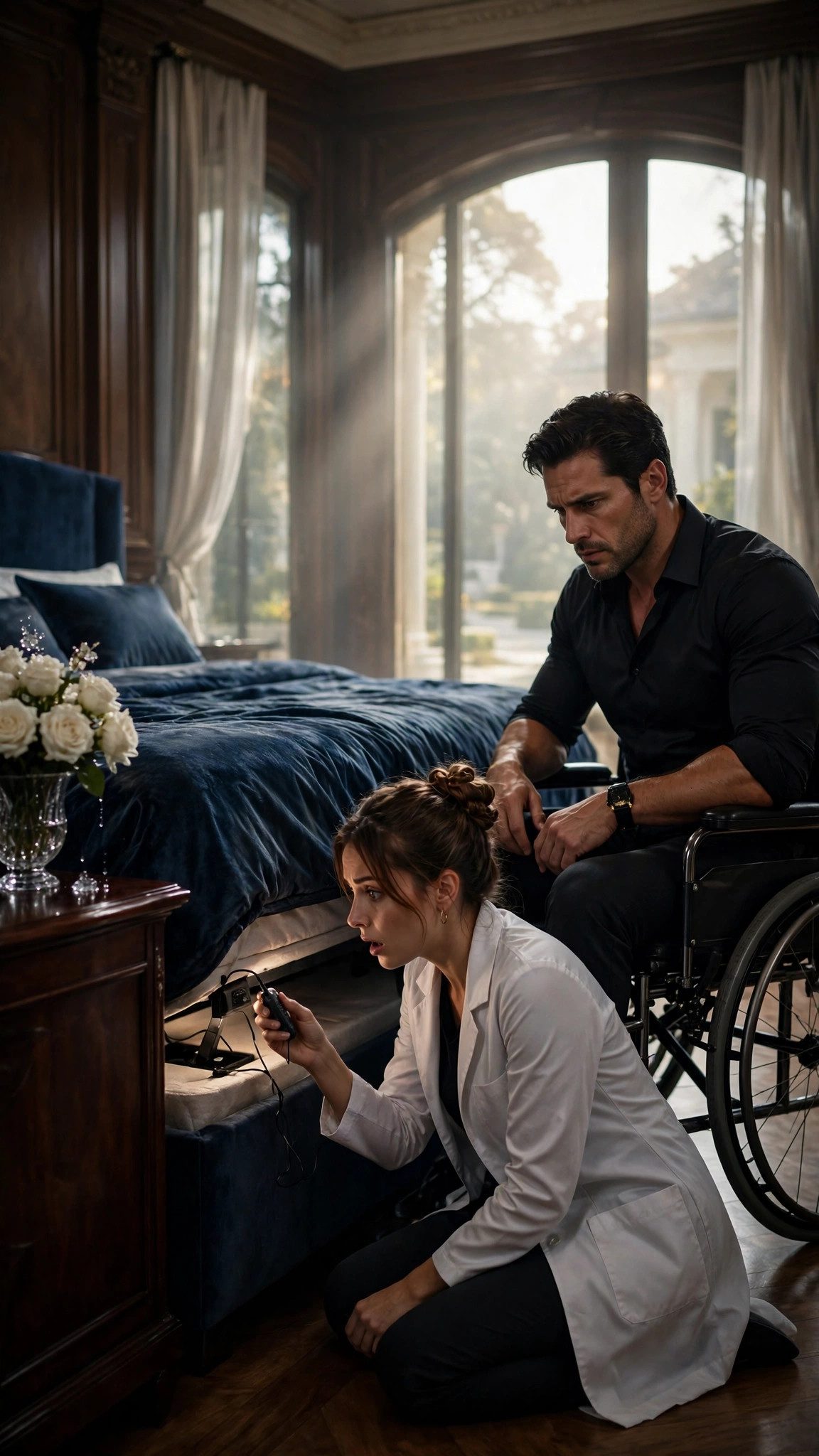
The night after the gala, Vincent sat in his study with Cole Ramsey, and they talked about Elena Marchetti.
She was in custody, but she had not been charged with anything. The police had taken her statement, and then they had let her go home with her daughter, who had come to the station in the middle of the night, crying, holding her mother's hand.
"She didn't hire the shooter," Cole said. "Not directly. She gave Silas Kane twenty thousand dollars. That was all she had. Her savings. Six years of sewing, six years of saving, every penny she could put aside. She gave it to Kane, and she told him she wanted Vincent Corvino dead."
"And Kane took the rest of the money from someone else," Vincent said.
"Yes," Cole said. "Kane charged fifty thousand dollars for the job. Elena paid twenty. The other thirty came from a man named Adrian Voss."
"Who is Adrian Voss?" Vincent asked.
"A developer," Cole said. "He wanted the Corvino freight contracts. He wanted the docks. He wanted the warehouses. He has been trying to buy you out for three years, and you have refused every time. So he found Elena, and he found her grief, and he used it. He gave Kane the money. He gave Kane the information about the restaurant. He gave Kane the schedule. All Elena had to do was agree."
Vincent sat in silence for a long time. He thought about Elena Marchetti, in her black dress, in the third row, watching him. He thought about the twenty thousand dollars, saved penny by penny over six years. He thought about Adrian Voss, a man he had met at a dozen charity events, a man who had shaken his hand and smiled and called him a friend.
"Where is Voss now?" Vincent asked.
"In custody," Cole said. "He was arrested an hour after the gala. He had a plane ticket to Zurich in his pocket. He was going to run."
"And Marcus Hale?" Vincent asked. "The coffee guy?"
"Also in custody," Cole said. "He planted the listening devices. All three of them. He was paid by Kane. He was the one who photographed you outside the restaurant. He was the one who cut Lauren's call. He has been cooperating with the police since the moment they put the handcuffs on him. He is terrified, Vincent. He is twenty-four years old, and he thought he was going to make enough money to buy his mother a house. He did not know he was part of a murder."
Vincent nodded slowly.
"And Elena?" he asked.
Cole looked at him carefully.
"That depends on you, Vincent," he said. "The prosecutor wants to charge her with conspiracy to commit murder. She gave Kane twenty thousand dollars. She told him she wanted you dead. That is a crime. But she is fifty-eight years old. She has never been in trouble before. She lost her husband. She grieved for six years. And you are the victim. If you ask the prosecutor to show leniency, they will listen. If you ask them to throw the book at her, they will listen to that too."
Vincent thought about it for a long time. He thought about Frank Marchetti, the dockworker who had died in the fire. He thought about the trial. He thought about the eleven weeks in the courtroom, and the woman in the third row, and the way she had looked at him.
He thought about his own father, who had believed that respect was more valuable than money and fear was more reliable than either. His father had taught him to be strong. His father had taught him to be feared. His father had never taught him to be merciful.
But his father had never sat in a wheelchair, either. His father had never had to learn what it felt like to be helpless. His father had never had a nurse tell him that angry men miss things.
"I want to see her," Vincent said.
Cole raised an eyebrow.
"Are you sure?"
"I'm sure," Vincent said. "Arrange it. Not at the police station. At her house. I want to see where she lives. I want to see how she lives."
The next afternoon, Vincent went to the small house on the South Side where Elena Marchetti had lived for thirty years. It was a narrow, two-story house with a small front yard and a garden full of tomatoes, just like Daniel Hart's house. The paint was peeling. The steps were cracked. But the windows were clean, and there were curtains in them, and a small wooden cross hung beside the front door.
Elena opened the door herself. She was wearing the same black dress. Her gray hair was pulled back into the same tight knot. Her hands were folded in front of her, the way they had been in the courtroom.
She looked at Vincent in his wheelchair, on her front steps, and her face did not change. She did not smile. She did not cry. She simply stepped aside and let him in.
The house was small and clean and full of photographs. Frank Marchetti, smiling, in a work shirt, holding a fishing rod. Frank Marchetti with his children, at a birthday party. Frank Marchetti with Elena, on their wedding day, both of them young and laughing.
Elena made tea. She moved slowly, carefully, the way a woman moves when she has been carrying something heavy for a long time. She put the cups on the table, and she sat down across from Vincent, and she waited.
"I didn't come to hurt you," Vincent said. "I came to understand."
Elena looked at him for a long time. Then she began to talk.
She talked about Frank. She talked about the way he laughed. She talked about the way he came home every night smelling of diesel and sawdust, and how she would make him dinner, and how they would sit on the porch and talk about their children.
She talked about the fire. She talked about the phone call from the hospital. She talked about the funeral, and the way the Corvino company had sent flowers, and the way no one from the family had come to the service.
"I waited for someone to come," she said. "I waited for someone to say they were sorry. I waited for someone to tell me it was an accident and that they cared. No one came. So I went to the trial. I went every day. I sat in the third row, and I watched you, and I waited for you to look at me. You never did. Not once. You never looked at me."
Vincent felt something in his chest tighten. He had never looked at her. He had been too busy defending himself. He had been too busy being innocent.
"I'm looking at you now," he said.
Elena's eyes filled with tears.
"I know," she said. "And I'm sorry. I'm sorry I wanted you dead. I'm sorry I gave that man my money. I'm sorry I let my grief turn into hate. Frank wouldn't have wanted that. Frank was a kind man. He would have been ashamed of me."
Vincent reached across the table and took her hand. It was small and rough from years of sewing, and it trembled in his.
"Frank died in my warehouse," Vincent said. "I was acquitted. But I was responsible. I owned the building. I owned the company. I owned the system that put him there. And I never came to your house. I never said I was sorry. That was my failure, and I have carried it for six years without knowing it."
He looked around the small, clean house, at the photographs on the walls, at the tomatoes in the garden outside the window.
"I'm going to make it right," he said. "Not with money. Not with a check. With something real. The Corvino Foundation is going to build a community center on the South Side, in Frank's name. It will have a job training program for dockworkers. It will have a scholarship fund for their children. And your daughter — I understand she wants to go to nursing school. The foundation will pay for it. All of it."
Elena stared at him. Tears ran down her face, and she did not wipe them away.
"Why?" she whispered. "After everything I did? After what I tried to do to you?"
"Because someone has to stop," Vincent said. "Because if I punish you, then your children will hate me, and their children will hate my children, and it will never end. Because Frank was a good man, and you are a good woman, and this has to stop somewhere. It stops here. With us."
Elena nodded slowly. She squeezed his hand.
"Thank you," she said. "Thank you for coming to my house. Thank you for looking at me."
Vincent went home that evening, and Lauren was waiting for him in the study. She had been waiting for hours, and her face was pale with worry.
"How did it go?" she asked.
"It went well," Vincent said. "Better than I expected. Better than I deserved."
He told her everything. He told her about the house, and the photographs, and the tea, and the community center, and the nursing school. And Lauren listened, and when he finished, she took his hand, and she said, "I'm proud of you."
Vincent had not heard those words in a long time. He had heard them from his father, once, when he was a boy. He had heard them from his captains, when he closed a deal. But he had never heard them from his wife, in this way, with this meaning.
That night, something happened that had not happened in six months.
Vincent was lying in bed, listening to the quiet of the house, when he felt it. A tingle. A small, faint, electric tingle in his left foot. So faint he thought he had imagined it. So small he was afraid to believe it.
He did not say anything. He did not call Tessa. He did not call the doctor. He simply lay there in the dark, feeling the tingle come and go, come and go, like a light flickering at the end of a long hallway.
And for the first time in six months, Vincent Corvino allowed himself to hope.
The next morning, Vincent asked Cole Ramsey to take him to the cemetery where Frank Marchetti was buried. It was a small, quiet place on the South Side, with old trees and weathered stones, and Frank's grave was near the back, beneath a maple tree, with a simple granite marker that read "Frank Marchetti, 1979–2020, Beloved Husband and Father."
Vincent sat in his wheelchair beside the grave for a long time, and he did not speak. He did not pray. He simply sat there, looking at the name on the stone, thinking about the man he had never met and the fire he had never caused and the widow who had spent six years believing he was a murderer.
"I didn't kill you," he said quietly, to the stone, to the maple tree, to the morning air. "But I owned the building you died in. And I never came here. I never said I was sorry. I'm saying it now. I'm sorry."
He stayed for an hour. When he finally left, he felt lighter, as if he had put down something heavy that he had been carrying without knowing it.
That afternoon, Elena Marchetti's daughter came to the mansion. Her name was Maria, and she was twenty-six years old, with her father's dark eyes and her mother's gray-streaked hair. She had just started nursing school, and she was nervous, and she held her purse in both hands the way her mother held her hands in her lap.
"I wanted to thank you," she said to Vincent, sitting in the chair across from his desk, her voice shaking. "For what you said at the gala. For what you're doing for my mother. For the scholarship. No one has ever done anything like this for our family."
"Your father was a good man," Vincent said. "He worked for my family for eleven years. He deserved better than what happened to him. And your mother deserved better than six years of grief with no one to listen to her."
Maria cried then, quietly, the way her mother cried, and Lauren came in with tea and sat beside her, and the two women talked for a long time about nursing school, and about Frank, and about what it meant to lose someone you loved.
Before Maria left, she hugged Vincent. It was awkward, because of the wheelchair, because of the history, because of everything. But it was real.
"My father would have liked you," she said. "If he had known you. If things had been different."
"Thank you," Vincent said. "That means more than you know."
That evening, Cole Ramsey came to the study with his final report. Adrian Voss had been charged with conspiracy to commit murder, and the prosecutor was confident of a conviction. Silas Kane had agreed to testify against Voss in exchange for a reduced sentence. Marcus Hale had been given probation and community service.
"And Elena?" Vincent asked.
"The prosecutor has decided not to charge her," Cole said. "She gave Kane twenty thousand dollars, but she was manipulated. Voss found her grief and used it. The prosecutor believes she has suffered enough. And your statement helped. You told them she deserved mercy, not punishment. They listened."
Vincent nodded slowly.
"Good," he said. "That's good. That's how it should be."
Cole packed his files and stood up to leave. At the door, he turned back.
"Vincent," he said, "I've been doing this work for thirty years. I've seen a lot of men in your position. Most of them choose revenge. Most of them choose blood. You chose something else. You chose the truth. And you chose forgiveness. I don't know if you understand how rare that is. But I do. And I wanted you to know."
After Cole left, Vincent sat alone in his study, and he thought about the tingle in his left foot. It was still there. Faint, but there. Like a light flickering at the end of a long hallway.
He did not know if he would ever walk again. The doctors could not promise anything. But for the first time in six months, Vincent Corvino allowed himself to hope.