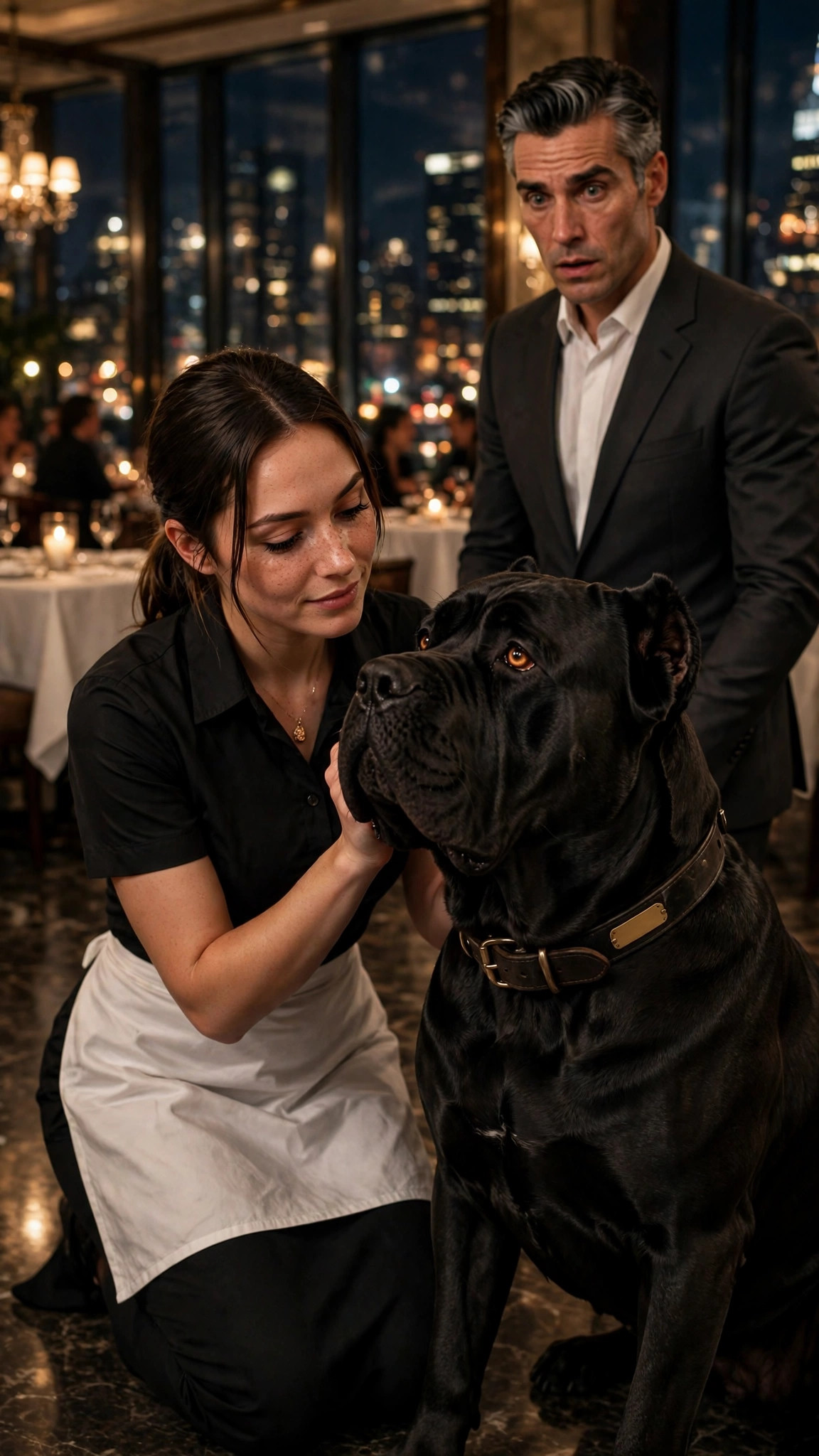
The first thing Dante did after I said yes was to assign me a guard. His name was Rocco, and he was built like a refrigerator and had the gentlest voice I had ever heard on a man his size. He drove me home in a car with windows so dark I couldn't see out of them, and he waited in the hallway while I fed Miso and packed a bag, because Dante had decided I would not be sleeping in my apartment that night.
"He says it's not safe," Rocco explained, as though this were the most normal thing in the world. "Not until we know who knows."
I packed clothes and my toothbrush and the small framed photograph of my mother that sat on my nightstand. I left a note for Mrs. Alvarez, my neighbor, asking her to feed Miso. Rocco carried my bag down the four flights of stairs like it weighed nothing.
On the drive back to the penthouse, I watched the city go by and thought about my father. Thomas Marshall. A dockworker. A man who had pulled a bleeding nineteen-year-old out of a river and hidden him for three days and died for it. I tried to remember his face and couldn't. I remembered his hands, rough and warm, and his laugh, and the way he used to lift me onto his shoulders. That was all. My mother had taken the rest of him with her when she ran.
After my mother died, I went to live with my aunt Carol in Brooklyn. She was kind, but she had five children of her own and a husband who worked two jobs, and there was never quite enough room, or enough food, or enough time. I slept on a couch in the living room, and I learned to be quiet, and I learned to make myself small, and I learned that the best way to survive in a crowded house was to be useful. I washed dishes. I folded laundry. I watched the younger kids while my aunt was at work. I was twelve years old, and I was already a second mother to children who weren't mine.
When I was fourteen, my aunt's husband lost his job, and the house got smaller, and one day a social worker came and said I would be better off in a group home, where there were resources and counselors and a structured environment. I didn't cry. I had learned by then that crying didn't change anything. I packed my things in a garbage bag — that's what you did, in those days, you packed your life in a garbage bag — and I went to St. Mary's, a gray building in the Bronx with a chain-link fence and a house mother named Mrs. Delgado who had a voice like a drill sergeant and a heart like a warm oven.
Mrs. Delgado taught me to cook. She ran the kitchen at St. Mary's, and she believed that every girl in that house should know how to feed herself and feed others, because nobody else was going to do it for them. She taught me to chop an onion without crying, to season a soup by taste instead of by measuring, to make a meal out of almost nothing — a can of tomatoes, a handful of pasta, a heel of bread. "Food is love you can taste," she used to say, wiping her hands on her apron. "Never forget that, Olivia. A person who can cook will never be alone in this world."
I held on to that. In my first week at St. Mary's, Mrs. Delgado let me help her make soup for thirty girls. I stood on a stool to reach the counter, and she showed me how to peel carrots without taking off half the carrot with the peel, and how to taste a broth and know what it needed. That night, when the girls sat down to eat, one of them — a girl named Teresa, who never spoke to anyone — looked up at me and said, "This is good." It was the first time anyone had ever praised something I made. I carried that sentence with me for years, the way other people carry photographs. Whenever a shift got hard, whenever a customer was cruel, whenever the rent was due and my bank account was empty, I thought about Teresa's voice saying, "This is good," and I kept going. Years later, when Mrs. Delgado died, I went to her funeral, and I cooked for the girls at St. Mary's afterward — a big pot of soup, the way she had taught me — and Teresa was there, all grown up, a nurse now, and she hugged me and said, "You still cook like her." And I said, "She taught us both." And we stood in that kitchen and cried, and the soup was good, and it tasted like love you could taste, and I knew that Mrs. Delgado would have been proud. When I turned seventeen, I left St. Mary's with a duffel bag and a dream I was too embarrassed to say out loud: I wanted to be a chef. Not a waitress. Not a girl who carried plates for rich people. A chef. I wanted a kitchen of my own, and I wanted to cook food that made people feel the way Mrs. Delgado's soup had made me feel — like someone cared. But culinary school cost money I didn't have, so I took a job at a diner in Brooklyn, working the breakfast shift, and I saved every dollar I could, and I told myself that one day, when I had enough, I would go to school. One day. Someday. The day never came. The rent always came first. The shoes always came first. Life always came first.
And now, sitting in a car with a man built like a refrigerator, driving through the city to a penthouse owned by a mafia boss, I understood something I had never understood before: my mother hadn't just been hiding me from Castellano's men. She had been hiding me from my own history. She had been trying to give me a normal life — a life without guns and debts and men who threw boys off piers. And she had almost succeeded. If I had never reached out my hand to a dog at table twelve, I might have gone my whole life without knowing who my father was, or what he had done, or why we had run.
I didn't know whether to be grateful to her or angry with her. I was both. I was so much of both that I couldn't tell where one feeling ended and the other began.
That night, Dante told me the whole story. We sat in the penthouse living room after dinner — dinner that a quiet woman in a gray uniform had cooked and served without a word — and Orion lay between us on the rug, his head on his paws, his eyes half closed. The fire was lit. The city glittered beyond the glass. And Dante Moretti, the most feared man in New York, told me about the night he was nineteen years old.
"I was stupid," he said. "I thought being my father's son made me untouchable. I went to a meeting at the docks without enough men, because I wanted to prove I could handle it alone. Vincent Castellano's people were waiting. They shot me twice — once in the shoulder, once in the side — and they threw me off Pier 41 like I was garbage."
He touched his left shoulder, unconsciously, the way people touch old scars when they talk about them.
"I woke up in your father's apartment. He had dragged me out of the water. He had a wife and a little girl sleeping in the next room, and he risked all of it for a stranger. He told me his name was Thomas, and he told me to shut up and let him work, and for three days he kept me alive with boiled water and bandages and a doctor he trusted. On the third night, he heard them coming. He pushed me out the back window and told me to run and not to look back. I ran. I heard a gunshot. I kept running."
Dante looked into the fire. "My father sent men for your family the next day. Your mother was already gone. She had taken you and vanished. My father searched for years, and then he died, and I kept searching, and after a while the trail went cold and I told myself that maybe it was better that way. Maybe you were safer lost."
"My mother never told me," I said. "She never told me anything about that night. She just… she worked double shifts at the hospital, and she came home tired, and she told me to be kind to people because you never knew what someone was carrying. That was her whole philosophy. Be kind. You never know."
"She was right," Dante said quietly. "Look at what your kindness did last night. You reached out your hand to a dog, and the whole world changed."
I looked at Orion, asleep on the rug, and felt something shift in my chest — a grief I hadn't known I was carrying, for a father I barely remembered and a mother who had hidden the truth to keep me safe.
"Why would Castellano still care?" I asked. "It's been nineteen years."
"Because Vincent Castellano is losing," Dante said. "His family is weaker than mine now. The docks, the shipping contracts, the unions — they all come to me. He has been looking for a weakness for years, and now he has one: the daughter of the man who saved me. If he takes you, he can make me give him anything. The docks. The contracts. My territory. Or he can kill you, and make me carry that for the rest of my life."
He said it plainly, without drama, the way a man might describe the weather.
"So I'm bait," I said.
"No," Dante said, and his voice hardened. "You are the daughter of the man who saved my life. You are under my protection. There is a difference."
The next morning, I insisted on going to work. I had a shift at Aurelia, and I had rent to pay, and I was not going to hide in a penthouse while my life fell apart. Dante argued. I argued back. In the end, he compromised: Rocco would drive me, Rocco would wait outside, and I would call him the moment anything felt wrong.
"Anything," Dante said, holding my gaze. "A wrong look. A familiar face in the wrong place. A car you've seen before. You call."
The shift was ordinary until it wasn't. At seven o'clock, I went out the back to take the trash to the alley, the way I did every night, and a hand closed around my wrist.
I didn't scream. I had no time. A man I had never seen before — short, wiry, with a scar across his knuckles — pulled me toward a dark van with its engine running, and his other hand came up to cover my mouth, and I thought, this is it, this is how it ends, in an alley behind a restaurant, because I petted a dog.
Then the alley exploded.
Orion came over the fence like a black wave. I didn't know how he had gotten there — Rocco must have brought him, or Dante had sent him, or the dog had simply known — and he hit the man holding me with the full weight of his enormous body and drove him to the ground. The man screamed. The van door slammed. The driver shouted something, and the van peeled out of the alley with its tires shrieking, and the man on the ground scrambled up and ran after it, clutching his arm, while Orion stood over me, his chest heaving, his teeth bared, his amber eyes fixed on the mouth of the alley until the sound of the van was gone.
Then he turned to me, and his whole body changed, and he pressed his head against my leg, and he whined, low and anxious, as though he were asking if I was all right.
Rocco came running from the front, his gun in his hand, his face white. "Are you hurt? Did they touch you?"
"I'm fine," I said, and my voice shook. "Orion — Orion saved me."
Rocco looked at the dog, and then at me, and something in his expression changed, the way Dante's had changed in the restaurant. "He's never done that before," Rocco said quietly. "He's a guard dog, Miss Marshall. He guards Mr. Moretti. That's all he's ever done."
I scratched behind Orion's ear, and his eyes closed, and his tail thumped once against the concrete.
"Maybe he guards more than Mr. Moretti now," I whispered.
That night, Dante did not sleep. I know because I didn't either. I lay in the guest room of the penthouse with Orion asleep across the foot of my bed — he had refused to leave my side — and I listened to Dante pacing in the living room, his voice low on the phone, giving orders in a tone I had never heard before. When the sun came up, he knocked on my door, and his face was gray with exhaustion and fury.
"They tried to take you," he said. "Castellano's men. They knew your schedule. They knew which alley you used. Someone inside my organization told them."
"Inside?" I said. "One of your own men?"
"Yes," Dante said. "And I will find out who. But until I do, you don't go anywhere without me or Rocco or Orion. Do you understand?"
I understood. I understood that the world I had lived in — the world of double shifts and rent notices and cheap black shoes — was gone. I understood that I was now a piece on a board in a war I had never asked to join, between men who killed each other over shipping contracts and old debts.
What I didn't understand yet was that Dante Moretti was not just protecting me because of a debt. I didn't understand that the way he looked at me when he thought I wasn't watching had nothing to do with my father and everything to do with me.
I would understand that soon enough. First, I had to survive the week.