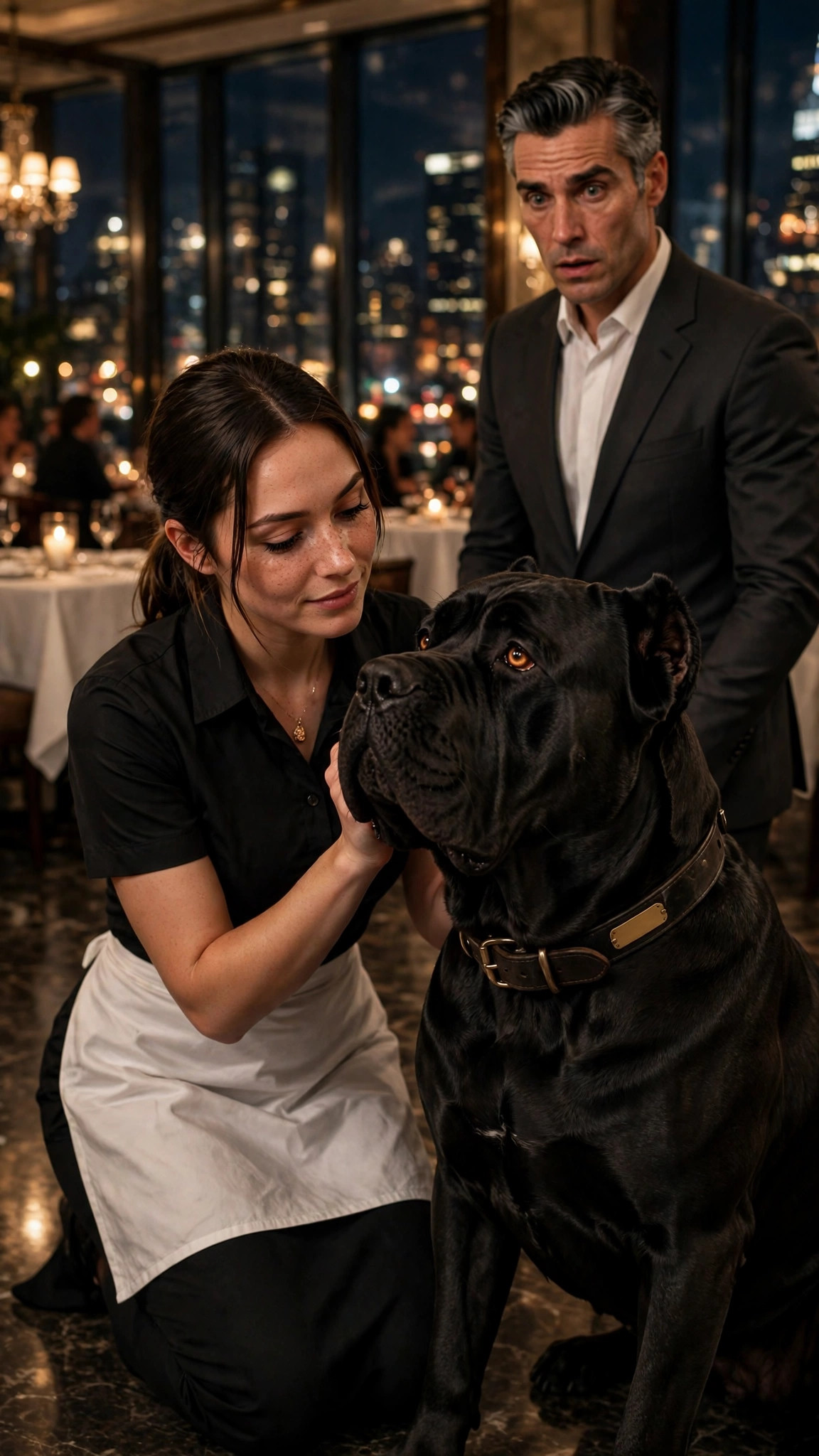
Living in Dante Moretti's penthouse was like living inside a museum that someone had forgotten to put ropes around. Everything was beautiful and expensive and silent. The woman in the gray uniform — her name was Rosa, and she had worked for Dante's family for thirty years — cooked meals I didn't recognize and left them on the table without a word. The windows looked out over the park. The fireplace was always lit. And everywhere I went, Orion went too, his massive body moving silently behind me like a shadow that had decided to love me.
I hated it. Not the beauty — the beauty was fine. I hated the waiting. I hated sitting in a stranger's living room while my life went on without me. I hated that my shifts at Aurelia were covered by other girls and my manager had stopped calling and Mrs. Alvarez was feeding Miso and watering my plants and I had no idea when I would be allowed to go home.
On the third day, I exploded.
"I can't just sit here," I said to Dante at breakfast. He was reading a newspaper in Italian, and Orion was asleep with his head on my foot, and Rosa had made eggs I hadn't asked for. "I have a life. I have a job. I have a cat. I can't stay locked in your apartment forever because some men want to kidnap me."
Dante folded the newspaper with deliberate care. "You can go home when it's safe."
"When will that be?"
"When I find the man inside my organization who is feeding Castellano information, and when Castellano is no longer a threat." He said it the way other men might say "when the rain stops."
"And until then I just… what? Sit here? Eat your food? Wear your clothes?" I gestured at the sweater I was wearing — it was Dante's, a soft gray cashmere, because my own clothes were in a bag in the guest room and the penthouse was cold in the mornings. "I'm not a pet, Mr. Moretti. I'm not Orion."
"No," Dante said, and his eyes flicked to the dog. "You're not. Orion chose you. I didn't get a choice."
The silence that followed was so loud I could hear the clock ticking.
Then Dante stood up, and he did something I had not expected. He took off his watch — a heavy silver thing that probably cost more than my apartment building — and he set it on the table between us.
"My mother gave me this watch the day I turned eighteen," he said. "She told me that a man is measured by what he does when no one is watching. She died six months later. Aneurysm. The same thing that took your mother, I believe. She was forty-four years old."
I stared at him. "I'm sorry."
"She used to say that the house was too quiet. That a home needed a dog, and a dog needed a person, and a person needed someone to come home to. She bought Orion when he was a puppy, eight weeks old, and she raised him herself. She taught him to sit and to stay and to be gentle with her hands. When she died, he sat by her bedroom door for three days and wouldn't eat. The vet said he was grieving." Dante's voice was steady, but his hands were not — they were gripping the edge of the table hard enough that his knuckles had gone white. "I have never seen him choose anyone since. Not my father. Not my men. Not anyone. Until you."
I didn't know what to say. So I said the truest thing I could think of. "I miss my mother too. Every day. I miss the way she used to hum while she cooked. I miss the way she knew when I was lying. I miss her hands."
Dante looked at me for a long moment, and something in his face shifted — the cold gray eyes warmed, just a fraction, like clouds breaking over water.
"Your mother was a nurse," he said. "My mother used to say that nurses were the only truly brave people in the world, because they walked into suffering every day and chose to stay."
We didn't say anything else. Rosa came in and cleared the plates. Orion sighed in his sleep. And I realized, with a shock that went all the way down to my bones, that I was beginning to understand the man behind the monster. He was not a legend. He was a son who had lost his mother, a boy who had been thrown off a pier, a man who carried a nineteen-year-old debt like a stone in his pocket and had no idea how to put it down.
That afternoon, Dante took me to the kitchen. Not Rosa's kitchen — his kitchen, the small one off the living room, where he cooked for himself when he was alone. He rolled up his sleeves, and I saw the scars on his forearms — thin white lines, old, from a life I couldn't imagine — and he showed me how to make his mother's pasta sauce, the way she had taught him. Tomatoes, garlic, basil, olive oil, salt. Nothing fancy. The kind of food that poor people in Sicily had been making for a hundred years.
"My mother said a sauce should taste like the person who made it," he said, stirring slowly. "Hers tasted like home. Mine tastes like… I don't know. I've been trying for twenty years."
I took the spoon from him, tasted it, and added a pinch more salt and a handful of basil torn by hand, the way my mother used to do it. "There," I said. "Now it tastes like someone who cares."
He looked at the pot, and then at me, and he laughed — a real laugh, low and surprised, the sound of a man who had forgotten he knew how. Orion lifted his head, startled, and then put it back down with a sigh, as though to say, finally.
That evening, before dinner, Dante showed me something he had never shown anyone. He took a small wooden box from the top shelf of the library, and he opened it, and inside were letters — dozens of them, tied with ribbons, in his mother's handwriting. "She wrote to her sister in Sicily every week," he said. "After she died, my father put the letters in this box and never opened it. I found it when I was twenty-five, cleaning out his study after the funeral." He took out one letter and read it aloud, translating as he went. It was about an ordinary day — the price of tomatoes, a neighbor's new baby, a recipe for lemon cake — and it was the most beautiful thing I had ever heard, because it was a woman writing about her life as though her life mattered, as though the small things were the big things. Dante's voice caught on the last line, and he folded the letter carefully and put it back, and he said, "She would have liked you, Olivia. She would have liked you very much." And I didn't know what to say, so I just took his hand, and we sat there in the library with the box between us, and the fire crackling, and Orion asleep at our feet, and for a little while the past didn't hurt quite so much.
That evening, we ate the pasta together at the small table in the kitchen, and Dante told me about his mother, and I told him about mine, and Orion lay between our chairs with his head on both our feet, and for one hour the world outside the penthouse — Castellano and his men and the mole inside Dante's organization — did not exist.
Later that afternoon, Rosa found me standing in the doorway of the penthouse library, staring at the shelves. It was a beautiful room — dark wood, a fireplace, a leather chair by the window — and the shelves were full of books in Italian and English, old leather-bound volumes and paperbacks with cracked spines. On the lowest shelf, there was a row of cookbooks, and one of them was open, face-down, as though someone had been reading it and walked away in the middle of a recipe.
"Those were Mrs. Moretti's," Rosa said, appearing beside me so quietly I jumped. "She loved to cook. She had a book for every occasion. That one — " she pointed at the open cookbook — "that one has her notes in the margins. In Italian. She wrote down what she changed and why."
I picked up the cookbook carefully. The pages were yellowed, and the margins were full of small, neat handwriting. I couldn't read Italian, but I could read the numbers — a little more salt here, a little less garlic there, a pinch of sugar in the tomato sauce. "She was a good cook," I said.
"The best," Rosa said. "Mr. Dante used to sit on the floor in the kitchen and watch her. He was a little boy then, maybe six or seven. He would ask a hundred questions, and she would answer every one of them. She told him that a man who could cook would never be lonely, because he could always feed himself and feed the people he loved." Rosa smiled, and her eyes went soft. "After she died, he stopped cooking. He stopped going into the kitchen at all. For twenty years, I cooked for him, and he ate what I put in front of him, and he never once asked me how I made it."
I looked at the open cookbook, and then I looked at Rosa, and I understood what she was telling me without saying it: that the pasta sauce Dante had made with me that morning was the first time in twenty years he had cooked his mother's food, and that it mattered, and that I mattered, even if neither of us knew how to say it yet.
That evening, I made breakfast for dinner — pancakes, the way Mrs. Delgado had taught me, with blueberries folded into the batter and butter melting on top. Dante sat at the small kitchen table and watched me cook, and Rocco stood in the doorway with his arms crossed, and Orion lay on the floor with his head on his paws, and when I set the plates down, Dante took one bite and closed his eyes.
"My mother used to make these," he said. "On Sundays. With the same blueberries. She said blueberries were the only fruit worth waking up for."
"My mother said the same thing about strawberries," I said, and I sat down across from him, and for a few minutes we just ate, and it was the most normal thing that had happened to me in days.
After dinner, I called Mrs. Alvarez from the penthouse phone. She told me Miso was fine, that he had eaten his dinner and was asleep on my bed, and that a black car had been parked across the street for two days, and that she had written down the license plate number, just in case. I told her to be careful, and to lock her door, and to call me if she saw the car again, and she said, "Mija, don't worry about me. Worry about yourself. You sound different. You sound like someone who finally knows where she belongs." I didn't know what to say to that, so I said goodnight, and I hung up, and I stood by the window for a long time, looking out at the city, thinking about a woman in Queens who watered my plants and fed my cat and knew me better than I knew myself.
Later, when I went to bed, I found a note slipped under my door. It was written in a neat, careful hand I didn't recognize.
"Miss Marshall — Mr. Moretti does not cook for anyone. In thirty years, I have never seen him make his mother's sauce for a guest. — Rosa"
I folded the note and put it in the pocket of my jeans, next to my mother's photograph, and I lay awake for a long time, listening to Orion breathing at the foot of my bed, thinking about a man who had spent nineteen years looking for me and a dog who had found me in a single evening.
The next morning, Dante came to my door with a look on his face I had not seen before. It was the look of a man who had made a decision.
"I've been thinking," he said. "About the leak. About who would know your schedule. Only four people knew you were going to Aurelia that night, and only two of them knew which alley you used. One is Rocco, and I would trust Rocco with my life. The other…" He stopped. "The other is Enzo. The younger guard. The one with the scar through his eyebrow."
"The man in the car," I said, remembering. "The one who drove me here the first day."
"Yes," Dante said. "And I think I know how to prove it."
He explained his plan. It was simple, and it was cruel, and it was exactly the kind of thing a mafia boss would think of. He would tell Enzo — and only Enzo — that I was going to a particular place at a particular time. A false location. A trap. And then he would wait and see who showed up.
"If Castellano's men come to the false location," Dante said, "then Enzo is the mole. And then I will deal with him."
"And if they don't come?"
"Then I was wrong, and I owe Enzo an apology." Dante's eyes were cold again. "But they will come. I'm sure of it."
He was right. That was the worst part. He was right about almost everything.
What he was wrong about was how much it would cost. He was wrong about how far Castellano was willing to go. And he was wrong about what would happen to me when the trap was sprung — because Castellano didn't send his men to the false location at all.
He sent them to the real one. He sent them to me.