Grant Holloway was arrested on a Thursday morning, in his office, in front of his entire staff. Special Agent Ruth Calder walked in with six federal agents, and she read him his rights, and he did not say a word. He just looked at the floor, and his hands shook, and for the first time in thirty years, Grant Holloway was afraid.
Marcus Hale was arrested the same day, at a motel outside Portland, trying to leave the state with a suitcase full of cash. He confessed within forty-eight hours. He told the agents everything — the dryer, the gas line, the fifty thousand dollars, the seven years of hush money. He said Grant had told him the laundromat would be empty, that no one would be hurt, that it was just a building. He said he had not known my mother was inside until it was too late. He said he was sorry. I did not care whether he was sorry. Sorry does not bring back the dead.
The trial took four months. I testified. Dale Kessler testified. Daniel testified — against his own father, in open court, in front of the whole town. Madeline Cross sat in the gallery every day, and she did not look at Daniel once, and when the verdict came back — guilty on all counts — she stood up and walked out without a word, and I never saw her again.
Grant Holloway was sentenced to life in prison. Marcus Hale was sentenced to twenty-five years. The Blackridge organization was dismantled, piece by piece, and the timber contracts went to companies that actually owned the land they were cutting, and the port contract went to Pinehaven, on fair terms, negotiated in the open, with no bribes and no threats.
And my mother's laundromat — the land, the building, the shop where she had spent nineteen years of her life — came back to me. The court ruled that the deed transfer had been forged, and the land was mine again, and I stood on that half-acre lot on a cold morning in March, looking at the burned-out shell of the building, and I cried, because my mother was gone, and no court in the world could bring her back, but at least the land was mine, and at least the truth was known, and at least Grant Holloway would never hurt anyone else.
Nathaniel stood beside me, in the cold, in the ruins of my mother's shop, and he said, "What do you want to do with it?"
"I want to rebuild it," I said. "Not as a laundromat. As something new. A community center, maybe. Or a library. Something my mother would have liked. Something that helps people, instead of hurting them."
"Then we'll rebuild it," he said. "Together."
And we did. It took six months, and it took more money than I had ever seen in my life, and it took architects and builders and permits and a hundred small decisions, but by the end of the summer, the laundromat was gone, and in its place stood a small, beautiful building with big windows and a garden out front, and a sign over the door that said, "The June Calloway Community Center." Inside, there were books, and computers, and a kitchen where Agnes taught cooking classes, and a room where children could do their homework after school. My mother would have loved it. She had spent her whole life helping people, and now her name was on a building that would help people for years to come.
The opening day of the June Calloway Community Center was the brightest day of that summer. The sun was high and warm, and the garden out front was full of roses — red ones, and white ones, and pink ones, because my mother had always said a garden should look like a celebration — and there were children everywhere, running across the new grass, laughing, chasing each other around the fountain that Nathaniel had insisted on building, even though I had told him it was too extravagant.
Agnes had baked enough bread to feed an army, and she stood in the kitchen doorway with flour on her apron and tears in her eyes, watching the children eat. Elias Ward, who had once followed me through the house with suspicion in his eyes, stood by the front door in his best suit, greeting people like he owned the place, and in a way, he did — he had helped build it, nail by nail, beside the contractors, refusing to let anyone else do the work.
I stood at the front of the room, holding a pair of oversized scissors, with a red ribbon stretched across the doorway, and Nathaniel stood beside me, and the mayor of Jackson stood on my other side, and there were cameras, and reporters, and more people than I had ever seen in one place. My hands were shaking. Nathaniel leaned down, very quietly, and he said, "You're doing fine. Just breathe."
I cut the ribbon. The crowd cheered. The children ran inside, and they found the books, and the computers, and the art supplies, and the little reading nook by the window that I had designed to look like the corner of the laundromat where my mother used to sit and read to me when I was small. I stood in the doorway, watching them, and I thought about my mother — June Calloway, who had run a laundromat for nineteen years, who had raised a daughter alone, who had died because she would not sell her land to a cruel man — and I thought about how proud she would have been, to see her name on a building full of children, full of light, full of life.
A little girl, no more than seven, tugged on my sleeve. "Is this your mommy's place?" she asked.
"Yes," I said. "It was. And now it's yours, too."
She smiled, and she ran off to join the other children, and I stood there, and I cried, quietly, happily, for the first time in years — not because I was sad, but because I was grateful. Grateful that the truth had come out. Grateful that Grant Holloway was in prison. Grateful that my mother's name meant something good now, instead of something sad. And grateful, most of all, for the man standing beside me, who had helped me build all of this, and who had never once asked for anything in return.
Nathaniel put his arm around me, and he kissed the top of my head, and he said, "She'd be proud of you, Nora. I know she would."
"I hope so," I whispered.
"I know so," he said. "Because I'm proud of you. And I'm a much harder man to impress than your mother ever was."
We stood there together, in the doorway of the June Calloway Community Center, watching the children, watching the sun, watching the future unfold in front of us, and I knew, with absolute certainty, that my mother was at peace. The fire had taken her. But it had not taken her name. It had not taken her daughter. And it had not taken the good she had put into the world.
The contract — the one I had signed in Nathaniel's kitchen, the one that said one year, two hundred thousand dollars, freedom at the end — expired on a Tuesday in October, exactly one year after the night I had flown to Pinehaven. I woke up that morning, and I looked at the calendar, and I realized that I was free. I could leave. I could take the money and go anywhere in the world. I could go back to Jackson, or move to Seattle, or start over somewhere no one knew my name.
I did not want to go anywhere. I wanted to stay.
That evening, Nathaniel found me in the garden, picking roses, and he stood behind me for a long time without speaking, and then he said, "Nora."
I turned around. He was holding a small velvet box, and his hands were shaking, and his gray eyes were bright in a way I had never seen before, and he looked, for the first time since I had met him, completely terrified.
"I'm not good at this," he said. "I was terrible at it twelve years ago, and I'm probably terrible at it now. But I've spent a year learning how to be the man I want to be, and you've spent a year teaching me, and I don't want to lose that. I don't want to lose you."
He opened the box. Inside was a ring — not a diamond, not a showpiece, but a simple sapphire, the exact color of the dress I had worn to the gala, set in a thin band of white gold. It was the most beautiful thing I had ever seen.
"Nora Calloway," he said, and then he did something I had never seen him do. He got down on one knee, in the garden, in the dirt, in his good suit, and he looked up at me, and he said, "Will you marry me? Not for a contract. Not for a port. Not for appearances. For real. Because I love you, and because you are the bravest woman I have ever met, and because I want to spend the rest of my life trying to be worthy of you."
I stared at him. I stared at the ring. I stared at the man who had crossed a ballroom for me, who had touched my scars without flinching, who had helped me bring my mother's killer to justice, who had poured my coffee every morning for a year and had never once asked for anything in return.
"Yes," I said. "Yes. Yes, yes, yes."
He stood up, and he took the ring out of the box, and he slid it onto my finger, and it fit perfectly, and then he took my face in his hands, and he kissed me, and it was nothing like Daniel's kiss beneath the fire escape. Daniel's kiss had been a promise he never intended to keep. Nathaniel's kiss was a vow. It was slow, and certain, and it tasted like the future.
We were married three months later, in the garden at Pinehaven, with the water behind us and the pine forest around us, and Agnes cried, and Elias — who had once thought I was a gold digger — stood up and gave a toast that made everyone laugh and cry at the same time, and Daniel sent a letter, which Nathaniel read aloud, and which said, "I was wrong about many things, but I was right about one: she deserved to be chosen. I'm glad you chose her."
The wedding was small. There were no chandeliers, no diamonds, no three hundred people waiting to judge me. There were forty people, and they were all people who loved us, and I wore a dress that showed my shoulders — my scars, all of them, in the open, in the sunlight — and nobody stared, and nobody whispered, and nobody laughed. Because these were my people now. And my scars were not something to hide. They were proof that I had survived.
One year after the wedding, we went back to the Blackridge Alliance Gala. Not because we had to — Blackridge was gone, and the gala was run by new people now, honest people — but because I wanted to. I wanted to walk into that ballroom one more time, in a dress I had chosen for myself, on the arm of a man I loved, and show the room that the girl at table nineteen was not a victim anymore.
I wore a sapphire dress. Not the same one — I had burned that one, in a small ceremony in the garden, with Nathaniel beside me, because it had been bought for a man who did not deserve it. This dress was new, and it was off the shoulder, and it showed my scars, and it was the most beautiful dress I had ever owned, because I had bought it for myself, with my own money, for my own reasons.
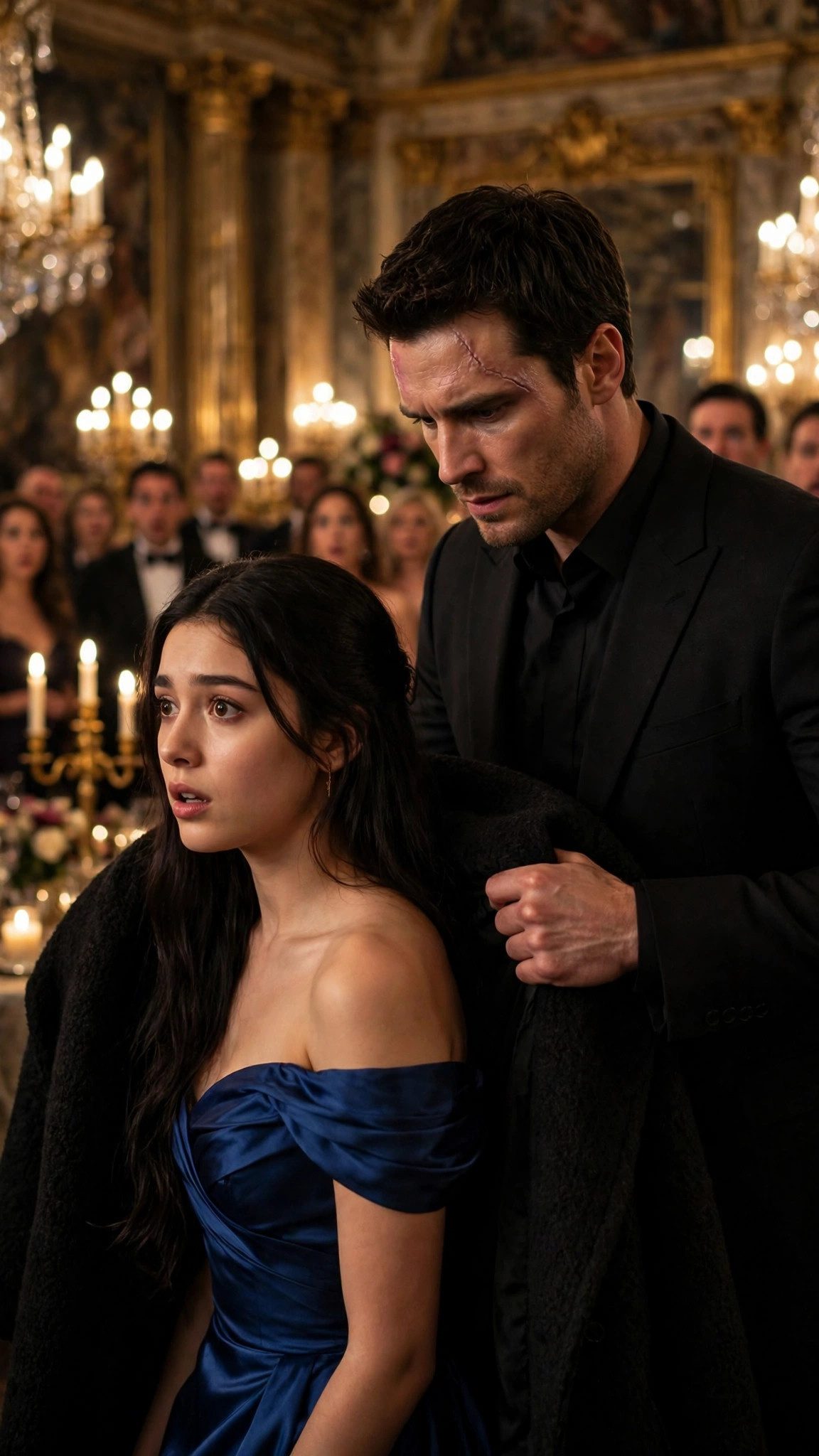
Nathaniel wore his black suit, and he had his coat over his arm, and when we walked into the ballroom, the whole room went quiet, the same way it had gone quiet two years before. Only this time, nobody was laughing. This time, people were smiling. This time, when the clock struck midnight, Nathaniel took my hand, and he led me to the center of the dance floor, and he draped his coat over my shoulders — the same coat, the same gesture, the same man — and he leaned down, close enough that only I could hear him, and he murmured, "Stand up and act like you're mine."
And I laughed, because this time, I was his. Not by contract. Not by pretense. By choice. My choice. And his.
"I am yours," I said. "And you are mine. For real this time."
He kissed my shoulder then — my left shoulder, the scarred one, the one no man had ever dared to touch — and his lips were warm against my skin, and I did not flinch, and I did not pull away, and I did not hide. I stood there, in the middle of the ballroom, in my sapphire dress, with the most feared man in the Pacific Northwest kissing my scars in front of everyone, and I thought about my mother, and the rule she had taught me, and I thought about how wrong she had been about one thing.
She had taught me never to give cruel people proof they reached the bone. She was right about that. But she had never told me what to do when a kind person reached the bone, and found it, and held it gently, and said, "This is beautiful. You are beautiful. All of you."
Nathaniel Mercer was the first man who dared to touch me. He was also the first man who ever saw me — all of me, scars and all — and stayed.
And as we danced, in the ballroom where I had once been humiliated, with three hundred people watching, I knew, with absolute certainty, that I would never again be the girl at table nineteen that nobody chose.
I was the woman Nathaniel Mercer chose. And I had chosen him back. And that was enough. That was everything.
The End.
THE END