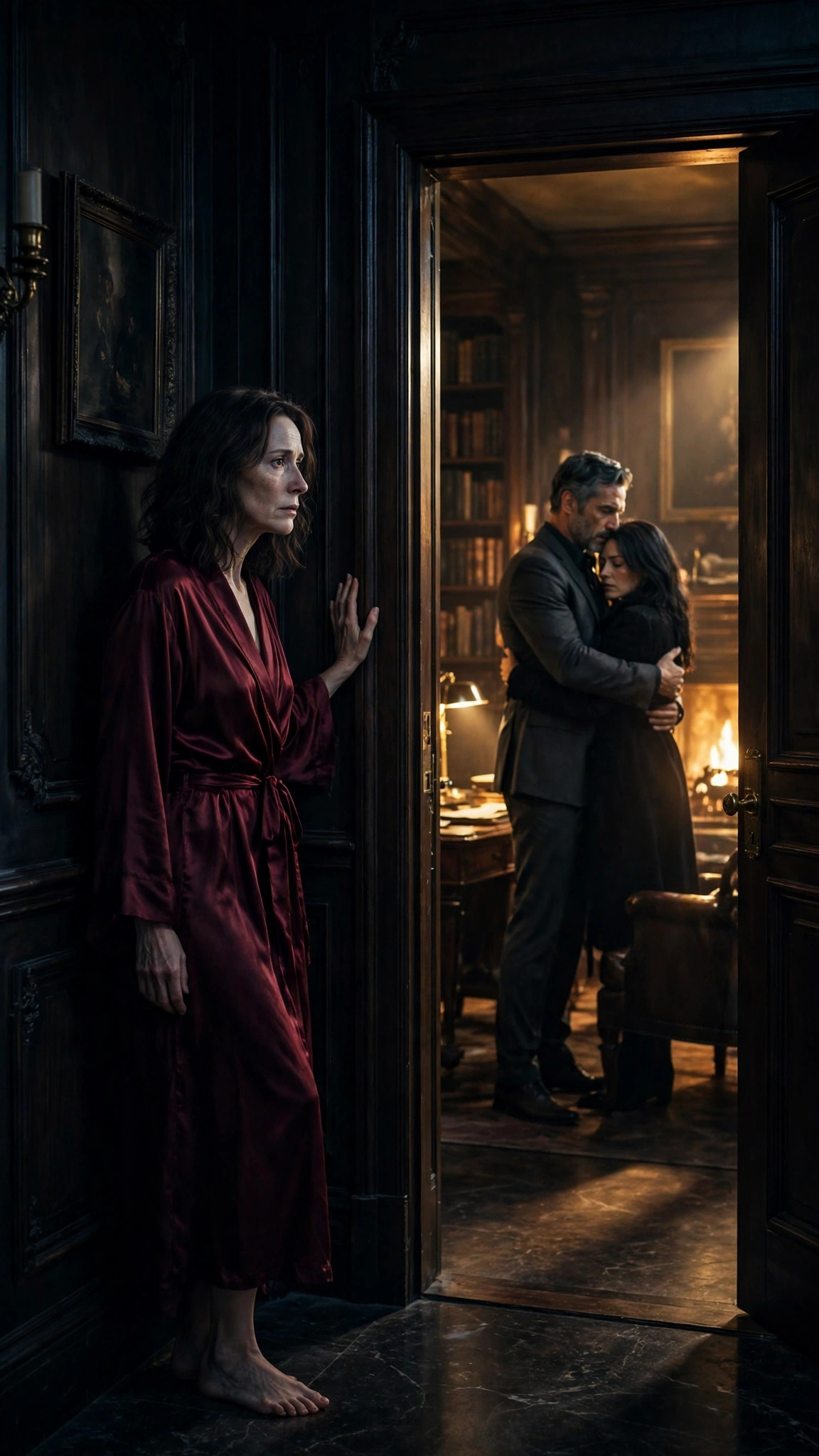
I went back the next morning.
Enzo drove me. He did not ask if I was sure. He simply opened the passenger door of the bakery truck, and I climbed in, and we drove through a Chicago morning that was grey and cold and ordinary, and the estate rose up in front of us the way it always had, walls and gates and cameras, and this time, when the truck rolled toward the eastern delivery gate, the gate did not open automatically.
A guard came out. He looked at me. He looked at Enzo. He spoke into his radio. And then the gate opened, slowly, and the truck rolled through, and I was inside the walls again, and the first thing I felt was not fear.
It was anger. Not at Adrian. At myself. Because I had walked out of this house believing I would never come back, and here I was, less than two days later, coming back through the same gate I had escaped through, and I did not know whether I was brave or foolish, and I was afraid it was both.
Adrian was in the study.
I found him there, sitting behind his desk, and he looked like a man who had not slept in two days. His shirt was unbuttoned at the collar. His hair was uncombed. There was a glass on the desk, untouched, and a stack of papers, and my wedding ring, sitting in the center of the desk like the smallest and heaviest thing in the world.
He looked up when I came in, and his face did something I had never seen it do before. It broke. Not dramatically. Not the way men break in films, with shouting and tears. Quietly. The way a wall breaks when the foundation shifts, one small crack at a time.
"You came back," he said.
"I came back for the truth," I said. "Not for you. For the truth."
He nodded, like a man who had expected exactly that answer. "Then I'll give it to you. All of it. Sit down, Claire."
I sat. He opened a drawer in his desk, and he took out a small key, and he went to the bookshelf, and he opened a panel I had never noticed, and behind it was a safe, and he opened the safe, and he took out a small black recorder.
"I record everything in this study," he said. "Every meeting. Every conversation. I told you that fifteen years ago, and you forgot, because it didn't matter then. It matters now."
He pressed play.
Elena's voice came out of the small speaker, frightened and fast. "Adrian, Vitale is going to strike at dawn. I got the warning an hour ago. His men are already moving. You have to be ready."
Adrian's voice, calm and low. "I am ready. I've been ready since you arrived. Tell me exactly what the message said."
And then Elena's voice again, softer, breaking. "Thank you. For taking me in. For keeping me safe. I don't know what I would have done—" And then silence. And then a sound I could not identify at first, a soft sound, close to the microphone. A kiss.
And then Adrian's voice, sharp and clear, holding her at a distance. "That was twenty years ago. My wife is upstairs."
Footsteps. A door opening. Elena's voice, small. "I'm sorry. I don't know why I did that."
Adrian's voice, at her door, low and final. "Elena, I will keep you safe, because I promised. But do not ever do that again."
The recording ended. The study was silent.
Adrian looked at me, and he said, "One second, Claire. That was the whole of it. One second, and then I ended it. I have spent two days asking myself whether one second is enough to lose fifteen years, and I still don't know the answer. But I know this: I never lied to you. Not once. Not ever. That was the deal, and I kept it."
I sat there for a long time, looking at the recorder, looking at my ring on the desk, looking at the man I had married across a bakery counter, and I thought about the eighteen hours I had spent believing I knew exactly what had happened in this room, and I thought about how easy it had been to write the ending of my marriage based on one second I had seen through a half-open door.
"You should have told me about the warning," I said finally. "You should have told me Vitale was coming at dawn. You should have told me Elena was in danger, not just from Vitale, but from the men who were coming to this house."
"I know," he said. "I thought I was protecting you. I thought that if you didn't know, you wouldn't be afraid. I was wrong. Secrets are just lies with better manners, and I promised you I would never lie to you."
Elena came to the study then. She stood in the doorway, her coat on, a small bag in her hand, and she looked at me, and her eyes were red, and she said, "I'm leaving tonight. Adrian's lawyer has arranged everything. I wanted to say goodbye, and I wanted to say I'm sorry, in person, not over the phone."
I stood up. I looked at her. The woman who had kissed my husband. The woman who had disabled the camera. The woman who had given me a door.
"Why did you disable the camera?" I asked.
"Because I saw you in the hallway," she said. "I saw your reflection in the glass, and I knew what you had seen, and I knew you would leave, and I knew that if the camera saw you, Adrian would stop you, and you deserved to leave on your own terms. I never had that. Twenty years ago, I left because I had no choice. I wanted you to have a choice."
"And the warning? Why didn't you tell me Vitale was coming?"
"Because Adrian swore me to secrecy," she said. "He said that if you knew, you would be in danger, and he said that the safest thing for you was not to know. He was wrong. I know that now. But he was trying to protect you. He has spent fifteen years trying to protect you, Claire. Sometimes he gets it wrong. But he has never once stopped trying."
She came to me, and she took my hand, and her hand was cold, and she said, "I loved him twenty years ago. I won't pretend I didn't. But I love you more, in a different way, because you are the woman he chose, and you are the woman who opened her door to me when I had nowhere else to go, and I will spend the rest of my life being grateful for that."
Then she left, and the study was quiet, and Adrian and I were alone, and the ring was still sitting on the desk between us.
I picked it up. I held it in my hand. It was heavy, the way it had always been heavy, and I looked at Adrian, and I said the words I had been rehearsing since the phone call, the words I had practiced in Sofia's flat and in the bakery truck and in the back of Enzo's truck, the words that were the only honest thing I had left.
"I'm not putting this back on yet," I said. "Not today. Not until I know who we are now."
"Then tell me who we need to be," Adrian said. "Tell me what you need, Claire. I'll give it to you. Whatever it is."
"I need the truth," I said. "All of it, all the time. No more secrets. No more closed study doors. No more warnings you don't tell me about. If this house is going to be a battlefield, I want to know when the battle is coming."
"Done," he said.
"I need my own life back," I said. "Not the estate. Not the guards. Not the cameras. I want to open a bakery. My own bakery. In Pilsen, near Sofia. I want to knead dough at midnight and pull bread from the oven at two in the morning, and I want to be a woman who makes something with her hands, not a woman who waits inside walls."
"Done," he said. "I'll buy the building tomorrow."
"I need time," I said. "I need to sleep in the guest room tonight, not our bedroom. I need to decide, day by day, whether this marriage is something I still want, or something I already left. And I need you to let me decide it. No pressure. No waiting outside my door. No grand gestures. Just time."
He was quiet for a long moment. Then he said, "Done. All of it. Every word."
Before I went upstairs, Adrian told me the rest of it, because he had promised me the truth, all of it, all the time, and he was keeping the promise in the only way he knew how: by saying the things that were hardest to say.
"Nico is in custody," he said. "He's in the security room downstairs, under guard. Tomorrow morning, my lawyer is handing him to the FBI, along with the Russo ledger. Nico talked, Claire. He told us everything. Vitale paid him two hundred thousand dollars, and he promised Nico's family would be safe, and he promised him a new life in Florida. Nico believed him, because Nico is a man who has spent ten years guarding other people's gates and never once asked who was paying him to do it."
"What happens to him?" I asked.
"He goes to prison," Adrian said. "And his family goes into protection, because I promised him that, and I keep my promises, even to men who betray me. Especially to men who betray me, because a man who breaks his word to a traitor is a man whose word means nothing."
"And Vitale?"
"The ledger goes to the FBI tomorrow morning," Adrian said. "Elena's ledger. The accounts. The names. The dates. Everything Vitale has done for six years, written down in her handwriting. He'll be arrested within the week. His organization will fall apart without him. The docks will be safe. The gala will go ahead, and Elena won't be there, because she'll be gone, and that's the way it has to be."
He stood up, and he went to the window, and he looked out at the garden, at the walls, at the cameras, and he said, "I've changed the codes, Claire. All of them. The security panel, the gates, the cameras. Only you and I will have them now. No one else. Not Nico's replacement. Not the guards. Just us. And I've ordered the eastern camera replaced, and the new one will be wired directly to my phone and yours, so that if it ever goes dark again, we'll both know in the same second."
I looked at him, standing at the window in his unbuttoned shirt, looking out at the fortress he had built, and I thought about the man I had married across a bakery counter, and I thought about the king he had become, and I thought about the fact that, for the first time in fifteen years, he was asking me to help him guard the walls, instead of guarding me behind them.
"That's a start," I said.
He turned, and he looked at me, and he said, "Claire, I know a recording doesn't fix what you saw. I know that one second doesn't disappear because I can prove what happened after it. You saw me kiss another woman, and no recording in the world changes what your eyes told you. But I need you to know that I ended it. I ended it in one second, and I have spent two days trying to find the words to tell you that, and the only words I have are these: I chose you. Fifteen years ago, I chose you. Last night, I chose you. Today, I choose you. And tomorrow, if you let me, I will choose you again."
I put the ring in my pocket, not on my finger, and I went upstairs to the guest room, and I closed the door, and I sat on the edge of the bed, and I listened to the house.
That night, in the guest room, I could not sleep. The bed was strange. The room was strange. The house was strange, even though I had lived in it for fifteen years, because I was seeing it through new eyes, and new eyes notice everything: the crack in the ceiling I had never seen, the way the moonlight fell across the floor in a shape like a door, the sound of the guards changing positions outside, steady and rhythmic, like a heartbeat.
There was a knock on the door, soft, and Rosa came in with a tray, tea and bread, the way she had come to my room a hundred times before, and she set the tray down on the small table by the window, and she sat on the edge of the bed, and she looked at me, and she did not ask how I was, because Rosa had never been a woman who asked questions she already knew the answer to.
"Forgiveness takes time, Claire," she said. "It is not a door you walk through once. It is a road you walk every day, and some days you walk it quickly, and some days you stop and sit down in the middle of it, and that is all right. The road doesn't mind. The road waits."
"I don't know if I can forgive him," I said. "I don't know if one second can be forgiven. I don't know if fifteen years can be rebuilt on a recording and a promise."
"You don't have to know tonight," Rosa said. "You only have to know what you need tomorrow morning. And tomorrow morning, you need bread, and coffee, and a bakery to build. The rest will come when it comes."
She poured the tea, and we drank it together in silence, and the house was quiet around us, and for the first time since I had come back, I felt something loosen in my chest, not forgiveness, not yet, but the beginning of it, the way a door opens a crack before you decide whether to walk through it.
The house was quiet. But it was a different kind of quiet than the silence I had fled from two days earlier. This quiet had a door in it. And the door was open.