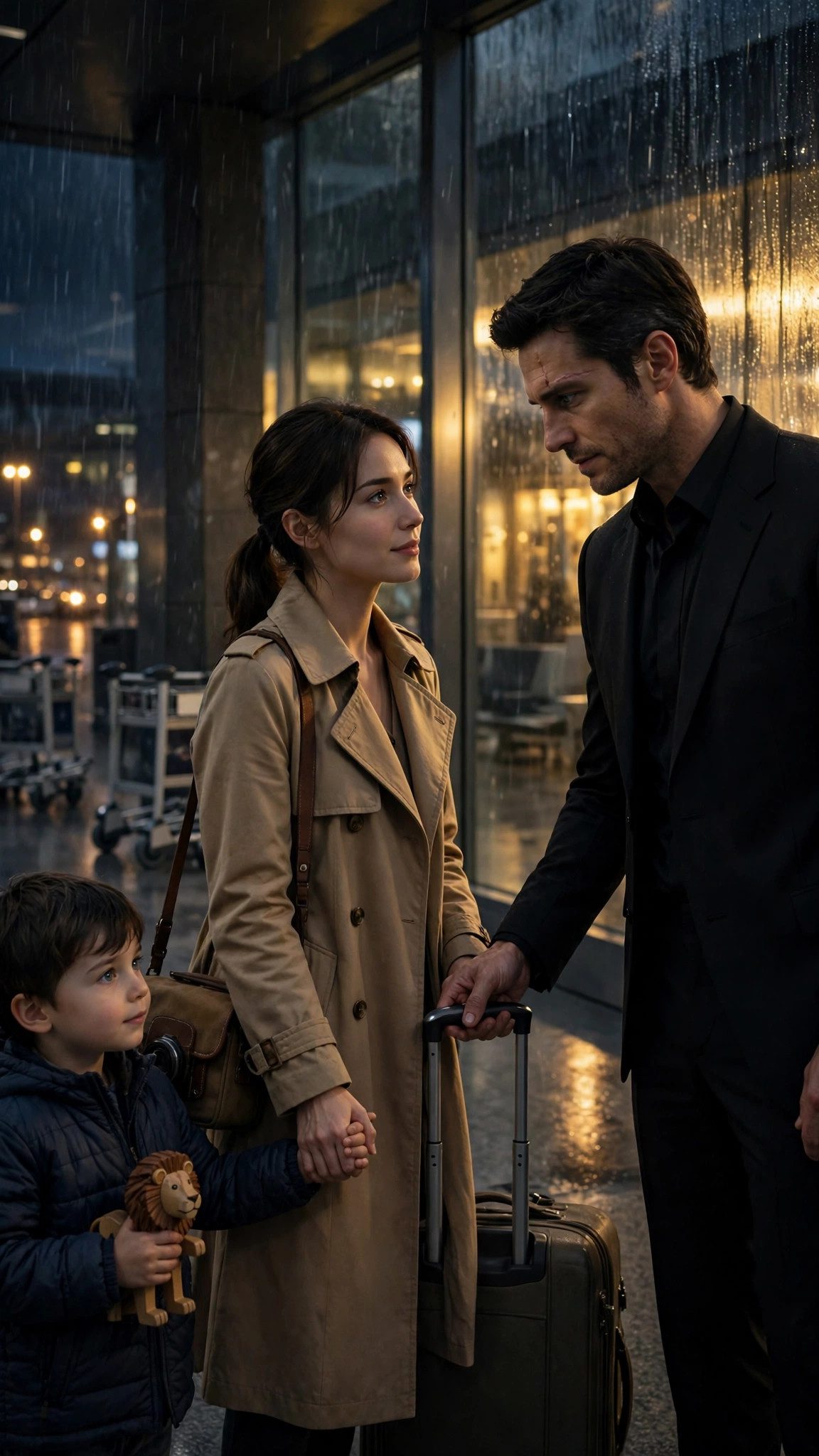
The first thing I saw when I stepped off the plane at O'Hare was Dante Moretti standing by the gate with my suitcase already in his hand, and for one wild second I thought the last three years had never happened.
It was June nineteenth, a warm night, and the airport smelled like jet fuel and rain. My flight from Geneva had landed late. I had Leo's hand in mine and my father's ashes in my carry-on, and I had rehearsed this arrival a hundred times in my head: I would walk fast, head down, get a cab, disappear into the city for five days, move my father's ashes to the family plot, and leave again before anyone who mattered even knew I was home. I had not rehearsed Dante.
He was leaning against the wall beside the gate in a black suit, no tie, his jacket open, his hands in his pockets like a man with all the time in the world. He looked older than I remembered and exactly the same. The same dark hair, a little more grey at the temples. The same grey eyes. The same scar through his left eyebrow that I had traced with my fingertip a hundred times in the dark. Three years had not softened him. If anything, Chicago had sharpened him.
Leo tugged at my hand. "Mama, who is that man?"
"Keep walking," I whispered, and I tried to walk straight past him.
Dante stepped forward and gently took my suitcase from my hand before I could stop him. His fingers brushed mine, and my whole body remembered him at once, which was unfair, because bodies are not supposed to remember what the mind has spent three years trying to forget.
"You don't run to say hello?" he asked.
I looked up at him. "Dante, I don't think you should be here."
He smiled, the slow smile that had always been the most dangerous thing about him. "We should probably talk. Let's catch up."
"I'm only here for five days," I said. "I'm here for my father."
"I know," he said. "I'm taking you to Sofia's restaurant."
Before I could refuse, he had already turned toward the exit with my suitcase, and Marco, his driver, was standing by the doors with the black car waiting, and Leo was staring up at Dante with wide, curious eyes, and I understood with a sinking feeling that Dante Moretti had not come to the airport by accident. He had come because he knew. He had always known everything, and I had been a fool to think three years and an ocean would change that.
The chauffeur drove us through the darkened streets of Chicago, and I kept hoping he would forget me and let the past stay where it belonged. Leo fell asleep against my shoulder halfway there, his small hand curled around my thumb, and I watched the city slide past the window, the lake on one side, the towers on the other, and I thought about how I had first come to this city as a girl of twenty-two with a camera around my neck and no idea what kind of man could ruin a life just by looking at it.
I was twenty-two when I met Dante Moretti. I was a banquet photographer, the girl with the camera at weddings and galas and charity dinners, the one people forgot was in the room until they saw the photographs later and wondered who had caught that exact moment. I had no mutual friends with him. There was no possibility of anything unfolding. He was the most powerful man in Chicago, and I was a girl who carried spare batteries in her pockets and ate dinner standing up in hotel kitchens.
It was a banquet at the Drake Hotel, a fundraiser for the children's hospital, and I had been hired to photograph the room. I remember the light that night, gold and low, coming through the tall windows, and the orchestra playing something soft, and the way the waiters moved between the tables like dancers. I remember lifting my camera and seeing him through the lens for the first time, standing alone near the bar, watching the room the way a wolf watches a field.
He was not dancing. He was not talking. He was watching, and when my lens found him, he looked straight into it, straight through it, straight at me, and I lowered the camera with my heart hammering because no one had ever looked at me like that before, like I was the only real thing in a room full of painted people.
He crossed the room to me. Later I would learn that Dante Moretti never crossed a room for anyone. That night he did.
"You're the photographer," he said.
"I am," I said, and my voice came out steadier than I felt. "Elena Carter."
"Dante Moretti," he said, and held out his hand, and when I took it his palm was warm and rough, a working man's hand in a tailored suit, and I thought, this man has scars, and I wanted to know every one of them before I knew his name.
"Don't photograph me," he said.
"Why not?" I asked.
"Because I don't like being seen," he said. "And you see too much."
I laughed before I could stop myself. "That's my job."
"Then do your job somewhere else tonight," he said, and there was no threat in it, only a kind of tired amusement, like a man who had spent his whole life being watched by people who wanted something from him and was briefly entertained by a girl who wanted nothing at all.
I photographed the room for the rest of the evening, and I did not photograph him, and at midnight, when the band was packing up and the waiters were stacking chairs, he was still there, standing by the bar with a glass of whiskey he had not drunk, watching me coil my cables.
"Let me drive you home," he said.
"I have a cab coming," I said.
"Cancel it," he said.
I should have said no. I was twenty-two, and I knew who he was. Everyone in Chicago knew who Dante Moretti was, even a banquet photographer who had only been in the city for a year. The newspapers called him a businessman. The whispers called him something else. My mother was still alive then, and she would have told me to run. But my mother had also taught me that a life without risk is just a long wait, and so I said yes, and he drove me home himself, no driver, no bodyguard, just Dante Moretti in a black car with the windows down and the lake wind coming in, and he asked me about my camera, and my work, and the photographs I loved, and he listened the way no one had ever listened to me, like every word I said mattered.
At my building he walked me to the door. He did not try to kiss me. He stood a careful distance away, his hands in his pockets, and said, "Good night, Elena Carter."
"Good night, Mr. Moretti," I said.
"Dante," he said.
He came to the next banquet. And the next. He never asked me to photograph him, and I never did, and after the third banquet he asked me to dinner, and after dinner he asked me to stay, and I stayed, and that was how it began, quietly, in a penthouse above the city with the lights spread out below us like a map of everything he owned, and for eight years he loved me behind closed doors.
Eight years. I knew how he took his coffee, black with one sugar, scalding hot, in a plain white mug, never a fancy cup. I knew which scars hurt during Chicago winters, the knife scar across his ribs that pulled when the cold came in off the lake, and the bullet scar on his left shoulder that ached so badly some January nights that he could not sleep on that side. I knew how quiet he became when something went wrong inside the Moretti organization, how he would stand at the window for hours without speaking, his jaw tight, his hands behind his back, and I knew not to ask, just to bring him coffee and sit nearby and wait until the quiet passed.
I knew the exact weight of his hand on the back of my neck. I knew the way he said my name when he was tired, low and soft, like a secret. I knew everything about him except the one thing I kept asking for, the one thing he would never give me.
"When are you going to stop treating me like a secret," I asked him once, on a rainy night in October, "and start showing the world you care about me?"
He looked at me for a long time, and I saw something move behind his eyes, something that might have been love and might have been fear, and he said, "I can't risk my Empire for you."
"Then what am I?" I asked.
"You're the part of my life that's mine," he said. "The only part."
It was not enough. It was never going to be enough. But I stayed, because when you are twenty-two and then twenty-five and then twenty-nine, and the most powerful man in Chicago looks at you like you are the only real thing in the room, leaving feels like dying, and I told myself that one day he would choose me, one day he would marry me, one day the doors would open and I would walk out of them beside him in the daylight.
Then the ivory invitation arrived.
It came in a cream envelope with gold edges, delivered by courier to my little apartment, and when I opened it I saw two names printed across it in elegant black script: Dante Moretti and Victoria Carter. My older sister.
My sister. The perfect one. The calm one. The one whose smile improved the numbers and whose touch made the family even more envied. The one who had always been the right daughter, the steady daughter, the one our father could present to the world without apology, while I was the reckless sister, the one with the camera and the late nights and the ribs that were always tattooed with other people's stories.
Victoria had entered the Moretti organization the way a queen enters a ballroom, and she completed the image. She was the flawless wife, and I was the scandal no one was allowed to name.
I did not go to the wedding. I watched it from the dressing room, because I could not stay away entirely, and I could not stand in the church and watch him promise himself to my sister. I stood in the little room off the vestry with my camera in my hands, useless for once, and I listened to the organ and the vows through the wall, and when it was over I walked out through the kitchens and into the rain and I did not stop walking until I was at the airport.
Dante stayed away from me for three years after that. Or I stayed away from him. It was hard to tell the difference. I took a job in Geneva, photographing conferences and weddings for people whose names I could not pronounce, and I told myself I was free, and then one morning in a little Swiss clinic, with snow on the windowsills and my heart hammering in my chest, a doctor told me I was pregnant, and I understood that I would never be free of him, and I would never tell him, because by then he was my sister's husband.
I raised Leo alone. It was harder than it looked. At night, I could see myself rocking him while his face grew up, and I wondered if Dante had noticed. I knew very little about my son, in the way a mother knows everything and nothing at once. He was itchy, always moving, always reaching. He was incredibly clever and tenacious, but also very spontaneous, the kind of child who would take apart a clock to see how it worked and then be genuinely surprised when it did not go back together. I had never told him where he came from. That was dangerous, because my almost-three-year-old son had my smile and my stubbornness, but everything else belonged to Dante. The dark hair. The grey eyes. The way he held his chin when he was thinking, exactly the way his father did.
And now here I was, back in Chicago for five days to move my father's ashes, sitting in the back of Dante Moretti's car with my sleeping son in my arms, driving through the darkened streets toward Sofia's restaurant, and Dante was watching me in the mirror, and I could feel his eyes on me the entire ride, and I knew he knew.
At Sofia's, he carried my suitcase inside like it weighed nothing, and Sofia herself came out of the kitchen, wiping her hands on her apron, and looked at me and then at Leo asleep in my arms, and her face did something complicated, and she said, "Elena. It's been a long time."
"Sofia," I said.
She led us to the corner table, the one by the window with the candle in the red glass, the table where Dante and I had eaten a hundred quiet dinners, and she brought bread and oil without being asked, and then she left us alone, and Dante poured the wine himself, and for a while neither of us spoke, because there are some silences that have been waiting three years to be broken, and neither of us knew how to break them gently.
Finally he set down his glass and looked at me, and his voice was low and careful, the voice of a man handling something explosive.
"Is he your son?" he asked.
My phone was on the table between us, and as if on cue it lit up with a text, and I glanced down and saw a message from a number I did not recognize, and my blood went cold, because the message said only: I know about the boy.
Dante saw my face change, and he leaned forward, and his eyes never left mine.
"You need to tell me," he said. "Tell me."
I knew he knew. I knew he had known before he ever came to the airport. And I also knew, with a sudden terrible clarity, that whatever he was about to say next would change everything, because the most feared Mafia boss in Chicago, the man who had never begged anyone for anything in his life, was sitting across from me with his hands flat on the table like a man holding himself down, and he was begging me for ten minutes.
Ten minutes. That was all he asked for. And I had no idea what he was about to confess.