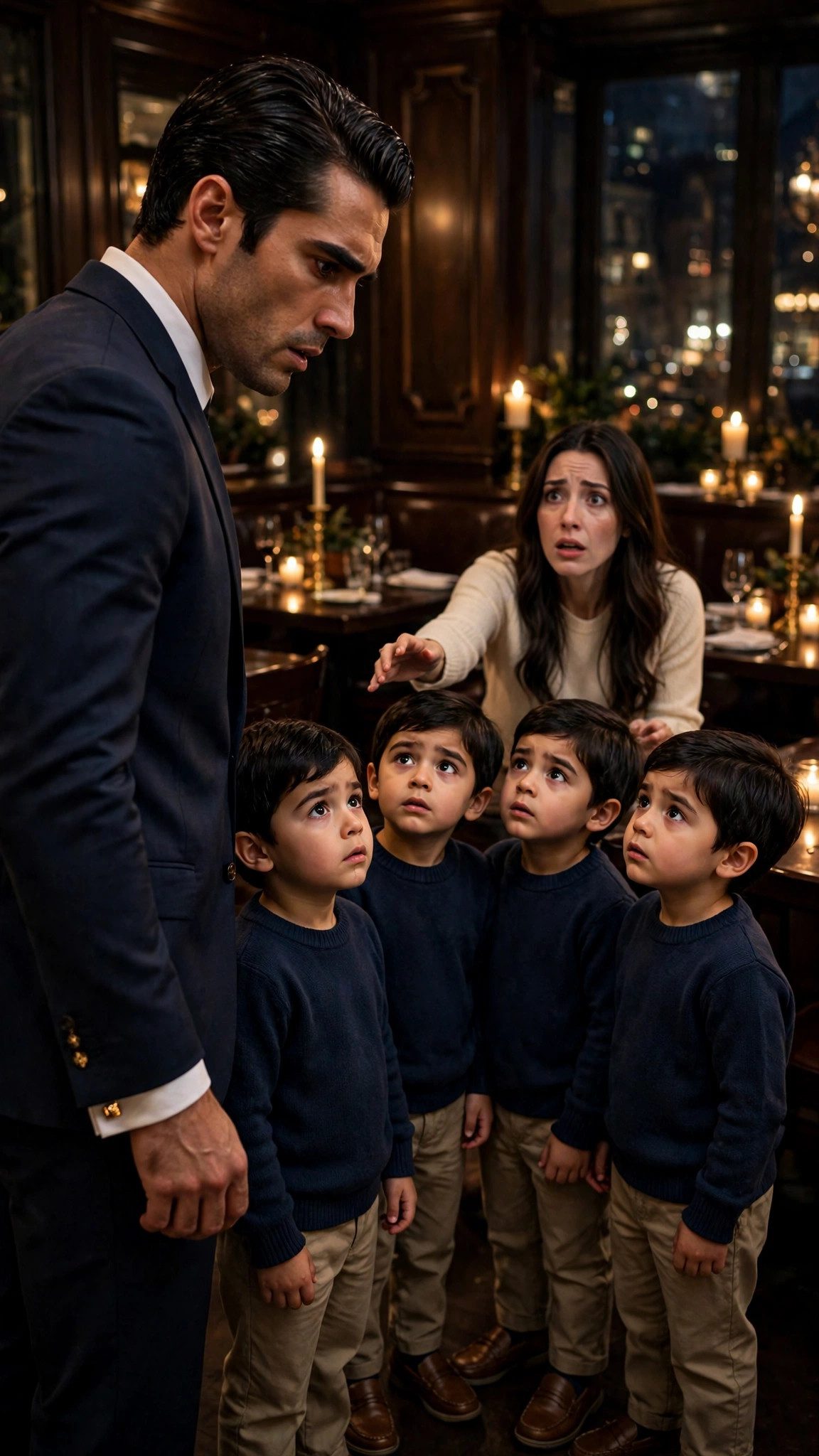
The DNA results came back in twenty-four hours, as Rocco had promised. Four envelopes, four names, four identical conclusions: 99.99 percent probability of paternity. I sat in my office with the envelopes spread out on my desk, and I read each one twice, and I thought about the fact that a laboratory in Cambridge could tell me in a single page what I had known from the first second in a restaurant bathroom.
They were mine. Matteo, Luca, Enzo, and Nico Moretti. My sons.
Rocco stood by the door, watching me. "What now, boss?" he asked.
"Now," I said, "we find out who has been watching them. And then we find out who drove their mother out of this city six years ago. And then, Rocco, we are going to have a very public conversation about it."
Rocco nodded slowly. "Doyle talked," he said. "The private investigator. My men picked him up last night. He didn't need much persuading. He's been following Miss Fontaine and the boys for two years, on a monthly retainer of four thousand dollars. The money comes through a shell company. But Doyle kept records, boss. He kept everything. Dates, times, photographs. And the name on the account that hired him."
"Tell me," I said.
"Sloane Barrett," Rocco said. "She hired him herself. Two years ago, right after she learned that Isabella had moved back to Providence from—" He stopped. "Boss, there's more. Doyle says Sloane didn't just want the boys watched. She wanted to know everything. Their school. Their doctor. Their routines. She asked him, more than once, whether it would be possible to make them disappear. Not hurt. Disappear. A boarding school in Europe. A new identity. Something clean."
The room went very quiet. I looked at the four envelopes on my desk, at the names of my sons typed in neat black letters, and I felt something cold and precise settle over me. It was the feeling I got before I did something that could not be undone.
"And my father?" I asked. "What did Doyle say about my father?"
"Nothing," Rocco said. "Doyle never dealt with your father. But boss, I looked into something else. The money for Rosa Fontaine's surgery, six years ago. It came from a private foundation. The foundation is controlled by the Barrett family."
I closed my eyes. The pieces were falling into place, and every one of them had Sloane Barrett's fingerprints on it. She had not simply benefited from Isabella's departure. She had helped arrange it. She had been the one who told my father about Isabella in the first place. She had been the one who made sure the threat was delivered, and the money was paid, and the door was closed behind her.
"There's one more thing," Rocco said, and he put a folder on my desk. "Isabella kept something. A note. She gave it to me this morning, when I went to talk to her. She said she kept it for six years because she was afraid of it, and then she kept it because she was angry, and now she wants you to have it."
I opened the folder. Inside was a single sheet of paper, yellowed at the edges, with a handwritten note in elegant, looping handwriting.
"Leave tonight and never come back. He was never yours. — S."
I knew that handwriting. I had seen it a hundred times: on place cards, on thank-you notes, on the invitations Sloane sent out for her charity galas. Elegant. Looping. Certain.
Sloane Barrett had gone to Isabella's apartment six years ago. She had stood in the same hallway where Frankie Lombardo had stood, and she had delivered her own message, in her own hand. She had looked a frightened young nurse in the eye and told her that the man she loved was never hers.
And then she had spent six years waiting for her prize, and two years paying a man to watch four little boys, and asking whether they could be made to disappear.
I stood up. I put the note in my pocket, next to my heart, and I looked at Rocco.
"Is the conservatory still booked for Saturday?" I asked.
"Your father kept the booking," Rocco said. "He said the families still expect an announcement."
"Good," I said. "Then we're going to give them one."
On Saturday morning, Isabella stood in front of the mirror in her small bedroom and stared at the dark blue dress hanging on the door, and she thought about not going.
She had laid the dress out the night before, after Rocco had explained the plan: walk in, stand beside Dominic, let the room see four little boys with his face, and say the words she had rehearsed a hundred times in her head. It had sounded simple when Rocco said it. Standing in front of the mirror, it sounded like the most terrifying thing she had ever done.
"What if they laugh at me?" she said to her mother, who was sitting on the bed, watching her with the calm eyes of a woman who had survived far worse rooms than a conservatory full of rich people.
"Let them laugh," Rosa said. "You survived six years alone with four babies, my love. You survived a bus to Providence and a motel room and a doctor telling you to be brave. A room full of people in expensive clothes is nothing. You walk in there, and you hold your head high, and you let them see what a mother looks like."
"But the boys," Isabella said. "What if they get frightened? What if someone says something cruel in front of them?"
"Then their father will be standing right there," Rosa said. "And their nonno will be standing right there. And I will be standing right there. You are not walking into that room alone, Isabella. Not this time. Not ever again."
Downstairs, Rocco was waiting in the car, and beside him sat Ray Doyle, the private investigator, pale and sweating in a suit that did not fit him, holding his folder of records like a shield.
"Are you sure about this, Mr. Doyle?" Rocco asked him, not unkindly.
"I've never been sure about anything," Doyle said. "But I've kept every receipt, every photograph, every bank statement for two years, and I know what I saw. She paid me to watch children, Mr. Rocco. Children. I told myself it was just surveillance. I told myself nobody was getting hurt. But I knew. I always knew. So yes. I'm sure. I'll tell them everything."
My father called me that morning, too. His voice on the phone was careful, measured, the voice of a man walking across thin ice.
"Dominic," he said. "Whatever you are planning tonight, I want you to know something. I was wrong six years ago. I have known it for six years, and I have said nothing, because saying it would mean admitting what I did. But I am saying it now. I was wrong. And tonight, whatever happens in that room, I will stand beside you. Not behind you. Beside you."
"Thank you, Father," I said, and I meant it. It was not forgiveness. Forgiveness would take time. But it was a beginning.
On Saturday evening, the conservatory was full. My father stood by the glass wall, talking to Sloane's father in low voices. Sloane stood near the string quartet in a white dress, beautiful and composed, as if the last three days had never happened, as if I had never called off the engagement over the phone. Her mother was showing photographs to my father's friends. Waiters moved through the room with trays of champagne. Everyone was smiling. Everyone was pretending.
I walked in with Rocco at my side, and the room went quiet in waves, the way a room does when the guest of honor arrives late and wrong. Sloane came toward me, her smile fixed in place.
"Dominic," she said. "You're here. I knew you'd come to your senses."
"I came to make an announcement," I said, loudly enough for the whole room to hear. "But it's not the one you're expecting."
My father stepped forward. "Dominic," he said warningly. "Not here. Not like this."
"Yes, here," I said. "And yes, like this. Because what happened six years ago happened in the dark, and it's time it happened in the light."
I turned to the room. Fifty people. Two families. A string quartet. A glass roof full of stars.
"Six years ago," I said, "a woman named Isabella Fontaine loved me. She was a nurse. She was kind, and brave, and she believed that love was enough. My father disagreed. He sent a man to her apartment to threaten her mother. He paid for her mother's surgery in exchange for her silence. And he told her that if she ever came back, the arrangement would end."
The room was so quiet I could hear the ice melting in someone's glass.
"But my father wasn't the only one who went to her apartment that night," I said, and I took the note from my pocket and held it up. "Someone else came too. Someone who wrote her a note in her own handwriting. Someone who told her to leave tonight and never come back. Someone who told her that I was never hers."
I looked at Sloane. Her face had gone white under her makeup, but her smile was still there, stretched thin and terrible.
"Would you like to read it, Sloane?" I asked. "Or should I read it for you?"
"Dominic, this is absurd," she said, her voice steady, her hands steady, everything about her steady except her eyes. "You can't possibly believe—"
"I believe evidence," I said. "And I have more. For two years, you paid a private investigator named Ray Doyle four thousand dollars a month to follow Isabella Fontaine and her four children. Her four children, Sloane. My four sons. You had their school photographed. You had their doctor's office watched. And you asked Doyle, more than once, whether it would be possible to make them disappear."
A gasp went through the room. Sloane's mother put a hand to her mouth. Her father took a step forward, his face darkening.
"That's a lie," Sloane said. "That man is a liar. He'll say anything for money."
"Then you'll be happy to know," I said, "that Mr. Doyle is waiting in the next room, with his records, his photographs, and his bank statements. And he's very eager to talk to anyone who wants to listen."
I turned to the door and nodded at Rocco. He opened it, and Ray Doyle walked in: a thin, nervous man in a cheap suit, carrying a folder thick with paper. He looked at Sloane, and he looked at me, and he said, "I'll tell you everything. I kept it all."
Sloane's composure finally broke. It did not break loudly. It broke the way ice breaks on a river in spring: silently, and all at once, and with a sound like the world ending.
"You don't understand," she said, and her voice was shaking now, really shaking, for the first time since I had known her. "You don't understand what your family is. What this life costs. I did what I had to do. I did what your father wanted. I did what anyone in my position would have done. She was a nurse, Dominic. A nobody. And you were going to throw away everything—everything your family built—for her."
"She is not a nobody," I said. "She is the mother of my sons. And you are not a fiancée. You are a woman who tried to erase four children from the world because they were inconvenient to your plans."
Then the door opened again, and Isabella walked in.
She was wearing a simple dark blue dress, and her hair was down around her shoulders, and she was holding Matteo's hand on one side and Luca's on the other, with Enzo and Nico just behind her. She walked across the conservatory floor with her head high, and four little boys in matching navy sweaters walked with her, and every person in the room turned to look at them, and I heard someone whisper, "They look just like him," and someone else whisper, "My God, there are four of them."
Isabella stopped in front of Sloane. She looked at the woman who had tried to erase her, and her voice, when she spoke, was calm and clear and carried to every corner of the room.
"You told me he was never mine," she said. "You were wrong. He was never yours. He was mine from the first night he walked into my clinic with blood on his hands and a lie on his lips, and he has been mine every day since, even when I was a thousand miles away. You can buy a threat. You can buy a private investigator. You can buy a surgeon. But you cannot buy a man's heart, Sloane. And you cannot buy his children."
Sloane stared at her. For a long moment, neither woman moved. Then Sloane did something I did not expect. She laughed. It was a small, bitter sound, like glass breaking far away.
"You think you've won," she said. "You think this is a victory. But you have no idea what you've just done. The Castellanos—"
"Will be dealt with," I said. "Starting tonight. Starting with you."
Rocco stepped forward and took Sloane gently by the arm. Her father started to protest, and my father held up a hand, and the room went still.
"Dominic," my father said, and his voice was old and tired in a way I had never heard before. "I'm sorry. I was wrong. I thought I was protecting you. I thought I was protecting the family. I was wrong about all of it."
I looked at my father, at the man who had built an empire and broken a young nurse's heart to protect it, and I felt the anger drain out of me, replaced by something heavier and sadder.
"Then help me fix it," I said.
He nodded. He looked at Isabella, and at the four boys, and his eyes filled with tears.
"They have your mother's eyes," he whispered. "All four of them."
And in that moment, under the glass roof where I was supposed to propose to the wrong woman, the woman I loved exposed my fiancée in front of two families, and the truth finally came out into the light where it belonged.