The family met on a Thursday night, in a private room at a restaurant on the river — the same restaurant, I realized when I walked in, where Alexander had eaten dinner on the night my father was shot. The room was wood-paneled and quiet, with a long table and candles, and twelve men sat around it, old and young, in dark suits, their faces closed and unreadable.
Frank DeLuca sat at the head of the table. Alexander sat at the far end, alone, in a black suit, his hands folded in front of him. He looked older than I had ever seen him — older, and smaller, as if the last four days had taken something out of him that could not be put back.
I sat in a chair by the door, where Frank had placed me — not at the table, but not outside it either. A witness. A daughter. A creditor.
Frank stood. "We are here," he said, "because an oath was broken. Eighteen years ago, in a hospital room, Alexander Moretti swore, on his mother's grave and before God, that the daughter of Robert Hayes would live a life of honor and protection. Robert Hayes saved Alexander's life. He took a bullet that was meant for Alexander, and it damaged his heart, and it killed him, eighteen years later, in an intensive care unit at St. Mary's Hospital."
He paused, and the room was silent.
"Alexander married Robert's daughter," Frank said. "And for twelve years, he treated her as a debt, not a wife. He gave the ring of his mother — the ring that belongs to the wife of the head of this family — to his assistant. He sent his wife twenty-five dollars while her father was dying. He threatened to cut off her father's hospital money in front of three hundred people, not knowing the man was already dead. And his assistant — the woman he trusted — was feeding information to Vincent Castellano, the man who ordered the shooting that put a bullet in Robert Hayes's chest."
He looked around the table. "This family was built on honor. On debts paid and oaths kept. What Alexander did was not honor. It was the opposite of honor."
One by one, the men at the table nodded. Old men, young men, men I did not know — they nodded, slowly, the way men nod when they have heard something they cannot unhear.
Frank turned to Alexander. "Do you deny any of it?"
Alexander was silent for a long moment. Then he stood up, slowly, and he looked at me — across the long table, across twelve years, across the whole of our marriage — and he said, very quietly, "No. I deny none of it. It is all true."
The room held its breath.
"I have spent twelve years," Alexander said, "telling myself that I honored my debt by marrying Emma. I told myself that a palace and a pension and a name were enough. I told myself that she was safe, and that safety was the same as honor. I was wrong. I was wrong about all of it."
He walked around the table, slowly, until he was standing in front of me. And then, in front of twelve men, in front of Frank DeLuca, in front of the whole of his world — Alexander Moretti, the most feared man in Chicago, went down on one knee.
"I broke my oath," he said. "I broke it every day for twelve years, and I did not even see it. I gave your ring to another woman. I sent you twenty-five dollars while your father died. I threatened you in front of three hundred people. I am not asking you to forgive me, Emma. I am asking you to let me try to earn it."
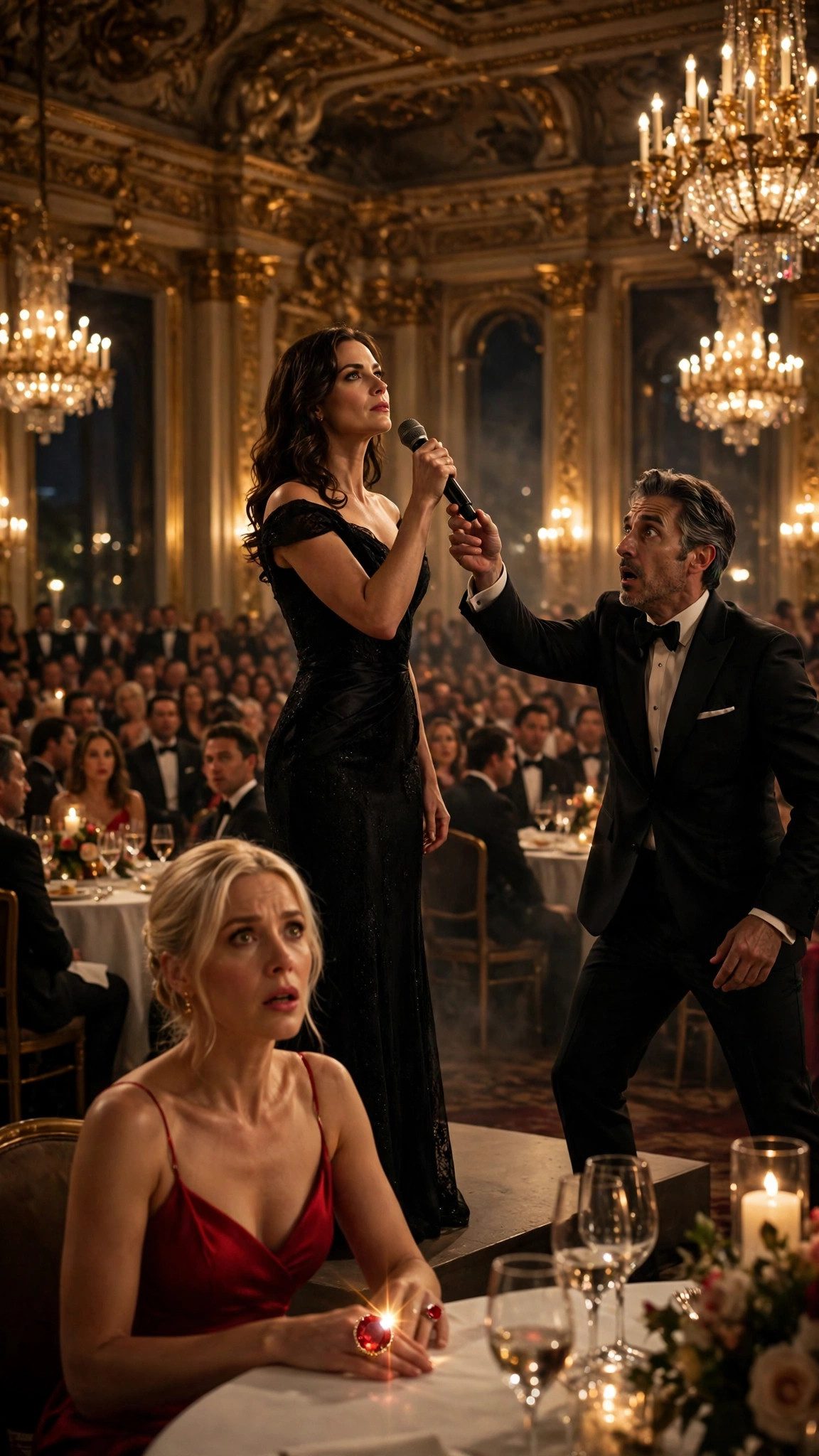
He reached into his jacket, and he took out a small velvet box, and he opened it. Inside was the ruby ring — the Moretti matriarch's ring, the ring that had been passed from mother to wife for four generations, the ring that belonged to the wife of the head of this family. It was clean. It had been taken from Vivian Cross that morning, and it had been polished, and it caught the candlelight, red as blood, red as a promise.
"I gave this ring to the wrong woman," Alexander said. "I am giving it to the right one. Not because you are my wife. Not because of a debt. Because you are Emma Hayes, and you stood in front of three hundred people and told the truth, and you are the bravest person I have ever known. I am asking you — not telling you, asking you — to stay. To stay, and to let me learn how to be a husband. To let me learn how to be a man your father would be proud to have saved."
I looked at the ring. I looked at Alexander, on his knee in front of me, his eyes wet, his hands shaking. I looked at Frank DeLuca, who nodded, very slightly. I looked at the twelve men around the table, who watched me in silence.
And I thought about my father, in the ICU, breathing through a tube. I thought about my mother, crying in our kitchen. I thought about the bullet, and the debt, and the twenty-five dollars, and the twelve years. I thought about the woman I had been at twenty, who had not been given a choice. And I thought about the woman I was now, thirty-two years old, with a letter in her purse and a room full of powerful men waiting to hear what she would say.
I took the ring out of the box, and I held it in my hand, and I said, "I will stay, Alexander. But not as your debt. Not as your receipt. I will stay as your wife — if you can learn what that word means. And I will stay on my terms. I will keep my job. I will keep my name — Emma Hayes Moretti, both names, because I am my father's daughter before I am anyone's wife. And you will visit my father's grave with me, every year, on the day he died, and you will tell him yourself that you have kept your oath. Those are my terms."
Alexander nodded, tears on his face, the most feared man in Chicago crying in front of twelve men, and he said, "I accept. All of it. Every word."
I slipped the ring onto my finger. It fit. It had always fit — it had only ever been waiting for the right hand.
Frank DeLuca stood, and he raised his glass, and he said, "To Robert Hayes. A good man. A brave man. A man whose daughter has more courage than any of us."
And the twelve men raised their glasses, and they drank, and the room that had been so quiet was quiet no longer — it was full of voices, and of relief, and of something I had not heard in a long time.
It was full of respect.
But the marriage did not become mine in a single night, in a single room, in front of twelve men. It became mine slowly, in the months that followed — in small things, in ordinary things, in the thousand tiny choices that make a marriage real.
Alexander came to my office, for the first time, three weeks after the family meeting. He did not send a car. He did not call ahead. He walked into the small accounting firm downtown, past the receptionist, past my colleagues staring at him in his dark suit, and he stood in the doorway of my little office, holding a paper bag, and he said, "I brought lunch. Mrs. Okafor's lemon cake. I remembered you liked it."
My colleagues stared. I stared. Alexander Moretti, the most feared man in Chicago, standing in my office with a paper bag, looking nervous — actually nervous, like a schoolboy on his first date.
"I also," he said, clearing his throat, "wanted to ask you something. About the bakery on the corner. Their books. I thought — if you have time — you might explain to me how you balance them. I have never understood accounting. I have always had other people do it for me."
I laughed. I could not help it. I laughed, and he laughed, a little, and we sat in my office and ate lemon cake, and I explained debits and credits to the most feared man in Chicago, and for the first time in twelve years, we talked — really talked — like two people who were curious about each other.
He came back the next week. And the week after that. He learned the names of my colleagues. He learned that Mrs. Okafor's dance studio needed a new roof, and he paid for it — anonymously, through a foundation, because he had finally learned that generosity does not need a signature. He learned to cook — badly, at first, burning everything, setting off the smoke alarm in the palace kitchen twice, until Rosa took pity on him and taught him to make my mother's soup, the soup I had brought my father in a bowl with both hands when I was fourteen.
He gave me a study of my own, in the palace — a real study, with a desk and a window looking out over the lake, where I could work, where I could be alone, where I could be myself. He planted a garden for my mother, with the flowers she had loved — white lilies, and roses, and lavender — and he tended it himself, on Sunday mornings, in old clothes, with dirt on his hands, because he said a garden planted by someone else was not a gift.
And he visited my father's grave with me, every month, on the day he died, and he stood there, in the rain or the sun, and he told my father, in a low voice, what he had done that month to keep his oath — the roof for the dance studio, the foundation for the children's hospital, the men he had refused to hurt, the deals he had walked away from because they were not honorable.
Six months after the family meeting, I found out I was pregnant.
I was sitting in my study, in the palace, looking out over the lake, when the doctor called, and I sat very still for a long time, with the phone in my hand, and I thought about my father, and my mother, and the bullet, and the debt, and the ring, and the long road from a rainy street in Chicago to this quiet room by the water.
I told Alexander that night, over dinner — a dinner he had cooked himself, badly, but with love — and he put down his fork, and he stared at me, and then he laughed, and then he cried, and then he came around the table and he knelt beside my chair, and he put his hand on my stomach, very gently, as if he were afraid to break something precious, and he said, "A daughter. I hope it is a daughter. A daughter like you."
"It is a daughter," I said. "The doctors told me."
He pressed his forehead to my stomach, and he whispered, "Hello, little one. I am your father. I am going to be a better father than I was a husband, I swear it. I am going to learn. I am going to learn every day."
One year later, on a cold October morning, Alexander and I stood at my father's grave together. The rain had stopped, and the sky was clear, and the lake was blue in the distance. I placed a bouquet of white lilies on the stone, and Alexander placed his hand on the stone, and he said, very quietly, "Robert, I have kept my oath. Your daughter is honored. Your daughter is protected. Your daughter is loved. I swear it again, on my mother's grave, and I will keep it this time."
I stood beside him, with his hand in mine, and with our child growing inside me — a daughter, the doctors said, a girl who would one day hear the story of her grandfather, the driver who took a bullet for a man he barely knew, and who would know that courage is not the absence of fear, but the decision to speak when silence would be easier.
I took the twenty-five-dollar bill out of my purse — the bill I had taken back from the stage that night, the bill Alexander had sent me while my father died — and I folded it, carefully, and I placed it under the lilies on my father's grave.
"Keep it, Papa," I whispered. "It is the price of a marriage that was never worth what you paid for it. But the marriage I have now — the marriage I chose — that one is worth more than twenty-five dollars. That one is worth everything."
Alexander put his arm around me, and we stood there together, in the clear October morning, a husband and a wife, a family, and I thought about my mother, and my father, and the bullet, and the debt, and the ring, and the long road from a rainy street in Chicago to this quiet place by the lake.
And I thought: the debt is paid. The oath is kept. The marriage is mine.
We were married a second time, six months later — not in a church, not in front of three hundred people, but in the garden Alexander had planted for my mother, with white lilies and roses and lavender all around us, and only Rosa and Frank DeLuca and Mrs. Okafor as witnesses. There was no palace. There was no orchestra. There was only a man and a woman, standing in a garden, making promises they meant.
Alexander held my hands, and he said, "Emma Hayes Moretti, I promise you this: I will never again measure you in money. I will never again make you a debt, or a receipt, or a silence. I will ask you what you want, and I will listen to the answer, and I will spend the rest of my life earning the right to hear it."
And I said, "Alexander Moretti, I promise you this: I will stay, not because I owe you, but because I choose you. And I will tell you the truth, even when it is hard, especially when it is hard, because the truth is the only thing that ever set me free."
Frank DeLuca cried. Rosa cried. Mrs. Okafor cried, and then she went home and baked us a lemon cake, and we ate it in the garden, under the trees, with dirt on our hands and the sun on our faces, and it was the best wedding I have ever had.
Because this time, I chose it.
The End.
THE END