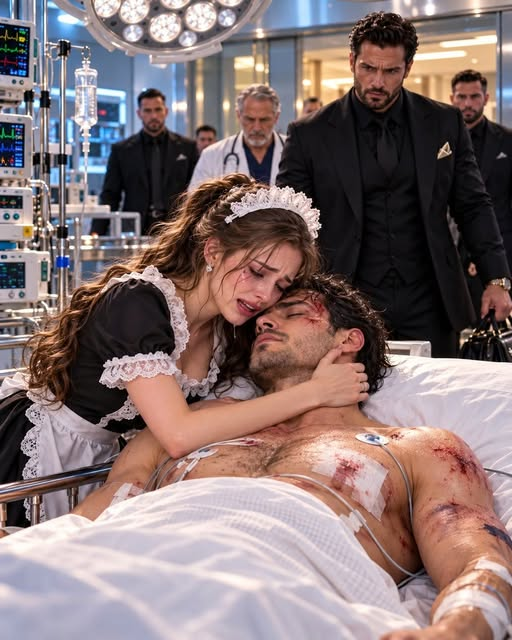
At 11:42 P.M., every doctor in the room declared Chicago's most feared mafia boss dead and covered his face with a white sheet. By midnight, his own men were already fighting over his billion-dollar empire, and the hospital staff had abandoned his body on a freezing steel table. But at two in the morning, I slipped into the medical wing, climbed onto that table, and wrapped my arms around him — never imagining that what I heard beneath his chest hours later could get us both killed.
My name is Matilda Higgins. I'm twenty-six years old, and I worked as a maid in the mansion of Gabriel Falcone, one of Chicago's most powerful and dangerous mafia bosses.
I wasn't wealthy. I wasn't important. I was just a young woman who cleaned rooms, washed expensive sheets, and tried to stay invisible around dangerous men.
I had come to that house with one suitcase, two spare uniforms, and a promise to myself that I would keep my head down, save every dollar I could, and never, ever be noticed by the men who decided whether other people lived comfortably, lived afraid, or did not live at all. Invisibility, in a house like that, was not cowardice. It was a skill. You learned which corridor to take when voices rose behind a closed door. You learned to polish a table while two men discussed money that could buy a street, and to act as if you had heard nothing but the cloth moving over wood. You learned to smile politely, to curtsy in the old-fashioned way Mrs. Alvarez, the housekeeper, insisted on, and to disappear before anyone remembered you had a face, a name, or ears.
Most of the household staff treated me as though I didn't belong. Perhaps they were right. I had not been born into service the way some of them had, following mothers and aunts into great houses. I had taken the job because the pay was steady, because the advertisement had said room and board included, and because after my father died I discovered how quickly rent and grief could empty a bank account. The other servants gave me the hardest jobs — the fireplaces black with soot in winter, the guest bathrooms after parties that lasted until dawn, the linen that had to be ironed until it felt like paper between your fingers. Some guards laughed whenever I made a mistake. And Gabriel's underboss, Carmine, seemed to enjoy humiliating me.
Carmine was a handsome man in the way a knife is handsome: polished, expensive, and happiest when someone was afraid of being cut. He had dark hair slicked back from his forehead, a smile that never warmed his eyes, and a habit of standing too close when he gave an order, as if his height were part of the instruction. He called me "mouse" when Gabriel was not in the room. "Hurry, mouse. Quiet, mouse. Don't drop anything, mouse." The others laughed because it was safer to laugh with Carmine than to be remembered by him for not laughing.
One afternoon, Carmine deliberately stuck out his foot as I carried a tray of crystal glasses.
I fell.
Every glass shattered.
The room erupted in laughter.
I remember the sound first — crystal does not break like ordinary glass. It sings, high and bright, even as it dies. Then I remember the pain in my knees, the wet shock of water and lemon slices soaking through my apron, and a thin line of blood opening across my palm where I had tried, stupidly, to catch myself on the wreckage. I remember Carmine's shoe, black and shining, still extended. I remember knowing, with absolute certainty, that if I cried, I would be called clumsy and dramatic in the same breath, and if I accused him, no one would back me.
Except for one person.
Gabriel Falcone.
He rose from his chair and looked directly at Carmine.
"Apologize to her."
Carmine laughed nervously. "Boss, she's just a maid."
Gabriel's expression turned ice-cold. "I didn't ask what she does. I told you to apologize."
Nobody laughed after that.
Carmine apologized. The words were stiff and ugly in his mouth — "Sorry, Matilda" — and he did not mean a syllable of them, but he said them in front of captains and guards and two men who poured wine for a living and pretended not to hear anything important. And Gabriel personally helped me to my feet. His hand was warm and steady under my elbow. He glanced at the cut on my palm and told Mrs. Alvarez to bring the first-aid box, and when I whispered that I could finish my shift, he said, "You will sit until that stops bleeding. That is an order, if you need it to be one."
He never treated me like I was invisible again.
That did not mean he treated me like a friend. Gabriel was not a man who scattered kindness carelessly. He was feared for a reason. I had seen rooms empty when he entered them angry. I had seen grown men, men with guns under their jackets and scars on their knuckles, study the floor when he asked a question twice. But he noticed work done well. He drank his coffee black, exactly at six, and once, when a new cook sugared it, he simply set the cup down and said, "Again." He hated people wasting food — hated it with a cold, personal fury that made more sense when Marco, his oldest captain, told me Gabriel had grown up hungry in a house where his mother counted potatoes. And once, when a young guard mocked a driver for giving his sandwich to a stray dog outside the gates, Gabriel had said, without raising his voice, "Kindness isn't weakness. Cruelty to prove you are strong is."
That's why, when I heard he'd been shot, something inside me broke.
It happened on a night when rain had turned the drive to black glass. I was folding sheets in the laundry when Rosa, one of the kitchen girls, burst in with her phone clutched in her hand and her face the colour of ash. "The warehouse," she said. "Mr. Falcone — they ambushed him."
Gabriel had been ambushed at one of his warehouses. Three bullets struck him. His men rushed him to the private medical wing inside his estate, where surgeons fought desperately to save him.
The medical wing was not a hospital, not really, though it had cost more than most hospitals I had ever been inside. It occupied the east end of the ground floor: two operating rooms, a recovery suite, steel and glass and machines that beeped in soft, expensive rhythms. Doctors came when Gabriel called them and left with envelopes and silence. That night the corridor filled with wet shoes, shouted orders, and the smell of rain, iron, and antiseptic. I stood in a doorway with a stack of clean towels no one had asked for, watching stretchers and suits blur past, and prayed to a God I was not sure listened to houses like this one.
But something was wrong.
The bullets had been coated with a mysterious poison. I did not know that word at first — poison — I only knew the doctors' voices changed. At first they were urgent and confident, the clipped music of people who know their trade. Then they were puzzled. Then they were afraid. His blood pressure would not hold. His skin cooled when it should have warmed. Medicines that should have dragged his heart into a stronger rhythm seemed to slide off him, useless.
Despite everything the doctors tried, his condition deteriorated. Then his heart appeared to stop.
At exactly 11:42 P.M., the lead surgeon lowered his head. Dr. Elias Vane was a tall man with silver threading his temples and hands that, until that night, I had never seen shake. He looked at the flat line, at the clock, at the men waiting for a miracle they could order into existence, and he said, "Time of death."
A white sheet was pulled over Gabriel's face.
And just like that, the most feared man in Chicago was gone.
By midnight, the mansion had changed. You could feel it in the way doors closed — not softly anymore, but with decision. His lieutenants argued behind closed doors. Men who'd once sworn loyalty to Gabriel started discussing who would inherit his territory, his docks, his clubs, his routes, his name. And Carmine was already giving orders as though the empire belonged to him. "Double the guard on the gates. No one leaves. The council meets at dawn." Each instruction was reasonable. Each one was obscenely fast.
Nobody seemed interested in mourning. Except me.
Servants were sent to bed shortly after one, though no one slept. I lay in my narrow room under the eaves and listened to the house rearrange itself around an absence, like furniture being dragged across the floor of my chest. At two in the morning, I quietly entered the deserted medical wing.
The lights were dim. The room was freezing. Gabriel lay alone on a narrow steel table, covered by a thin sheet.
I approached slowly. "Mr. Falcone?" No answer.
I lifted the sheet just enough to see his face. He looked peaceful. But terribly pale. Bandages crossed his chest where the surgeons had worked; bruises were blooming dark beneath his skin. His lashes lay still. His mouth, which could flatten a room with a single word, was slack and colourless.
My throat tightened. "You can't be dead," I whispered. I touched his hand. Ice-cold.
I remembered the day he'd helped me up from that floor covered in broken glass. The way he'd looked at me like I mattered. And suddenly, I couldn't bear the thought of leaving him alone. In life, Gabriel Falcone had never been alone unless he ordered it so. Men had waited outside his doors, drivers outside his cars, guards at the foot of his stairs. To leave him now, cold and discarded while the house divided itself upstairs, felt like a second betrayal — smaller than bullets, perhaps, but mine.
So I did something foolish. I climbed onto the narrow steel table beside him.
Carefully, I wrapped my arms around his motionless body and rested my head against his chest.
"I won't let you be cold," I whispered.
I knew I couldn't bring him back. But I could stay.
One hour passed. Then another. The clock on the wall ticked with a patience that felt cruel. I spoke softly about the little things I remembered, because silence in that room had a weight that pressed on my ears. How he always drank his coffee black. How he hated people wasting food. How he'd once told me that kindness wasn't weakness. I told him Mrs. Alvarez kept the good linen on the second shelf no matter what the inventory said. I told him the stray dog by the gate had puppies. I told him I had never thanked him properly for the afternoon of the broken glasses, because thanks, in that house, always sounded like asking for more.
At 4:15 A.M., I shifted closer. My cheek pressed against his chest.
And then — something moved.
I froze. Had I imagined it? I held my breath. Nothing. Then, faintly, I heard it again.
Thump.
My entire body went rigid. I pressed my ear harder against his chest. "Mr. Falcone?" Nearly a minute passed. Then another faint sound. Thump. So slow. So impossibly slow, like a man knocking once on a door at the bottom of the sea.
My hands began trembling. Because if I was hearing what I thought I was hearing, Gabriel Falcone wasn't dead. And somebody had been dangerously quick to declare him gone.
I reached toward the emergency call button. Then I heard footsteps outside.
Two men. One voice belonged to the doctor. The other was Carmine's.
"Make sure the body is ready before sunrise," Carmine said.
The doctor sounded uneasy. "What about another examination?"
Carmine answered sharply. "There won't be another examination."
My blood turned cold. Through the small window in the door, I saw them approaching with a black body bag. I was still lying beside Gabriel. There was nowhere to hide.
Then, beneath my hand, something happened that made me stop breathing. Gabriel's fingers moved. Only slightly. But enough. I looked at his face. His eyes remained closed. I leaned toward his ear. "Please," I whispered. "If you can hear me, don't move."
The footsteps stopped outside the door. A key turned in the lock. And just as the handle began moving, I felt Gabriel's hand slowly tighten around mine.