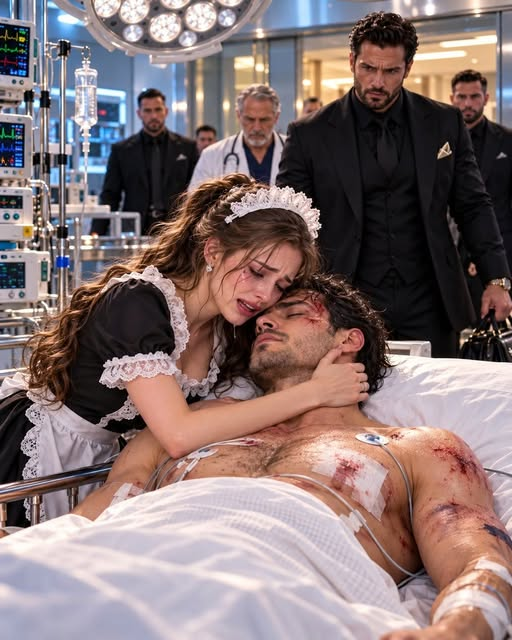
I backed into the pantry and pulled the door to within an inch of its frame, standing among hanging hams and sacks of flour in the dark, with the towels crushed against my racing heart.
Carmine passed with two men. "…the west rooms searched anyway," he was saying. "Bellini asked too many questions at midnight. Watch him. When this is over, we'll discuss his retirement." Their footsteps faded toward the main hall. I stayed in the dark a long time after the sound died, understanding that I was not only going to fetch Marco — I was going to warn him that he was already on the list of men Carmine intended to survive the night only until he was no longer useful.
Marco's door, when I reached it, was shut, with a strip of yellow light beneath it. He was awake. Of course he was awake. Men like Marco do not sleep on the night their king dies in a locked room full of lies.
I knocked twice, softly, with the pattern the servants used — knuckle, pause, knuckle — so he would know it was staff and not a gun hand testing the door.
The door opened six inches. One eye, grey-browed and bloodshot, considered me. Then the chain rattled and Marco Bellini pulled me inside by the wrist so fast my shoes left the floor.
"You shouldn't be out," he said. "Carmine's —" Then he saw my face properly. "Girl. What is it?"
"Gabriel Falcone is alive."
He did not move. For three full seconds the captain of the Falcone guard simply looked at me, and I watched hope and training fight each other across his face like armies.
"Vane signed —" he began.
"Vane is bought," I said. "Carmine owes him or he owes Carmine — debts, Marco, I heard them. There's poison on the bullets, it slows his heart to less than a beat a minute, it makes him cold so he reads as dead. I lay beside him for two hours. At 4:15 I heard it. His fingers moved. They are coming back at five with a body bag and a car to a crematorium Carmine controls, and if that car leaves, they are burning a living man before sunrise and there will never be a body to prove it. Marco — please. You said it yourself. You don't bury kings on a schedule set by their heirs."
He closed his eyes. When he opened them, something in the room had changed allegiance. "If you're wrong," he said, "or lying, or mad with grief —"
"Then I'm a maid who went mad on a bad night," I said, "and you can hand me to Carmine yourself. But if I'm right, and you stay in this room, you will remember it every night for the rest of your life."
He was already moving before I finished. Gun, checked without looking. Jacket. A torch. A key ring I had never seen, heavy as knuckles. "The service door?" he asked. I nodded. "Good girl. Walk ahead of me like you're escorting laundry. If we're stopped, you cry and I scold. Go."
We reached the medical wing at 4:44 by the corridor clock, and no one saw us, and Marco unlocked the door Carmine had locked with a key from that great ring — the captain's master, cut years ago, which Carmine had forgotten existed, because men planning funerals forget that old servants and old soldiers keep the real keys to a house.
Inside, the blankets. The knotted gloves gone cool. Gabriel exactly as I had left him.
Marco laid two fingers against Gabriel's throat and waited. I have never envied any human being the way I envied Marco his training, because he waited a full ninety seconds without moving, without hoping aloud, without a sound — and then his shoulders, those broad, ageing shoulders, dropped two inches all at once, and he said, in the voice of a man at a graveside and a cradle in the same breath, "Madonna. There it is. There it is. Boss. Boss, it's Marco."
"He squeezed my hand," I said. "Twice. When they came with the bag."
Marco bent to Gabriel's ear. "We're moving you before five. It'll hurt. You hold on."
And that was when the door at the end of the room — not the main door, the recovery suite door I had left ajar in my hurry for blankets — swung slowly inward, and Dr. Elias Vane stood in it with a chart in his hands, staring at a captain with a gun and a maid with a torch over the corpse he had certified.
Everyone froze. The clock ticked.
Vane said, "Oh, God."
"Choose," Marco said pleasantly, and the gun was up, and it was not shaking. "Right now, Elias. Choose fast and choose once."
Vane looked at Gabriel. He looked at the blankets — the warm-water gloves, arranged with a maid's pitiful ingenuity — and something in his face collapsed like a wall giving way. "You kept him warm," he whispered to me. "All night? Then the toxin — it metabolises with warmth. It would have worn off by morning. He'd have woken in the bag." His hand went to his mouth. "He'd have woken in the furnace queue."
"Then help us," I said. "Not Carmine. Him."
"I —" Vane swallowed. "Carmine bought my debts six years ago. Every year he owns another piece of the signature on my certificates. If I'd ordered a second examination, a monitoring line, anything, he'd have called them due and ruined — I told myself the poison was enough on its own. I told myself he was dying regardless. I am a coward, not a murderer."
"Prove the distinction," Marco said. "Quickly. The car comes at five."
What Vane did then bought back some piece of his soul, whatever it cost him later. He moved — fast, professional, a surgeon again instead of a clerk of other men's deaths. Monitor leads, feather-light. A reading so low the machine wanted to call it error. "Forty seconds between beats and strengthening," he said. "No sedatives — his system will clear the toxin faster if we keep him warm and still. Move him on the table itself; don't lift him, wheel him. Where?"
"The old nursery," Marco said. "East attic corridor, behind the linen store. Carmine had it sealed years ago; no cameras since the renovation. My grandmother's generation of this house hid brides there during the prohibition wars. It'll hide a king."
We wheeled Gabriel Falcone through his own darkened mansion at 4:52 in the morning, a covered shape on a steel table, a maid pushing from the foot, a captain pulling from the head, a bought doctor walking beside with one hand on the covered chest, counting under his breath like a rosary — "forty-one… forty…" — and when we reached the service lift, the doors opened on the young guard from the pantry, the one who had shown me mercy by the kitchen.
His mug was gone. His hand went halfway to his weapon and stopped.
Marco said, "Son. Look carefully and decide what you saw tonight."
The guard looked at the covered table. He looked at me. He said, "I saw laundry, Captain," and held the lift door with his own hand until it closed, and pressed the button for us himself.
We had just settled Gabriel in the sealed nursery — low ceiling, dust sheets, a narrow bed Marco and I made up with every blanket the linen store held, warm-water bottles in place of my ridiculous gloves — when, from the floor below, a shout went up, and then another. Five o'clock. An empty medical wing. A body bag with nobody to put in it.
Marco smiled for the first time that night, grim as winter. "Let them search," he said. "Now it gets dangerous."
And beside me, on the narrow bed, Gabriel Falcone opened his eyes.
They were unfocused at first, filmed with pain and poison, wandering the ceiling beams as if he were surfacing from deep, black water. Then they found my face. His cracked lips moved. No sound came. I leaned close, so close my hair fell across his bandaged chest, and his voice arrived like something carried a very long way at great expense.
"Matilda," he said. "Don't… let them… take me."
"Never," I told him. "You gave the order yourself, Mr. Falcone. I sit until the bleeding stops. Remember?"
The ghost of something crossed his face that was not quite a smile, and his eyes closed again, and his hand — cold, heavy, alive — found mine on the blanket and stayed there.
After his eyes closed again, Marco and I stood over the bed for a while without speaking, listening to the house discover its loss a floor below. Shouts multiplied and then organised themselves — Carmine's talent, turning panic into procedure. Doors began to open and close in sequence: searchers working a pattern. Marco lifted the nursery's inner bolt with one finger, soundlessly, and slid it home, and then did something that told me exactly who he had been for forty years. He took his gun out, checked it by touch, put it away again, and sat down on the floor with his back to the door. Not beside it. Against it. His own body as the second lock.
"If they force this door," he said quietly, "they step over the captain to reach the king. That has a cost even Carmine must count, and counting takes time, and time is what this one buys with." He nodded at Gabriel. "You did the first watch, girl. I'll do the second. Warm water. Blankets. Whatever your doctoring is, keep doing it."
Vane's stolen visit, an hour later, came up the back stair on feet so light I knew guilt had taught him the servants' routes better than any map. Marco let him in with a gun at his spine and searched him for wires out of pure professional spite before letting him near the bed. What Vane told us in that low room, while he changed a dressing with hands that shook only when they were empty, rearranged the whole night for me. The toxin, he said, had a country name and a clinical one, and both sounded like things that should never have been ground into the jacket of a bullet. It told the heart to rest and the blood to cool, and it lied to every instrument that listened briefly and believed what it expected. A busy surgeon, a bought surgeon, a surgeon in a hurry to please an heir — all three would sign. He had been all three in one man, which was, he said, Carmine's particular genius: he never bought a villain. He bought a weakness and let it dress itself.
"The warmth," Vane said, watching me replace the bottles, "is not sentiment, whatever it felt like. Core temperature is the antidote's poor cousin. You kept the poison from settling. Do you understand? Another hour on that steel, alone, and the waking — if it came at all — would have come in the bag, in the dark, in the car." He looked at me then with something almost like professional respect through the wreckage of his shame. "Your foolishness has a dosage, Miss Higgins. Two hours. It appears to have been precisely enough."
I did not feel vindicated. I felt the floor of the night tilt under me at the nearness of the margin, and I sat down hard on the linen press and put my head in my hands while Marco, gruffly, for exactly as long as it took, rested one great hand on the top of my head like a blessing at a bus stop.
Below us the search went on until the sky thinned. It did not find the attic. By the time the house settled into its false funeral morning — flowers arriving, telephones beginning, a king to be buried at a decent, lying hour — Gabriel's heart was beating once every thirty seconds, and mine, whenever I let myself listen for it, seemed determined to make up his missing numbers on his behalf.
There is a detail from that ride through the house that I have never told Marco, and will set down here because this account is meant to be the whole of it. Halfway along the service corridor, with the covered table rolling between us and the lift doors sighing somewhere ahead, Gabriel's hand slipped from beneath the sheet. It hung, pale and heavy, over the side of the steel, swinging slightly with our motion — a dead man's hand, any witness would have said. I caught it as I walked, without breaking step, and held it against my apron the rest of the way, warming the fingers in my fist like a girl carrying a bird in winter. At the lift, when the doors closed on the three of us and the traitor doctor, that hand turned in mine — turned, unmistakably, with intention — and laid itself palm-up in my grip, the way a man offers to have his fortune read. I did not read it. I held it. Some fortunes a woman writes herself, walking beside a stolen king in a service lift at five in the morning, with a body bag opening its zipper tooth by tooth in an empty room behind her and the whole of the rest of her life deciding itself, floor by descending floor, in the dark.