I waited until the house was quiet.
It was past midnight when I went down to the library, and the mansion was dark except for the lamps I switched on as I went, and the portraits on the walls watched me the way they had watched me my whole life, with the flat, painted patience of dead men. My mother's portrait hung at the far end of the library, covered with a cloth, the way I had kept it for fourteen years. Once a month, on the fourteenth, I uncovered it and sat with it for an hour. Tonight was not the fourteenth. Tonight I uncovered it anyway, and I sat down in the chair across from it, and I took the folded letter out of my inside jacket pocket, and I held it in my hand for a long time without opening it.
I was afraid of it. I had not been afraid of anything in twelve years, and I was afraid of a piece of paper folded seven times.
My mother looked at me from the portrait. Elena Orsini, forty-one years old forever, dark hair and dark eyes and a mouth that smiled even when she was not smiling, the way my mouth did not smile anymore. She had been dead for fourteen years, and I had spent fourteen years being angry at her for leaving me, and fourteen years being angry at myself for the argument I had with my father on the telephone the night he died.
I remembered the argument perfectly, the way you remember a wound. I was nineteen. I wanted to go with him to the meeting on the river road. I wanted to be at his side, to learn the business, to prove I was ready. He said no. He said stay home tonight, son, and I said I was not a child, and he said I know you are not a child, and that is why I am telling you to stay home, and I slammed the telephone down, and an hour later he was dead, and I spent fourteen years believing that if I had been in that car with him, I could have saved him, or died with him, and either one would have been better than living with the argument.
I unfolded the letter. Once. Twice. Seven times, until it lay flat in my lap, and the paper was soft and thin with age, and my mother's handwriting covered both sides in her careful, looping script, and at the top was the date.
October 14.
The first line alone was enough to make me feel guilty.
"Forgive me, my son," it said. "I let them take your father because I was afraid to lose you both."
I stopped reading. I sat in the dark library with my mother's portrait looking down at me, and I read the first line again, and again, and I felt fourteen years of anger shift inside me like a building settling on its foundation, and I understood that I had been wrong about the most important night of my life.
I read on.
"My dearest Carmine," my mother wrote, "if you are reading this, then I am gone, and you are a man now, and there are things you must know that I could not tell you while I was alive, because telling you would have put you in danger, and I have already lost your father, and I will not lose you too."
"Your father did not die because a driver ran. He died because a man named Vincent Castellano ordered it, and because Castellano is a patient man who has been waiting for fourteen years to finish what he started. On the night your father died, Castellano's men came to Thomas Delacroix, your father's driver, and they told him that if he drove Salvatore down the river road that night, they would kill his wife and his baby daughter. And if he did not drive, they would kill Salvatore. Thomas chose his family. He drove his wife and his baby out of the city, to a cousin's house in Baton Rouge, and your father drove himself to the meeting, because he knew. He had been warned, and he went anyway, because a man who does not go to his own meeting is a man who has already lost his city, and your father would rather die than lose his city."
"Your father knew, Carmine. And he sent you away that night because he knew. The argument on the telephone was not an argument. It was your father protecting you the only way he knew how, by making you angry enough to stay home. He told me so, that morning, before he left. He said, 'If they come for me tonight, let them come for me alone. The boy stays home.' And I let him go, because I was his wife, and I knew that a man like Salvatore cannot be stopped once he has decided. And I have carried that guilt for every day since, because I let them take your father to save you, and I chose you over him, the way Thomas chose his family over your father, and the way any mother would choose, and I am sorry, my son, and I am not sorry, and both of those things are true at the same time."
I put the letter down. My hands were shaking. I picked it up again.
"There is proof," my mother wrote. "Your father kept a ledger, in his own hand, of every payment Castellano made to the men who betrayed us, and every name, and every date. The ledger is in a safe-deposit box at the First National Bank on Canal Street, box number 214, and the key is inside this letter, folded into the paper. The box is in my name, and the bank has instructions to open it only to you, my son, or to Maureen, my sister, who knows the words to say. Go and get it. Show it to the men who need to see it. Finish what your father started."
"And one more thing, my son. Inside this letter you will find a passport, in Maureen's name. I arranged it myself, in case Castellano ever came for her and the baby. Maureen and little Violet are innocent, and I have protected them since the night your father died, the way I would protect you. If you ever have to choose between revenge and mercy, remember that your father chose his city, and I chose you, and Thomas chose his baby, and every one of those choices was made out of love, even the ones that hurt. Be better than the men who killed your father, Carmine. Be the man I raised you to be."
"All my love, always. Your mother, Elena. October 14."
I sat in the library for a long time after I finished reading, with the letter in my lap and my mother's portrait looking down at me, and then I felt something small and hard inside the folded paper, and I turned the letter over, and there, tucked into the last fold, were two things.
A small brass key. And a passport, dark blue, with Maureen Delacroix's name on it and her photograph inside, a young woman with dark hair and tired eyes, holding a baby in her arms.
The letter was not just a letter. It was a passport. It was my mother's way of saying that the women of this family protect each other, even when the men are killing each other, and that Violet's family had been under my mother's protection since the night my father died, and that I had inherited that protection along with everything else.
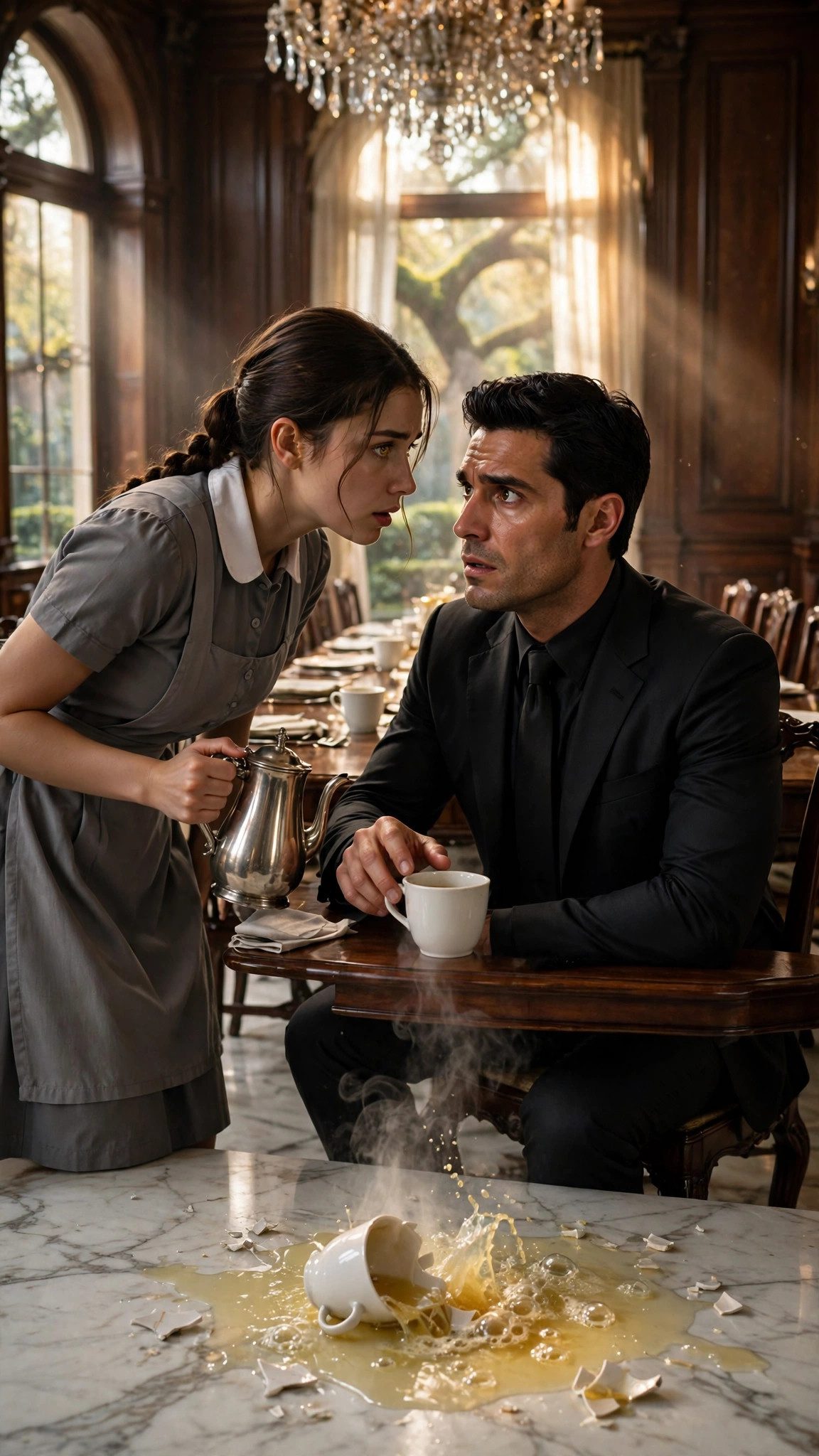
I heard a sound behind me, and I turned, and Violet was standing in the library doorway, in her gray uniform, with her hands folded in front of her apron, watching me the way she had been watching me for three years.
"Did you read it?" she asked quietly.
"Yes," I said.
"Are you all right?"
"No," I said. "But I am better than I was an hour ago. My father sent me away that night to save me. I spent fourteen years believing I had failed him, and he had been protecting me all along."
She came into the library and sat down in the chair beside mine, without being asked, and she looked at my mother's portrait, and then at me, and her eyes were steady.
"Maureen told me to tell you one more thing," she said. "She said, 'Tell him to find the letter.' She meant this letter. But she also meant the other one. The one your father wrote."
"My father wrote a letter?" I said.
"Maureen said your father wrote a letter the night he died, and gave it to her for safekeeping, because he knew he might not come back. She said it is in the safe-deposit box too, with the ledger. She said your father's letter names the men who did it, in his own hand, so that no one could ever say it was a lie."
I stood up. I put my mother's letter back in my pocket, carefully, seven folds, the way it had been folded when she gave it to me. I put the small brass key in my other pocket. I left the passport on the library table, because it belonged to a story that was finished, and I was about to start a new one.
"First thing in the morning," I said, "we go to the bank."
But the morning did not wait for the morning. Benny came into the library at that moment, without knocking, his face gray with exhaustion, and he held out a cream-colored envelope with my name on it, in handwriting I recognized, because I had seen it twice now, on a banknote in a coffee packet and on a note in a hidden room.
Small. Careful. Deliberate.
"That came an hour ago," Benny said. "A boy on a bicycle left it at the gate. It is an invitation to dinner. Tomorrow night. At Castellano's house."
I opened the envelope. The invitation was written on thick cream paper, and it said: Vincent Castellano requests the pleasure of Carmine Orsini's company for dinner, to discuss peace between our families. Seven o'clock. Come alone.
Violet leaned over my shoulder and read it, and her face went white.
"That handwriting," she whispered. "That is the same handwriting as the banknote. The same handwriting as the note in the hidden room. Whoever wrote those wrote this."
"Then it is a trap," I said.
"Yes," she said. "It is a trap. And you are going to walk into it anyway, aren't you?"
I looked at her. I looked at my mother's portrait. I looked at the passport on the library table, and the key in my pocket, and the letter over my heart.
The next morning, before the sun was fully up, Benny drove Violet and me to the First National Bank on Canal Street, and I walked into that marble lobby with my mother's letter in my pocket and the small brass key in my hand, and I gave the key to a nervous young clerk, and I said the words my mother had written down for me, and the clerk led us down into the vault, past rows of steel doors, to box number 214.
The key turned smoothly, as if it had been waiting fourteen years to be turned. The box slid out, and inside it, wrapped in oilcloth, were two things.
A ledger, small and black, in my father's handwriting, full of names and numbers and dates, and on the first page, in Salvatore Orsini's own bold script: "Vincent Castellano paid Thomas Delacroix nothing. Thomas was threatened, not bought. Castellano paid Marcel Dubois. Castellano paid Aldo Boudreaux. Castellano paid the men on the river road. If you are reading this, I am gone, and Castellano did it, and this book is the proof."
And underneath the ledger, a letter, in my father's handwriting, addressed to me.
"My son," it said, "if you are reading this, then the night I feared has come, and I am gone. I am writing this in the library, an hour before I leave for the river road, because Benny's cousin heard Castellano's men talking, and I know what is waiting for me. I am going anyway, because a man who does not go is a man who has already lost. Do not blame Thomas. He was given a choice no man should have to make, and he chose his baby, and I would have chosen you, and that is not betrayal, that is love. Do not blame your mother. She begged me not to go, and I went, and that was my choice, not hers. And do not blame yourself for the argument on the telephone. I made you angry on purpose, my son. I needed you to stay home. I needed you to live. You are the future of this family, and I am the past, and the past must sometimes step aside so the future can walk through the door. Be better than me, Carmine. Be better than all of us. Your father, Salvatore."
I stood in the vault of the First National Bank on Canal Street, holding my father's letter in one hand and his ledger in the other, and Violet stood beside me, very still, and Benny stood behind us with his hand on his pistol, and I understood that I was holding fourteen years of truth in my hands, and that tonight, at seven o'clock, at Castellano's table, I was going to lay it down in front of him and watch his face when he saw it. Fourteen years of waiting was over. Tonight, the truth would sit at Castellano's table, and it would not be leaving until it had been heard.
"But this time, I am not walking in alone. And this time, I am bringing the truth with me."