The silence in the mansion was worse than the shouting.
I had only worked in the Moretti house for three days, but I already knew the difference. Shouting meant the family was alive — angry, frightened, human. Silence meant something had gone wrong in a way no one knew how to name. That morning the silence was so thick I could hear the clock in the hall ticking through the pantry door, and behind that door, in the narrow space where the staff hid from the family, somebody was crying.
I stood in the kitchen with a bowl in my hands and listened to it. The bowl was warm. I had cooked what was in it myself the night before, and I had cooked it again this morning, and the smell of it rose up around my face — blistered tomatoes, garlic burned just dark enough on the iron pan to turn golden at the edges, olive oil, salt. It smelled like my grandmother's kitchen on a Sunday. It smelled like safety.
And underneath it, faint as a rumor, was the other smell. The sweet one. The oily one. The smell I had carried in my nose for seventeen years, since the night my father lifted the lid off a cardboard box and said, "Let me smell."
I pushed the bowl across Arthur Moretti's mahogany desk and said nothing. He stared at it in silence. He had been staring at food in silence for three weeks, ever since his father died at his own birthday dinner with a cup of tea in his hand. Nobody in this house understood why the boss wouldn't eat. They whispered about grief. They whispered about madness. They whispered about a curse.
I knew. I had known since the second day, when I walked past the pantry and the smell caught me from underneath a cardboard box lid, the same way it had caught my father. But knowing and proving are different things, and a maid who has worked in a house for three days does not walk up to the most feared man in Chicago and tell him his own kitchen is trying to kill him.
Not until he is about to put the poison in his mouth.
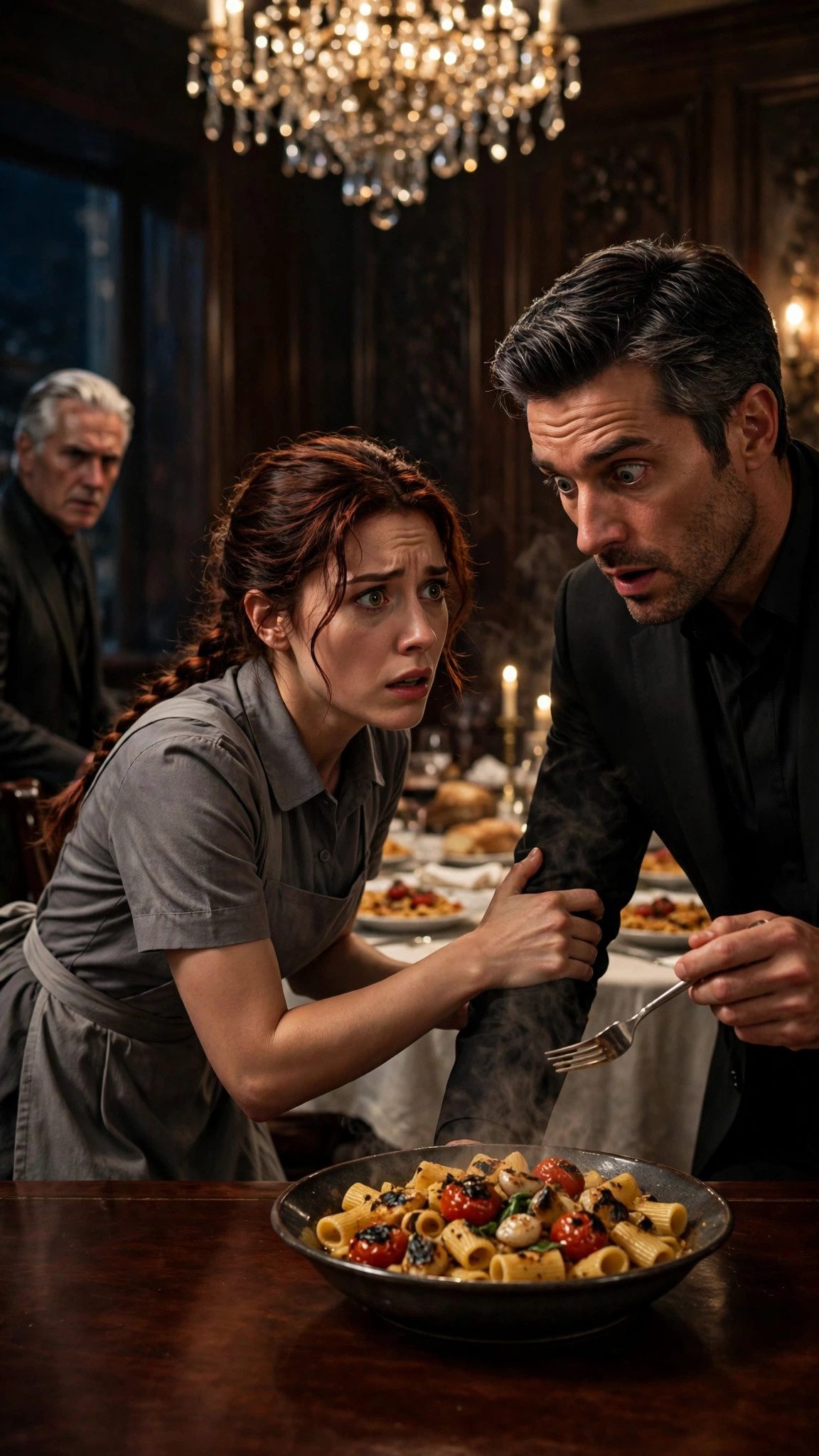
Arthur Moretti sat behind the desk with his dark hair combed back and his gray eyes fixed on the bowl, and his hand was already moving toward the fork. His underboss, Dominic Ferrante, stood by the window with his arms folded, watching us both the way a man watches a dog he is not sure will bite. The dining room beyond the open door was full of the family, waiting for their dinner, and the pasta order — the whole pasta order, every plate — was already on the table out there, steaming, beautiful, poisoned.
"Eat," Dominic said. "For God's sake, Arthur. Eat something. You look like a ghost."
Arthur's fingers closed around the fork. I saw the muscles in his jaw tighten, the way they had tightened every time food was put in front of him for three weeks. He did not want to eat. His body knew what his mind could not prove. But a man cannot sit at the head of his own family's table forever and refuse every plate, and tonight his sister Aria had laid the table herself and told him, in front of everyone, that if he did not eat tonight she would have the doctor come and have him declared unfit.
So he lifted the fork. He took a mouthful of pasta. And I did what I had come into this house to do, though I had not known it until that moment.
I gripped his forearm tightly and said, "It was poison."
The room went silent. Not the ordinary silence of a house holding its breath. The other kind. The kind that comes after a gunshot, when everyone is waiting to see who falls.
Arthur froze with the fork halfway to his mouth. Dominic unfolded his arms. Out in the dining room, a chair scraped. Somebody laughed, a short, nervous sound, and then stopped.
"What did you say?" Arthur asked. His voice was very quiet. It was the quietest voice I had ever heard from a man, and the most frightening, because it was the voice of a man who had been waiting three weeks for someone to say the thing he could not say himself.
"It was poison," I said again. My hand was still on his arm. I could feel his pulse under my fingers, fast and hard. "The whole pasta order. All of it. Don't eat it. Don't let anyone eat it."
Dominic took a step toward me. "She made all of this?" he said, looking at Arthur, not at me. "She made this? A girl who has been here three days is telling the Don of this family that his own kitchen is poisoned?"
"She made this?" Aria said from the doorway. She had come in without a sound, the way she did, dark hair, dark dress, her father's eyes. "Nora. What are you doing?"
I did not answer either of them. I was watching Arthur. He had set the fork down very carefully, the way a man sets down something that might explode, and he was looking at the bowl the way he had looked at his father's teacup three weeks ago, the night the old man died.
"Tell me," he said.
So I told him. I told him about the smell. I told him about the cardboard box in the pantry, and the paper bag above the ceiling tiles, and the birthday tea that had tasted bitter, and the reason his body had refused every plate for three weeks. I told him the truth I had carried since I was nine years old, the truth that had killed my father and brought me, seventeen years later, to the kitchen of the most dangerous house in Chicago.
And as I told it, I remembered the beginning. Because every story about poison starts long before anyone tastes it.
Three weeks earlier, on the night of Vittorio Moretti's seventy-first birthday, the mansion had not been silent at all. It had been full of music and laughter and the smell of Chef Pascal's cooking, and the old Don had sat at the head of the table in his best suit with a glass of red wine in one hand and a cup of his favorite tea in the other, and he had told his children that he was proud of them, and that the family would go on, and that nothing — nothing — could break the Morettis while they stood together.
He had taken a sip of the tea. He had made a face, just for a second, the way a man does when something tastes wrong. And then he had laughed, and said the new blend was too bitter, and that Pascal was getting old and heavy-handed with the leaves. Everyone had laughed with him. His daughter Aria had refilled his cup. His son Arthur had raised his glass. The band had played. And an hour later, Vittorio Moretti was dead on the floor of his own dining room, his teacup shattered beside him, and the family doctor had said the words that would haunt this house for three weeks: a heart attack, sudden, nothing anyone could have done.
But I had not been there that night. I had been in a small apartment across the city, ironing a gray uniform I had just been given, reading a letter that said the Moretti family needed a new maid because the last one had quit without notice. Her name was Gabby. "Where is Gabby?" the housekeeper had asked when I arrived, as if I might know. "She went upstairs," someone else had answered. And no one had explained what that meant.
I arrived on a Tuesday. The house was already silent by then. The staff moved through it like people in a church, whispering, flinching at sudden noises. In the kitchen, Chef Pascal cooked elaborate meals that no one ate, and then threw them away, and cooked them again. In the dining room, Arthur Moretti sat at the head of an empty table at every meal and stared at the plates until they were taken away untouched. He drank sealed bottled water. He ate bread he bought himself from a bakery two streets away, standing on the sidewalk like a stranger. He had lost fifteen pounds in three weeks. His suits hung on him. His sister Aria wept behind closed doors and then came out with her chin up and told everyone her brother had lost his mind with grief.
I believed none of it. Not because I knew anything, but because I knew the smell.
On my second day, I was sent to the pantry for a bag of flour, and there it was — faint, sweet, oily, wrong — rising from underneath the cardboard box lid on the bottom shelf, the way it had risen from my father's box seventeen years ago. I stood there with the flour in my hands and the whole of my childhood came back to me at once: the kitchen of my grandmother's bakery, the smell of bread, my father's voice saying "Let me smell," and then the ambulance, and then the silence that came after, which was worse than the shouting.
I did not say anything that day. I was a new maid. New maids do not accuse the house of murder.
On my third day, I cooked. I had been told to make the pasta for the family dinner — the blistered tomatoes, the burned garlic, the way my grandmother taught me, pressing the tomatoes with a wooden spoon until their skins split and released their juice, loosening the dark garlic from the iron. I cooked it the night before in my own small kitchen, the way I always do, so the flavors would settle. And when I brought it into the Moretti kitchen the next morning, I smelled it again — stronger this time, coming from the pasta order itself, from the great trays Chef Pascal's kitchen had prepared for the family table.
That was when I understood. It was not one plate. It was not an accident. The entire pasta order was poisoned, and someone in this house had poisoned it, and Arthur Moretti's body had known it for three weeks, the way a body knows a thing before the mind can name it.
So I pushed my own bowl across his desk, and I waited, and when he lifted the fork, I gripped his forearm and said the words.
"It was poison."
Now the room was silent, and Dominic was staring at me, and Aria was staring at me, and Arthur Moretti was staring at the bowl with the eyes of a man who has just been told that the war he thought was over has only just begun.
"I will explain," I said. My voice did not shake. I was surprised, but it did not shake. "But first, take the pasta off the table. Every plate. Nobody eats tonight. Not until I show you."
Arthur looked at me for a long moment. Then he stood up, slowly, like a man rising from a sickbed, and he walked to the dining room door and said, in a voice that carried to every corner of the house, "Nobody eats."
And behind the pantry door, somebody was crying. And in the kitchen, the smell of sweet rhubarb hung in the air like a question no one had dared to ask.
I did not sleep that night. I lay in the narrow bed in the servants' wing, in the room that had been Gabby's room before it was mine, and I listened to the house. A great house at night makes sounds — the cooling of the pipes, the settling of the wood, the sigh of the wind against the windows — but the Moretti mansion made a different sound. It made the sound of people holding their breath. Twice I heard footsteps in the hall outside my door, slow, careful footsteps that stopped and then went on. Once I heard a woman crying, very softly, somewhere below me. I did not get up. I did not open the door. I lay still, and I thought about what I had done, and about what I would have to do next, and about the fact that I had been in this house for three days and I had already accused the most trusted man in it of murder.
In the morning, Mrs. Delgado found me in the kitchen before anyone else was awake. She put a cup of tea in front of me — real tea, from her own tin, not the house tea — and she sat down across from me, and she said, in a voice so low I had to lean in to hear it, "You did right, girl. Whatever happens now, you did right. I have worked in this house for twenty years, and I have seen the old man die, and I have seen the young one starve himself at his own table, and I have seen the staff cry behind doors, and I have said nothing, because I was afraid. You were not afraid. Remember that, whatever they say to you today."
"Who was crying behind the pantry door?" I asked.
"All of us," Mrs. Delgado said. "In turns. We take turns, so the family doesn't hear. We cry because we loved Mr. Vittorio, and because we are afraid of what is happening to Mr. Arthur, and because we don't know who to trust anymore. The kitchen is supposed to be the safest room in a house, Nora. It is where the food is. It is where mothers feed their children. And now the kitchen is the most dangerous room in this house. Do you understand what that does to people who have cooked in it for twenty years?"
I understood. I understood better than she knew.
Later that morning, Aria found me in the hall outside the library. She had been crying — her eyes were red, though her chin was up, the way it always was — and she stood in front of me, blocking my path, and said, "My brother believes you. I don't know why he believes you, but he does. And if you are lying — if you are making this up, if you are some girl with a story and a grudge — then I will destroy you myself, and no one in this house will stop me. Do you understand?"
"I understand," I said. "And I am not lying."
She looked at me for a long time. Then she said, very quietly, "My father died in my arms, Nora. In the dining room. On his birthday. I held his hand, and I watched his face change, and I have told myself every day since then that it was his heart, and that there was nothing anyone could have done. If you are right — if someone did this to him — then I have been grieving a lie for three weeks. And I don't know how to grieve the truth."
She walked away then, and I stood in the hall, and I thought about what she had said, and about the weight of what I had started. A lie is a comfortable thing. It lets people sleep. The truth is harder. It wakes people up, and it does not let them sleep again until the thing that caused it is finished.
Arthur watched me from the library doorway as Aria walked away. He did not say anything. He did not have to. His gray eyes said it for him: whatever happens next, we are in it together now.