We walked in the garden, Arthur Moretti and I, in the late afternoon, when the light was gold and the air smelled of roses and cut grass, and the mansion stood behind us, quiet now in a good way — the quiet of a house at peace, instead of the quiet of a house holding its breath.
"I have been thinking," Arthur said, "about what my father would say, if he could see this house now. He would say that a family is not the walls, or the name, or the money. A family is the people who sit at the table together, and eat together, and tell each other the truth. He would say that we forgot that, for a little while, and that you reminded us."
I did not know what to say to that, so I said nothing, and we walked, and the roses smelled sweet, and the air did not smell of rhubarb at all.
"Pascal is cooking tonight," Arthur said. "A real dinner. For the whole family. Not a trap. Not a test. A dinner. And I want you to cook with him."
"Me?" I said. "I'm a maid, Mr. Moretti. I clean. I serve. I don't —"
"You are not a maid," Arthur said. He stopped walking, and he turned to face me, and his gray eyes were very serious. "Not anymore. You are the woman who saved my family. You are the woman who smelled the poison first, when no one else could smell it, and who stood in my dining room in front of twenty people and told the truth, when no one else would tell it. That is not a maid, Nora. That is —" He stopped, and he took a breath, and for a moment, he looked like a man who was about to do something very frightening, and very brave. "That is the woman I want beside me. At the table. And everywhere else. If you will have me."
I stared at him. The Don of the Moretti family. The most feared man in Chicago. The man who had not eaten in three weeks, who had sat at an empty table and stared at poisoned food and refused to die. He was standing in a garden, in the gold light, asking me — a maid, a girl from a bakery, a girl whose father had died of a smell — if I would have him.
"Mr. Moretti," I said, "I don't know how to be the wife of a Don. I know how to cook. I know how to clean. I know how to smell poison. I don't know how to —"
"You know how to tell the truth," Arthur said. "And you know how to protect the people you love. That is all a Don's wife needs to know. The rest, we will learn together."
I thought about my father, and about my grandmother, and about the cardboard box, and about the nine-year-old girl in her nightdress who had promised herself that she would never let what happened to her father happen to anyone else. And I thought about the house behind us, and the table inside it, and the family that would sit at that table tonight, and eat together, and live.
"Yes," I said. "Yes, I will have you."
That night, Pascal and I cooked together in the great kitchen, side by side, the way my grandmother had cooked beside me when I was a girl standing on a chair. We made the blistered-tomato and burned-garlic pasta — the tomatoes pressed with a wooden spoon until their skins split, the garlic burned just dark enough on the iron pan to turn golden at the edges, the olive oil, the salt, the patience. I cooked it the way I had cooked it the night before, in my own small kitchen, and this time, when I lifted the lid, there was no other smell underneath it. No sweetness. No oiliness. No wrongness. Only tomatoes, and garlic, and safety.
We carried it to the dining room together, and the family was already there — Aria, and Mrs. Delgado, and Dr. Ellison, and Chef Pascal, and all the cousins, and all the people who had sat at that poisoned table the night before. And Arthur stood at the head of the table, and he looked at the food, and he looked at me, and he picked up his fork.
He took a bite. He chewed it slowly. He closed his eyes. And then he smiled — the real smile, the warm smile, the smile of a man eating a meal cooked by someone he loves, in a house that is finally safe.
"It is perfect," he said. "It is the best thing I have eaten in three weeks. In three years. In my whole life."
And then everyone ate. Everyone at the table ate together, laughing, talking, reaching across for the bread, arguing about the wine, the way a family is supposed to eat — and I sat beside Arthur at the head of the table, not behind it, not against the wall, but beside him, where I belonged.
After dinner, Aria came to me with a glass of wine in her hand, and she raised it, and she said, "To Nora. Who smelled it first." And everyone at the table raised their glasses, and they said my name, and for the first time in seventeen years, the smell in my nose was not the smell of poison. It was the smell of tomatoes, and garlic, and roses, and a house full of people who were alive because a maid had trusted her nose.
Six months later, we were married in the garden, under the roses, with the whole family watching, and Chef Pascal cooked the wedding dinner himself, and he tasted every dish before it left his stove, and he said, loudly, to anyone who would listen, "No one poisons my kitchen. Not while I am alive. Not while Nora is alive."
Gabby came to the wedding, with her baby in her arms, and she cried, and she hugged me, and she said, "You did what I couldn't do. You stayed. And you saved them."
The wedding itself was everything a wedding in that house should have been, and nothing like what I had imagined when I was a girl standing on a chair in my grandmother's bakery, stirring a pot and dreaming about a future I could not yet see. It was held in the garden, under the roses, on a day so bright and clear that the sky looked like it had been washed clean just for us. Mrs. Delgado had spent a week arranging the flowers, and she had cried twice while doing it, and she had told me, both times, that she was crying because she was happy, and I had believed her, because I was crying too.
My dress was simple — white, plain, with no lace and no jewels, because I am a maid, and a cook, and I have never wanted jewels. Aria had offered me her mother's pearls, and I had said no, and then she had offered me her mother's veil, and I had said yes, because a veil is not a jewel, it is a promise, and I wanted to wear something that had belonged to a woman who had loved this family. Aria cried when I put it on. She cried, and she laughed, and she said, "My mother would have loved you, Nora. She would have loved you the way I love you now — like a sister."
Arthur waited for me at the end of the garden path, in a black suit, with a rose in his buttonhole, and his gray eyes were wet, and his hands were steady, and when I reached him, he took my hands in his, and he said, very quietly, so that only I could hear it, "I have not eaten in three weeks, once in my life, because I was afraid. I will never be afraid again, as long as you are beside me. You are my proof, Nora. You are the proof that this family can be saved."
We said our vows under the roses, with the whole family watching, and with Chef Pascal standing at the back, in his whites, crying openly into his apron, and with Dr. Ellison smiling, and with Gabby holding her baby, and with Old Enzo nodding slowly, the way a man nods when he has seen something he did not expect to see, and he is glad he lived long enough to see it.
After the ceremony, Pascal cooked the wedding dinner himself — seven courses, each one more beautiful than the last, and he tasted every dish before it left his stove, and he announced it loudly, to anyone who would listen: "I taste everything! Everything! No one poisons my kitchen! Not while I am alive! Not while Nora is alive!" And everyone laughed, and everyone ate, and the candles burned down, and the music played, and the night went on until the stars came out, and Arthur danced with me in the garden, under the roses, to a song I did not know, and he held me close, and he said, "This is the first meal of the rest of our lives, Nora. And every meal after this one will be like this one. Clean. And safe. And ours."
In the year that followed, I learned what it meant to be the wife of a Don — and I learned that it meant, more than anything else, what it had always meant to be a cook. It meant feeding people. It meant keeping them safe. It meant smelling the food before it reached the table, and telling the truth when something was wrong, and standing beside the man you love when the whole world is watching.
I taught the staff's children to bake, on Sunday afternoons, in the great kitchen, standing them on chairs beside the stove the way my grandmother had stood me on a chair beside hers. I taught them to knead dough, and to smell bread, and to tell when a tomato is ready, and I taught them the most important lesson of all — the lesson my grandmother had taught me when I was twelve years old, holding a rhubarb root under my nose. I taught them the smell that kills quietly, and I told them, the way she had told me: "If you ever smell it in a kitchen where it does not belong, you run, and you tell someone."
Arthur learned to cook, too — badly, at first, burning the garlic and splitting the tomatoes too hard with the spoon, and laughing at himself, and laughing with me, and trying again, until one night he made the pasta all by himself, from beginning to end, and he carried it to the table, and he set it down in front of me, and he said, very proudly, "Taste it." I tasted it. It was perfect. It was the best thing I had eaten in months. And he smiled — the real smile, the warm smile — and he said, "I learned from the best."
And Dominic's daughter — the frightened nineteen-year-old girl who had come to the front door with her hands twisted together — she came to the house often, after that. She came for Sunday dinner. She came for Christmas. She came to learn to bake, standing on a chair beside my stove, the way I had stood beside my grandmother's. And one day, she looked up at me with flour on her nose, and she said, "Thank you for saving my father, Mrs. Moretti. Even though he did a terrible thing. Thank you for letting him live."
I held her hands — her young hands, clean, unmarked — and I said, "Your father is paying for what he did, every day, in prison. But you are not your father. You are you. And you are welcome here. Always."
Dominic was tried in a courtroom, in front of the whole city, with the ledger, and the bag, and the handkerchief, and Gabby's testimony, and Dr. Ellison's test. He was found guilty, and he was sentenced to life in prison. Vincent Castellano was arrested a month later, on the evidence in the ledger, and the Castellano family — the family that had tried to destroy the Morettis for thirty years — fell apart, the way a house falls apart when its foundations are rotten.
And the Moretti house — our house — went on. Pascal cooked. Aria laughed. Mrs. Delgado ran the household. Dr. Ellison came for Sunday dinner. And every night, I cooked for the man I loved, in a kitchen that smelled of garlic and butter and clean iron, and every night, before I served a single plate, I leaned over it, and I smelled it, the way my father taught me, the way my grandmother taught me.
Because a gift like that is also a burden. And a burden like that is also a gift. And I would rather smell the poison first, every night, for the rest of my life, than let what happened to my father happen to anyone I love ever again.
Six months after the wedding, on a bright morning in spring, I opened the door of my own small bakery — not a grand place, not a palace, but a warm room with flour on every surface and a wood-fired oven and a bell over the door that rang every time a customer came in. I named it after my grandmother. I named it after my father. I hung a wooden spoon on the wall beside the door, and underneath it, I put a small sign, in my own handwriting, that said: "Here, we smell everything before we serve it."
Arthur came to the opening, in his best suit, with a bouquet of roses in his hands, and he stood in the doorway of my little bakery, and he looked at the oven, and at the flour, and at the sign, and he smiled — the real smile, the warm smile — and he said, "Your grandmother would be proud of you, Nora. And your father would be proud of you, too."
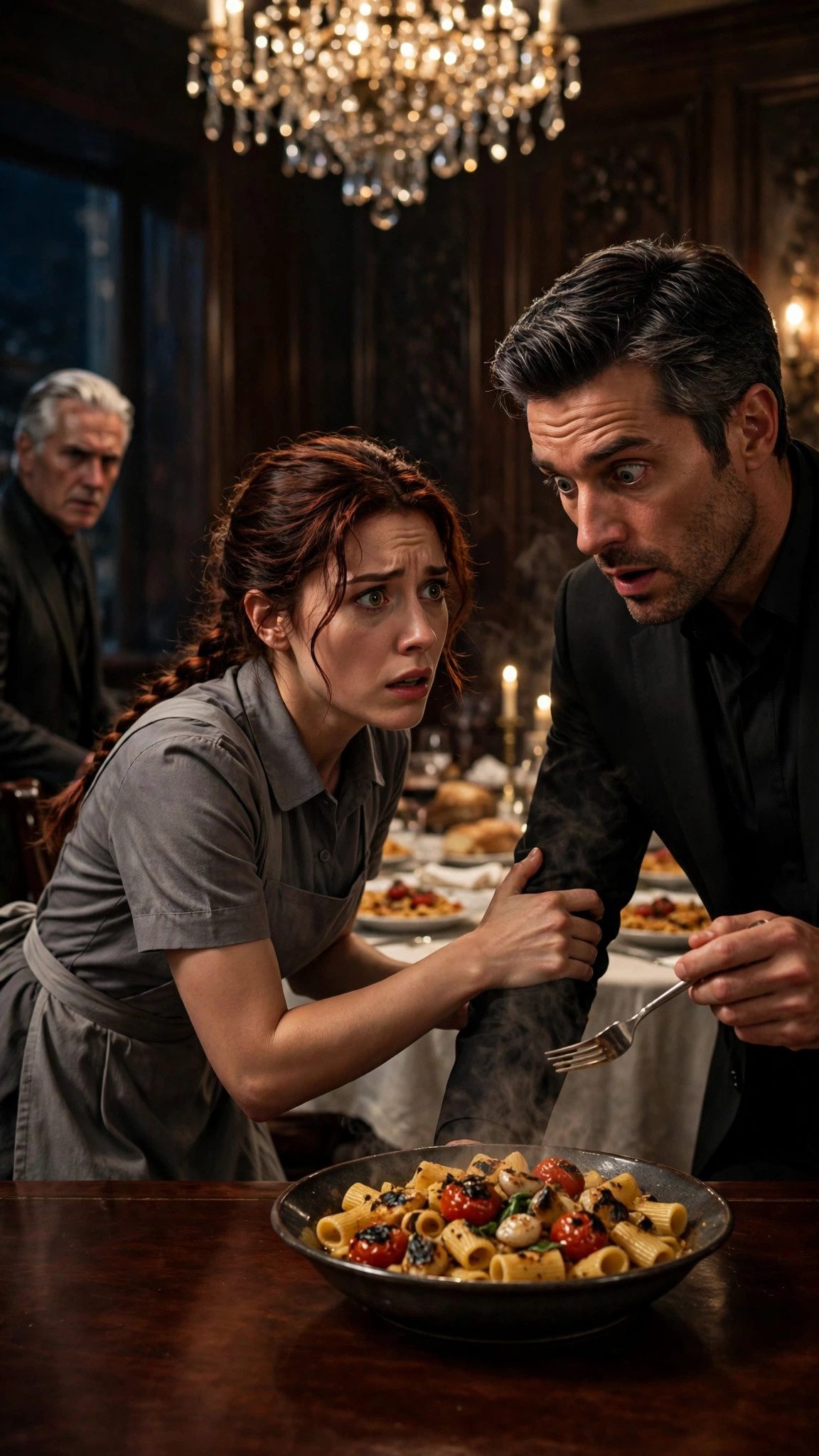
On the first anniversary of the night I gripped his forearm at the mahogany desk, Arthur took me back to that dining room, and we sat at the great table together, just the two of us, and Pascal cooked for us himself — the blistered-tomato and burned-garlic pasta, the tomatoes pressed with a wooden spoon until their skins split, the garlic golden at the edges, the olive oil, the salt, the patience — and before we ate, Arthur leaned over his plate, and he smelled it, the way I had taught him, the way my father had taught me, and he smiled, and he said, "Clean."
"Clean," I agreed. "Every night. For the rest of our lives."
And every night since then, in our house, in our kitchen, before a single plate is served, I lean over it, and I smell it. I smell the tomatoes. I smell the garlic. I smell the butter, and the bread, and the roses from the garden. And I smell for the other thing, too — the sweet thing, the oily thing, the wrong thing — because a gift like that is also a burden, and a burden like that is also a gift, and I will carry it gladly, for as long as I live, for the people I love.
The End.
THE END