The restaurant was always quiet when Lorenzo Bianchi walked in.
It was not the kind of quiet that comes from an empty room. Il Cielo was full that evening, every white tablecloth taken, every candle lit, the low murmur of Chicago's richest diners rising and falling like a tide. And then the door opened, and the tide went out. The clink of silverware faded. A wine glass stopped halfway to a woman's lips. Even the pianist in the corner let his hands hover above the keys for one held breath, as if the music itself knew better than to play while the Mafia boss crossed the floor.
Emily Carter felt it before she saw him. She was balancing a tray of bread and olive oil near table twelve when the whole room seemed to lean away from the door, the way tall grass leans away from a coming storm. She looked up, and there he was.
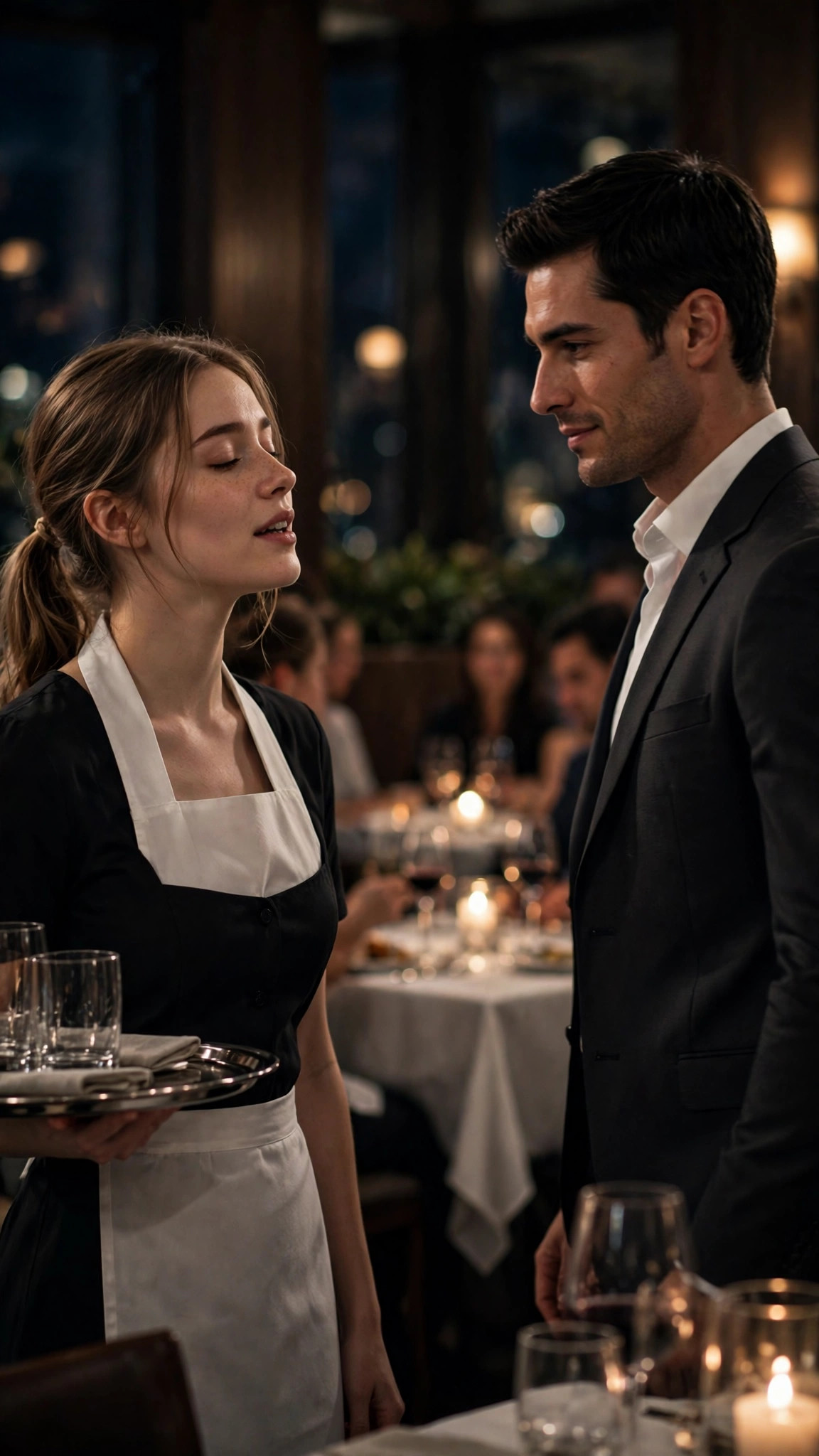
Lorenzo Bianchi was a man made of stone. That was the first thought she had, and it stayed with her for a long time afterward, because it was the truest thing anyone had ever said about him in her hearing, even if she only said it inside her own head. He was tall, dark-haired, his face sharp and cold and handsome in the way of a statue in a museum — beautiful, and untouchable, and not quite alive. He wore a tailored dark suit with a white shirt and no tie, and he moved through his own restaurant like a man walking through a house he had already decided to sell. His eyes were cold and distant. They did not land on anyone. They passed over the room the way a searchlight passes over water.
No one had seen him smile in three years. Emily knew that the way everyone in Chicago knew it, the way you know things about the weather: it was simply a fact of the city. Lorenzo Bianchi did not smile. Not since the night his fiancée had disappeared without a trace, three years ago, the night before their wedding. Not since forty million dollars had gone missing from his family's bank accounts in the same week. The papers had called it a tragedy. The police had called it an open case. The men who worked for Lorenzo called it nothing at all, because men who worked for Lorenzo Bianchi had learned when to be silent, and the answer was almost always.
Emily had been working at Il Cielo for nine days. She was twenty-six years old, with a soft pretty face and light brown hair tied back, and she wore the simple elegant black waitress dress with the white apron that all the waitresses wore, and she had spent nine days learning the floor, learning the tables, learning which regulars wanted their bread warm and which ones wanted to be left alone. She had spent nine days being invisible, which was exactly what she wanted. Invisibility was a skill she had practiced for three years, ever since the night she had run from a job she could never put on a résumé, from men who had come asking questions she could never answer safely.
The nine days had taught her the shape of the place. Il Cielo was the kind of restaurant where the menus had no prices and the waiters wore white gloves for the wine service and the kitchen ran like a ship — the chef, a broad man named Carlo who shouted in Italian and English in the same sentence, the line cooks who moved without talking, the dishwasher who had been there longer than anyone and knew everyone's secrets and kept all of them. Emily had learned the floor the way you learn a new city: table by table, face by face. Table four wanted the bread warm and the butter cold. Table nine was a couple celebrating their fiftieth anniversary, and the husband always ordered the same bottle of Barolo, and the wife always pretended not to notice the price. Table twelve sent things back. Table twelve always sent things back.
There was another waitress, Sofia, twenty-four years old, with dark curls and a laugh that came out of her before she could stop it, and Sofia had taken Emily under her wing on the first day, showing her where the extra aprons were kept, which elevator was faster, which of the busboys would steal your tips if you turned your back. "You'll get used to it," Sofia had said, on the third day, when Emily had dropped a fork and nearly cried over it. "Everyone drops something in the first week. The trick is to drop it like you meant to."
And there was the piano player, old Enzo, seventy-eight years old, with white hair and hands that shook until they touched the keys, and then did not shake at all. He played without sheet music, without looking at his hands, and he knew a hundred songs, and he played them in the order the room seemed to need them — something slow when the couples arrived, something brighter when the wine started flowing, something quiet and sad near the end of the night, when the candles burned low.
And there was the table by the window. Lorenzo Bianchi's table. It was always set, even when he did not come — white tablecloth, two glasses, a single candle — and the staff treated it the way sailors treat a shrine: with respect, and with a little fear. Emily had seen him four times in nine days, always at the same hour, always alone, always in the dark suit with the white shirt and no tie, and each time, the restaurant had gone quiet, and each time, she had watched him from the kitchen doorway, and each time, she had thought the same thing: he looks like a man who is waiting for someone who is never going to come.
She had not known, in those nine days, that he was waiting for her. She had not known that the song she carried in her head — the song she had written in a one-room apartment with the curtains drawn, on the worst night of her life — was the key to a door he had kept locked for three years. She had only known that she needed the job, and that Chicago was big, and that invisibility was a skill, and that she was good at it.
Every night, after her shift, she walked home through the dark streets to the small apartment above the bakery on the West Side, and she counted her tips at the kitchen table, and she checked the locks twice, and she slept with the notebook — the small notebook with the transfer records, the copies of every order Isabella had dictated — under her pillow. And every morning, she woke up and told herself the same thing: one more day. Just one more day of being invisible. Just one more day of surviving.
She did not know who Lorenzo Bianchi was when she took the job. That was a lie she told herself on the first day, and a lie she stopped telling herself on the second, when Tony the maître d' pulled her aside and said, very quietly, "That's his table, the one by the window. You don't speak to him unless he speaks to you. You don't look at him too long. You don't ask him anything. And whatever you do, you do not sing."
"Sing?" Emily had said.
Tony had looked at her the way you look at someone who has just asked whether the stove is hot. "The last girl who sang in this dining room," he said, "was his fiancée. On the night before she vanished. He has not allowed music with words in this room since. The piano plays. Nobody sings. Do you understand?"
Emily had understood. She had nodded, and she had gone back to work, and for nine days she had not sung a single note inside Il Cielo.
But on the tenth day, she forgot.
It was not a decision. That was the thing she would tell herself later, and it was true: it was not a decision at all. It was a Thursday, and the dining room was full, and table twelve had sent back a plate, and the kitchen was behind, and her feet ached, and her head ached, and she was carrying a tray past the piano when the pianist began to play a melody she knew — not a song she knew, exactly, but a shape of a song, a few notes that rose and fell the way a question rises and falls — and without thinking, without meaning to, without any warning at all, she began to sing softly while she worked.
It was a song she had written herself, three years ago, in a one-room apartment with the curtains drawn, on the worst night of her life. A song about love, and loss, and everything in between. She had never sung it for anyone. She had barely sung it for herself. But her voice came out soft yet powerful, the way it always did when she stopped being afraid of it, and it filled the room the way light fills a room when someone opens a door.
Her voice, soft yet powerful, filled the room.
And then, something incredible happened.
Lorenzo Bianchi stopped dead in his tracks.
He had been halfway to his table, halfway through the dining room, a man in motion the way a glacier is in motion — slow, unstoppable, indifferent. And then he stopped. He turned slowly, his whole body turning, and his eyes locked onto the waitress, and for a moment the room seemed to disappear, and all that was left was the song, and the voice, and the woman singing it.
Emily saw his face change. She saw it the way you see a crack appear in ice: slowly, and then all at once. His face softened, just for a moment. His lips curled into the faintest smile — the first one in three years, though she did not know that yet, though no one in the room had ever expected to see it again — and for one heartbeat, Lorenzo Bianchi looked like a man who had been touched by something unexpected. Like a man who had forgotten, for one second, how to be made of stone.
But the smile quickly faded, replaced by his usual cold stare. He walked over to Emily, his steps slow and deliberate, and the whole dining room held its breath, and Emily's heart beat so hard she was certain everyone in the room could hear it, and she thought, absurdly, of Tony's warning, and of the last girl who had sung in this dining room, and of how she had spent three years being invisible, and how she had thrown it all away in eight bars of a song she had never meant to sing out loud.
He stopped in front of her. He was taller than she had thought. Up close, his eyes were not cold at all. They were something worse than cold. They were hungry.
"Sing that again," he said, his voice low and commanding. "Tonight, after closing."
Emily's heart skipped a beat. She had no idea who this man was — no, that was another lie; she knew exactly who he was, and that was the problem, that was always the problem, that was why she had run in the first place — but she knew one thing, and she knew it with a clarity that cut through the fear like a knife: this was no ordinary request.
"Mr. Bianchi," she said, and her voice came out steadier than she felt, "I didn't mean—"
"After closing," he said again. "Just you. Just the song."
And then he turned and walked to his table by the window, and sat down, and picked up the menu, and the dining room exhaled, and the pianist began to play again, and the clink of silverware came back like rain after a drought.
Sofia found her by the service door a minute later, her eyes wide, her voice a frantic whisper. "What did he say to you? What did he want?"
"He wants me to sing again," Emily said. "After closing. Just the song."
Sofia stared at her. "Do you know what that means? Nobody sings for him. Nobody. In nine days, have you ever seen him speak to anyone in this room? Have you ever seen him look at anyone the way he just looked at you?"
"No," Emily said. "And I don't want to know what it means. I just want to get through the next nine hours without dropping anything."
But as she went back to work, carrying her tray from table to table, she could feel his eyes on her — not constantly, not obviously, but in glances, the way you feel the sun through a window even when you're not looking at it — and she understood that the next nine hours were not going to be ordinary hours, and that the man at the table by the window was not going to forget her, and that the song she had sung by accident had just become the most important thing she had ever done. And Emily stood there with her tray of bread and olive oil, her hands shaking so slightly that only she could feel it, and she understood two things with perfect, terrible clarity.
The first was that Lorenzo Bianchi had smiled at her song, and that meant he had heard something in it that no one else had ever heard.
The second was that the song she had written three years ago, on the worst night of her life, was a song about a woman who had disappeared — and the man who had just asked her to sing it again was the man that woman had left behind.
She did not know, then, how the night would end. She did not know about the police lights, or the FBI, or the gun, or the woman who would step out of the back room with dark hair and a familiar face. She did not know that by midnight, everything she had spent three years hiding from would be standing in the middle of the dining room with her, under the chandeliers, with nowhere left to run.
She only knew that she had nine hours until closing, and that the most dangerous man in Chicago had asked her to sing, and that she was going to do it — because she had been running for three years, and she was tired of running, and because somewhere underneath the fear, in a place she had not visited in a very long time, a small stubborn voice was saying that maybe, just maybe, this was why she had written the song in the first place.